
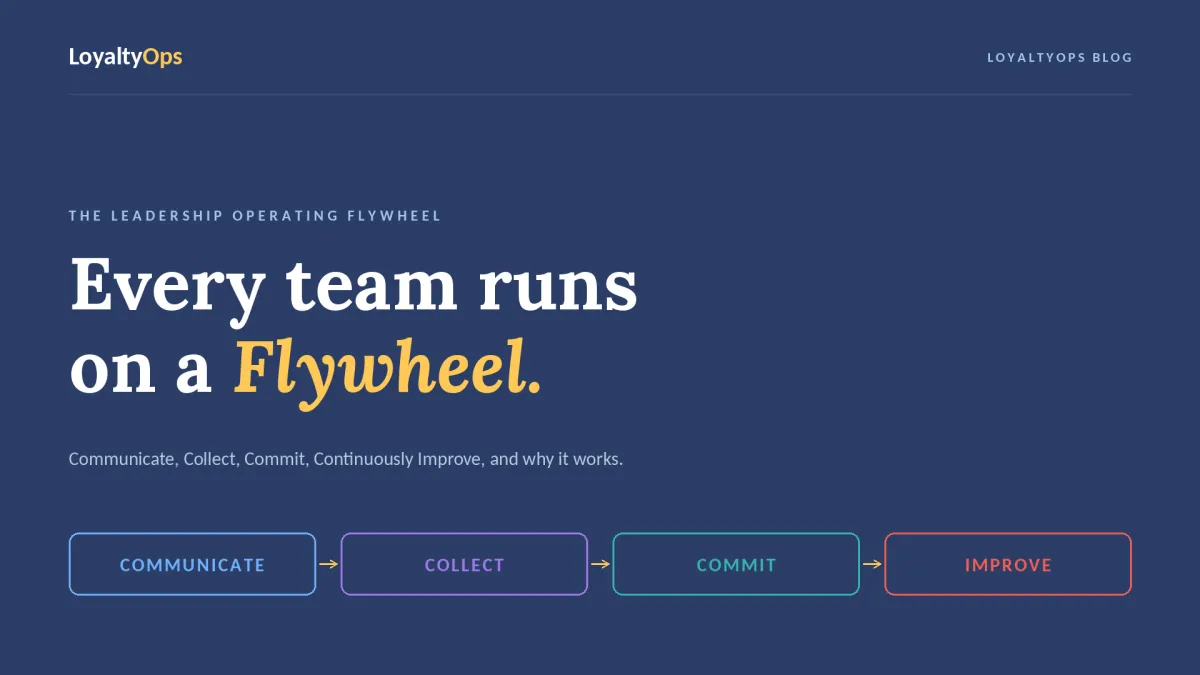
The Leadership Operating Flywheel: 4 Stages Explained
The Leadership Operating Flywheel: The Four Stages Every Team Runs On
Every growing team runs on the same four stages, whether the leader ever named them or not.
The team communicates.
It collects what's really happening.
It commits to decisions.
It improves on the work. Then it runs again.
We call that system the Leadership Operating Flywheel, and once you can see it, you can find the exact place your team's operations are breaking.
This is the model behind how we help leaders build operations at LoyaltyOps. Here's what the Flywheel is, why it works, and how to use it to find the one stage that's quietly taking up most of your week.
What is the Leadership Operating Flywheel?
The Leadership Operating Flywheel is a four-stage model of how a team operates day to day. The four stages are Communicate, Collect, Commit, and Continuously Improve, and they turn in that order, every time: Communicate, then Collect, then Commit, then Continuously Improve, then back to Communicate.
You start with Communicate, you don't skip a stage, and you don't jump ahead without coming back through Communicate first. That order matters, because each stage sets up the one after it. Clear communication makes honest collection possible; honest collection makes good decisions possible; good decisions give you something real to improve on; and improvement feeds back into clearer communication next time around.
The key idea most leaders have never been told is this: you're already running all four stages. The only question is how well each one is built.
Why your team already runs on a Flywheel
You can usually tell when a team is running well before any number confirms it. The work moves, decisions get made close to the work, and the same problems stop coming back every few weeks.
You can also tell when a team is struggling. The team is busy and capable, and the week still takes more of your time than it should. You're in every decision, work you thought was clear comes back needing another pass, and you can't always say why.
There's a reason for that, and it's more specific than it feels. The four stages are always present on your team. If you never built them on purpose, they still exist, just left to chance, and the stage that got the least attention is usually the one costing you the most.
The four stages of the Flywheel
Each stage does one job, and each has a healthy version and a breaking one. Read them with your own team in mind.
Communicate: speak it, show it, live it
Communicate carries objectives, expectations, decisions, and standards into the team, through behavior as much as through words.
When it's strong, people can name what the team is doing and how, your behavior matches what you've said, and standards hold in the small moments. When it's breaking, different people read the same standard in different ways, the standard you set gets bent under pressure, and decisions get reopened in side conversations.
Collect: listen, observe, learn
Collect brings reality back to you and to the team. It verifies what was understood and surfaces what's actually happening, so drift gets caught while it's still small.
When it's strong, the team plays back what they heard before they act, people bring real information forward, and drift gets caught early. When it's breaking, you hear what the team thinks you want to hear, hard information shows up late, and the updates feel more polished than the reality underneath.
Commit: own it, honor it
Commit turns alignment into action. Every decision has one owner, accountability stays calm, and priorities hold across the time they were set for.
When it's strong, owners are clear, accountability holds when the work is hard, and the priority list doesn't shift every week. When it's breaking, decisions get made but no one owns the next step, priorities shift weekly, and the same decision gets made two or three times.
Continuously Improve: reflect, refine, repeat
Continuously Improve closes out the work that just happened and starts the next round. Reflection turns into a real change the team carries forward.
When it's strong, reflection becomes a change in how the team works, standards tighten, and the team gets sharper over time. When it's breaking, the team talks about what could be better and nothing changes, and the same issues return in a different form.
Notice the pattern across all four: a breaking stage shows up as the same problem, again and again, in a slightly different form. The stage where that happens most is the one to build first.
Why does the Flywheel work?
The Flywheel isn't a productivity trend. It's built on four methods that hold up under real pressure, the same ones that keep Tier 1 Special Operations teams performing when the stakes are high.
Social modeling.
People copy what their leaders consistently do. Behavior carries a standard further than words ever will, which is why Communicate is about what you live, not just what you say.
Psychological safety.
Teams that can raise hard information without fear catch problems early and improve over time. That's the engine behind a strong Collect stage.
Commitment and consistency.
Public, standards-based commitments make follow-through far more likely, which is what makes Commit hold when the work gets hard.
Deliberate practice.
Small, visible improvements compound into performance that lasts. That's Continuously Improve doing its job.
These methods are simple, they've been tested, and they hold when the pressure is on. The Flywheel just puts them in the order a team actually runs them.
Why the usual fixes don't move it
If the Flywheel is breaking at one stage, the common fixes won't touch it. More meetings spend time managing the gap without changing the structure underneath. Better people join the same operations and, within a quarter, work the same way as everyone else. New tools used by two teams that operate differently still produce two different ways of working.
The issue was never effort or talent. It's the system the work runs through, and that system is something you build, not something you buy.
The one weak stage
Here's the most useful thing we've learned from working with capable leaders: three of the four stages are usually running fine, and one is weak.
That single gap is where most of the week goes.
A leader with a weak Collect stage spends the week reacting to problems that surfaced too late. A leader with a weak Commit stage spends it being the person every decision comes back to. The team feels disorganized from the inside, and the real cause is one stage that was never built to hold on its own.
So the move that helps most is straightforward: find the one stage that's costing you the most right now, and build that one first. Y
ou don't have to fix all four at once, and trying to usually stalls the whole effort.
How the Flywheel fits the wider system
The Flywheel is the map. Each stage is built with specific LoyaltyOps methods, two per stage, in the order that makes each piece hold.
Clear Intent and Cultural Standards strengthen how you Communicate.
Feedback Loops and Back Briefing strengthen how you Collect.
Decision Rights and Accountability Standards strengthen how you Commit.
After Action Reviews and a Quarterly Performance Cadence strengthen how you Continuously Improve.
That order is what turns a model you read once into a Flywheel your team actually runs. It's built into the meetings and decisions your team already has, so the change stays after the building is done.
Get the free Leadership Operating Flywheel guide
We put the whole Flywheel on paper in the free Leadership Operating Flywheel guide. It walks through all four stages, shows the healthy and breaking version of each, and helps you find the weak stage that's taking up your week. You can read it and use it on your own team the same afternoon.
→ Download the free guide: loyaltyops.com/leadership-operating-flywheel
If you want to build the Flywheel with a room of leaders working through the same shift, that's what we do inside the Leaders Mastermind.
Frequently Asked Questions
What is the Leadership Operating Flywheel?
It's a four-stage model of how a team operates every day: Communicate, Collect, Commit, and Continuously Improve, run in that order. Every team already runs all four stages; the Flywheel just makes them visible so you can see which one is weak.
What are the four stages of the Flywheel?
Communicate (carry direction and standards into the team), Collect (bring reality back and catch drift early), Commit (make decisions with one clear owner each), and Continuously Improve (turn reflection into a real change the team keeps).
How is the Flywheel different from an operating system like EOS?
The Flywheel focuses on how a leader and a small team actually operate day to day, decision by decision and standard by standard, rather than on a quarterly planning cadence alone. It names the four stages the work moves through and helps you find and build the weakest one first.
Which stage should I fix first?
The one costing you the most right now. For most leaders, three stages run fine and one is weak, and that weak stage is where most of the week goes. Read the good-and-breaking signs for each stage and notice which one matches your last month.
Does the Flywheel work for small teams?
Yes. It's built for the leader of a small team, roughly under thirty people, who has outgrown running everything in their head. The four stages are the same at any size; smaller teams just feel a weak stage faster.