
CROSS-FUNCTIONAL COLLABORATION
Cross-functional collaboration is what makes the work add up.
Every function in your business has a plan built to move the objectives forward, and the plans were built separately. Here's what changes when your functions build them together.
Every function is busy, and none of the work adds up.
Each of your functions has its own plan and its own numbers, every one of those plans was written to move the business objectives forward, and every one of them was written separately.
So each function works hard on its own list, hits its own targets, and the business still misses the objectives all that work was meant to deliver.
That is what a silo looks like from the inside.
The business grew past the point where your leaders could keep each other informed in passing, and nothing replaced that.
THIS IS THE NORMAL CASE
Nearly 75 percent of cross-functional teams are dysfunctional, failing on at least three of five criteria: staying on budget, keeping to schedule, holding to specification, meeting customer expectations, and supporting the company's goals.
Tabrizi, 75% of Cross-Functional Teams Are Dysfunctional, Harvard Business Review, 2015.
More meetings won't change this.
You can add a standing meeting and get another status update. You can take everyone offsite and get agreement that lasts for a few weeks.
Working across functions depends on things a meeting cannot create by itself.
Enough trust that your leaders will say the difficult thing to each other.
Enough shared information that each one knows what the others are dealing with.
And enough practice at disagreeing openly and committing anyway that it stops being a risk.
Those get built by leaders working on real problems together, more than once.
What changes when your leaders work as one team.
They tell each other what is really happening. They know enough about each other's work to plan around it. Problems get solved between them. Disagreements get said out loud and settled, and then everyone commits to what was decided.
What you'd notice inside a quarter:
Your leaders tell each other about problems early, while there is still time to do something about them.
Each one knows what the other functions are dealing with, so nobody plans as though they were working alone.
Disagreements happen openly and get settled, and everyone commits to the decision.
Problems between two functions get solved by those two functions.
Your leaders trust each other enough to ask the difficult question.
Every function is working towards the same business objectives, because they built the plan together.
Your people know what matters, they make decisions at the right level, and they deliver the priorities that count.
THIS IS THE WORK WE DO
“I have had the opportunity to work with Mickey several times over the past year and already have future engagements planned with her. Each session has been engaging, interactive, and thought-provoking.”
Terry Walker
Regional Director, Eastern Ontario and New Brunswick, Desjardins Insurance Agents
FREE · CROSS-FUNCTIONAL PRACTICE GUIDE
Give your leaders a way to practice working as one team.
Your leaders take a real problem from your business and work on it together, practicing the way a leadership team solves something when all of them are working towards the same goal.
What you get:
Something real to practice on: they build the skill on a problem from your own business, so it matters to them from the first minute.
A way for everyone to arrive informed: your leaders arrive with context and an objective, which is what makes a real conversation possible.
Permission to disagree: it becomes safe to say the difficult thing to each other, and that is where the better answer comes from.
An agreement they keep: your leaders finish with something all of them agreed to, owned by one of them, with a date.
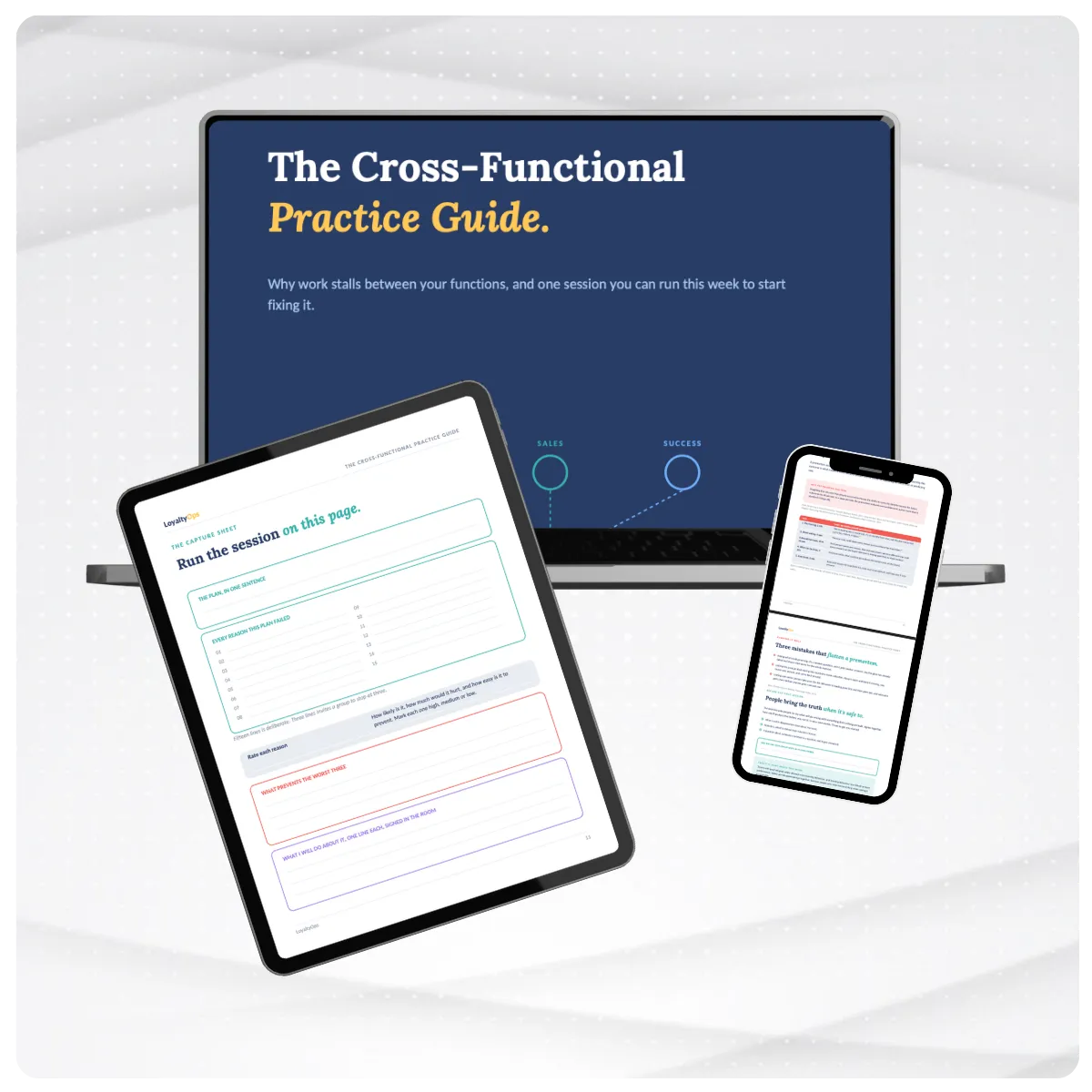
Download the Cross-Functional Practice Guide and start now.
Working across functions is a skill, and your leaders can build it.
Nobody is born knowing how to do this, and very few leaders are ever taught it. Working across functions is a set of skills, and like any skill, it gets better with practice. Helping leadership teams build these skills is the work we do.
Trust
Believing your peers will do what they said, and that none of them is working against you.
Candour
Saying what you think, including the part nobody wants to hear, to the person who needs to hear it.
Solving together
Taking a problem that belongs to more than one function and working on it as one group until it is settled.
Disagreeing well
Making your case hard, hearing the case against it, and keeping all of it about the work.
Committing
Backing a decision you argued against, so the business can get on with it.
A leadership team with these skills delivers what it says it will. A group of function leaders that does not will keep missing the objectives that need all of them.
Why this keeps happening, even to good leadership teams.
Functions that are each doing well, and a business that is still missing its objectives. This conversation is about why that happens and what it takes to change it.

Start building the skills your leaders need to deliver together.
Leaders build these skills by consistently practicing them on real problems. The free guide gives your leaders everything they need to start.
Use it once, and your leaders will have solved something together that neither function could have solved alone.
Use it again, and it starts becoming the way they work.
Three ways we help you build this.
The Work That Moves Between Teams Workshop
Your leaders get their first experience of solving something as one team, and they see what the business gets when they work that way.
Two hours, virtually or on-site.
The Cross-Functional Cadence
Your leaders build these skills until working across functions is simply how things get done here, and your own people take it over so it continues after we go.
Twelve weeks, facilitated.
Leadership Team Development
Your executive team agrees on what good leadership looks like here, then develops every leader against that standard, so performance improves across the organization.
Six months.
Schedule a 30-minute conversation about where your organization is now and what would move it forward.
Here's what leaders ask about cross-functional collaboration.
What is cross-functional collaboration?
It is leaders from different parts of the business working a problem together that none of them could solve alone. It depends on trust between them, on each one understanding what the others are dealing with, and on being able to disagree openly and still commit to what gets decided.
Why does cross-functional collaboration break down?
Usually because the things it depends on were never built. Leaders who do not know each other well enough to say the difficult thing, who do not know what the other functions are dealing with, and who have never settled a real disagreement together. Each one can be doing their own job well while the business misses what it needed from all of them.
How do you improve cross-functional collaboration?
Your leaders work on real problems together, often enough that it becomes normal. Trust, candour and the ability to disagree and commit are skills, and they get stronger with practice. The free guide on this page gives your group its first go.
Is this the same as breaking down silos?
Breaking down silos names the goal, and it usually ends up meaning a reorganization or a new tool. This is about what your leaders do with each other, and you can start it this month without changing anybody's reporting line.
Our leaders get along. Is this still for us?
Getting along and driving business outcomes by working together are different things. Plenty of friendly leadership teams have never told each other the difficult things, and that is the part that costs the business.
What if people won't say what they really think?
That is the usual starting point, and it is why the first conversation is built around a problem nobody has to defend. People say far more than you expect when disagreeing is the point of the exercise.
Who should be involved?
Every leader whose function depends on other functions to drive business outcomes. Four to ten leaders work well.
Do we need someone from outside?
You can do the first one yourselves with our free guide. The challenge is that whoever brings the group together has a stake in the answer, which makes it hard to be neutral and argue a position at the same time.
Get started in three simple steps.
01
Book a 30-minute discovery call.
We'll learn about you, your people, and what you want to change, and we'll both decide whether it makes sense to keep talking.
02
Join a free 90-minute strategy session.
If it's a good fit, we'll meet for a free 90-minute strategy session to look closely at your priorities and agree on the first steps.
03
Start the work.
You choose the option that fits, and we start with the priorities that matter most to your organization.
Contact Us
LoyaltyOps™ HQ
430 Hazeldean Road,
Unit #6, Suite 17
Kanata, Ontario, Canada
K2L 1T9
Email: [email protected]
Phone: 1 365-659-4720
Company
Copyright 2025 LoyaltyOps Inc. All Rights Reserved