
LEADERSHIP TEAM DEVELOPMENT
Performance stops depending on who someone reports to.
Your priorities get delivered, your good people stay, and performance stops varying from one part of the organization to the next.
Your organization has never agreed what good leadership means here.
You have values, targets and performance reviews. What you do not have is an agreed definition of how a leader in this organization is supposed to lead, and most organizations never write one.
Every leader fills that gap with their own judgment, which is how the same company ends up with as many leadership styles as it has leaders.
Your people get different answers depending on who they ask
What is expected, what good work looks like, and what gets escalated all change from one part of the organization to another.
Talent decisions rest on impressions
With no standard to assess against, leaders get judged on results and on how well they are liked, and the same person reads as high potential to one executive and not to another.
You cannot develop leaders against a definition you do not have
Training gets bought, courses get completed, and nothing about how your leaders lead is measurably different afterward.
Nobody below the leadership team can fix this. Setting the standard is executive work, and it is the work this engagement does.
Your leaders stop waiting for direction and start making the call.
Most growing organizations run on centralized control. Decisions travel up to the people with the most context, and the pace of the organization is set by how fast the people at the top can answer.
The alternative is decentralized command, a model developed for this exact problem: people across the organization act without waiting, and they can only do that safely when everyone agrees on the objective, the standards, and the limits. Set those at the top, and judgment at the edges becomes an asset.
What your organization does with it
People make decisions at the right level without checking upward first.
Leaders give the same answer to the same question.
Problems surface while they are still small enough to fix cheaply.
Work moves between teams without stalling at the handoffs.
New leaders are held to clear standards that already exist.
Six months, and your leadership team builds every piece of it.
We teach the frameworks and facilitate the sessions. Your leadership team writes the standards in their own words, because a standard your leaders wrote is one they will hold each other to.
Month 1. Kickoff
ONE FULL DAY ONSITE, OR TWO 3-HOUR VIRTUAL SESSIONS
Your leadership team agrees the direction and the priorities, sets the first standard for how leaders here work with their people, and records where the organization is starting from.
Month 2. How direction travels
3-HOUR WORKING SESSION
Your leaders agree how direction gets passed on, and they practice it on work your organization is doing right now, so you can see for yourself how it lands.
Month 3. How problems reach you
3-HOUR WORKING SESSION
Your leaders agree how problems get raised up, down and across the organization, so they arrive while they are still small.
Month 4. Accountability
3-HOUR WORKING SESSION
Your leadership team agrees the standard they will hold each other to, and they commit to it, because a standard people agreed to is a standard they will use.
Month 5. Decision ownership
3-HOUR WORKING SESSION
Your leaders agree which decisions belong at which level, and the first of those decisions move to the people who should have been making them all along.
Month 6. What happens next
3-HOUR WORKING SESSION
Your team reviews what changed against where you started, and sets the priorities for the next six months.
Between sessions, your leadership team can reach us on weekdays through a shared channel, and you get a 60-minute 1:1 call each month. Accountability comes before decision rights, because handing decisions to people who have not agreed on how they will be held accountable does not work.
You find out how strong your leadership team is, and whether it got stronger.
Most CEOs are working from impressions of their own leaders. You know who you would trust with a difficult conversation and who you would not, and almost none of that is written down or comparable from one leader to the next.
At the start of the engagement, every leader on your team is rated against the same leadership competency assessment, and you are rated alongside them, because a standard the CEO is exempt from is not a standard.
You get a clear picture of your leadership team: where it is strong, where the same weakness shows up across most of the room, and which part of the standard your organization is furthest from living.
That is what the six months is focused on. The same assessment completed before the final session, so what improved is something you can see for yourself.
Your organization keeps performing as it grows.
Performance improves across the organization, and it stops depending on who someone reports to.
Good people stay, because the experience of working here stops varying by manager.
New leaders inherit a definition of the job on the day they start.
Your leaders are measured against a standard your team wrote, in hiring, promotion and review.
Decisions get made at the right level, so the organization moves at its own speed.
The organization absorbs change, because your people know the objective well enough to adjust without being told.
CEOs call us when one of these is true.
Your organization has grown past the point where you can set the tone by being in the room.
Your leadership team is not aligned on what matters most, and it shows further down.
Your values are written down, and they rarely shape a real decision.
Each of your leaders leads their own way, and your people have learned to work around the differences.
You are losing people you wanted to keep, and the pattern follows particular managers.
You have bought leadership training before and nothing about how your leaders lead changed.
Every session is prepared, and every session moves something forward.
“One of Mickey’s strengths is her ability to quickly bring people together and build an environment of trust where different viewpoints can be shared openly and respectfully. She keeps discussions productive and focused while ensuring everyone has the opportunity to contribute.”
Terry Walker
Regional Director, Eastern Ontario and New Brunswick, Desjardins Insurance Agents
Questions leaders ask before they book a call
What does this ask of my leadership team’s time?
A full day for the kickoff, then a 3-hour session each month for five months. Before the kickoff each leader completes a short assessment and drafts their part of the direction. The rest of the work happens inside meetings and decisions your team is already having.
Who sees the assessment results?
Each leader sees their own. Peer ratings are collected by a named person inside your organization and are only ever shown as an average, so no individual peer is identifiable. At the kickoff we name the pattern across the team without naming anyone. We recommend keeping the ratings out of pay and promotion decisions, because people stop answering honestly once a rating affects their pay.
What if one of my leaders does not want to do this?
That usually surfaces in the first two sessions. Most of the time, it is a leader who has not been told why this matters or who expects it to be a personal assessment, and both are answerable. Occasionally it tells you something you already suspected about that leader’s fit, which is also useful.
How is this different from a leadership offsite?
An offsite produces agreement in the room. This produces standards your leaders wrote, measures against a baseline, and six months of working sessions where each of those is used on real decisions before the next one is built.
Do we meet virtually or in person?
Virtually by default, which is how we work with teams across Canada and the United States. Onsite is an option for any team, the kickoff is a full day when it is onsite, and teams in the Ottawa area meet onsite as standard.
What happens after six months?
Most teams continue with a working session each quarter, the monthly call, and continued access between sessions, cancellable with 30 days’ notice. The standards and the tools are yours either way.
Every engagement starts with a 30-minute discovery call.
On the call we learn about your organization, your leadership team, and what you want to be different in six months. If it is a fit, the next step is a free 90-minute strategy session where we look closely at your priorities and agree the first steps.
Contact Us
LoyaltyOps™ HQ
430 Hazeldean Road,
Unit #6, Suite 17
Kanata, Ontario, Canada
K2L 1T9
Email: [email protected]
Phone: 1 365-659-4720
Company
Copyright 2025 LoyaltyOps Inc. All Rights Reserved
Recommended Insights
Recommended Insights on Founder Performance
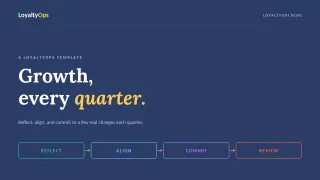
Quarterly Performance Cadence: Reflect First
Most performance reviews change nothing because they run in the wrong order. Reflection first, then alignment, then two or three behaviours you would actually see. ...more
Feedback
July 18, 2026•9 min read
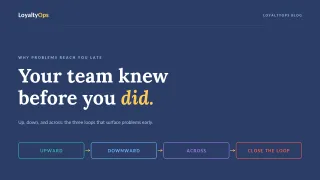
Feedback Loops: How to Hear Problems Early
Your team usually knows before you do. Why an open door is not a system, the three directions feedback has to run, and the test for whether a loop is really closed. ...more
Feedback
July 16, 2026•10 min read
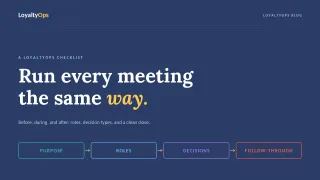
Meeting Standards: Run Meetings That End in Decisions
Meeting standards give every meeting a purpose, an owner and a decision. Here is the one-page standard, what meetings cost, and how to run it this week. ...more
Standards
July 15, 2026•8 min read