
Quarterly Performance Cadence: Reflect First
TL;DR
A quarterly performance cadence is a rhythm that puts reflection before feedback. The person reflects on their own quarter first, alone and in writing.
Then you meet to align.
Then they commit to two or three behaviours for the next ninety days, specific enough that you would see them happening.
Most reviews change nothing because they run the other way round, delivering a verdict first and leaving improvement as an afterthought.
What is a quarterly performance cadence?
A quarterly performance cadence is a structured rhythm for reviewing how the last quarter actually went and naming a short list of behavioural changes for the next one.
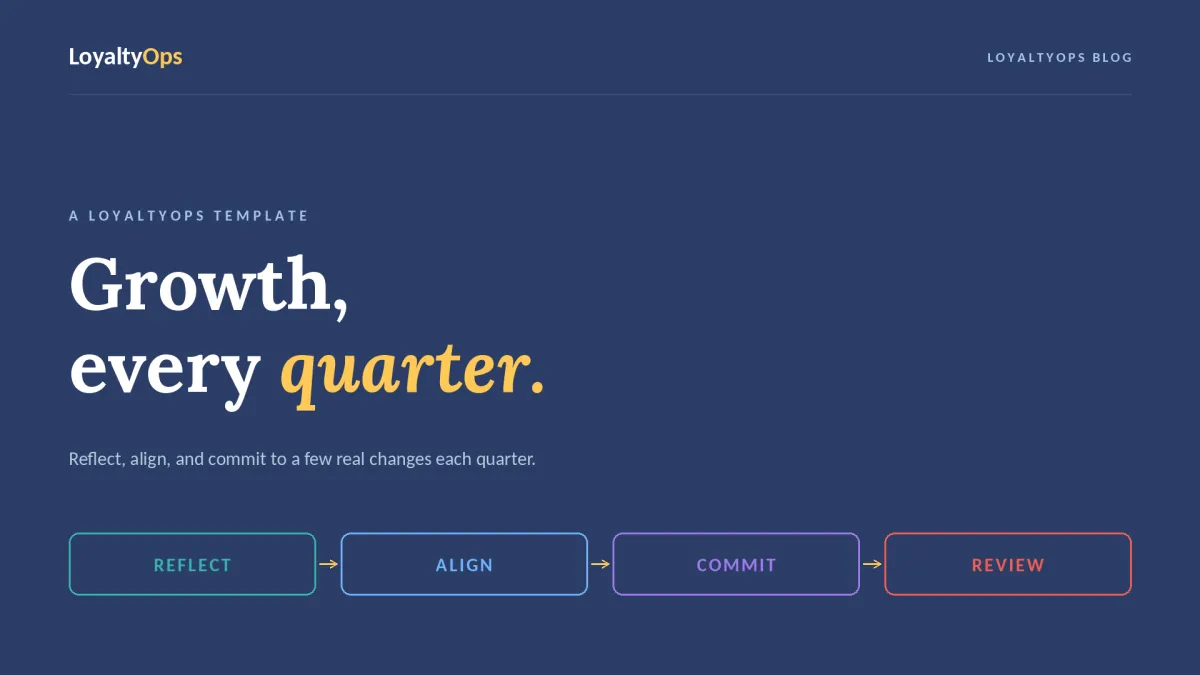
It runs in three parts. Reflect, where the person assesses their own quarter on their own. Align, where you meet to compare what each of you saw and adjust. Commit, where they confirm two or three observable behaviours for the next ninety days, with a review date.
The cadence does not replace quarterly planning or performance measurement. It addresses the behaviours that determine whether either one produces anything.
Why your performance reviews change nothing
Once a quarter, or once a year, you sit down for the conversation. You arrive with your read on how things went. The other person arrives a little braced. The hour gets spent re-arguing the past; you both leave with vague intentions, and next quarter brings the same problems and the same conversation.
The cause is usually the order.
A standard review asks two different things of one hour, and they work against each other: look honestly at the past, and decide what improves next. Crammed together in that sequence, your feedback arrives first as a verdict the person did not see coming, and improvement gets tacked on at the end and assumed rather than chosen.
That design produces a defensive conversation and a vague ending almost regardless of who is in the room.
A braced person does not change
This is the part that matters most.
When someone walks into a room expecting to be judged, they spend the hour protecting themselves rather than thinking about how to get better. Every piece of feedback becomes something to explain away. That is not a character flaw, it is how anyone responds to a surprise verdict about their own work.
Real change asks someone to look squarely at what did not go well and decide to do something differently, and nobody does that while defending themselves. So the more the conversation feels like a judgment, the less it produces the thing it exists for.
None of which means your people are allergic to feedback. Committed people leave reviews unchanged all the time, because the conversation never gave them a calm moment to reflect or a clear decision to make. A review that ends in "let's communicate better next quarter" did not hand anyone something to improve.
A badly ordered conversation is far easier to fix than a motivation problem.
Part one: the person reflects on their own
Before any conversation, the person fills in an honest reflection on the quarter. Honesty is the whole point here, and going through the motions helps nobody.
It has two halves.
Looking back: the major outcomes this quarter, where things went smoothly, and where things felt harder than they should have.
How they operated, beyond what they finished: their clarity and communication, how well they listened and checked reality, their ownership and follow-through, and what they learned.
It closes with two things:
the single biggest challenge in how they work; and
the one strength they want to keep.
Doing this first is what keeps the later conversation calm. Someone who has already assessed their own quarter arrives ready to talk it through rather than braced to defend it.
Part two: two or three behaviours you would actually see
From that reflection, the person picks two or three changes for the quarter ahead, and no more, because more than that splits attention and none of them sticks.
Two rules make a commitment real.
It is a behaviour rather than an outcome. How the work gets done is the part a person actually controls. An outcome on its own gives them nothing to practice.
It is observable. You would see it happening.
Weak: "Be more strategic." "Be more careful."
Strong: "Block two ninety-minute strategy sessions on my calendar each week."
For each one, the person names when and where it matters most, and how they will know they are doing it consistently.
Part three: align, confirm, and set the date
The person shares the reflection and the draft commitments at least a day before you meet, so you both come in prepared.
The meeting is for alignment. You talk through what they saw, make any adjustments together, name the support or context they need, and confirm the two or three behaviours and a review date about ninety days out. You both leave holding the same plan.
Then you run it again next quarter. That is what makes it a cadence, and it is why improvement accumulates: each ninety days starts from the last one.
Why reflection before feedback works
The order is the mechanism rather than a courtesy.
People who assess themselves first stay regulated, and the conversation turns collaborative, because they are not hearing a verdict cold. Centring the commitments on behaviour rather than outcomes gives them something they can actually change. Capping the list at two or three lowers the load and lifts follow-through. And using the past only to decide what changes next keeps the whole thing forward-looking rather than a rehearsal of old arguments.
Running it with the leadership team
The same rhythm works on a leadership team, reviewing how the organization operated rather than how one person did.
The review moves through four questions, one per stage of the Leadership Operating Flywheel.
Communicate. Where did clarity hold during the quarter, and where did it erode? Whether priorities were consistently understood, whether meeting standards held under pressure, whether decisions were documented, and whether communication drifted as the quarter went on.
Collect. What did the organization hear, and what did it miss? Feedback themes, surprises, signals that surfaced late, and signals that were ignored. This is often where the most valuable learning sits, because it surfaces information the organization already had and did not act on.
Commit. Did ownership stay explicit, or did it blur? Top commitments, where execution held, where commitments slipped, what distracted the team, and where prioritization broke down.
Continuously Improve. What has to change next quarter, in terms of behaviour? Two or three focus areas, each with a named owner.
The same rules apply. Focus areas are observable rather than aspirational, and the cap at two or three is what keeps them realistic. A strong one looks like documenting escalation thresholds, protecting deep work time weekly, or limiting quarterly priorities to three.
A session like this needs a facilitator, whose job is to protect the structure: prevent storytelling, interrupt blame, push for clarity, and keep the focus on behaviour rather than personality. The structure itself is what makes honest diagnosis possible. Without it, the conversation defaults to storytelling and defensiveness.
What accumulates
The first cadence usually surfaces obvious friction that has been tolerated for months. Later ones surface subtler patterns that only become visible once the obvious problems are gone.
Each reflection starts from the last one, and each set of behaviours builds on what came before, which is what turns a conversation into a habit of getting better.
Start this quarter
Do not overhaul anything.
For the next review, send the person a short reflection to fill in on their own a day or two ahead: what went well, what felt harder than it should have, and how they operated rather than only what they finished. Then use the meeting to compare views and agree on one or two behaviours they will practice for the next ninety days.
One conversation run in that order will feel different from every review before it, because the person shows up thinking rather than defending.
You can also run it on yourself first. Fill in the reflection, pick two or three behaviours, set your own review date. It is a useful way to understand the conversation before you bring it to anyone else.
Where the cadence fits
It is one of the tools of the Leadership Operating Flywheel, and it is how each person keeps improving so the organization gets better over time.
It pairs with the after action review, which does the same thing for finished work rather than for people.
Common questions
What is a quarterly performance cadence?
A rhythm you run each quarter that puts reflection before feedback. The person reflects on their own, you align in a shared conversation, and they commit to two or three observable behaviours for the next ninety days.
What are the three parts?
Reflect, Align, Commit. Reflection happens alone and in writing before any meeting, which is what keeps the conversation calm.
Why put reflection before feedback?
Because someone hearing a surprise verdict spends the hour defending rather than reflecting, and a braced person does not change. Assessing their own quarter first means they arrive ready to talk it through.
What makes a good commitment?
A behaviour you would actually see, capped at two or three. "Be more strategic" is a trait nobody can observe. "Block two ninety-minute strategy sessions each week" is a behaviour anyone can.
How is this different from an annual performance review?
An annual review is usually one long verdict delivered once a year, easy to brace against and easy to forget. This runs every quarter, reflection first, and ends in a short list of observable behaviours.
How does this relate to OKRs?
Differently enough that they work together. Goal frameworks define what to pursue and tell you whether you hit the target. They do not explain why you hit or missed it, so a team that lands seventy percent of its key results knows the score without knowing which behaviours produced the gap. The cadence examines how the team operated, which is what makes the next set of goals more achievable.
How does this relate to KPIs?
The same way. Metrics tell you the score and can signal that something is wrong, and they cannot diagnose which behaviour needs to change. Managing only by metrics means reacting to lagging indicators rather than adjusting the behaviours that drive them.
Can I use this on myself rather than my team?
Yes. Fill in the reflection, choose two or three behaviours, set your own ninety-day review date.
Get the template
We have put the whole method into a free template: the three-part rhythm, the self-reflection worksheet, strong-versus-weak examples for writing a behaviour you would actually see, the commitment page, and the alignment page with a confirmed ninety-day focus.