
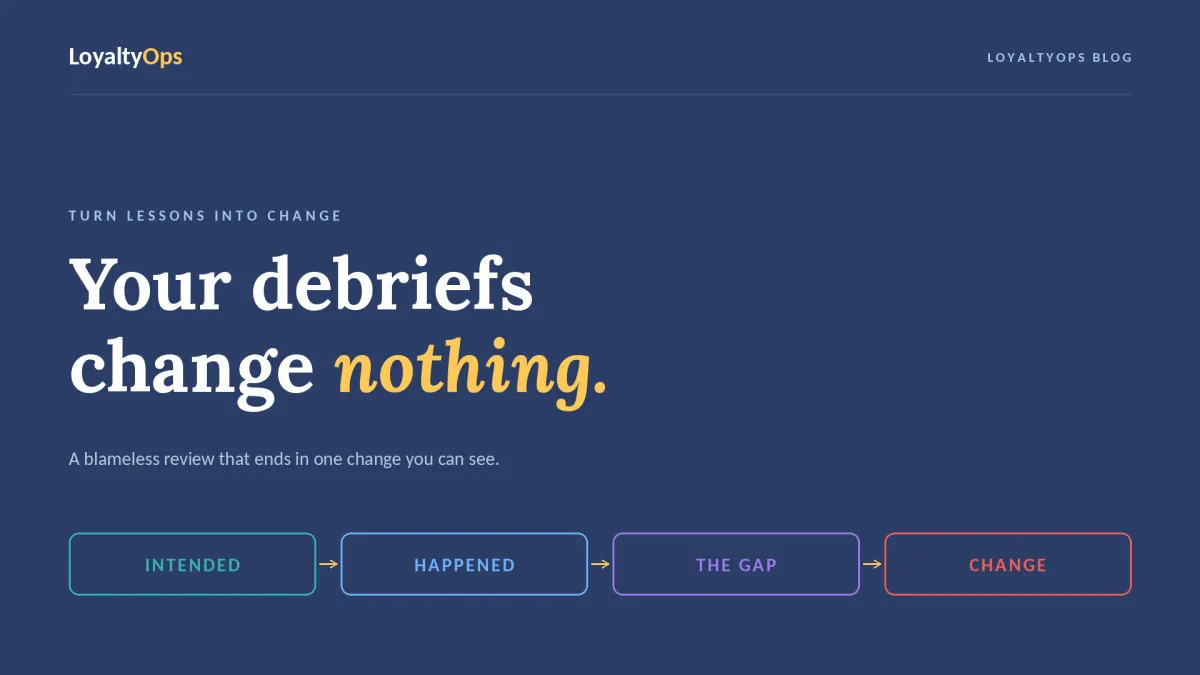
After Action Review: End With One Real Change
TL;DR
An after action review is a structured, blameless review held after something finishes, built so the conversation has to end in at least one change you could actually see someone making, with a named owner and a date.
Most debriefs end in a good discussion and change nothing, because a good discussion feels like progress on its own.
The practice runs on a fixed ninety-minute agenda, and the predictability of that agenda is what makes it safe to be honest.
What is an after action review?
An after action review is a structured practice where a team pauses after meaningful work to examine what happened, why it happened, what was learned, and what will change going forward.
It focuses on the system and the process rather than on blame or individual performance, and it is governed by standards that define when reviews are triggered, who participates, how people show up, and how learning turns into action.
It is not a performance review, and it is not reflection for its own sake, because it always ends in a change and a shared lesson. A review that ends without a change was a conversation.
Where the practice comes from
The military developed it as a way for a unit to learn from an operation while the details were still fresh, with the review run on a fixed structure, kept off the question of who was at fault, and held after successes as much as after failures.
That last part is what most organizations lose when they borrow the idea. A review triggered only by failure teaches you about your worst days. A review triggered by anything significant teaches you about all of them.
Why the same problems keep coming back
A problem you fixed last quarter is back, and the team is solving it again from scratch. A mistake you thought was behind you returns in a slightly different shape. The same surprise shows up at the same stage of the same kind of project.
The lesson from the last time never became a change. A project wraps, the team takes a breath, and everyone moves to the next thing. Whatever that project could have taught you stays inside it, and an uncaptured lesson cannot stop anything. The next team to hit the same situation starts with the same blank page and makes the same call.
That is not carelessness. Experience only prevents a mistake once it has been turned into something the team does differently. Left as a memory in one or two people's heads, it fades; those people get busy or move on, and the mistake is free to happen again. The team learns. The learning has nowhere to go.
Which is better news than it sounds, because a missing habit is far easier to fix than a motivation problem.
The debrief that changed nothing
You have probably already held the debrief. Most of them change nothing, for two reasons.
They turn into blame. The conversation quietly becomes about who dropped the thing, everyone gets defensive, and the real causes never surface because nobody wants to be the example. The team learns to say less next time.
They turn into storytelling. Everyone recounts what happened, nods, feels productive, and leaves without deciding to do a single thing differently.
A good discussion is not a change
This is the idea the whole method turns on.
Insight is the feeling of understanding something. A change is a specific thing you do differently. The two are easy to confuse, and confusing them is why so many thoughtful debriefs lead nowhere.
Even debriefs that reach a takeaway usually reach the wrong kind. "Communicate better." "Be more careful." "Plan earlier." They sound reasonable, and not one of them tells anyone what to do differently on Monday morning. A takeaway nobody can act on is a nicer way of hoping.
An after action review exists to close that distance on purpose. It is built so the conversation has to end somewhere real.
The four standards behind the practice
The review works because four things are agreed in advance rather than decided in the moment.
1. When reviews are triggered.
The organization names which moments warrant one, so the practice becomes automatic. Common triggers are a completed project or initiative, the end of a client engagement, a missed goal or significant delay, a major decision that affected several teams, and the close of a planning cycle.
2. Who participates.
The people closest to the work have the most relevant observations. Cross-functional participants see what the core team cannot. The standard names the right combination for each type of review.
3. How people show up.
Curiosity rather than defensiveness. Facts rather than opinions. Behaviour rather than intent. Improvement rather than justification. These four are what make honest diagnosis possible.
4. How learning turns into action.
Every review produces a small number of changes with named owners, recorded somewhere the rest of the organization can find them.
Timing matters as much as structure. Waiting too long lets memory fade and context blur, so the review happens while the experience is fresh.
The ninety-minute agenda
The review follows the same order every time, and that predictability is also what keeps it safe. When everyone knows the same questions are coming and the review stays on the system, people can speak plainly.
Open (5 minutes). Name it as a blameless review, name the facilitator and scribe, and set the one rule: leave with at least one change.
What we expected (10 minutes). The goal, the assumptions, and what success looked like going in.
What actually happened (15 minutes). Facts and observable outcomes only, walked through as a timeline.
The signals we saw (10 minutes). The early signs someone noticed, and when the team first sensed something was off.
What we could have done differently (15 minutes). Where the gap was, in the process, the communication, the escalation, the decisions or the assumptions. On the system rather than the person.
What we learned, and what to keep (15 minutes). The patterns worth carrying forward, and what went well.
What we'll change, and who owns it (15 minutes). One to three observable changes, each with a named owner and a date.
Close, document, and share (5 minutes). Confirm what is changing, where it is recorded, and which teams need to hear it.
Two roles, kept separate
A facilitator runs the agenda, keeps it blameless, keeps it on the system and keeps it on time. A scribe captures the review as it happens: the decisions, the changes and the owners. Keep those two roles with different people, so the person running the conversation stays free to run it.
Rotate who facilitates. When the same senior person always runs it, the review starts to feel like a performance evaluation, and rotating the role puts ownership of the learning with the team.
Name one more person as the steward, who keeps every review in one shared place so they stay findable over time.
Make the change something you would actually see
The one rule is that you leave with at least one change you can see, and this is exactly where most reviews fail, because the change they name is too soft to do anything.
Weak: "Communicate better." "Be more careful." "Plan earlier."
Strong: "Escalate a timeline risk within twenty-four hours." "Write down cross-functional decisions the same day."
The test is whether you would actually see it happening. If you can picture someone doing it, it is a change. If you cannot, it is a sentiment.
Keep the list to one to three, each with a named owner and a date, because too many at once means none of them sticks. And write it down, because a change that is not recorded quietly reverts to the old way by the next busy week.
Keeping it blameless
People are honest in a review only when it is safe, and the safety comes from the structure itself rather than from asking for candour.
Deal in observable facts. Interrupt blame and storytelling when they start. Ask what part of the process or the handoff contributed rather than who was at fault.
Make the lesson reach other teams
A review that stays with the people who were in the room only helps those people.
The scribe finalizes the notes, and the steward stores them in one shared place. The notes, with the change, the owner and the date, go to everyone who attended. The bigger lessons get written into a short briefing and sent to the teams they affect, sometimes as a short session when a lesson touches several teams.
Keeping every review in one place means the next team facing the same thing is one search away from the answer.
What accumulates
The first few reviews tend to surface obvious problems. Later ones surface subtler things that would never have been identified without the discipline of a structured look.
Each review produces a small number of improvements, and those add up. New people benefit from the learning of the people who came before them, because it is written down somewhere rather than stored in individual memories.
Start this week
Pick the last thing your team finished, good or bad.
Name a facilitator and a scribe, gather the facts and the timeline, and book ninety minutes with only the people the learning needs. Run the agenda, and leave with one change that is owned, written down and shared.
One review, with one change owned and recorded, is the habit starting.
Where the after action review fits
It is one of the tools of the Leadership Operating Flywheel, and it is how the Continuously Improve stage works in practice, the part where the team learns from the work rather than only doing it.
It works alongside the others: a team that shares one direction, raises problems early, and holds each other accountable for the changes it commits to.
Common questions
What is an after action review?
A structured, blameless review held after something finishes, to turn the experience into at least one change the team actually makes. In about ninety minutes the team covers what was expected, what happened, the early signals and where the gap was, and ends with a specific change that has an owner and a date.
How do you run one?
Name a facilitator and a scribe, book ninety minutes, and follow the fixed agenda. Keep it on the system rather than the person, and close by confirming the change, where it is recorded and who needs to hear it.
What makes a change observable?
You would actually see it happening. "Communicate better" is not observable. "Escalate a timeline risk within twenty-four hours" is. Observable changes can be checked and practiced, which is why the list is capped at one to three.
When should we run one?
After anything worth learning from: a finished project, a client engagement, a missed goal, a major decision, or the close of a planning cycle. It does not need to be every task. It needs to be consistent enough that the team expects real work to close out with a change.
How do we keep it from becoming a blame session?
Agree the four standards in advance, rotate the facilitator so it never reads as a senior leader's evaluation, deal in observable facts, and interrupt blame when it starts.
Do I need training to run one?
No. Name a facilitator and a scribe and follow the agenda. The structure does most of the work.
Why share the results with other teams?
A lesson that stays with the people who were in the review only helps them. Written down and sent to the teams it affects, it stops the same problem reappearing somewhere else.
Get the template
We have put the whole method into a free template: the timed ninety-minute agenda, the roles, the before-the-meeting prep, a one-page worksheet the scribe fills in as you go, weak-versus-strong examples for writing an observable change, and the steps for documenting and sharing the lesson.