
LoyaltyOps War Games
A battle-tested planning, collaboration, and execution framework so your team thinks clearer, decides faster, and executes as one.
Your Team Has the Talent.
The Planning Process Is Leaving Results on the Table.
When planning is unstructured, capable teams underdeliver because the process was never designed to turn collaboration into results.
Problems get discussed before they are clearly defined
Too many solutions get mixed together too early
Decisions made in the room get questioned in the hallway
Cross-functional work breaks down at the handoffs because ownership was never explicit
The same planning conversations happen every quarter with the same inconclusive results

The Same Planning Discipline That Makes Tier 1 Special Operations Teams Unstoppable.
Tier 1 Special Operations perform because every person in the room plans, decides, and executes from the same disciplined process.
War Games is directly adapted from the planning and execution process used by Tier 1 Special Operations — the most disciplined planning methodology ever developed for high-stakes, complex, time-pressured environments.
The same process that allows elite military teams to walk into uncertainty with clarity, make confident decisions under pressure, and execute without confusion, adapted for the complexity and pace of growing organizations.
The methodology is the same. The environment it is built for is yours.
What Is War Games
A planning discipline that turns collaboration into momentum and decisions into results.
Most organizations have capable people and good intentions. What they lack is a shared structure that turns a room full of smart people into a team that consistently produces better plans, moves faster on initiatives, and delivers what they said they would.
War Games is a two-day teaching and facilitation engagement, so every planning session produces a decision that the whole team owns. Every initiative starts with clarity on who does what and what happens next. Every quarter, the organization executes more of what it planned and wastes less time on the friction that slows capable teams down.
The work gets done, the results show up, and the team gets better at producing them every time they use the process.
Who War Games Is For
Any team that plans, works across departments, and is ready to produce results that match their capability.
War Games is for organizations that want to install a proven planning and execution framework across their teams, whether the organization is running strategic planning, managing cross-functional initiatives, or simply ready to operate at a standard where plans actually execute and results compound.


What Changes When the War Games Discipline Is Installed
The team stops talking about what needs to happen and starts delivering it.
Planning produces clear decisions and owned initiatives instead of follow-up meetings about the meeting.
Cross-functional teams move faster because collaboration has structure instead of assumptions.
Initiatives that used to stall at the handoffs between departments start finishing.
The gap between what the organization planned and what it delivered closes quarter after quarter.
Leadership spends less time resolving what should have been clear at the start and more time building on what the team produced.
See Exactly How War Games Works
Get the War Games Overview and walk through the two-day engagement adapted from the Tier 1 Special Operations.
What's inside:
The planning problem that leaves capable teams underdelivering, quarter after quarter
The bottom-up planning discipline War Games installs, and the five rules that make it hold
What changes for the team once the discipline is in place
A full look at both days, from learning the process to running it on a real decision
Ready to Install the Planning Discipline That Makes Elite Teams Elite?
Walk away from the Discovery Call with a clear picture of what War Games would produce for your organization.
In 30 minutes, we will identify whether War Games is the right engagement, what the scope should be, and what the organization would be producing differently on the other side. You will leave with a clear answer either way.
Recommended Insights
Recommended Insights on Founder Performance
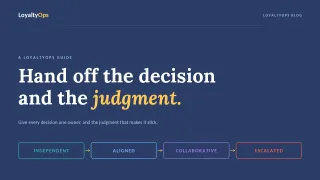
The Decision Rights Map: Free Delegation Template
Download the free Decision Rights Map: the four decision types, how to decide who owns a call, a hand-off card with a worked example, and two standards. ...more
Execution and Operations
July 18, 2026•6 min read
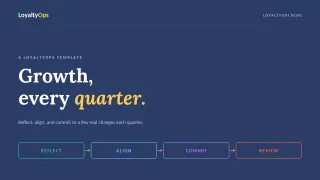
Quarterly Performance Cadence Template (Free)
Download the free Quarterly Performance Cadence Template: a self-reflection worksheet, strong-vs-weak behavior examples, and an alignment page for a 90-day focus. ...more
Execution and Operations
July 18, 2026•6 min read
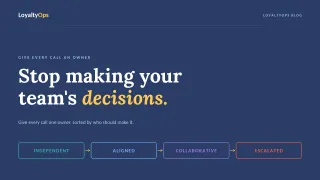
Decision Rights: Give Every Call One Owner
Decision rights, made simple: give every decision one owner and one of four types, sort by what it touches, and hand off the judgment, not just the call. ...more
Leadership Operations
July 17, 2026•7 min read
Contact Us
LoyaltyOps™ HQ
430 Hazeldean Road,
Unit #6, Suite 17
Kanata, Ontario, Canada
K2L 1T9
Email: [email protected]
Phone: 1 365-659-4720

Facebook
LinkedIn
Youtube