
1:1 LEADERSHIP ADVISORY
You get measurably better at leading, and your team follows.
You lead with a method you trust, your people deliver the priorities you set, and your part of the organization performs better.
Most leaders are promoted for the work, then asked to lead people.
You were good at the work, so you were given people to lead. The skills that made you good at the work are different skills from the ones that make a team perform, and most organizations expect you to pick those up while doing the job.
You set the direction, and the work goes somewhere else
Your people work on whatever you looked at most recently, and the priorities you set at the start of the quarter get less of the week than they should.
Your people wait to be told
Work your team could carry on its own stays open until you are part of it, and the pace of everything you are responsible for is set by how fast you can get to it.
The priorities slip
Everyone is working hard, and the things you said mattered most are the things that move to next quarter.
Every leader has this gap at some point, at every level. What separates leaders is how fast they close it.
You can see what better looks like, and whether you got there.
Most leaders build this by trial and error over several years, picking up what works from the leaders they happened to have. It works eventually, and it is slow, and much of what you learn depends on who you happened to work for.
Three things make it faster here.
1
A model
Ten leadership competencies, written as behaviours, so being better at leading is a list of specific things you do and not a feeling.
2
A measure
You rate yourself on all ten at the start of the engagement and again at the end, so the change is something you can see.
3
Tools
Every tool is simple and ready to use immediately in your day-to-day, with no rollout and no new system.
Ten leadership competencies, and you will know where you stand on each one.
The competencies follow our process, with strategic clarity first, then four stages that come in order and repeat. Each stage asks you to go first, because people copy what their leaders consistently do.
Strategic Clarity
Your people know what your priorities are, why they matter, and what good work looks like.
Sets Clear Direction
Lives the Standards First
Communicate
Direction, decisions and standards reach your people, through behaviour as much as words.
Makes Expectations Clear
Communicates Often and Openly
Collect
What is really happening reaches you and your team early, so problems get caught while they are small.
Updates Their View When the Facts Change
Is Open to New Ideas
Commit
Alignment turns into action, with a clear owner for every decision and commitments people can count on.
Gives People Ownership
Builds a Team That Succeeds and Fails Together
Continuously Improve
What your team learns from its work turns into real changes, and your people grow with it.
Makes It Safe to Try and Learn
Grows the Next Leaders
You rate yourself at the start, and again at the end.
Before the first session, you rate yourself on all ten competencies, and you write one real example for each, so every number has a story behind it. You rate what has happened over the last three months, including the harder weeks, and the whole thing takes about 20 minutes.
The results decide where the work starts. You spend part of the first session on them, and you leave with one competency and one behaviour to practice. Before the final session, you rate yourself again, and we read both pictures side by side.
The ratings belong to you
The results stay with you when the engagement ends, and that matters because the assessment is built to be repeated. Each competency is scored on what you did over the last three months, with a real example written beside it, so a year from now you can rate yourself again and see exactly what moved. It is a baseline you own for the rest of your career, including in roles you have not taken yet.
If your organization is sponsoring the work
The person you report to can complete the same assessment, so there are two views at each end. Your organization can also name a business result for the work to focus on, and most choose priorities delivered, decisions made at the right level, alignment on what matters, or keeping the people they need.
You leave every session with a tool you can use immediately.
Your assessment decides which competency you work on first, and from there the order follows our process, because each tool makes the next one useful.
In each 90-minute session, we teach one concept, you apply it to a real situation from your own team, and you leave with the tool for it.
Each tool is simple, easy to use, and ready to apply immediately. Your people need no training for it to work, and you use it in the course of your regular day-to-day.
The tools are yours to keep, and they carry the work forward after the engagement ends.
Between sessions, you can reach us by email or WhatsApp, so you can ask about a decision before you make it.
Choose the pace that fits your needs.
Foundation
SIX MONTHS · ONE 90-MINUTE SESSION PER MONTH
Six months on the leadership competencies and the tools that enable them. You work through them one at a time, with a month between sessions to put each into practice before the next. This fits a leader who wants to get better at leading and wants the time spent on exactly that.
Most Popular
Accelerator
SIX MONTHS · TWO 90-MINUTE SESSIONS PER MONTH
Twice the sessions across the same six months, so the competencies move faster and there is room for what is happening in your team while you learn them. You can bring a live problem to a session without losing your place in the work.
Most Flexible
Sprint and Sustain
TWELVE MONTHS · TWO SESSIONS A MONTH FOR THREE MONTHS, THEN ONE A MONTH
Two sessions a month for three months builds the competencies quickly, then nine months of monthly sessions you can spend on whatever the year brings. A department head, a VP or an executive needs that flexibility, because a year of their job includes hiring and exits, a team that grows, leaders of their own to develop, and their own performance under review.
Every package includes the leadership competency assessment at both ends, access between sessions by email and WhatsApp on weekdays from 8am to 5pm Eastern with a response within 48 hours, and sessions delivered virtually or in person at our Kanata office.
You're probably reading this because one of these is true.
You were promoted for your work, and most of your job is people now.
You want the next level, and leadership is the part standing between you and it.
You have read the books and listened to the podcasts, and your day-to-day has stayed the same.
You have just taken on a bigger team, or a wider scope than you have led before.
You are doing fine at this, and you want to be better than fine.
Your organization has development budget, and you want it pointed at a result you chose.
This is for anyone responsible for results through other people: a frontline manager with a first team, a new director or VP, a department head, a founder or an executive.
Every session is prepared, and every session moves something forward.
“She’s helped me get clear on my 2027 vision and goals and build real momentum. She has shown up prepared every session and asks exactly the right questions to move things forward.”
Maggie Strong
Founder, Strong Consulting
Questions leaders ask before they book a call
Is this coaching?
Yes, and it is more than coaching. The work combines coaching, education, and advice: the questions and honest feedback of good coaching, plus direct advice from experience, tools you can use with your people the same week, and access to us between sessions. The clearest difference is that leadership here has a definition and a number. You are rated against ten competencies at the start and again at the end, so better is something you can point at. Most leadership coaching and executive coaching measures how the sessions felt. LoyaltyOps is a leadership development firm.
Who sees my ratings?
You do, and we review them with you in the sessions. The results stay yours during the engagement and after it ends. If your organization is sponsoring the work, we agree at the start what gets shared and what stays between us.
Does my manager need to be involved?
No. The assessment works on your own ratings, and the sessions are yours. When an organization sponsors the work, the person you report to can complete the same assessment on both ends, giving you a second view to compare against your own.
How much of my time does this take?
One or two 90-minute sessions a month, depending on the package, plus about 20 minutes for the assessment at each end. The practice between sessions happens inside your regular day-to-day.
What if my organization is paying for it?
That is common, and it changes nothing about how we work. Your organization names what it wants to improve, you decide what you bring to the sessions, and the competency ratings give everyone something concrete at both ends.
Can my whole leadership team do this?
Yes. Leadership Team Development applies the same model to a whole leadership team over six to twelve months, where every leader rates themselves and also rates each of the leaders on the team. Leaders on a team already doing that work often add 1:1 advisory of their own.
Every engagement starts with a 30-minute discovery call.
On the call we learn about you, the people you lead, and what you want to be different in six months. If it is a fit, the next step is a free 90-minute strategy session where we look closely at your priorities and agree the first steps.
Contact Us
LoyaltyOps™ HQ
430 Hazeldean Road,
Unit #6, Suite 17
Kanata, Ontario, Canada
K2L 1T9
Email: [email protected]
Phone: 1 365-659-4720
Company
Copyright 2025 LoyaltyOps Inc. All Rights Reserved
Recommended Insights
Recommended Insights on Founder Performance
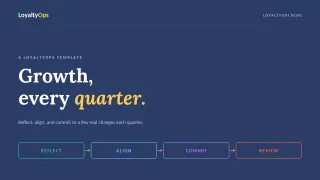
Quarterly Performance Cadence: Reflect First
Most performance reviews change nothing because they run in the wrong order. Reflection first, then alignment, then two or three behaviours you would actually see. ...more
Feedback
July 18, 2026•9 min read
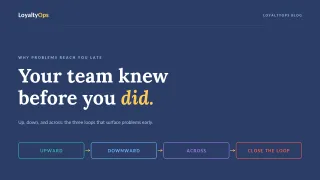
Feedback Loops: How to Hear Problems Early
Your team usually knows before you do. Why an open door is not a system, the three directions feedback has to run, and the test for whether a loop is really closed. ...more
Feedback
July 16, 2026•10 min read
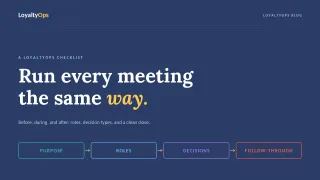
Meeting Standards: Run Meetings That End in Decisions
Meeting standards give every meeting a purpose, an owner and a decision. Here is the one-page standard, what meetings cost, and how to run it this week. ...more
Standards
July 15, 2026•8 min read