
How to Set Clear Expectations for Employees
How to Set Clear Expectations for Employees When Only 46% Strongly Agree They Know What’s Expected
Quick answer: To set clear expectations for employees, name four things: the outcome you want, what good looks like, the resources to do it, and what comes first when priorities compete. It matters now because Gallup found just 46% of US employees strongly agree they know what’s expected of them at work, down three points in one quarter.
Key takeaways
Gallup found just 46% of US employees strongly agree they know what’s expected of them at work, down from 49% in the first half of 2026.
US employee engagement fell to 29% in the third quarter of 2026, its lowest level since 2011.
Engagement fell five points among fully remote employees and two points among hybrid employees.
BCG found nearly 90% of CEOs are confident their employees trust their leadership, and 46% of employees agree.
A clear expectation has four parts: the outcome, what good looks like, the resources, and what comes first.
Watch the full episode of UNLEASHED, where Mickey Anderson, Co-Founder of LoyaltyOps, walks through Gallup’s new engagement numbers.
Confirm what your people heard before the work starts
When people aren’t sure what you expect, they guess, and they find out whether they guessed right when the feedback arrives. The free Back Briefing Guide walks you through a one-minute playback that confirms understanding before work starts.
How many employees know what’s expected of them at work?
Fewer than half of US employees strongly agree they know what’s expected of them at work. Jim Harter, Gallup’s chief scientist for the workplace, published Gallup’s third-quarter engagement numbers on October 28, 2026, from the Gallup Panel, a random, probability-based sample of 21,648 US adults surveyed from August 5 to 19, 2026, with a margin of error of plus or minus one point.
Engagement fell two points to 29%, its lowest level since 2011.
18% of employees were actively disengaged and 53% were not engaged.
About 11 million fewer US employees are engaged than at the 2020 peak of 36%.
Gallup measures engagement through 12 elements of the workplace, and knowing what’s expected of you is the first of them. Just 46% of employees strongly agree they know what’s expected of them at work, down three points from 49% in the first half of 2026 and back to its 2024 low. Gallup’s high for this item was 61% in 2015.
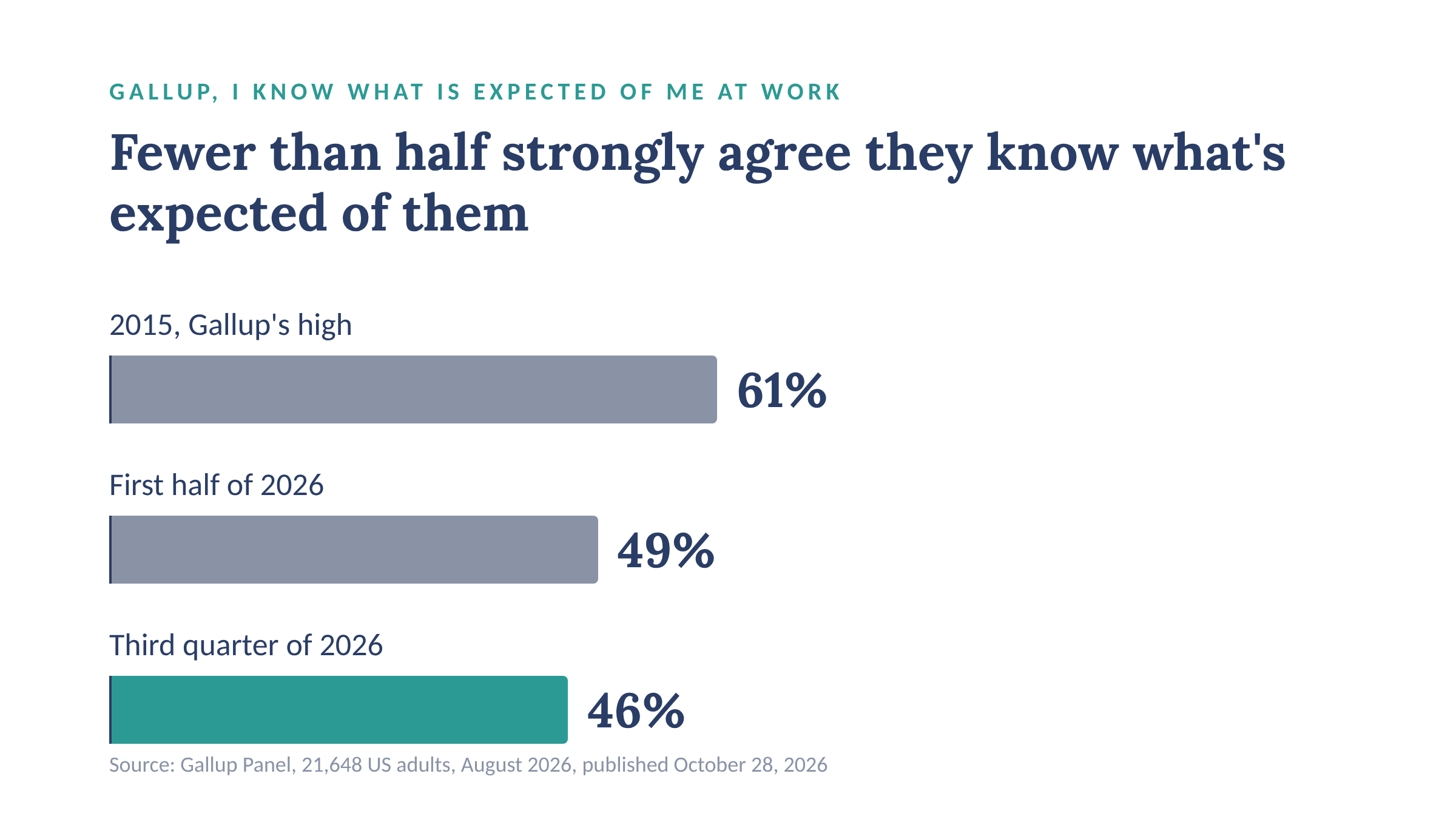
Gallup found 46% of US employees strongly agree they know what’s expected of them, down from 49% and a 2015 high of 61%.
Gallup describes this element in one line:
“Clear expectations are the most basic and fundamental employee need.”
With 46% strongly agreeing, more than half of your people may have at least some doubt about what you expect of them. This is self-reported US data, so we read it as a strong signal of direction for Canadian organizations too, without assuming the exact numbers apply here.
Mickey Anderson, Co-Founder of LoyaltyOps, said on UNLEASHED:
“When most people aren’t sure what’s expected, they don’t say so. They guess, and they work hard on their guess, and they find out whether they guessed right or wrong when feedback arrives.”
A second element fell in the same quarter. The share of employees who strongly agree that their supervisor or someone at work cares about them as a person dropped from 40% to 37%, down from a peak of 47% in March 2020. The two are closer than they look, because talking with someone about what’s expected of them is one of the clearest signs that someone at work is paying attention, and neither one needs a budget.
When engagement drops, the usual responses are a new survey, a perk or an event, and clear expectations come before all of those. Gallup’s research talks about managers, and a manager is a role, so anyone who leads people can set clear expectations, whatever their title.
Why are remote and hybrid employees less clear on what’s expected?
People who work remotely or work from home part of the week miss many of the small moments where expectations get corrected, so their sense of what’s expected slips fastest.
Engagement fell five points among fully remote employees and two points among hybrid employees, both larger than the margin of error.
Engagement among on-site employees changed by about one point.
From 2020 to 2023, clarity of expectations declined about twice as much among hybrid and fully remote employees as among on-site employees whose jobs could be done remotely.
In a shared office, people adjust their sense of what’s expected all day in small ways. Someone overhears how a leader handled a client, asks a quick question in the hallway, or sees what a finished piece of work looks like.
Mickey Anderson said on UNLEASHED that:
"This says nothing against remote or hybrid work. It just means that expectations that used to travel by watching now have to be said out loud and written down."
Work is also changing quickly with new tools, AI and reorganizations, and every change like that resets what’s expected. Gallup’s own recommendation this quarter was to clarify AI expectations by role as responsibilities change. When did you last tell each of your people, in plain words, what’s expected of them now? For many leaders, the honest answer is the day that person was hired.
Why do expectations look clearer to leaders than to their people?
Leaders usually check whether they’ve explained an expectation, while only the people doing the work can say whether they understood it, and new research from BCG shows how far apart those two views can be.
BCG, the global consulting firm, released the second edition of its CEO Insomnia Index on October 14, 2026. It surveyed 645 CEOs of companies with at least $100 million in annual revenue and, separately, 500 non-executive employees.
Nearly 90% of CEOs are confident their employees trust their leadership, and 46% of employees agree.
Nearly 70% of CEOs are confident their employees trust them to prioritize their well-being, and 36% of employees agree.
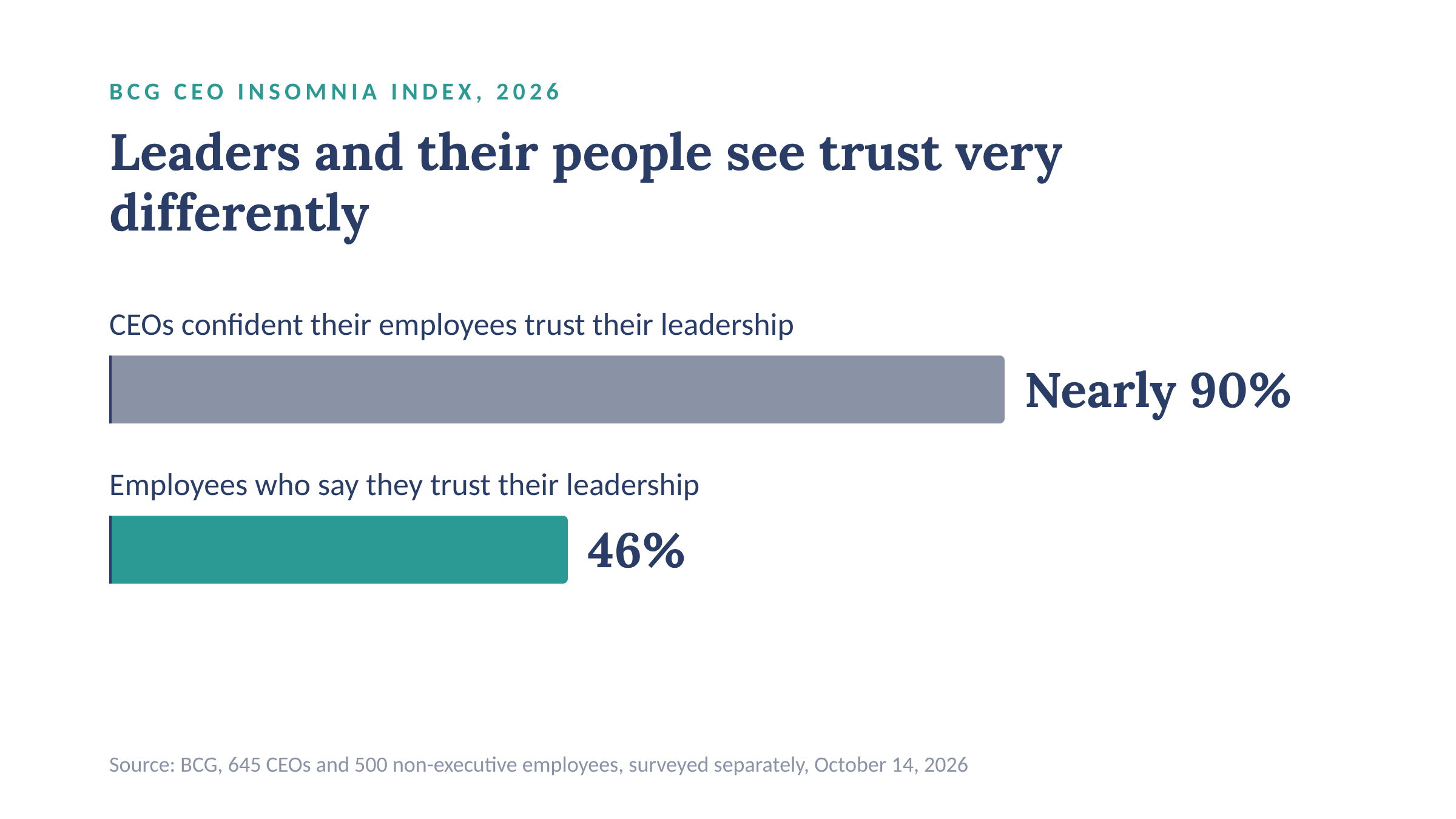
BCG found nearly 90% of CEOs are confident their employees trust their leadership, and 46% of employees agree.
The employees weren’t rating those particular CEOs, and both sides are self-reported, so we read the finding as a gap between how the two groups see leadership.
What the two studies share is that leaders tend to see things as clearer than their people do, and the only way to learn what your people see is to ask them. In an organization of a few hundred people or fewer, you can do that person by person within a week.
What does this look like in an organization of 30 to 300 people?
In an organization of 30 to 300 people, expectations are often known to only a few leaders, and as the organization grows, a few things tend to happen:
Roles change faster than anyone rewrites them.
Someone hired at 40 people is doing a different job at 120.
Each leader explains expectations in their own way.
Two people in similar roles hear two versions of what good looks like.
We worked with an organization of about 80 people where a coordinator had been hired three years earlier to keep projects on schedule. As it added two service lines, her workload more than doubled, and her leader also wanted her to train newer people, document the team’s processes and take on more management work.
Her title and job description stayed the same, and nobody told her clearly what was expected in the new parts of her role or how to take them on while keeping up with her daily work. She worked hard on the job she’d been hired for, while her leader was frustrated with the job she was actually in.
Our post on defining leadership expectations for managers walks through a one-page version of what good leadership looks like for the people who lead others.
How do you set clear expectations for employees?
A clear expectation has four parts: the outcome, what good looks like, the resources to do it, and what comes first when two things compete. When an expectation goes unmet, it usually misses at least one of these parts, and the coordinator’s new responsibilities were missing all four.
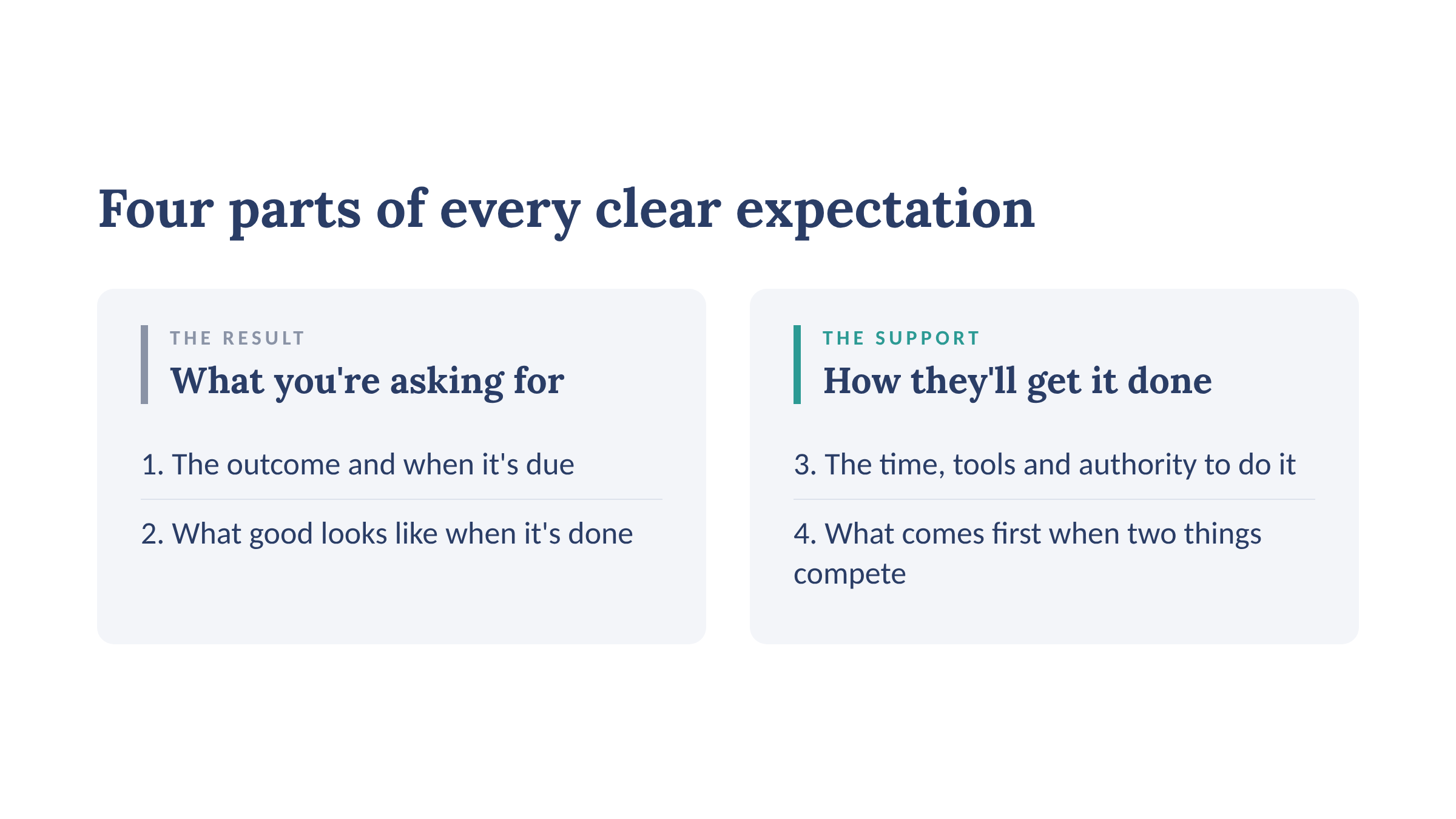
Four parts of every clear expectation: the outcome, what good looks like, the resources, and what comes first.
1. The outcome you’re asking for
Name the result you want along with the work that gets you there. Say what finished means, who the result is for, and when it’s due.
2. What good looks like
If two people can’t agree the work was done well, the expectation needs more detail. Describe a finished piece of work, share an example when you have one, and say how they’ll know they’ve done it well.
3. The resources to get it done
Every expectation needs the time, tools and authority to meet it. Set aside time for the work, confirm the tools and budget, name the people they can ask for help, and say which decisions they can make on their own. The Decision Rights Map helps you agree which decisions each person makes independently and which ones come to you.
4. What comes first when two things compete
Your people will face trade-offs you didn’t plan for, so tell them which expectation comes first. Rank the two or three things you most expect, say what can wait, and update the order when the work changes.
How can you check whether your people know what you expect?
Ask them one question in your next one-on-one and compare their answer with yours, using these six steps.
Pick three people who report to you today. Choose at least one person whose role has changed since they were hired.
Write your list before you meet. For each person, write down the two or three things you most expect from them right now, and how they’d know they’ve done them well, so your answer doesn’t change once you hear theirs.
Ask one question in your next one-on-one: “What do you think is most expected of you in your role right now?”
Listen without correcting. Notice answers that list tasks without an outcome, put a different priority first, or come after a hesitation, then thank them and share what you wrote.
Restate any expectation that doesn’t match, in writing. Agree on it together and send a short note after the conversation that covers all four parts.
Ask your leaders to do the same with three of their people, and bring what you all found to your next leadership meeting.
You’ll know it’s working when you ask the same question a few weeks from now and their answer matches yours without any prompting.
Frequently asked questions
Why is knowing what’s expected important for employee engagement?
Gallup lists knowing what’s expected at work as the first of the 12 elements it uses to measure engagement, and calls clear expectations “the most basic and fundamental employee need.” In the third quarter of 2026, just 46% of US employees strongly agreed they know what’s expected of them at work.
What are the four parts of a clear expectation?
A clear expectation names the outcome you’re asking for and when it’s due, what good looks like when it’s done, the time, tools and authority to do it, and which expectation comes first when two compete. When an expectation goes unmet, it’s usually missing at least one of these parts.
How do you set clear expectations for remote and hybrid employees?
Say them out loud and write them down. Gallup found that from 2020 to 2023, clarity of expectations declined about twice as much among hybrid and fully remote employees as among comparable on-site employees. Remote work removes many of the small moments where people learn what’s expected by watching.
How do you know if employees understand what’s expected of them?
Ask them. In your next one-on-one, ask, “What do you think is most expected of you in your role right now?” Compare their answer with a list you wrote beforehand, agree on any differences together, and confirm the expectation in a short written note after the conversation.
How do you develop leaders who set clear expectations?
Start by measuring where each leader stands on the leadership part of their role. The Leadership Competency Assessment is completed by each leader and the people who see their work, so you can see which leaders set clear expectations well and where each one should develop first.
Make Expectations Clear Across Every Team You Lead
If roles in your organization have grown faster than anyone has rewritten them, a discovery call is a chance to talk through how your leaders set expectations today and what to develop first. LoyaltyOps is a leadership development firm that develops individual leaders and leadership teams against clear leadership competencies, so performance improves across your organization.
Sources
Gallup, U.S. Employee Engagement Below 30% for First Time in 15 Years, Jim Harter, Gallup Panel of 21,648 US adults surveyed August 5 to 19, 2026, published October 28, 2026
Gallup, How to Measure Employee Engagement With the Q12, no publication date listed, accessed November 3, 2026
BCG, Forty Percent of Employees Say Their CEO Isn’t Transparent Enough on AI, press release for The BCG CEO Insomnia Index, 645 CEOs and 500 non-executive employees, October 14, 2026
BCG, The Insomnia Index: Understanding CEO Pressure, October 2026