
LEADERSHIP WORKSHOPS FOR ORGANIZATIONS
Get your leaders delivering what they commit to.
Your leaders work on one thing your organization needs to get better at, and before they leave they agree what changes and how they will do it.
Most leadership training changes nothing.
Your leaders come back knowing more, and the organization works the same way it did before.
Your leaders sit through a good session and agree with most of what they hear, and then the week starts again, nobody has agreed what specifically changes, and the material goes in a drawer.
Information on its own rarely changes how anyone behaves, because behaviour changes when a few people agree out loud what each of them will do differently and then have something practical to do it with.
Your leaders use what they learn the following week.
Every workshop follows the same four steps.
1
Learn it
We teach one idea in plain language, with the reason it works.
2
Use it on your own work
Your leaders apply it to real situations from inside your organization.
3
Agree what changes
Each leader says what they will do differently and when they will have done it.
4
Leave with a plan
Everyone leaves with what the group agreed, along with a one-page tool that makes it easy to keep using.
Signature Workshops
Each one is two hours, delivered virtually or onsite, and it works for a leadership team, a group of managers, or a wider group of leaders.
Where Performance Is Breaking Down
TWO HOURS · THE LEADERSHIP OPERATING FLYWHEEL
Organizations improve in a repeating cycle, and when performance slips it is usually one stage of that cycle that has stopped working. Your leaders learn all four stages and work out which one is costing you the most right now.
They leave agreeing on what to fix first.
Plans Your Team Will Deliver
TWO HOURS · WAR GAMES PLANNING
A plan written at the top loses the people who have to deliver it. Your leaders learn the planning process we use in War Games, then use it on one of your own objectives.
They leave with a plan for that objective, and the owners and handoffs are settled.
Commitments People Keep
TWO HOURS · OWNERSHIP AND ACCOUNTABILITY
Accountability breaks when nobody owned the decision or the commitment was never explicit. Your leaders learn to give every decision one owner, set standards their team agrees to, and confirm understanding before work starts.
They leave with an owner named for every decision and a standard they wrote together.
Work That Moves Between Teams
TWO HOURS · CROSS-FUNCTIONAL COLLABORATION
Cross-functional work stalls when it passes from one team to another, because each side assumes the other one is already moving. Your leaders learn how to end meetings with named decisions and how to hand work between teams cleanly.
They leave with the handoffs between your teams mapped and a signal agreed for each one.
Custom Workshops
We build these for a problem that is specific to your organization.
Some organizations know exactly what they need their leaders doing differently, and it does not match one of the four above. We build those from scratch, keeping the same two hours and the same four steps, with the content drawn from your situation.
Custom workshops take design time beforehand, so they are scoped on the discovery call.
The priorities you care about get delivered.
Your leaders know what to fix first, and they agree on it.
People do what they committed to, without being chased for it.
Decisions get made at the right level.
Plans your team builds get delivered.
Work moves between teams without stalling at the handoffs.
CEOs and HR leaders call us when one of these is true.
You want a change in how your leaders lead, and a workshop is the right size of first step.
You have a specific problem, like decisions getting reopened or work stalling between teams.
You are responsible for development and you need something your leaders will keep using.
Your leaders have been through training before and nothing changed.
You are bringing leaders together anyway, and you want that time to produce something.
Clients notice what happens in the room.
“One of Mickey’s strengths is her ability to quickly bring people together and build an environment of trust where different viewpoints can be shared openly and respectfully. She keeps discussions productive and focused while ensuring everyone has the opportunity to contribute.”
Terry Walker
Regional Director, Eastern Ontario and New Brunswick, Desjardins Insurance Agents
Questions leaders ask before they book a call
How many people can attend?
These have worked for a leadership team of eight and for a room of forty in small groups. What matters more than the number is that everyone in the room leads people, because the agreement at the end is about what each of them will do differently.
Can you run it virtually?
Yes, and the structure is the same either way. Teams in the Ottawa area usually choose onsite, and the Kanata office has boardrooms if you would rather not host it.
Is this training?
Your leaders learn something, so part of it is teaching. The difference is what the two hours produce, which is an agreement about what changes and a plan to carry it out.
What if none of the four signature workshops fit what we need?
Then we build a custom one, same two hours and same four steps, with content drawn from your situation.
Do you tailor the standard workshops to us?
Yes, in the examples. The method stays the same because it works, and the situations your leaders work on come from your organization.
What do we get afterwards?
Everyone keeps what the group agreed and the one-page tool behind it. Most organizations find that is enough to keep going.
Every engagement starts with a 30-minute discovery call.
On the call we will work out what you need your leaders doing differently, which workshop fits, and whether a session is the right size of step.
Contact Us
LoyaltyOps™ HQ
430 Hazeldean Road,
Unit #6, Suite 17
Kanata, Ontario, Canada
K2L 1T9
Email: [email protected]
Phone: 1 365-659-4720
Company
Copyright 2025 LoyaltyOps Inc. All Rights Reserved
Recommended Insights
Recommended Insights on Founder Performance
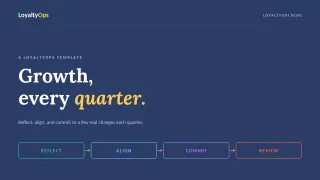
Quarterly Performance Cadence: Reflect First
Most performance reviews change nothing because they run in the wrong order. Reflection first, then alignment, then two or three behaviours you would actually see. ...more
Feedback
July 18, 2026•9 min read
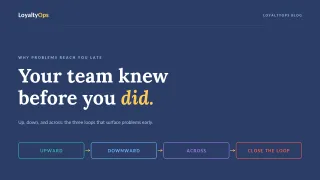
Feedback Loops: How to Hear Problems Early
Your team usually knows before you do. Why an open door is not a system, the three directions feedback has to run, and the test for whether a loop is really closed. ...more
Feedback
July 16, 2026•10 min read
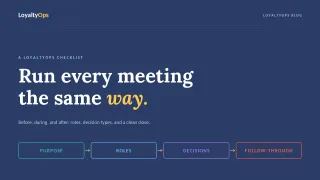
Meeting Standards: Run Meetings That End in Decisions
Meeting standards give every meeting a purpose, an owner and a decision. Here is the one-page standard, what meetings cost, and how to run it this week. ...more
Standards
July 15, 2026•8 min read