
Why Employees Don’t Want to Be Managers
Why Employees Don’t Want to Be Managers, and What Leaders Can Do About It
Quick answer: Why employees don’t want to be managers usually depends on what they watch. Ipsos found that just one in four employees say becoming a people manager looks attractive, based on what they see in their organization today. The leadership part of the role is growing, and many managers do it with little support, so the job looks like a burden.
Key takeaways
Ipsos found that just one in four of 9,100 employees across 32 countries say becoming a people manager looks attractive.
Ipsos found career support is the factor most consistently linked to wanting to manage.
66% of talent and senior leaders surveyed by Korn Ferry expect managers to spend more time guiding change than managing day-to-day work.
Edelman found 85% of employees trusted their manager after a positive experience of change, compared with 60% after a negative one.
One question in your next three one-on-ones tells you what your people see.
Watch the full episode of UNLEASHED, where Mickey Anderson, Co-Founder of LoyaltyOps, walks through the research.
Show your people leadership they’d want for themselves
Your next managers are watching the leaders they have now. The free Leadership Modeling Reference Card helps each of your leaders choose two or three behaviours to model for 30 days, so what your people watch is leadership worth taking on.
Get the Leadership Modeling Reference Card
Why don’t employees want to be managers?
Employees decide whether they want to manage by watching the managers they already have, and when that role looks like a burden with little support, many decide the trade isn’t worth it.
Ipsos, the global market research company, published The Workplace Reality in October 2026, drawing on 9,100 employees in 32 countries. Just one in four said becoming a people manager looks attractive, based on what they see in their organization today. Ipsos describes management as “increasingly viewed as a burden rather than a reward, particularly where career support is lacking.”
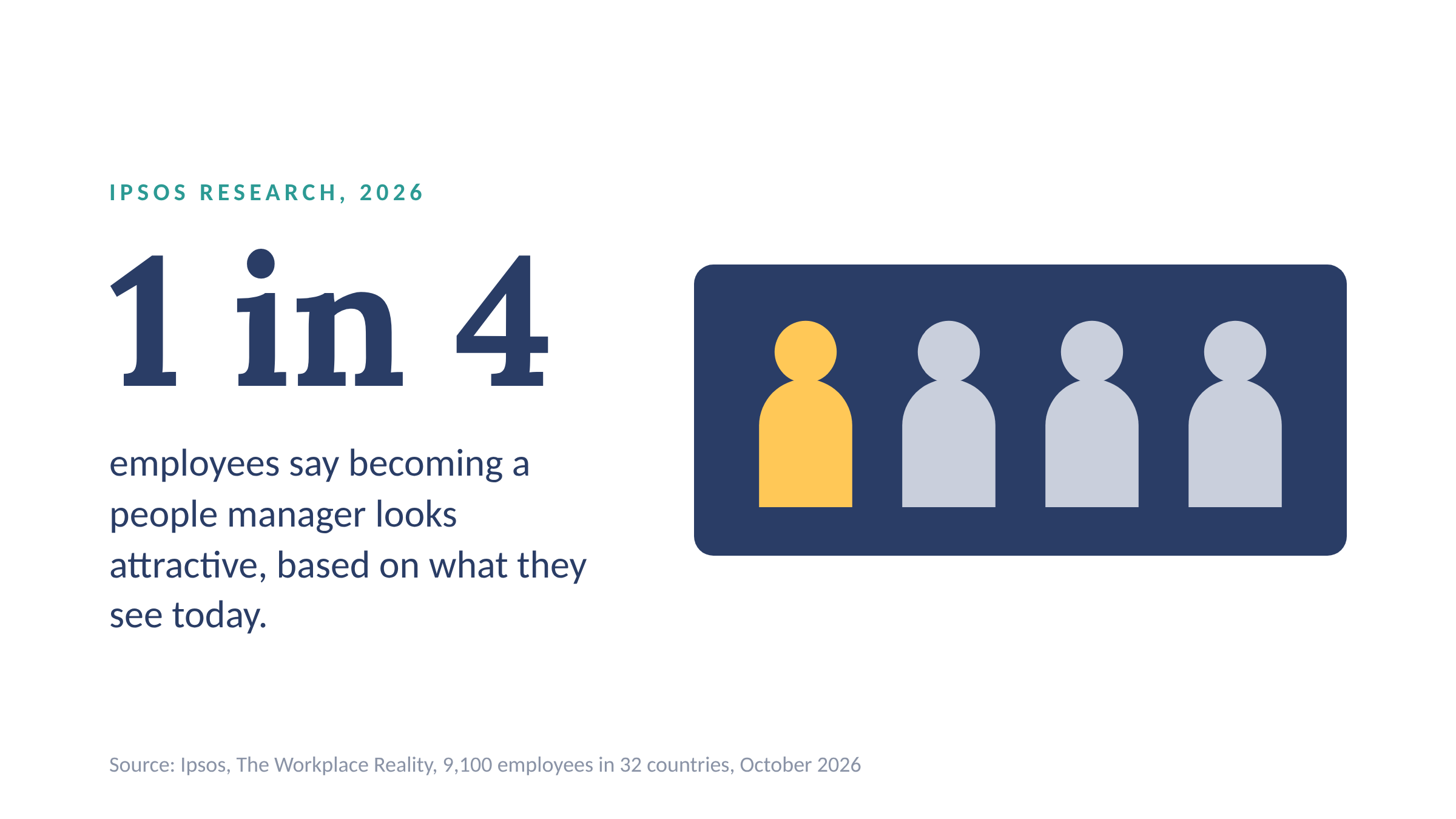
Just 1 in 4 employees say becoming a people manager looks attractive, from Ipsos research with 9,100 employees.
Career support is the single factor Ipsos found most consistently linked to three outcomes:
Employees recommending their employer
Employees planning to stay or leave
Employees wanting to take on a people manager role
The finding is self-reported, and Ipsos hasn’t published its full method on its public page, so we read the one-in-four as a strong signal of direction.
Mickey Anderson, Co-Founder of LoyaltyOps, said on UNLEASHED:
“When good people turn down a management role, they’ve usually watched the job up close and decided the trade doesn’t look worth it.”
What’s the difference between management and leadership?
A manager is a role, someone with people reporting to them, and leadership is what the person in that role does with their people. The research covers the whole role, so it helps to separate its two parts.
The management part is about the work | The leadership part is about the people |
Planning and assigning work | Setting direction and explaining why |
Tracking progress and deadlines | Guiding people through change |
Solving day-to-day problems | Making decisions people trust |
Reporting results | Coaching and developing the people on the team |
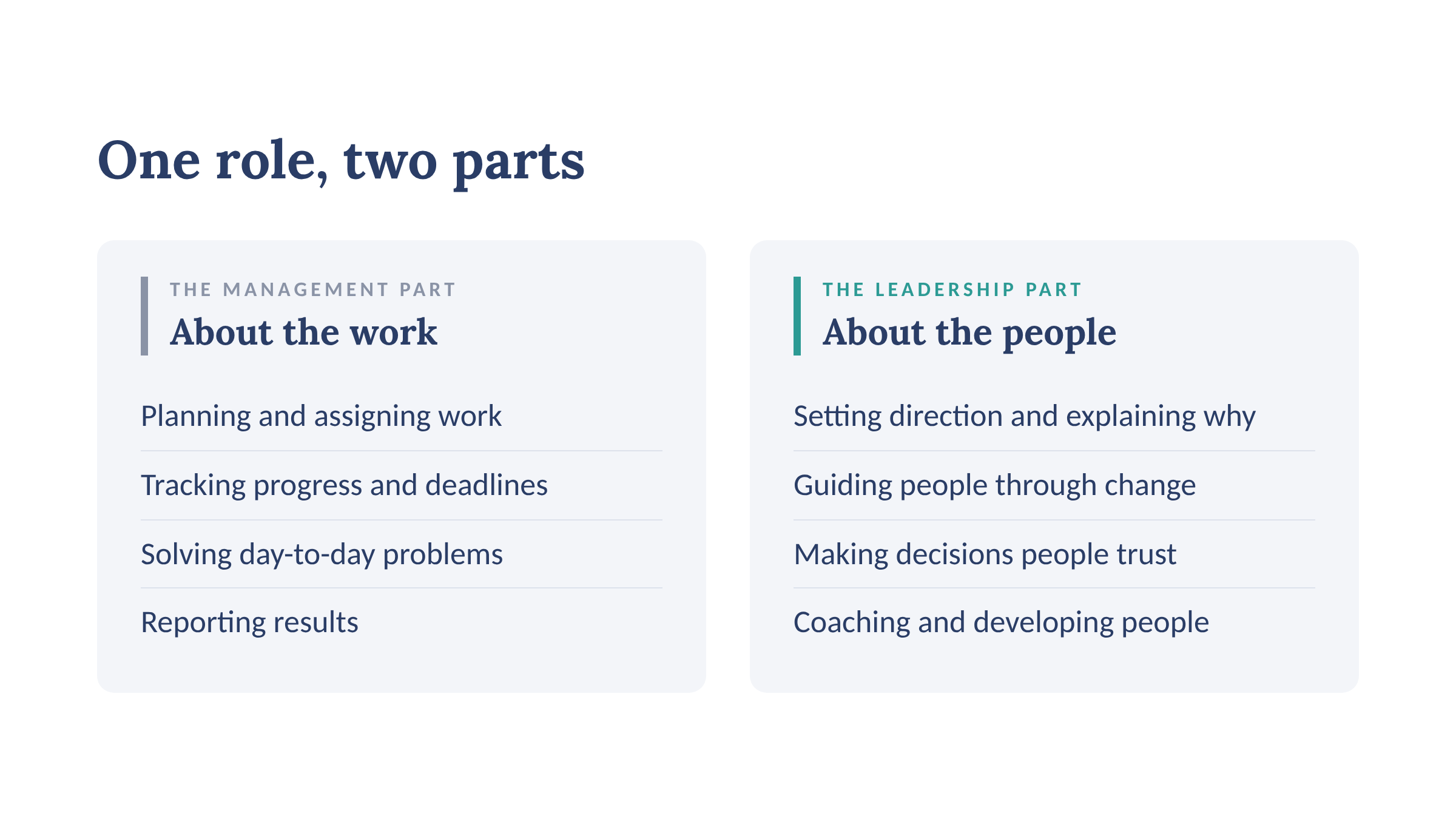
The management part of the role is about the work, and the leadership part is about the people.
Many organizations promote people into the manager role because they were good at the work, then measure them on the management part, because it’s easier to see and easier to count. The leadership part gets far less attention, and it’s the part your people watch most closely when they decide whether they want the job.
Why is the leadership part of the manager role growing?
Managers are expected to spend more of their time leading people through change and less on day-to-day work. Korn Ferry, the global consulting firm, published its talent forecast for 2027 on October 22, 2026, based on a survey of more than 1,300 talent and senior leaders across more than 75 countries.
66% expect managers to spend more time guiding their teams through change than managing their day-to-day work.
91% say coaching and people skills will become more important.
78% say too few people are prepared for how work will be done in the future.
63% expect AI agents to take over routine tasks.
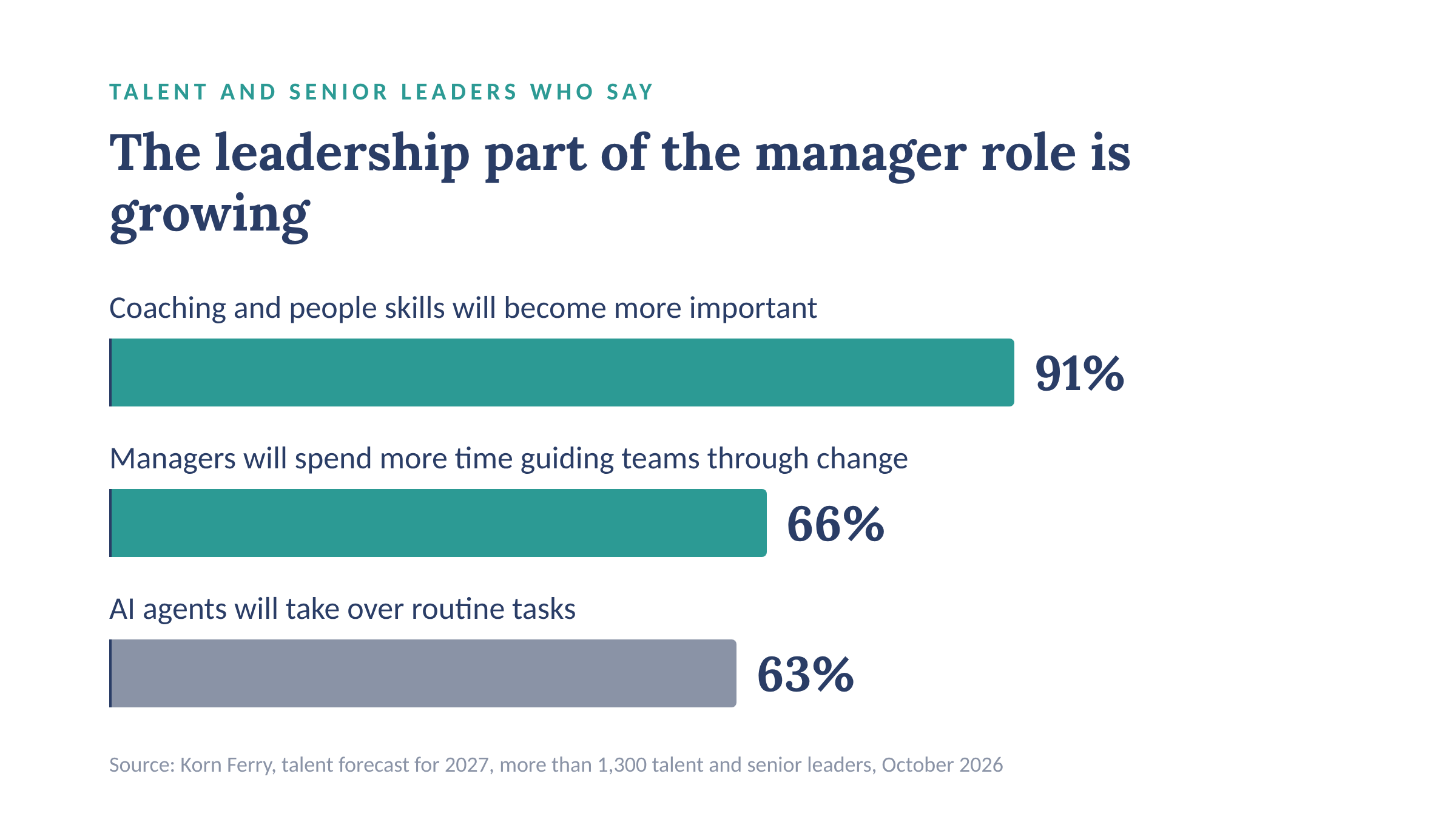
Korn Ferry found 91% of leaders say coaching skills will matter more and 66% expect managers to guide more change.
Whatever AI agents end up doing in your organization, the work left for the person managing a team is explaining change, coaching and helping people learn new work. That’s also the part of the job that’s hardest to see from the outside, because your people mostly see the meetings, the late-night emails and the problems that come to their manager. We read the Korn Ferry and Ipsos studies together this way: the leadership part of the role is growing while fewer people look at the role and want it.
How does leading people through change affect trust in managers?
How a manager leads people through change affects whether those people trust them. Edelman published its Trust at Work research on October 6, 2026, drawing on more than 10,000 employees in 10 markets, including Canada.
Trust in direct managers fell from 79% to 72%, a record low in Edelman’s data.
76% of employees had been through at least one major change at work in the past year.
85% trusted their manager when their experience of that change was positive, and 60% did when it was negative.
44% of Canadian employees said their experience of change wasn’t positive.
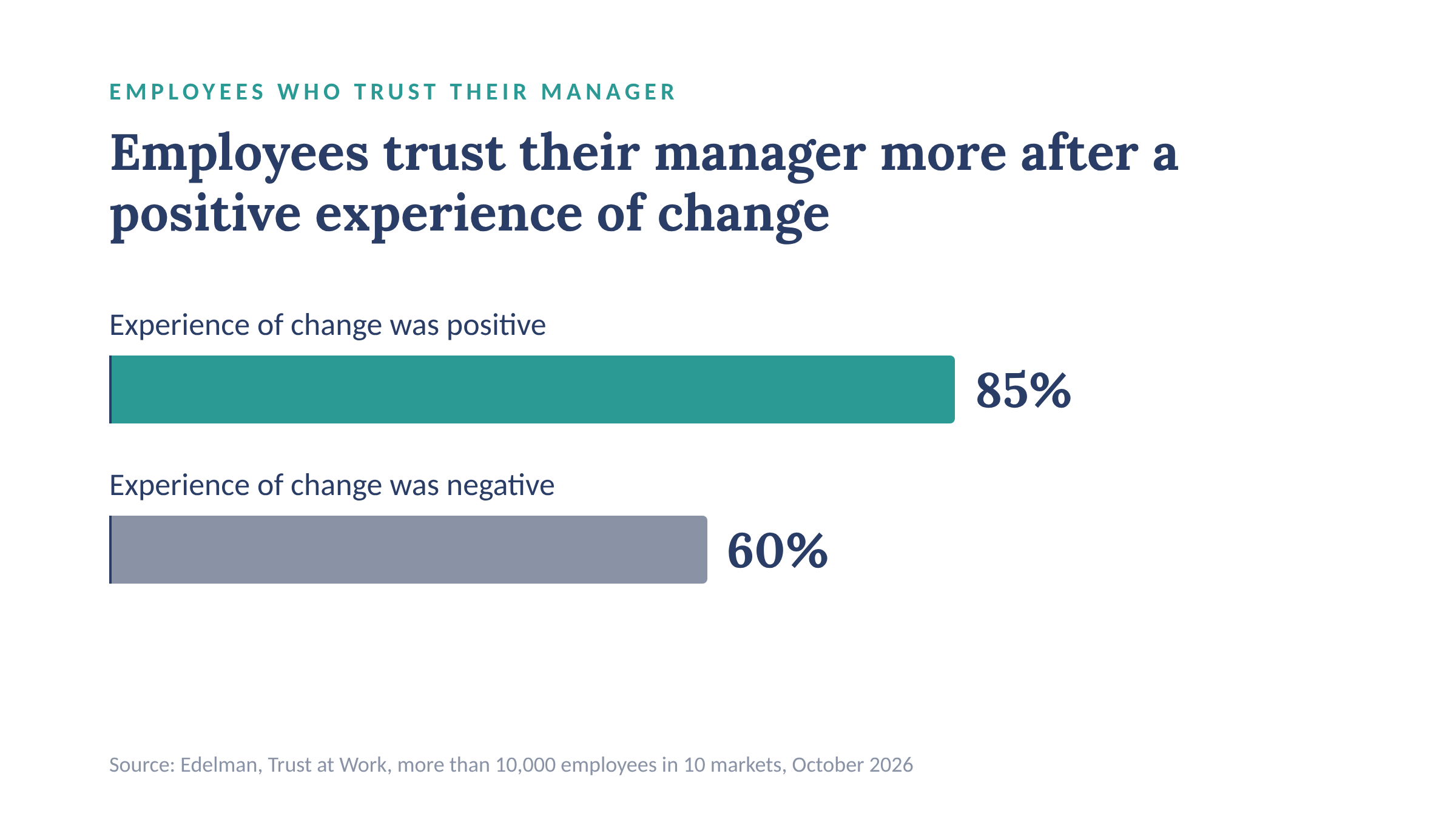
Edelman found 85% trusted their manager after a positive change and 60% after a negative one.
The 25-point gap between those two groups reflects how people were led through change. When change goes badly, the manager is often the one who loses their people’s trust, and the people who might manage next see it happen.
Gallup wrote in July 2026 that it “has consistently found that managers are the primary way employees experience their organization,” and it found managers among the groups with the sharpest drops in engagement since 2020.
What does this mean for organizations of 30 to 300 people?
In an organization of 30 to 300 people, most of your future managers already work for you, and they’ve been watching your current managers all along. Four moves give the leadership part of the role the attention it needs.
1. Name the leadership part of the job
If the leadership part of the role isn’t written down, it rarely gets developed or measured. List what your managers do with their people, including guiding them through change, and use the list in promotions and reviews. Our post on defining leadership expectations for managers walks through a one-page version, and the Cultural Standards Builder helps turn each expectation into a behaviour people can see.
2. Support your managers through change
Your managers lead every change your organization makes, so they need support before their teams do. Brief managers before a change reaches their teams, share the reasons along with the decision, and ask what their people need to get through it.
3. Make career support every leader’s job
In a smaller organization, career support usually comes from the leader each employee reports to, often with no HR team behind them, so career growth belongs in regular one-on-ones.
4. Listen to how your managers talk about the job
How a manager describes their own week tells their people what the role costs. Mickey Anderson put it this way on UNLEASHED: “The way your leaders talk about leading is part of leading. A leader who describes their week as something to survive is telling their people what leadership costs.” Ask your managers to name the work they’re proud of along with the hard parts.
How can you find out what your people see?
Ask one question in your next three one-on-ones: “From what you see, what does leading people here look like?”
Add the question to your one-on-one notes today, so it doesn’t get skipped.
Ask it and write down what you hear. Thank people for honest answers, and don’t defend your managers in the moment.
Ask your leaders to do the same with one or two of their people before your next leadership meeting.
Listen for two things: whether people mention a manager getting support or being developed, and what they’ve watched managers do.
Compare notes at your next leadership meeting. If everything people describe is a cost, that’s what your managers are showing them.
Close the loop with the people you asked. Tell them what you heard and one thing your leadership team will do differently.
The last step matters most in the research. Ipsos found that asking employees for feedback without visibly responding is associated with worse sentiment than not asking at all, and that being open about what you heard and what you plan to do is itself experienced as action. The Feedback Loops Blueprint sets out clear, safe paths for that information to move through your organization.
You’ll know it’s working when someone names a part of leading people they’d want for themselves.
Frequently asked questions
Why don’t employees want to be managers?
Many employees see the manager role as a burden, based on what they watch their own managers go through. Ipsos found that just one in four employees say becoming a people manager looks attractive in their organization today, and that management looks least attractive where career support is lacking.
How can you make the manager role more attractive to employees?
Give the leadership part of the role the attention it needs. Write down what good leadership looks like, support managers before a change reaches their teams, make career support part of every leader’s one-on-ones, and notice how managers talk about their own work.
How do you develop managers as leaders?
Start by measuring where each manager stands on the leadership part of the role. The Leadership Competency Assessment is completed by each leader and the people who see their work, so you can see where each leader is strongest and where to develop first.
Make Leading People a Job Your People Want
If your next managers already work for you, how your current leaders lead is what they’re learning from today. On a discovery call, we’ll talk through where your leaders stand on the leadership part of their role and what to develop first. LoyaltyOps is a leadership development firm that develops individual leaders and leadership teams against clear leadership competencies, so performance improves across your organization.
Sources
Ipsos, The Workplace Reality, 9,100 employees in 32 countries, October 2026
Korn Ferry, Korn Ferry Report: AI and Capability Gaps Will Reshape Talent in 2027, more than 1,300 talent and senior leaders in more than 75 countries, October 22, 2026
Edelman, Trust at Work: Transformation Triggering Trust Demise, more than 10,000 employees in 10 markets, October 6, 2026
Gallup, Employee Engagement Remains Flat as AI Adoption Accelerates, July 21, 2026