
Why New Managers in Professional Services Can’t Coach, Delegate, or Develop Their Teams
Why New Managers in Professional Services Can’t Coach, Delegate, or Develop Their Teams, and What Firms Can Do About It
Quick answer: New managers in professional services often can’t coach, delegate or develop their people because the role leaves them no time to do it. Client delivery, reviews, sales and administration take the hours first. The Chartered Management Institute found that 82% of UK managers entering the role had no formal management training, so most learn the leadership part on their own.
Key takeaways
A 2023 Chartered Management Institute study found 82% of people entering management roles in the UK had no formal management and leadership training.
91% of talent and senior leaders surveyed by Korn Ferry say coaching and people skills will become more important.
Culture Amp found 55% of vice presidents say their managers organize workloads to support high performance without burnout, compared with 78% of C-suite employees.
In a Betterworks survey of 521 HR and business leaders, lack of manager training ranked last of the named barriers to manager effectiveness, at 25%.
When most of your managers struggle with the same thing, the cause is usually the conditions your firm sets, and six firm-level moves address them.
Decide what your new managers can decide on their own
A new manager who needs approval for every call has no time left to coach. The free Decision Rights Map helps your leadership team give every decision one owner and one of four decision types, so your managers know which calls are theirs to make.
Why doesn’t promotion for technical excellence make someone a leader?
Technical excellence shows someone can do the work, and leading people requires skills most new managers have had little chance to learn or practise.
Professional services firms often promote the person who produces the best work, because it’s the clearest evidence a firm has. The new role keeps much of the old work and adds coaching, delegating, giving feedback and developing people, and nobody may have taught the new manager how to do any of it.
The Chartered Management Institute, the UK professional body for managers, published Taking Responsibility with YouGov in October 2023, based on a survey of more than 4,500 UK workers and managers. It found 82% of people entering management roles had no formal management and leadership training. In the same study, 46% of managers said colleagues won promotions based on internal relationships and profile ahead of ability and performance. The study covers all sectors in the UK and is self-reported.
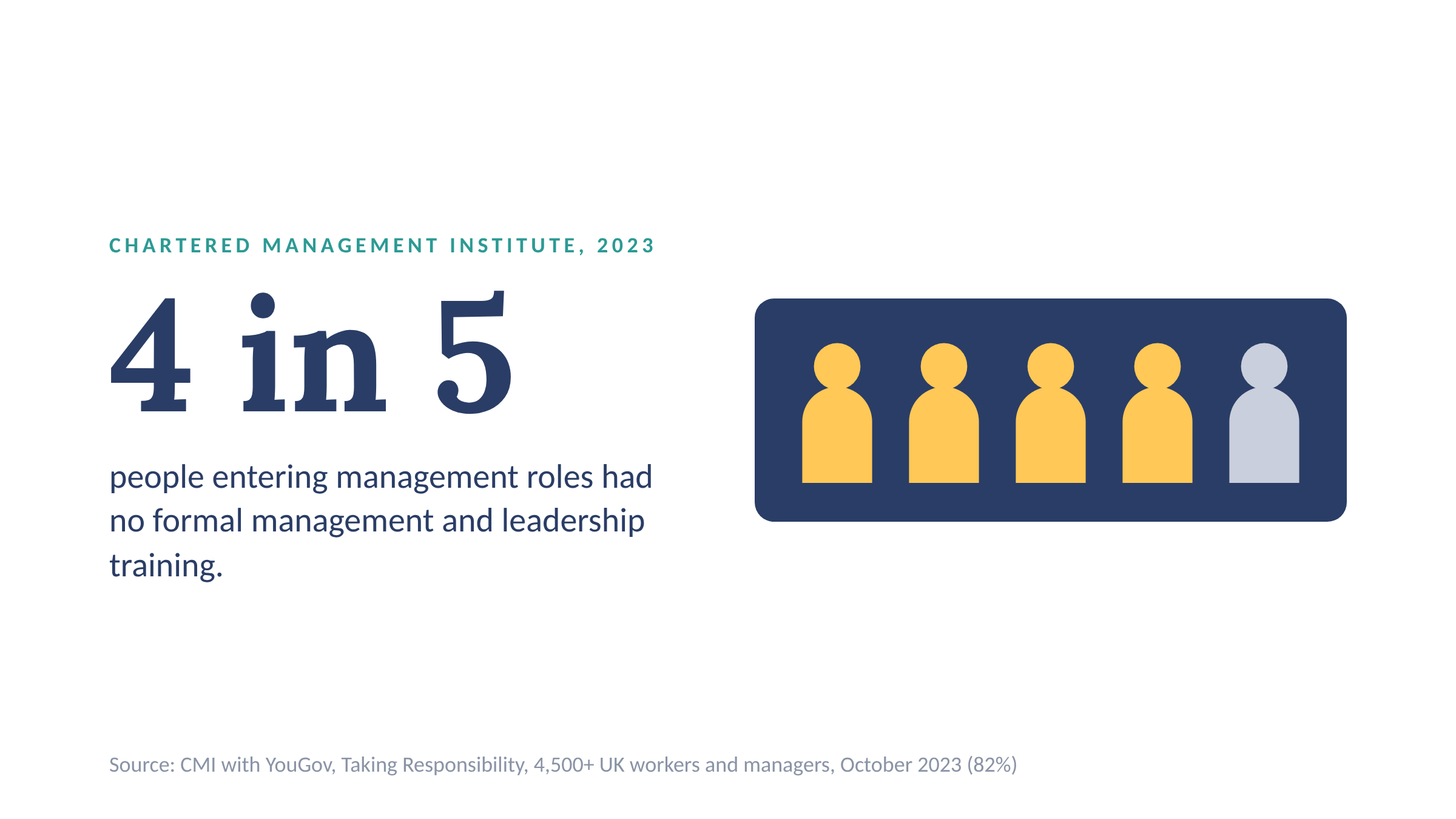
More than 4 in 5 people entering management roles had no formal management and leadership training, CMI, 2023.
The leadership part of the role is also growing. Korn Ferry, a global consulting firm, published its 2027 talent forecast on October 22, 2026, based on a survey of more than 1,300 talent and senior leaders in more than 75 countries. 91% said coaching and people skills will become more important, and 66% expect managers to spend more time guiding their teams through change than managing day-to-day work.
People notice what the role asks of new managers. Ipsos found in October 2026 that only 1 in 4 of 9,100 employees in 32 countries say becoming a people manager looks attractive, and it describes management as “increasingly viewed as a burden rather than a reward, particularly where career support is lacking.” Our post on why employees don’t want to be managers covers that research in full.
What is the manager capacity gap?
The manager capacity gap is the difference between the hours a manager’s role asks for and the hours they have, and in professional services, the leadership part of the role usually loses.
A new manager’s week has six kinds of work competing for the same hours:
Client delivery and billable work
Reviewing other people’s work
Business development and proposals
Staffing and scheduling
Firm administration
Developing the team
The first five each have a client, a deadline or a partner waiting for them. Developing the team has none of those, so it waits until the rest is done, and in a busy season the rest is rarely done.
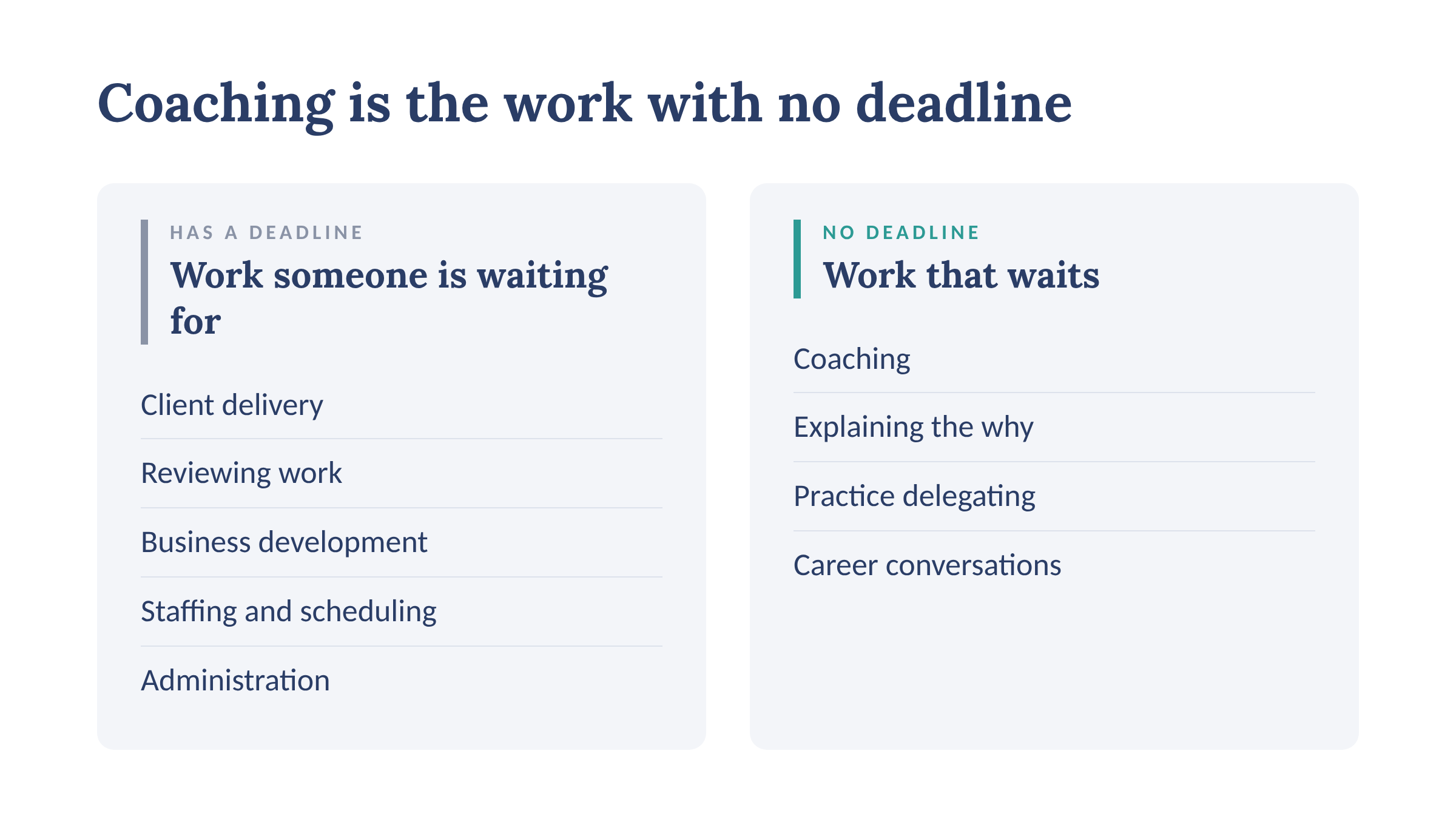
Client work, reviews, sales, staffing and administration have deadlines, and coaching and developing people don’t.
Many firms add the management work to a full delivery load and leave billable targets as they were. The new manager is still measured as a producer, so their performance review reflects the work that takes up their time.
Why is coaching the first thing an overloaded manager drops?
Coaching has no deadline and no immediate cost when you skip it, so it’s the easiest work to move when the week fills up.
When a junior’s draft comes back with errors the night before a client deadline, fixing it yourself takes twenty minutes and coaching the junior through it takes an hour. The draft gets fixed, the review notes replace the teaching, and the junior learns by trial and error. The same errors come back on the next engagement, and the manager has even less time than before.
Culture Amp, an employee experience software company, published its first Performance Culture benchmarks on November 5, 2026, based on employee survey data from up to 3,807 companies and about 2.3 million employees, collected from July 2025 to July 2026. 55% of vice presidents said their managers organize workloads and resources to support high performance without burnout, compared with 78% of C-suite employees. The data is self-reported and comes from companies that chose to use Culture Amp’s survey.
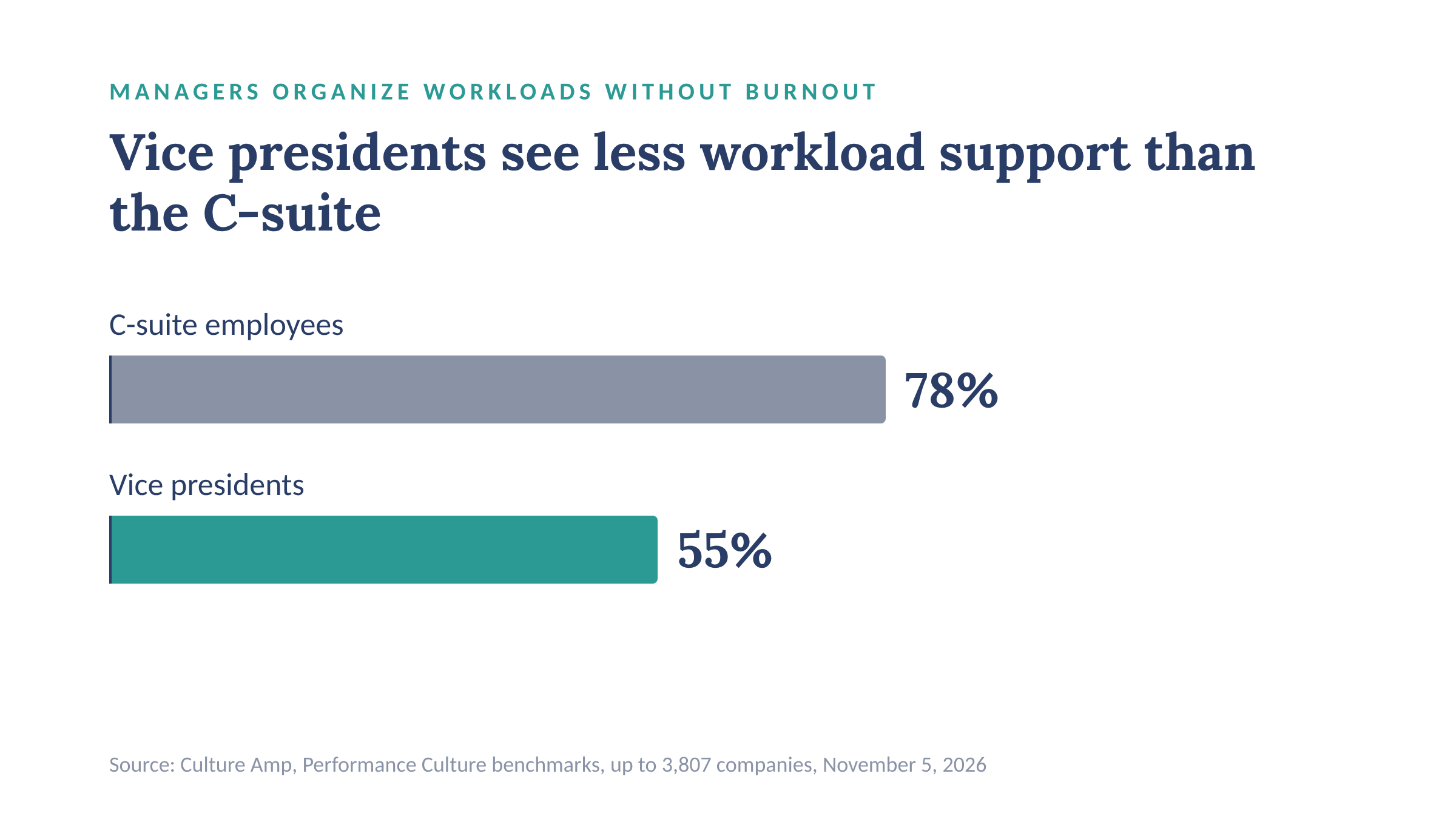
55% of vice presidents and 78% of C-suite employees say managers organize workloads without burnout, Culture Amp, 2026.
The leaders who work most closely with managers see the least workload support, and the most senior leaders see the most. In a firm of 30 to 300 people, the vice president is closest to your senior managers and directors, the people who lead the managers.
Sending an overloaded manager to training adds one more commitment to the same week. Betterworks, a performance management software company, surveyed 521 HR and business leaders in the US and the UK in August 2026, and a lack of manager training ranked last among the named barriers to manager effectiveness, at 25%. Leadership expectations ranked first as the source of friction for managers, at 48%.
Is it an individual skill gap or a firm-level problem?
An individual skill gap belongs to one manager, and a firm-level problem appears in many managers at once, because it comes from how the firm staffs, measures and supports them.
Signs of an individual skill gap | Signs of a firm-level problem |
One manager struggles while peers in similar roles develop their people | Most new managers struggle with the same things |
The manager has time set aside for coaching and uses it poorly | Nobody has time set aside for coaching |
Training changes how the manager works | Training changes little, because the week looks the same afterward |
The manager has authority to decide and hesitates | Managers need approval for decisions they’re told to own |
The manager gets specific feedback on how they lead | Managers are measured on billable work alone |
Your people experience a firm-level problem through their manager. Gallup estimates managers account for at least 70% of the variance in employee engagement across business units, and in July 2026 it wrote that it “has consistently found that managers are the primary way employees experience their organization.”
Decision authority is a common firm-level gap. In the same Culture Amp data, only 45% of vice presidents said it’s clear who should make a decision, so managers spend time waiting for approval that could go to their people. A Leadership Competency Assessment shows where each leader stands, from the leader and the people who see their work, which helps you tell one manager’s gap from a pattern across the firm.
What can firms do so new managers have time to lead?
Change the conditions around your managers first, then develop each manager inside those conditions. Six moves address the most common firm-level gaps.
1. Protect development time
Book a fixed block each week for coaching and development, and count it as part of the job in billable targets and reviews. Time that’s counted as a cost gets cut first, and time that’s counted as work gets done.
2. Staff for the work you’ve sold
Before a new client or engagement goes to a team, check whether the team can deliver it and still develop its people. If it can’t, decide what changes before the work starts, whether that’s the scope, the timeline or the staffing.
3. Give managers decision rights for their own work
List the decisions your managers make every week, and agree which ones they can make on their own. A manager who doesn’t need to wait for approval can spend that time teaching their people to decide.
4. Set a workload limit for each manager
Agree how many engagements, reviews, and direct reports one manager can lead well, and what comes off their list when something new is added.
5. Onboard new managers into the leadership part of the role
Give every new manager a plan for their first 90 days: a mentor, a reduced delivery load, clear leadership expectations, and practice delegating real work. Our post on leadership expectations for managers walks through a one-page version, and the Back Briefing Guide gives new managers a one-minute check that the person taking on delegated work understands it.
6. Hold senior leaders accountable for developing managers
New managers copy what the leaders above them do. Ask partners and senior leaders to coach their managers in the same way they ask managers to coach their teams, and review how it went together with an After Action Review after each major engagement.
Does your firm make it possible for managers to lead?
Answer each question yes or no with your leadership team:
Does every manager have time set aside each week to coach and develop their people?
Do billable targets and reviews count the time managers spend developing people?
Before work is sold, do you check whether the team can deliver it and still develop its people?
Does each manager know which decisions they can make without approval?
Is there an agreed limit on how much work one manager leads?
Do new managers get a plan, a mentor and a lighter delivery load in their first 90 days?
Have your leaders agreed on what good leadership looks like for a manager?
Do senior leaders coach the managers who report to them?
If you answered no to three or more, start with the move above that matches your first no.
Frequently asked questions
Why do new managers struggle to delegate?
New managers often struggle to delegate because doing the work themselves is faster in the moment, and they were promoted for doing it well. Delegating takes time to explain the work and review it, and overloaded managers rarely have that time. Clear decision rights, protected development time and a quick check that the person understands the work make delegation easier.
Is leadership training enough for new managers?
Training helps when managers have the time and authority to use what they learn. In a Betterworks survey of 521 HR and business leaders, a lack of manager training ranked last among the named barriers to manager effectiveness, at 25%. Agreeing on leadership expectations, protecting coaching time and setting workload limits give the training something to work with.
What is the manager capacity gap?
The manager capacity gap is the difference between the hours a manager’s role asks for and the hours they have. In professional services, client delivery, reviews, business development, staffing and administration all have deadlines, and developing the team doesn’t. When there aren’t enough hours, coaching and development usually wait.
What should a new manager’s first 90 days include?
A new manager’s first 90 days should include a mentor, a reduced delivery load, clear leadership expectations and practice delegating real work. The Chartered Management Institute found 82% of people entering management roles in the UK had no formal management and leadership training, so a planned start gives new managers support most of them don’t get.
Give your managers the time and support to lead
If your managers spend their weeks on delivery, reviews and sales with no time left to develop their people, a conversation with us is a good place to start. LoyaltyOps is a leadership development firm that develops individual leaders and leadership teams against clear leadership competencies, so performance improves across your organization.
Sources
Chartered Management Institute, New study: Bad managers and toxic work culture causing one in three staff to walk, Taking Responsibility report with YouGov, more than 4,500 UK workers and managers surveyed in June 2023, October 16, 2023
Korn Ferry, Korn Ferry Report: AI and Capability Gaps Will Reshape Talent in 2027, more than 1,300 talent and senior leaders in more than 75 countries, October 22, 2026
Ipsos, The Workplace Reality, 9,100 employees in 32 countries, October 2026
Culture Amp, Culture Amp’s New Performance Culture Data: Organizations are Setting Expectations, but Aren’t Following Through, press release via PR Newswire, employee survey data from up to 3,807 companies and about 2.3 million employees, July 2025 to July 2026, November 5, 2026
Betterworks, 2026 manager effectiveness survey: The multiplier most orgs haven’t turned on, 521 HR and business leaders in the US and UK, fielded August 2026, October 14, 2026
Randall Beck and Jim Harter, Gallup, Managers Account for 70% of Variance in Employee Engagement, April 21, 2015
Gallup, Employee Engagement Remains Flat as AI Adoption Accelerates, July 21, 2026