
First 90 Days as a Manager: A Transition Plan | LoyaltyOps
The First 90 Days as a Manager in Professional Services: A Practical Transition Plan
Quick answer: The first 90 days as a manager move you from producing work to delivering it through your people. Agree expectations and learn your team in days 1 to 30, set routines and delegate in days 31 to 60, and own their development by day 90. Gallup found just 46% of US employees strongly agree they know what’s expected of them.
Key takeaways
In professional services, the first 90 days as a manager move you from producing work to leading people, managing clients and delivering through others.
Gallup found just 46% of US employees strongly agree they know what’s expected of them at work, down from 49% in the first half of 2026.
In a Betterworks survey of 521 HR and business leaders, 48% named leadership expectations as the biggest source of friction for managers.
The Chartered Management Institute found 82% of people entering management roles in the UK had no formal management and leadership training.
Sort every piece of delivery work you hold into three groups: work to retain, work to delegate and work to redesign.
Ask for support in your first month, because the leadership part of the role is the part most new managers learn on their own.
Watch a related episode of UNLEASHED, where Mickey Anderson, Co-Founder of LoyaltyOps, looks at why fewer people know what’s expected of them at work.
Check that the work you hand over is understood
Delegating is one of the first new habits a manager builds, and it works when the person taking the work has understood it. The free Back Briefing Guide gives you a one-minute playback to use every time you hand off work or agree an expectation, starting in your first week.
What changes when you move from producing work to leading people?
Your results now come from the work your people deliver, so your job becomes setting direction, developing people and managing the client relationship while others do more of the production.
Professional services firms usually promote people for the quality of their own work: the cleanest analysis, the strongest drafts, or the client who asks for them by name. The manager role keeps some of that work and adds three new jobs:
leading people
managing clients
delivering through others
Each one asks for hours that don’t show up in your own output.
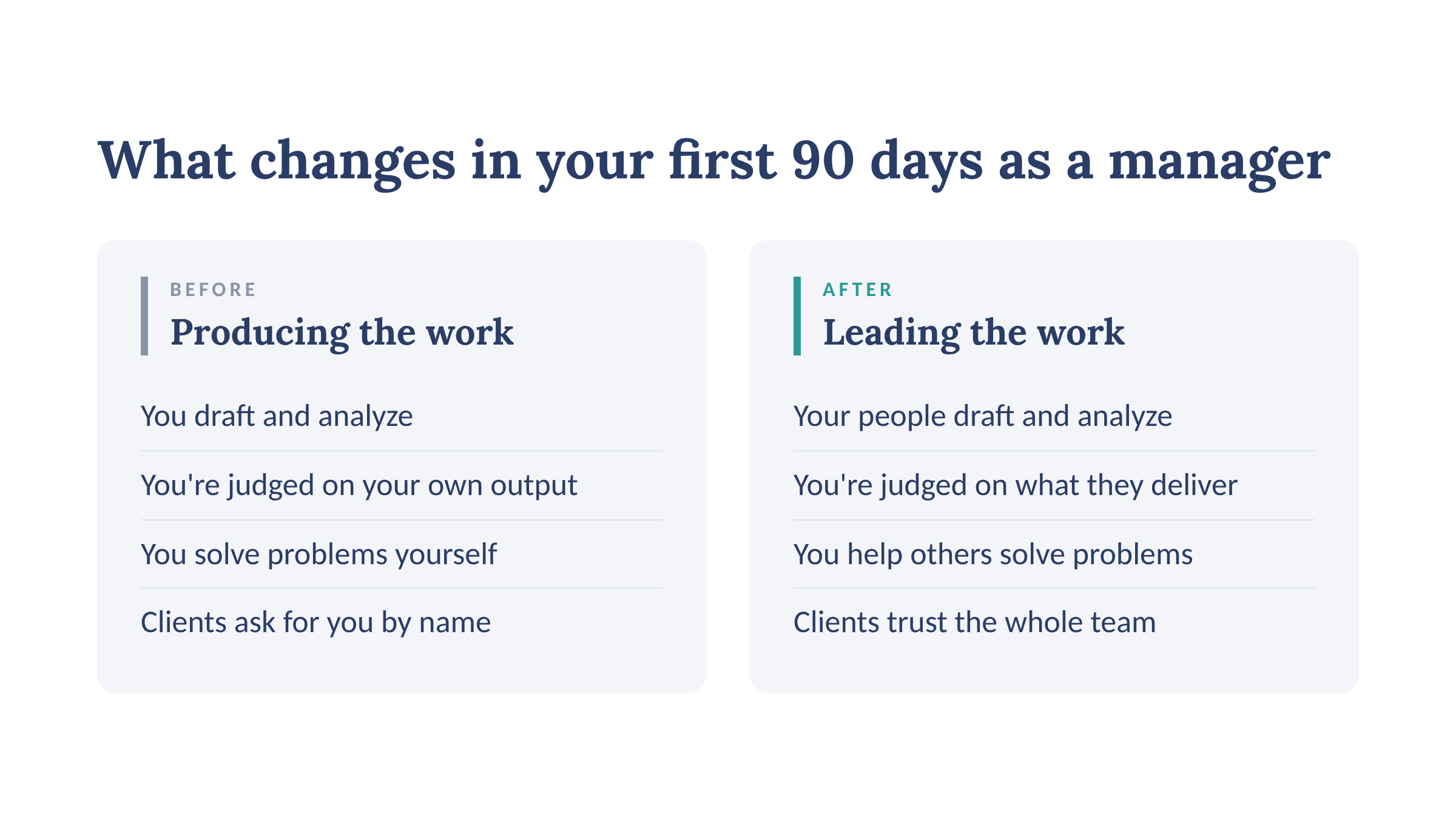
The first 90 days as a manager move you from producing the work yourself to leading the people who produce it.
Few new managers are taught this part of the role. The Chartered Management Institute, the UK professional body for managers, published Taking Responsibility with YouGov in October 2023, based on a survey of more than 4,500 UK workers and managers. It found 82% of people entering management roles had no formal management and leadership training. The study is self-reported and covers every sector in the UK.
The leadership part of the role is also growing. Korn Ferry, the global consulting firm, published its 2027 talent forecast on October 22, 2026, from a survey of more than 1,300 talent and senior leaders in more than 75 countries. 66% expect managers to spend more time guiding their teams through change than managing day-to-day work, and 91% said coaching and people skills will become more important. These are leaders’ expectations for the year ahead, so read them as a forecast.
Your firm sets many of the conditions around you, such as your billable target and your workload. Our post on why new managers in professional services can’t coach, delegate or develop their teams covers what firms can change, and the plan below covers what you can do yourself in your first quarter.
How do you clarify expectations with your partner or director?
Schedule a separate conversation in your first two weeks, ask what success looks like at 90 days, and play back what you heard so you both finish with the same list.
Unclear expectations are a common source of trouble for managers. Betterworks, a performance management software company, surveyed 521 HR and business leaders in the US and the UK in August 2026, all at director level or above. 48% named leadership expectations as the biggest source of friction for managers, ahead of communication at 43% and performance management at 40%. In a separate question, a lack of manager training ranked last among the named barriers to manager effectiveness, at 25%. The answers are self-reported.
Your partner or director may assume your new expectations are obvious, because they’ve watched you work for years, so it’s worth asking even when the answers seem clear. Bring these questions to the conversation:
What should be true about my team and my clients 90 days from now?
Which client relationships do you want me to own, and which stay with you for now?
How much of my own billable work should I keep while I take on the team?
Which decisions can I make on my own, and which do you want to see first?
How will you judge how I’m leading, separately from the quality of my own work?
How often should we meet, and what do you want to hear from me each time?
At the end, play back the answers in your own words and ask what you missed. Write the agreed list down, send it the same day, and review it together at 30, 60 and 90 days. Our post on how to set clear expectations for employees covers the four parts of a clear expectation, and you can use the same four parts with your own people.
Which delivery work should a new manager retain, delegate or redesign?
List every piece of delivery work you hold, then sort each item: retain the work only you can do right now, delegate the work someone on your team can learn, and redesign the work that shouldn’t take a manager’s time.
New managers often keep their old work because it’s familiar and they’re good at it. The list is usually longer than expected once it’s written down, with client deliverables, reviews, proposals, staffing, internal reporting and the requests people send you because they know you’ll answer.
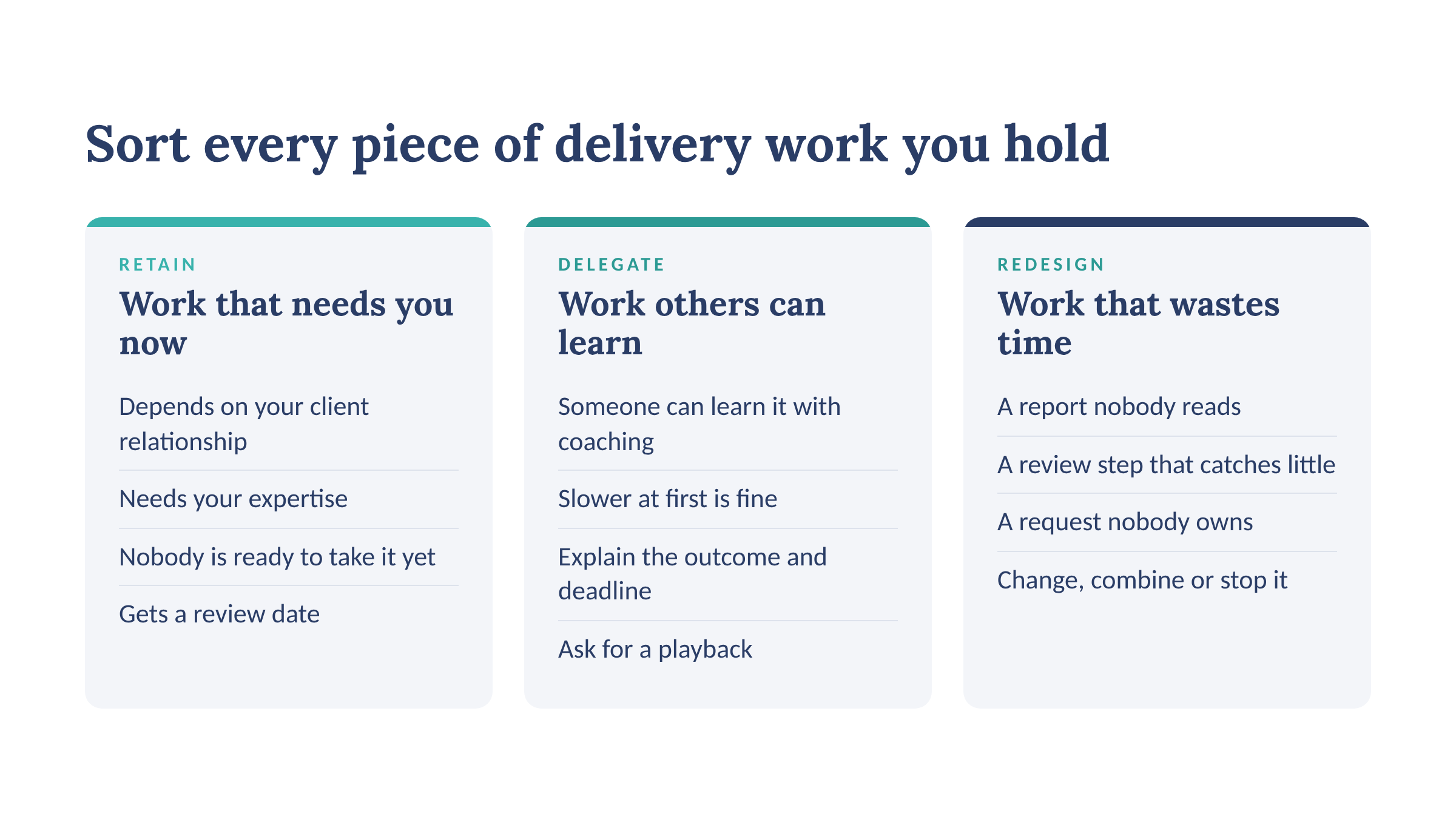
Sort each piece of delivery work: retain what needs you now, delegate what others can learn, and redesign what wastes time.
Retain the work that needs you for now
Keep work that depends on your client relationship or your expertise, or where a mistake would be costly and nobody is ready to take it yet. Put a review date on each item, because most of this list should get shorter over the year.
Delegate the work someone can learn
Delegate work a person on your team can learn with your coaching, even when they’ll be slower at first. Explain the outcome, what good looks like, the deadline and when to check in with you, then ask them to play it back in their own words. The Decision Rights Map helps you and your partner agree which decisions your people can make on their own, so they can finish delegated work without waiting for approval.
Redesign the work that shouldn’t need a manager
Some work wastes a manager’s time: a weekly report nobody reads, a review step that adds a day and catches little, or a request that reaches you because nobody owns it. Bring these to your partner or director with a proposal to change, combine or stop each one.
What should a 30/60/90-day plan for a new manager include?
A 30/60/90-day plan gives each month one focus: learn your team and build credibility in the first 30 days, establish routines in days 31 to 60, and take ownership of your people’s development in days 61 to 90.
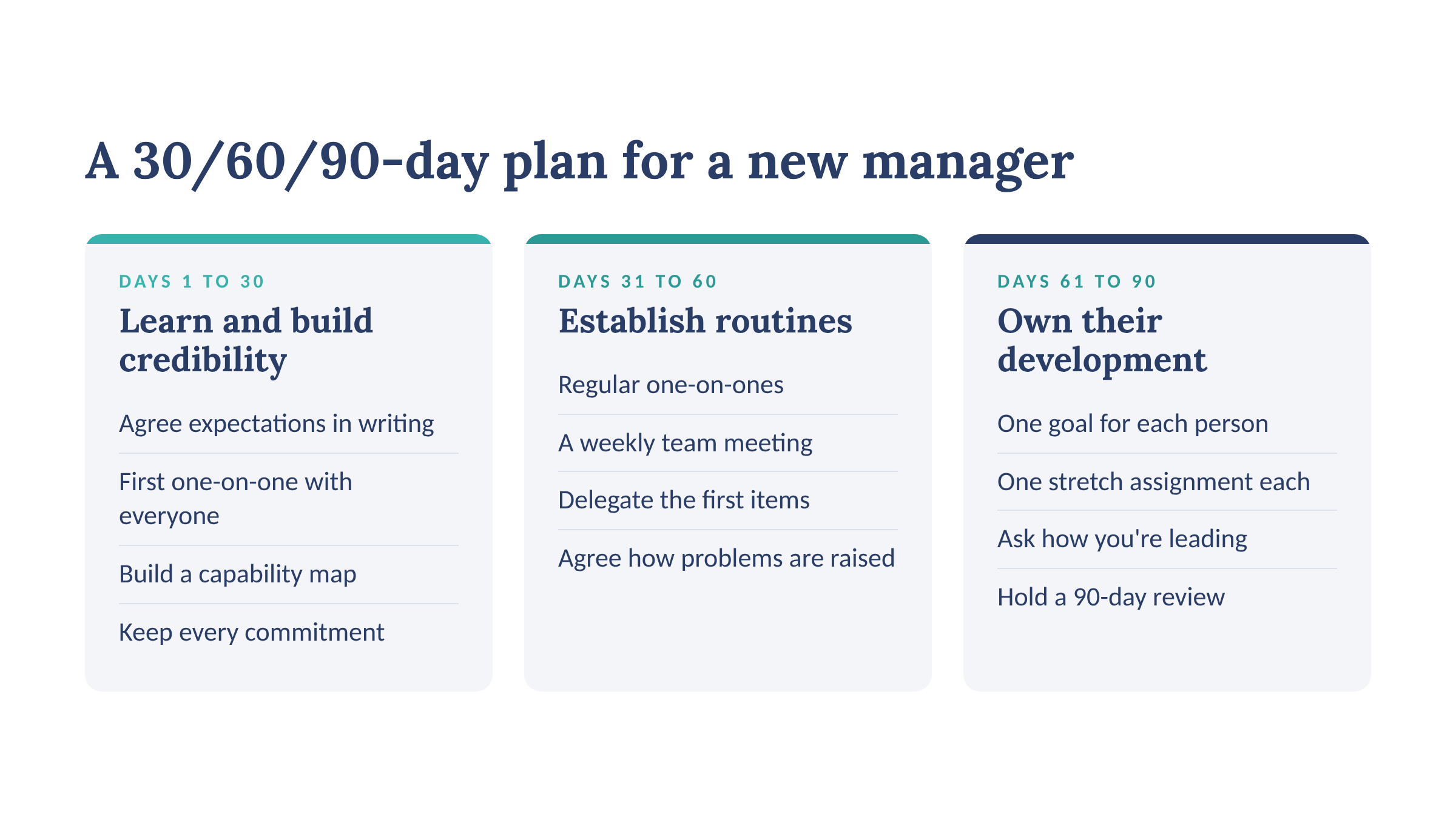
A 30/60/90-day plan: learn and build credibility, establish routines, then take ownership of development.
Use the three lists below as your first 90 days as a manager checklist, and tick each item off as you finish it.
Days 1 to 30: Learn your team and build credibility
Agree your expectations with your partner or director, and confirm them in writing.
Hold a first one-on-one with every person you lead.
Build your team capability map, described in the next section.
List your delivery work and sort it into retain, delegate and redesign.
Meet your main client contacts with the person who led each relationship before you.
Keep every commitment you make, however small, because your people decide whether to trust you from what you follow through on.
Days 31 to 60: Establish routines
Set a regular one-on-one with each person, and keep it when the week gets busy.
Start a short weekly team meeting with an agenda, recorded decisions and a named owner for each action. The Meeting Standards Checklist gives you a before, during and after list for it.
Delegate the first items on your list, and ask for a playback each time.
Agree with each person how they’ll raise a problem early.
Review your first 30 days with your partner or director.
Days 61 to 90: Take ownership of development
Agree one development goal with each person, tied to their real work.
Give each person one stretch assignment with your coaching behind it.
Ask your people how you’re leading, and act on one thing they say.
Take your redesign list to your partner or director, and change or stop at least one task.
Hold a 90-day review against the expectations you agreed in your first two weeks, and set the focus for the next 90 days.
Your own development belongs in this plan too. The Leadership Competency Assessment shows how you lead from your own view and the view of the people who see your work, so you know which part of leading to develop first.
What should you ask in your first one-on-ones?
Ask questions that help you learn how each person works, what they need from you and what they understand is expected of them, and spend most of the time listening.
Many people aren’t sure what’s expected of them. Gallup reported on October 28, 2026 that just 46% of US employees strongly agreed they knew what was expected of them at work in the third quarter, down from 49% in the first half of 2026 and from a high of 61% in 2015. The figures come from a Gallup Panel survey of 21,648 US adults in August 2026, and they’re self-reported. Gallup describes clear expectations as “the most basic and fundamental employee need.”
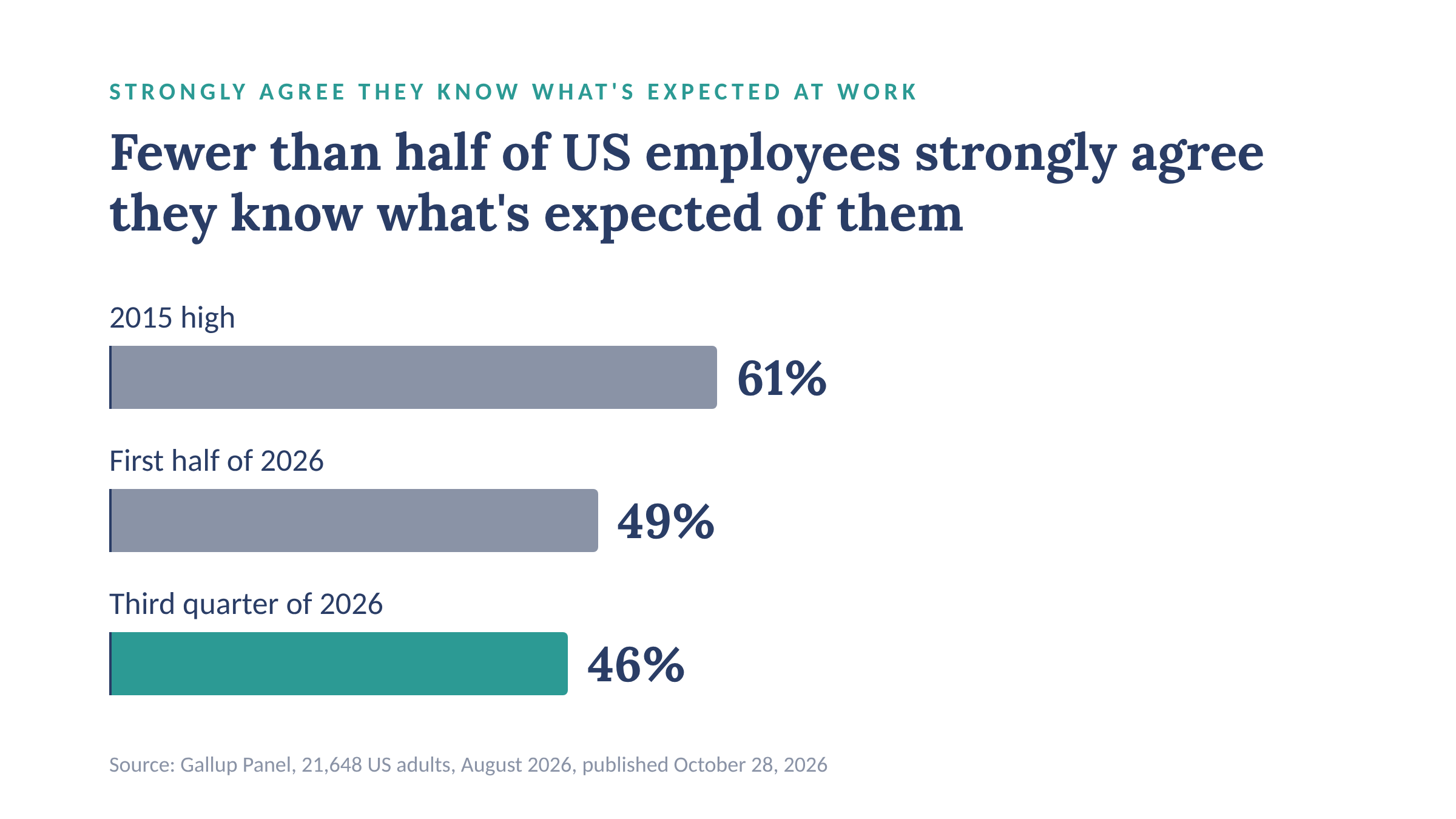
Gallup found 46% of US employees strongly agree they know what’s expected of them, down from 49% and a 2015 high of 61%.
These questions work well in a first one-on-one:
What do you enjoy most about your work, and what drains you?
What do you understand is expected of you in your role right now?
What gets in the way of your best work?
How do you like to get feedback?
What did your last manager do that you’d like me to keep doing?
Where do you want to grow over the next year?
How will I know when you need help, and how will you tell me?
Write down what you hear, and go back to each person within two weeks with one thing you did about it.
A simple team capability map
A team capability map is a one-page table with one row for each person you lead. It shows the work they lead now, what they’re strong at, what they’re building and what they could take from you.
Person | Work they lead now | Strongest skills | Skills they’re building | Growth goal | Work they could take from you |
Analyst, two years in | Monthly client reporting | Data analysis, accuracy | Presenting to clients | Lead a client meeting | Drafting the quarterly review deck |
Senior associate | Two small client accounts | Client relationships, scoping | Reviewing others’ work | Move into a manager role | First review of the analyst’s work |
Fill it in from your first one-on-ones and update it at 30, 60 and 90 days. The “skills they’re building” column tells you where to coach, and the last column becomes your delegate list.
What mistakes do first-time managers make, and how can you avoid them?
Four mistakes are common in the first 90 days as a manager: doing everything personally, avoiding difficult conversations, overcorrecting, and failing to ask for support. Each one has a simple first step.
Doing everything personally
Fixing a junior’s draft yourself is faster tonight, and the same errors return on the next engagement because nobody learned anything. Choose one piece of work this week to coach someone through, and accept that it will take longer the first time.
Avoiding difficult conversations
Many new managers lead people who were their peers a month ago, which can make feedback feel personal. A small issue left unspoken usually grows. Raise a concern within a week, describe what you saw and its effect on the work or the client, and ask what got in the way.
Overcorrecting
Some new managers swing from doing everything to handing everything off at once, or from relaxed to strict in a single week, and their people find either change hard to follow. Change one thing at a time, explain why you’re changing it, and keep everything else steady while your people adjust.
Failing to ask for support
New managers often wait to ask for help until a problem is visible. With 82% of new managers in the Chartered Management Institute study starting without formal training, needing support is the usual situation. Ask your partner or director for a regular conversation about how you’re leading, find a peer manager to compare notes with, and say early when your workload leaves no time for your people. Our post on leadership expectations for managers shows how a leadership team defines good leadership, which gives you something specific to ask about.
Frequently asked questions
How should a new manager spend their first 90 days?
A new manager should spend the first 30 days agreeing expectations with their partner or director and learning their team, days 31 to 60 setting routines such as one-on-ones and delegating real work, and days 61 to 90 taking ownership of each person’s development. A 90-day review against the expectations agreed in the first two weeks sets the next quarter.
What questions should a new manager ask in a first one-on-one?
Ask what the person enjoys and what drains them, what they understand is expected of them, what gets in the way of their best work, how they like feedback, and where they want to grow. Gallup found that only 46% of US employees strongly agree they know what’s expected of them, so the expectations question matters most.
What should a new manager delegate first?
Delegate work someone on your team can learn with coaching, such as a recurring report, a first review or a draft deliverable. Keep work that depends on your client relationship or expertise for now, and give it a review date. Explain the outcome, what good looks like and the deadline, then ask the person to play it back.
How do you go from peer to manager in professional services?
Agree your new expectations with your partner or director first, then hold a one-on-one with each former peer about how you’ll work together. Raise concerns within a week, keep every commitment you make, and change one routine at a time. Most of the trust you build in the first 90 days comes from following through on what you said.
Give your new managers a strong first quarter
If you’ve just stepped into your first manager role, or your firm is promoting people into theirs and wants them leading well by day 90, a conversation with us is a good place to start. LoyaltyOps is a leadership development firm that develops individual leaders and leadership teams against clear leadership competencies, so performance improves across your organization.
Sources
Gallup, U.S. Employee Engagement Below 30% for First Time in 15 Years, Jim Harter, Gallup Panel of 21,648 US adults surveyed August 5 to 19, 2026, October 28, 2026
Gallup, How to Measure Employee Engagement With the Q12, no publication date listed, accessed November 3, 2026
Betterworks, 2026 manager effectiveness survey: The multiplier most orgs haven’t turned on, 521 HR and business leaders in the US and UK, fielded August 2026, October 14, 2026
Chartered Management Institute, New study: Bad managers and toxic work culture causing one in three staff to walk, Taking Responsibility report with YouGov, more than 4,500 UK workers and managers surveyed in June 2023, October 16, 2023
Korn Ferry, Korn Ferry Report: AI and Capability Gaps Will Reshape Talent in 2027, more than 1,300 talent and senior leaders in more than 75 countries, October 22, 2026