
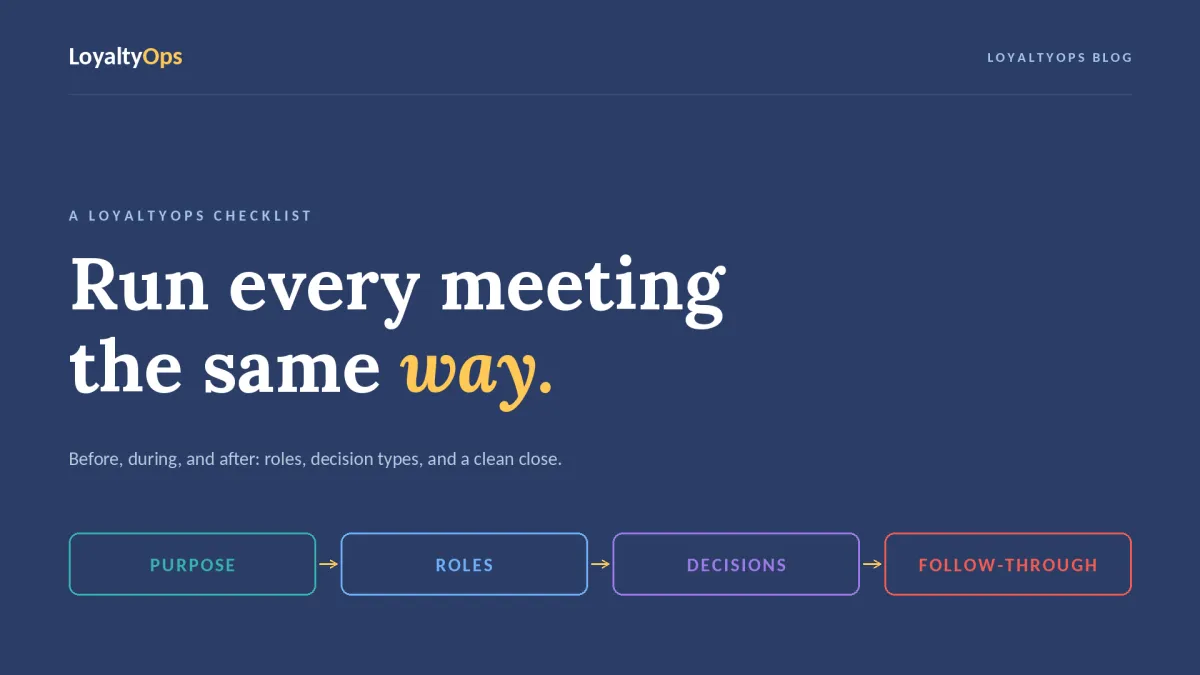
Meeting Standards: Run Meetings That End in Decisions
Meeting Standards: Run Meetings That End in Decisions
TL;DR
Meeting standards are a written set of agreements covering how every meeting in your organization is prepared, run and closed.
They replace informal habits with explicit rules, so meeting quality stops depending on who happens to be running the room.
The standard below covers what happens before, during and after, and you can run your next meeting against it without any setup.
What are meeting standards?
Meeting standards are the agreements that define how meetings are structured, facilitated and followed through on across an organization. They set expectations for preparation, participation, decision recording and follow-up that apply to every meeting, whatever its type, size or department.
Without them, the quality of a meeting depends entirely on who is running it. One leader runs a tight session that ends in a decision. Another runs one that wanders and closes with nothing named. There's no shared standard, so every meeting is a roll of the dice, and the cost accumulates in hours of leadership time that produce no decisions and no follow-through.
Meeting discipline is the practice of applying those standards consistently, so that every meeting produces a named decision, a clear owner and a defined next step.
Why meetings multiply
Meetings are easy to add and awkward to cancel. A project kicks off and brings a standing call. A team wants visibility and adds a weekly sync. Someone leaves a meeting unsure of what was decided, so a follow-up gets booked. A recurring invitation runs forever by default, and the team rarely stops to ask whether it still needs to happen.
Underneath that, meetings are the easiest answer to a coordination gap. When nobody is sure who owns a decision, someone schedules a meeting. When priorities are unclear, someone requests an alignment session. When follow-through has been patchy, someone suggests a weekly check-in.
This is also why the problem arrives with growth. In a small organization, the people in the room share context, and the distance between a conversation and a decision is short. A meeting that ends without a formal decision still produces movement, because shared context fills the gaps. As the organization grows, that informal mechanism stops working. A meeting of twelve leaders that ends with a general sense of alignment and no named decision produces twelve different interpretations of what was agreed, each reasonable to the person holding it, and collectively useless as a basis for doing anything.
The five leadership patterns behind the load
Five patterns show up consistently in organizations with heavy meeting loads, and every one of them is a leadership pattern that everyone else copies.
Leaders use meetings as thinking time.
Many leaders work out their ideas in the room, arriving to get clear rather than arriving already clear. The meeting drifts, it expands, and nobody knows what decision is needed. It also creates permission, so everyone else starts doing the same thing.
Leaders arrive unprepared.
When a leader sends materials late or hasn't read them, the message is that preparation is optional and the meeting can carry the weight. Teams mirror it, which is why so many meetings open with someone asking to be caught up.
Leaders invite people who don't need to be there.
Attendance gets confused with communication, and presence with alignment, so the whole leadership team gets invited along with anyone who might need to know something eventually. The room grows, roles blur, and most people in it are listening rather than contributing.
Leaders defer decisions.
Nothing multiplies meetings faster than indecision. Each unresolved meeting produces two more, the one to revisit it and the one to finally decide. Teams compensate for hesitation with calendar invitations.
Leaders tolerate low standards.
Without a standard, meetings expand to fill whatever time is available. Vague agendas, status updates read aloud, and recurring rituals that continue because they always have are all things a team keeps doing until a leader stops tolerating them.
What does a meeting actually cost?
A sixty-minute meeting with eight leaders isn't an hour. It's eight hours of leadership time, and the cost is total hours multiplied by fully loaded compensation.
Most organizations treat meetings as free, because no invoice arrives. Running that calculation once, on your three largest recurring meetings, changes behaviour faster than any policy. Leaders prepare more, teams focus more, and some of those meetings quietly come off the calendar.
The rule that follows: if the cost of the meeting is higher than the preparation you're willing to do for it, the meeting shouldn't happen.
The question that decides whether a meeting should exist
One question sorts the meetings worth keeping from the ones taking your week, and you ask it before the invitation goes out.
Why do these people need to be together?
A meeting earns its place when there's a real reason for it, usually an opportunity to move on or a problem to handle, and when the work genuinely calls for people to think, coordinate or decide together in a way they couldn't do apart. Most standing meetings don't pass, because they were scheduled once and never questioned since. The status update where everyone reads their part aloud, the sync that could have been three messages, the recurring call nobody wants to be the one to cancel: none of them pass.
Name what the meeting is for
Most organizations have never defined the types of meetings they run. A weekly leadership meeting blurs strategic planning, tactical updates, brainstorming and decision-making into one block, and when people sit down, they don't know whether they're there to decide, to discuss, to inform or to plan. That ambiguity changes how people participate. The strongest personalities set the direction, context gets lost because there's no shared preparation standard, and every unclear situation gets escalated to whoever is most senior in the room.
Naming the type before the invitation goes out tells people how to show up.
The two roles that carry every meeting
Two roles run the meeting, assigned before it starts and held by different people.
The facilitator runs the agenda and keeps the conversation moving toward the decision. The scribe records what was decided, who owns it and when it's due. Keeping the roles with different people matters, because one person trying to run the conversation and capture it accurately will do one of them poorly, and it's usually the capture.
The meeting standards checklist
Run every meeting against this. It fits on one page.
Before the meeting
The purpose is defined in one sentence. If you can't write it, you aren't ready to meet.
The purpose needs real-time conversation. If it's information sharing, send an update instead.
The attendee list holds only the people the meeting needs.
A facilitator and a scribe are assigned.
The briefing and agenda go out at least 24 hours ahead, with the purpose, the decision required and the context in three sentences.
Pre-work is explicit, so any thinking required happens before the room.
During the meeting
Start on time and name the purpose.
The facilitator runs the agenda.
Status updates stay out of the room, because they belong in the pre-work.
Name the decision type for each decision, so everyone knows who's deciding and how. Our Decision Rights Map covers the four types.
The scribe documents every decision, its owner and its deadline. One owner per action, never a committee.
Everyone participates, and anyone who doesn't know something commits to finding out.
Close with every commitment named and dated, and agree where the work gets briefed back.
End on time.
After the meeting
The scribe finalizes the notes and the facilitator reviews them.
The notes go to every attendee within 24 hours, covering decisions, owners and deadlines, and nothing else.
Every decision and task moves into wherever your organization tracks work.
How to start this week
Pick your largest recurring meeting. Run it against the question first, and cancel it if it doesn't pass. If it does, assign a facilitator and a scribe, write the purpose in one sentence, and send the briefing 24 hours ahead. Close with named owners and dates, and send the notes the same day.
One meeting run to the standard shows your leaders what the standard feels like, which does more than announcing it.
Common questions
How many meeting standards should we have?
Few enough that people remember them. The checklist above is the whole standard, and it fits on one page. A long list nobody uses is worth less than five rules everyone follows.
Who enforces meeting standards?
The facilitator enforces them in the room, and leaders enforce them by following them. A standard a leader ignores isn't a standard.
What if the meeting is with clients or people outside the organization?
The same standards apply, and they travel well. A stated purpose, a briefing sent ahead and notes within 24 hours read as professional to anyone.
How is this different from having an agenda?
An agenda covers one meeting. A standard covers every meeting, including whether it should happen, who runs it, how decisions get named and what happens afterward.
How long before this makes a difference?
The first meeting run to the standard feels different immediately. Consistency across an organization takes a quarter or so, because it depends on leaders modelling it rather than announcing it.
Get the one-page checklist
We've put the whole standard on a single page you can run a meeting against, with the before, during and after sections and space to assign the two roles.
Download the Meeting Standards Checklist
Once your meetings are running to a standard, the next question is usually who owns which decisions. That's what we work on with leadership teams.