
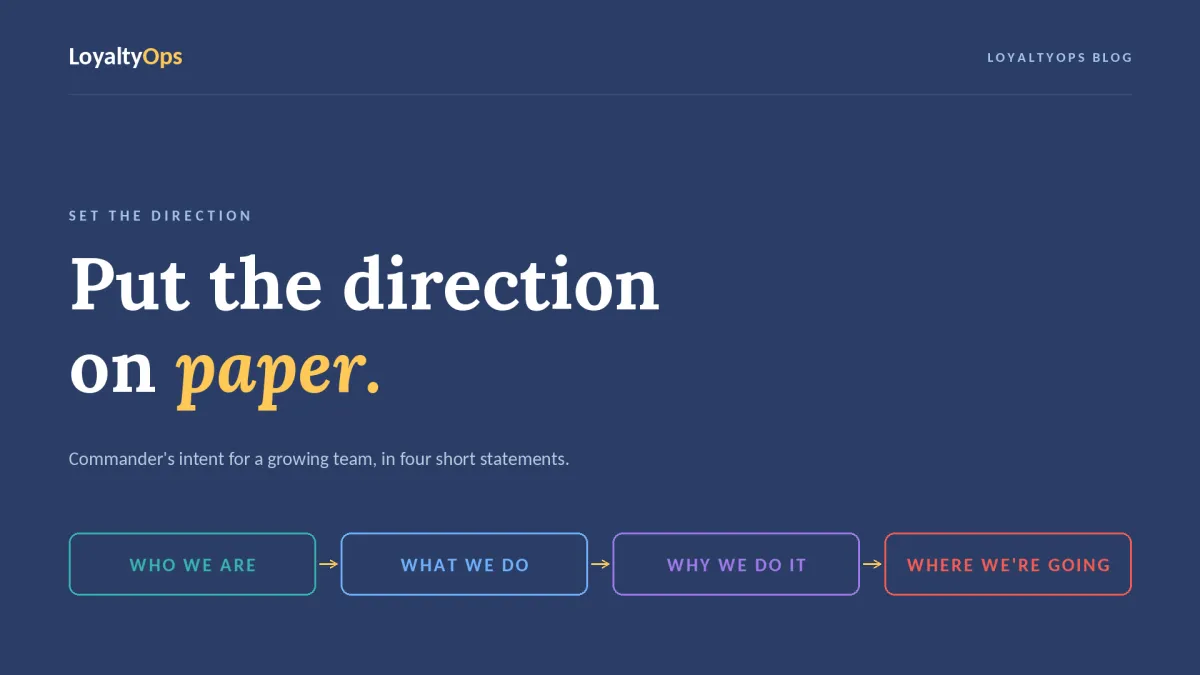
Clear Intent: Four Statements Your Team Can Repeat
TL;DR
Clear Intent is four short statements, in plain words, that name a team's direction: who we are, what we do, why we do it, and where we're going.
Each one fits in a single breath, carries no buzzwords, and sounds the same whoever says it.
The test is whether a new hire can repeat them the next day. When the direction lives only in the leader's head, each person fills the gap with their own version, and those versions agree less as the team grows.
What is Clear Intent?
Clear Intent is four short statements, in plain words, that name your direction so anyone on the team can act on it without checking with you first.
Who we are. What we do. Why we do it. Where we're going.
It is smaller than it sounds. It is not a strategy document or a brand exercise. It is four lines your newest hire could repeat after hearing them once, and that is the whole point, because a direction people can repeat is a direction they can use when you are not in the room.
Where the idea comes from
The military solved this problem a long time ago, and it named the solution commander's intent.
It belongs to a practice called Mission Command, which rests on a simple observation. A plan does not survive contact with reality, and the people closest to the work will face conditions nobody anticipated. Scripting every move guarantees that those people stop and wait for orders at the exact moment waiting is most expensive. So the commander does something different. Rather than issuing instructions, the commander states the purpose and the goal clearly enough that people can make the right decision themselves when the situation changes.
Intent travels further than instructions can, because it survives the situation changing.
The business version is the same idea, and it solves the same problem. When your team understands the intent behind the work, they make the decisions in front of them without routing each one back to you, and only the decisions that genuinely need you come up.
Why your team works from a different version of the goal
Try this. Ask three people on your team what the company is working to achieve, separately, and listen to what comes back. Three different answers means you have found something worth fixing.
On most teams the direction lives in the leader's head. It was never written in words the team can repeat, so each person fills the gap with their best guess. Early on those guesses are close, because everyone is near you while you set the direction. As the team grows, they drift.
You see it in small ways. Two people make reasonable decisions that turn out to conflict. A project gets built well and still is not what you wanted, because it was clear to you and fuzzy to them. New hires take a long time to become useful, because the one thing that would orient them fastest was never written anywhere. Decisions come back to you, because you are the only one who can say for certain what the goal actually is.
None of that is a talent problem. It is a clarity problem, and clarity can be written down.
Why a mission statement does not close the gap
Most organizations have a mission and vision statement somewhere. Very few of them change how anyone thinks, behaves or decides.
The reason is that they are usually written for audiences outside the building, for websites, investor decks and recruitment pages. They are polished, abstract and forgettable. Ask ten people what one of them means and you get ten answers, which is the same problem you started with.
The fix is a shorter, plainer set of statements people can actually recall in the moment they have to decide something without you.
The four statements
Each statement answers one question and follows one rule that keeps it usable.
Who we are.
Your identity and character, the truth about how you operate even on your worst day. Declarative, human, twenty-five words or fewer. For example: "We are a financial planning firm that puts client trust ahead of sales pressure."
What we do.
Your promise, the specific way you create value, written so a stranger understands your business from a single line. Fifteen words or fewer, starting with a verb like help or build, naming what changes because you exist. For example: "We help multi-location operators run smoother service by turning bookings, tables and demand into clear workflows."
Why we do it.
The belief that gives the work meaning, the part that stays true even if your products or markets change. Fifteen words or fewer, starting with the word "Because," which forces a real conviction rather than a slogan. For example: "Because financial clarity reduces fear and helps families make better long-term choices."
Where we're going.
The goal that sets your priorities, bold enough to matter and concrete enough to check. Future tense, specific. For example: "By 2035 we will be the operating standard for reservation and guest flow in our category."
The four checks every statement passes
One breath. Each statement fits in a single breath. Running out of air means it is too long.
Plain English. If a new hire cannot repeat it after hearing it once, simplify.
Aligned meaning. When five leaders say it, it sounds the same. The words are shared rather than personal.
No buzzwords. If you have to explain it, it is not clear yet. Words like innovative, world-class and cutting-edge sound impressive and communicate nothing. The strongest statements are built from verbs.
These checks are what separate this from a typical mission statement. A statement can sound impressive and still fail every one of them, which is how so many companies end up with direction on a wall that nobody can act on.
A full set, written out
Here is what the four look like together, for a small hospitality software firm.
Who we are: We are a hospitality software company that treats our customers' service reputation as our own.
What we do: We help multi-location restaurants turn bookings and demand into clear, calm service.
Why we do it: Because good service is hard, and the right tools let good people give it consistently.
Where we're going: By 2030, we will be the booking standard for growing restaurant groups.
Four lines, each short enough to say in a breath, and a new hire could repeat them the next day.
How to build it: draft alone, then align
Clear Intent works when the leadership team agrees on the exact words, and the fastest route there is a short sequence.
Draft alone. Each leader writes their own version of who, what, why and where, without seeing the others.
Compare. Put the drafts side by side and find where the language differs. That difference is the real work, because it shows where your leaders quietly disagree about the direction.
Refine until memorable. Shorten each statement until it can be spoken naturally and repeated from memory.
Test it. Ask a cross-section of people to repeat the statements the next day.
Publish. Put the final four into onboarding, meetings and reviews, so they become the team's first language.
The draft-alone step matters more than it looks. Two leaders who have sat in every strategy meeting together, and who both believe they are aligned, will often write two different versions of where the company is going. That gap only surfaces when each one writes it down separately, and left unaddressed it produces inconsistent hiring, conflicting resource decisions and execution pulling in two directions with nobody able to say why.
The test that tells you it worked
Ask three people on your team to read your four statements and say them back the next day.
If they repeat them without checking, your direction is clear and the team can use it. If they say them three different ways, that is the signal to simplify, because a statement people cannot repeat cannot guide a decision when you are not there.
Keep it alive
Writing them is the start. Repetition is what turns four statements into how the team actually works.
Open your meetings with them and ask whether your current decisions match them. Teach them on a new hire's first day. Re-test each one before a big planning session.
From centralized control to decentralized command
This is what the four statements are actually for.
Most growing organizations run on centralized control without ever deciding to. The leader holds the direction, so the leader has to approve the decisions, so the decisions queue up at the leader. Nobody designed that. It is what happens by default when the direction lives in one head, and it gets slower every time the organization adds a person.
Decentralized command is the alternative. Authority sits at the level closest to the information needed to make a good call, and the people there act without waiting for approval. It is the operating principle the military built Mission Command around, and it is the change most growing organizations actually need.
It has one prerequisite, and skipping it is why delegation so often fails. People can only act on intent they share. Someone who understands the direction clearly enough can carry it into a situation you never anticipated and still make the call you would have made, because they are working from the purpose rather than from a set of instructions that the situation has already outrun. Someone who does not understand it either stops and asks, or acts and drifts.
So the sequence runs one way. Clear Intent makes independent action safe, and decision ownership names who acts on it at each level. Handing out authority before the intent is shared is how organizations end up with people moving quickly in different directions.
Where Clear Intent fits
Clear Intent is the first of three foundations, and it comes first because direction has to exist before anything else can point to it.
Once it is written, cultural standards turn your values into behaviours that serve that direction, and leadership modeling means you live those standards yourself before the team is asked to. Together those three are the foundation the Leadership Operating Flywheel is built on.
Common questions
What is Clear Intent?
Four short statements, in plain words, that name a team's direction so anyone can act on it without checking first: who we are, what we do, why we do it, and where we're going.
What is commander's intent in business?
The practice of giving your team enough clarity about the purpose and the goal that they can make the right decisions on their own. It comes from the military practice of Mission Command, and it is most useful once a team grows past the size where the leader can be in every decision.
How is this different from a mission statement?
A mission statement is usually written to sound good. These four are written to be repeated and used. Every statement passes four checks, including that a new hire can repeat it after hearing it once, which most mission statements fail immediately.
How do I write these for my team?
Have each leader draft the four statements alone, compare them to find where the language differs, refine until each one can be repeated from memory, test that people can say them back the next day, and publish them into your meetings and onboarding.
Why do good people still make conflicting decisions?
Because each one is acting on their own version of the goal. Two reasonable people who picture the direction differently make reasonable decisions that conflict. A shared, written direction gives them one version to work from.
How long does it take?
About an hour to draft the four on your own, or one working session with the leadership team if you want the wording agreed together. The say-it-back test runs over the following day, and the statements take hold over the following weeks as they get used.
What is decentralized command?
An operating model where authority sits at the level closest to the information needed to make a good decision, so that people can act without waiting for approval. It is the principle behind Mission Command, and it depends on shared intent. People can only act on a direction they understand well enough to carry into a situation nobody anticipated.
What comes after Clear Intent?
Cultural standards, which turn your values into visible behaviours, and leadership modeling, where you live those standards before asking the team to.
Get the builder
We have put the whole method into a free builder: a page for each statement with a prompt, an example and a word limit, the four checks, a full worked example, and the test to run this week.
Download the Clear Intent Builder
Once the direction is named, the next question is usually who owns which decisions inside it, which is the Decision Rights Map.