
Lead by Example: How Leadership Modeling Works
TL;DR
Leadership modeling is choosing two or three behaviours and living them on purpose, so the example your team copies is one you decided on.
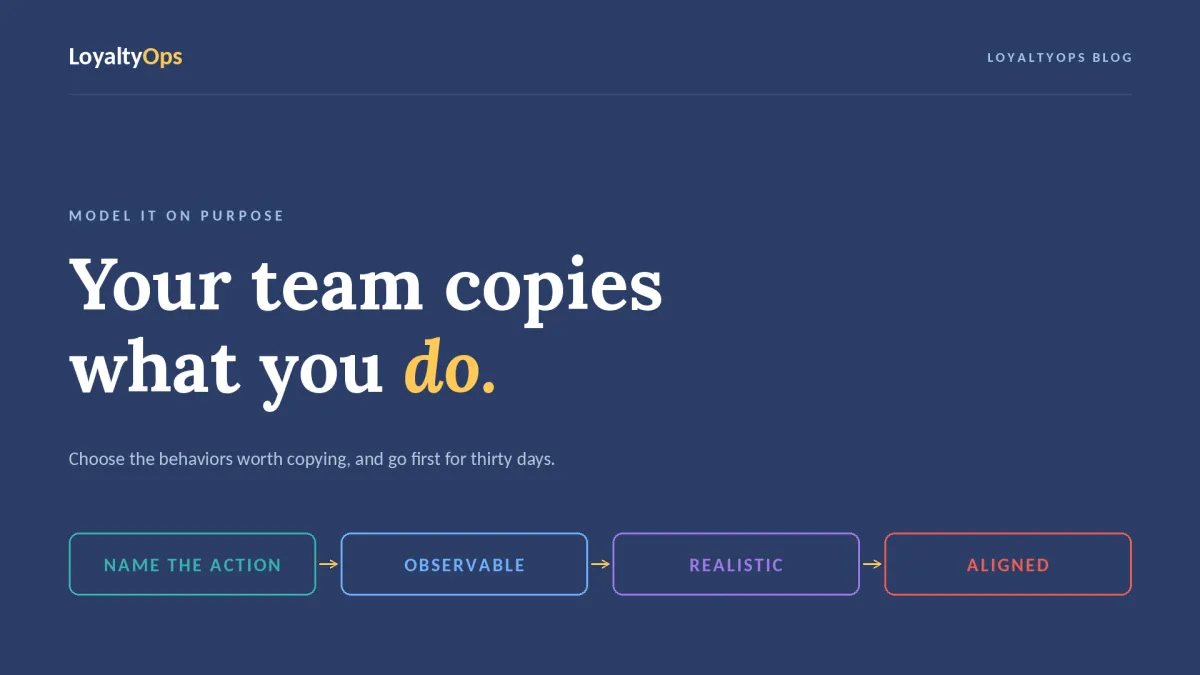
Each behaviour has to name an action rather than an outcome, be observable, be realistic in your hardest week, and fit the direction and standards you have already set.
You model each one for about thirty days before asking anyone else to pick it up.
You are already modeling something every day, so the only real choice is whether you chose it.
What is leadership modeling?
Leadership modeling is choosing two or three specific behaviours and living them deliberately, so that the example your team copies is one you picked.
It is a practice rather than a personality trait, which is exactly why any leader can do it. You pick the behaviours that matter most for how you want the team to work, treat them as the standard you go first on, and model them yourself before asking anyone else to.
"Lead by example" is the general idea, and almost everyone agrees with it. Far fewer people can tell you which behaviours to model, how to choose them, or how long to keep at it before the team picks them up. This is the specific version.
You are always modeling something
Your team learns how to behave by watching what you do rather than by hearing what you announce.
You can write a standard and say it clearly in a meeting, and the team will still take its real cue from your actions, particularly in a hard moment. So you are not choosing whether to lead by example. You are only choosing whether the example is one you picked.
What a tense week teaches
Take a standard like making decisions at the level closest to the work. You say it, you mean it. Then a tense week arrives, a decision comes up, and you step in and make it yourself to save time.
Nobody says anything. The team just learned something: the standard is real when things are calm and optional when they are not. They learned it faster than they learned the words, because a hard moment teaches louder than a meeting does.
This works both ways, which is the useful part. A team that watches you keep a standard in exactly the moment it would be easy to drop teaches them more than any handbook.
Saying it louder widens the gap
When a standard does not stick, the instinct is to say it again more firmly, and maybe add a policy.
Repetition is not the missing piece, because the team already heard the words. What they are waiting to see is whether the words match your own behaviour when it counts. More announcements without matching action actually widen the gap, because now there is an even clearer standard on record that the team has watched you set aside.
The four rules every behaviour passes
Before you commit to modeling something, run it through four rules.
Name the action rather than the outcome. Describe what you do, and leave out the result you are hoping for. "Be more focused in meetings" is an outcome. "End every meeting by naming who owns the next step" is an action. The team can copy an action.
Make it observable. A camera could record it. If you could not point to a specific moment where you did or did not do it, it is not observable enough yet.
Keep it realistic under pressure. You can do it in your hardest week. A behaviour that stops the moment the calendar gets tight teaches the team that the standard is for good weeks, so pick something smaller you can hold to.
Keep it aligned. It fits the direction you have named and the standards you have written. Where a behaviour contradicts either one, change one of them so they agree before you model it, because a team cannot follow a leader whose example points one way and whose stated standards point another.
Why two or three rather than ten
The number is deliberate.
A behaviour only teaches when you do it consistently, and consistency across ten behaviours in your hardest week is more than anyone can manage. Two or three you actually keep to will change how the team works. Ten you manage only on calm weeks will teach the team that standards are for calm weeks.
Start with the two or three that matter most. Get them to the point where the team uses them without prompting, then add the next one.
Go first for thirty days
Model each behaviour in your own work for about thirty days before you ask anyone else to pick it up. In that window, your consistency is the thing that tells the team the standard is real.
A short daily check keeps you honest.
Use it without exception. Apply the standard in your own meetings and decisions every day.
Say it out loud. Name it in at least one conversation a day, so the language becomes part of how the team talks.
Meet your own standard. Apply the same expectation to yourself that you ask of others.
Keep it under pressure. Protect it when the week gets tight, because that is the moment the team is watching most closely.
Treat friction as progress. Early slowdowns mean the standard is landing.
Why early friction is a good sign
When people slow down or ask clarifying questions in the first couple of weeks, that is not the plan failing.
New behaviour feels slower before it feels normal, and the questions mean people are adjusting to it rather than ignoring it. By around day thirty, the team tends to use the standard without being prompted, even in a difficult week, because they have watched you do the same for a month.
An example
Say you want the team to make more decisions without you.
"Be more decisive" is an outcome, so it fails the first rule immediately. Run it through the four rules, and you get something you can actually model.
The behaviour: when a decision comes to me that the team could make, I hand it back with what they need in order to decide, rather than deciding it myself.
Observable? Yes. A camera could record the moment you hand it back.
Realistic under pressure? Yes, though it is tempting in a tight week to just decide.
Aligned? Yes, if your direction is a team acting closer to the work.
Model that for thirty days, name it out loud when you do it, and keep doing it in the weeks when deciding yourself would be faster. By day thirty the team brings you fewer decisions that were theirs, because they have watched you hand them back consistently.
Here is a second one. If you want people to raise problems earlier, the announced version is "be more proactive," which gives nobody anything to do. The modeled version is that in your own updates, you name one risk you are watching before anyone asks, every week, out loud, in the calm weeks and in the ugly ones. For the first few weeks not much visibly changes. Then someone on the team names a risk early in a meeting, the way they have watched you do it, and nobody treats it as bad news.
Where the drift gets in
Leadership behaviour multiplies whatever structure already exists. Clear ownership, discipline and straight talk spread through an organization. So do exceptions made at the top, and they spread just as fast.
Every time a leader is exempt from the standard expected of others, the organization recalibrates to the exception. Two questions surface that faster than any survey: whether an observer watching your leadership team for thirty days would see behaviour matching what is communicated to everyone else, and where exactly leaders are exempt from the standards expected of others. Both are covered here.
Where leadership modeling fits
It is the third of three foundations.
Clear Intent comes first and names the direction. Cultural standards come second and turn your values into behaviours. Leadership modeling comes third, where you live those behaviours before the team is asked to, which is what makes the first two real. Announced standards that a leader does not model stay on paper.
Together, those three are what the Leadership Operating Flywheel is built on. With all of them in place, most of what used to come back to you has somewhere else to go: the direction answers what to aim for, the standards answer what good looks like, and your own example shows the team that both are real.
Common questions
What is leadership modeling?
Choosing two or three specific behaviours and living them on purpose, so the example your team copies is one you decided on. Each one names an action, is observable, is realistic under pressure, and fits your direction and standards.
How do I lead by example in a way that works?
Make it deliberate. Pick two or three behaviours, write each as a specific action a camera could record, and model them yourself for about thirty days, keeping them especially when the week gets tight.
Why won't my team follow the standards I set?
Usually because they take their real cue from what you do rather than what you announce. A standard dropped the moment a week gets tight teaches the team it is optional.
How many behaviours should I model at once?
Two or three. Once those are the norm, add the next one.
How long before the team picks it up?
About thirty days of consistent modeling. Early friction is a normal sign it is landing.
Is my team resisting me, or is something else going on?
Usually something else. When people drift back to old habits, it is rarely defiance. The standard was not yet modeled long enough or consistently enough to trust, which puts the fix on the leader's side and makes it doable.
What is the difference between leading by example and leadership modeling?
Leading by example is the general idea. Leadership modeling is the specific practice: which behaviours to pick, the four rules that make one modelable, and the thirty-day discipline of going first.
Get the reference card
We have put the whole method on one page: the four rules for choosing a behaviour worth copying, the daily check for your first thirty days, and space to name the two or three behaviours you will go first on.
Download the Leadership Modeling Reference Card
The behaviours you model are the ones that bring your standards to life, which is the Cultural Standards Builder.