
Good Leadership Qualities in the AI Era: Three to Do Uncommonly Well
Good Leadership Qualities in the AI Era: Three to Do Uncommonly Well
Good leadership qualities are the same ones that mattered before AI: setting clear direction, living the standard first, and building a team that learns and improves together. The pressure on them has grown. Gallup found 46 percent of US employees strongly agree they know what’s expected at work, down three points in one quarter.
Key takeaways
The core leadership competencies have stayed the same as AI changes work, and the way you practice them day to day has changed.
Gallup found 46 percent of US employees strongly agree they know what’s expected of them at work, with the sharpest drop among remote and hybrid employees in organizations adopting AI.
Edelman’s Trust at Work 2026 study found trust in direct managers fell from 79 percent to 72 percent, a record low in its data.
The three qualities that matter most are clear direction, living the standard first, and a team that grows, learns and improves together.
Frances Frei and Anne Morriss name three drivers of trust, authenticity, logic and empathy, and empathy is the one most high-achieving leaders struggle with.
This week, pick one standard you expect of your people and practice it yourself first for 30 days.
Why do good leadership qualities matter more as AI changes how work gets done?
Good leadership qualities matter more now because people are less clear on what’s expected of them and trust their leaders less than they did a year ago, and a leader can change both. The tools are changing quickly, and the core of leading people has stayed the same.
Mickey Anderson, Co-Founder of LoyaltyOps, joined Olivia Gamber, founder and CEO of Career Evolved, on the Career Evolved podcast to talk about what it takes to lead well as AI changes how work gets done. Olivia was a guest on UNLEASHED a few weeks earlier, in Why She Built Software for a Business Built on Trust, where she described what she calls a trust recession, with buyers and employers trusting less and wanting proof before they commit.
Mickey’s view on the podcast was that the leadership competencies themselves have stayed the same. Leaders still need to set direction, communicate, live the standards, ask the team for ideas and feedback, and keep improving. What’s shifted is how those look day to day, and the problems leaders face while they practice them.
Gallup’s latest research shows what’s changed. In a Gallup Panel survey of 21,648 US adults, conducted August 5 to 19, 2026, and published October 28, 2026, 46 percent of employees strongly agreed they knew what was expected of them at work, down three points from the first half of 2026. The figures are employees’ own answers, and Gallup reported that the decline was sharpest among remote and hybrid employees, particularly in organizations that have adopted AI.
Trust in leaders has fallen too. Edelman’s Trust at Work 2026 study, published October 6, 2026, surveyed more than 10,000 employees in ten markets and found trust in direct managers fell from 79 percent to 72 percent. Trust in their own CEO fell from 70 percent to 66 percent, and trust in co-workers fell from 82 percent to 73 percent, each a record low in Edelman’s data.
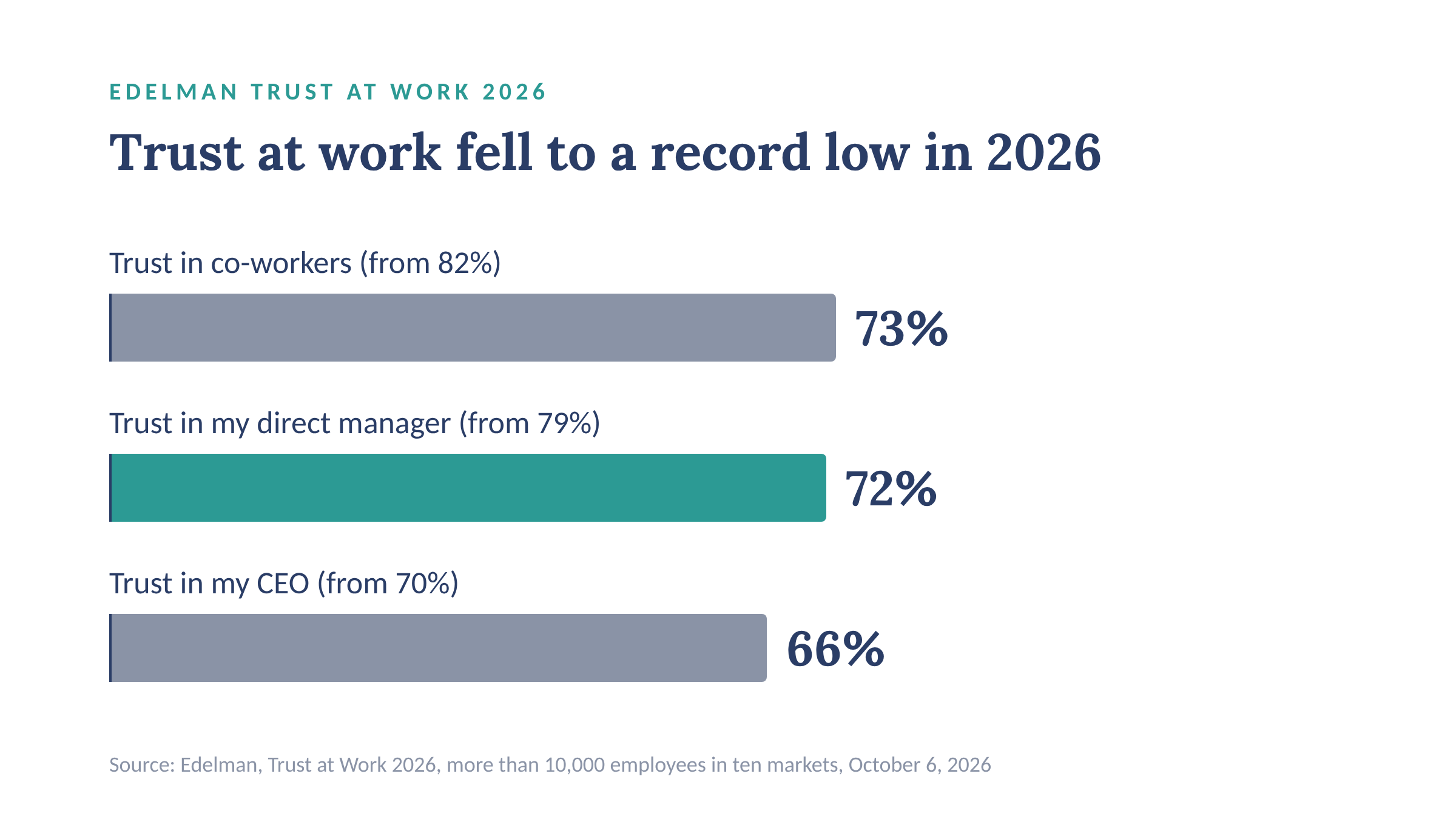
Edelman, 2026: trust in co-workers fell to 73%, in direct managers to 72% and in CEOs to 66%, each a record low.
When the work and the tools keep changing, people look to their leader for direction, for an example to follow, and for a team where they can say what’s really happening. Those are the three qualities this post covers.
Get the free Leadership Modeling Reference Card
What are good leadership qualities, and how do they connect to leadership competencies?
A good leadership quality is something people say about a leader they’d follow, and a leadership competency describes that quality as behaviours other people can see. People notice the quality, and you practice the behaviours.
In the LoyaltyOps Leadership Competency Model, we describe good leadership as competencies, each one a group of behaviours other people can see, and the Leadership Competency Assessment scores you on them from your own view and from observers who work with you. That turns a quality such as “strategic” into specific things you do, which you can practice and score again later.
On the podcast, Mickey suggested working backward from the quality. If you want people to see you as strategic, ask what someone would see you do that tells them so, such as the decisions you make, the conversations you have and the work you choose to say no to, then do those things today.
Her philosophy is virtuosity, doing the common uncommonly well. She said leaders tend to overcomplicate leadership, and that a few simple behaviours, done consistently and done well, lead to results that build on each other. Your job as a leader is to get the best out of the people around you, and the three qualities below are where she’d start.
Which three leadership qualities matter most right now?
Asked to pick three, Mickey chose clear direction, living the standard first, and building a team that grows, learns and improves together. Each one matches a competency in the LoyaltyOps Leadership Competency Model, so each one comes with behaviours you can practice.
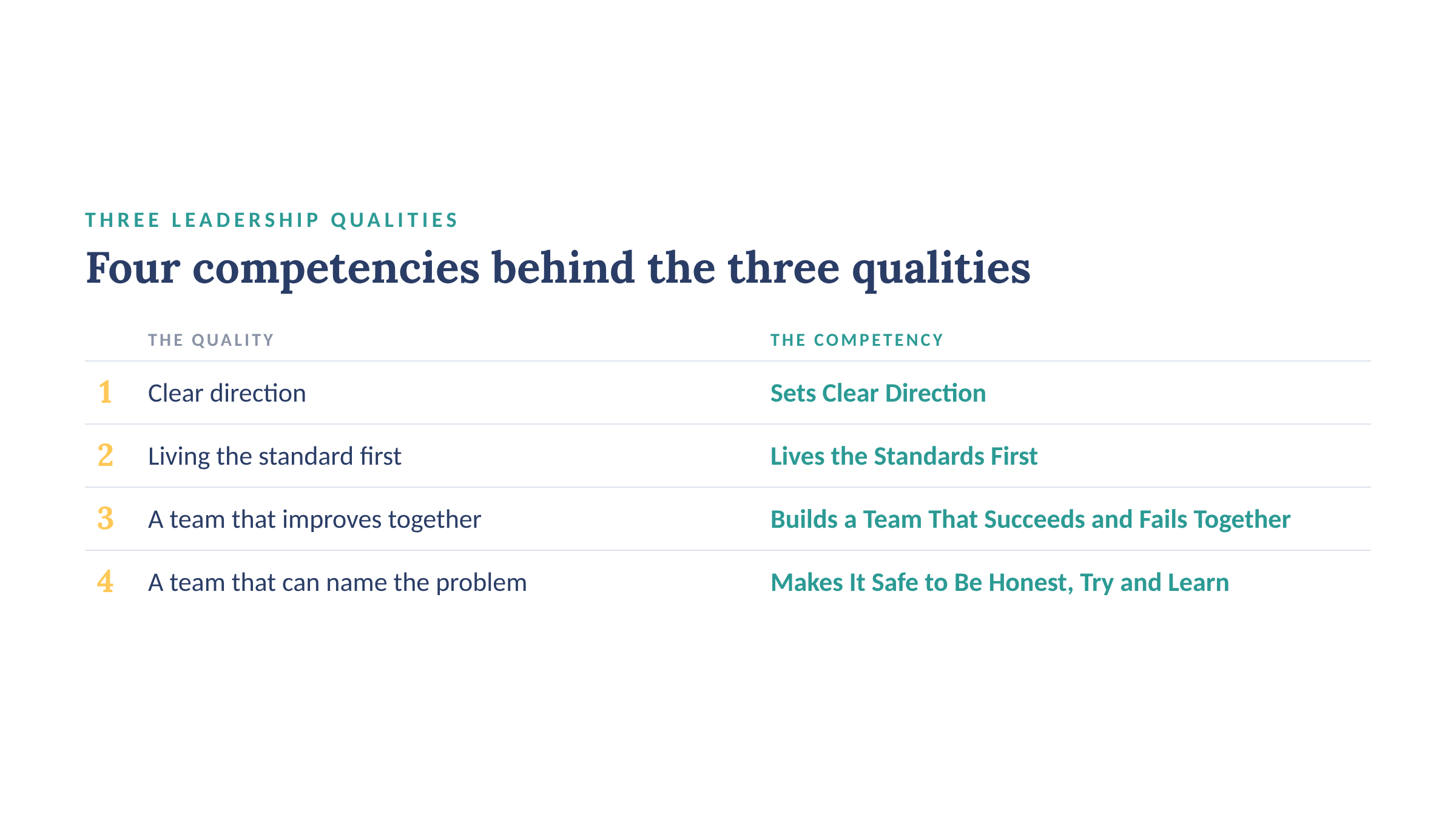
Three good leadership qualities, and the four LoyaltyOps leadership competencies behind them.
Clear direction
Clear direction means your people know where the organization is going, what matters most right now and why, so they can make good decisions without asking you. The competency is Sets Clear Direction. Mickey’s point on the podcast was simple: it’s very hard to lead people who don’t know where you’re going.
Gallup’s 46 percent finding shows how quickly clarity can fall, even in a single quarter. Write your direction in a few sentences your people could repeat: where you’re going, the outcome you’re working toward, and what comes first this quarter. Then ask two people to tell it back to you in their own words, and fix the parts they can’t. Our post on four statements your team can repeat shows how to write them.
The same applies to your own career. If someone asks what you’re working toward next and you’re unsure, people read that as a lack of direction, so get clear on it for yourself first.
Living the standard first
Mickey called this one her number one. She said on the podcast: “Whatever expectations you have of your people, of others, you must be willing to demonstrate those yourself.”
Her example was meetings. If you expect your team to arrive 10 minutes early, prepared and having read the agenda, and you arrive five minutes late expecting them to catch you up, people learn the standard from what you do. The competency is Lives the Standards First, which means practicing the behaviours you expect of others before you ask anyone else to, and keeping them in your hardest weeks. Our post on how leadership modeling works covers 30 days of going first.
A team that grows, learns and improves together
Mickey described the leader as the conductor of the orchestra, with the team playing the instruments. Your job is building a team where people feel safe to name the problem, deal with the thing they’d rather avoid, and give and receive honest feedback.
Two competencies describe it. Builds a Team That Succeeds and Fails Together means your people respect each other, speak honestly, commit to decisions together and share both the wins and the misses. Makes It Safe to Be Honest, Try and Learn means people raise problems and admit mistakes, and the team learns from what happens. In your next team meeting, ask what problem nobody has named yet, and thank the first person who answers. Our post on building psychological safety gives five behaviours that make it easier for people to speak up.
Career Evolved podcast: Olivia Gamber talks with Mickey Anderson, Co-Founder of LoyaltyOps, about the leadership qualities that matter most as AI changes how work gets done.
How do you build trust in leadership when people trust less?
You build trust by working on the driver people doubt most. Frances Frei and Anne Morriss name three drivers of trust, and for most high-achieving leaders the weak one is empathy.
In “Begin with Trust,” published in the May to June 2020 issue of Harvard Business Review, Frei, a Harvard Business School professor, and Morriss describe a trust triangle. People trust you when they believe they’re dealing with the real you (authenticity), when they have faith in your judgment and competence (logic), and when they believe you care about them (empathy). They write that lost trust can nearly every time be traced back to a breakdown in one of the three.
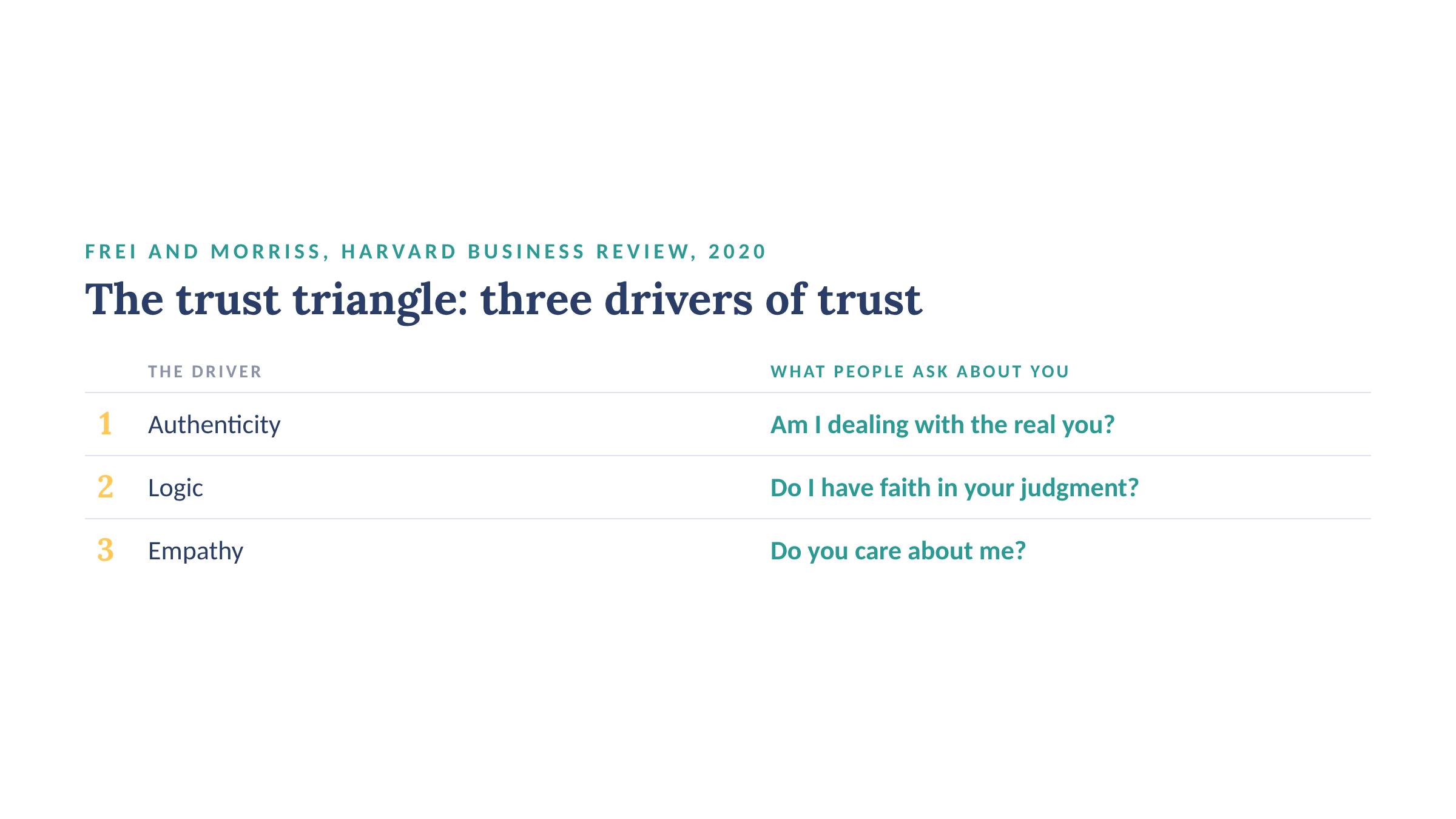
Frei and Morriss’s trust triangle: authenticity, logic and empathy, and the question people ask about each.
Frei and Morriss write that most high-achieving leaders struggle with empathy, and their example is a familiar one. Once a leader understands the discussion in a meeting and has given their ideas, their attention drops and they start multitasking. Mickey made the same point on the podcast: “Being truly present is one of the rarest and most powerful things you can do today.”
She suggested treating every meeting, interview and coffee conversation the same way, by putting the phone away, listening closely and asking questions, because the person you’re with notices. Being present is also how the three qualities show. People believe your direction when you’ve listened first, they believe your standard when they see you keep it, and they speak up when they’ve seen you take feedback well.
What should you do this week?
Pick one standard you expect of your people, and practice it yourself first, starting this week, for 30 days. It’s the quality Mickey would choose if she could choose only one.
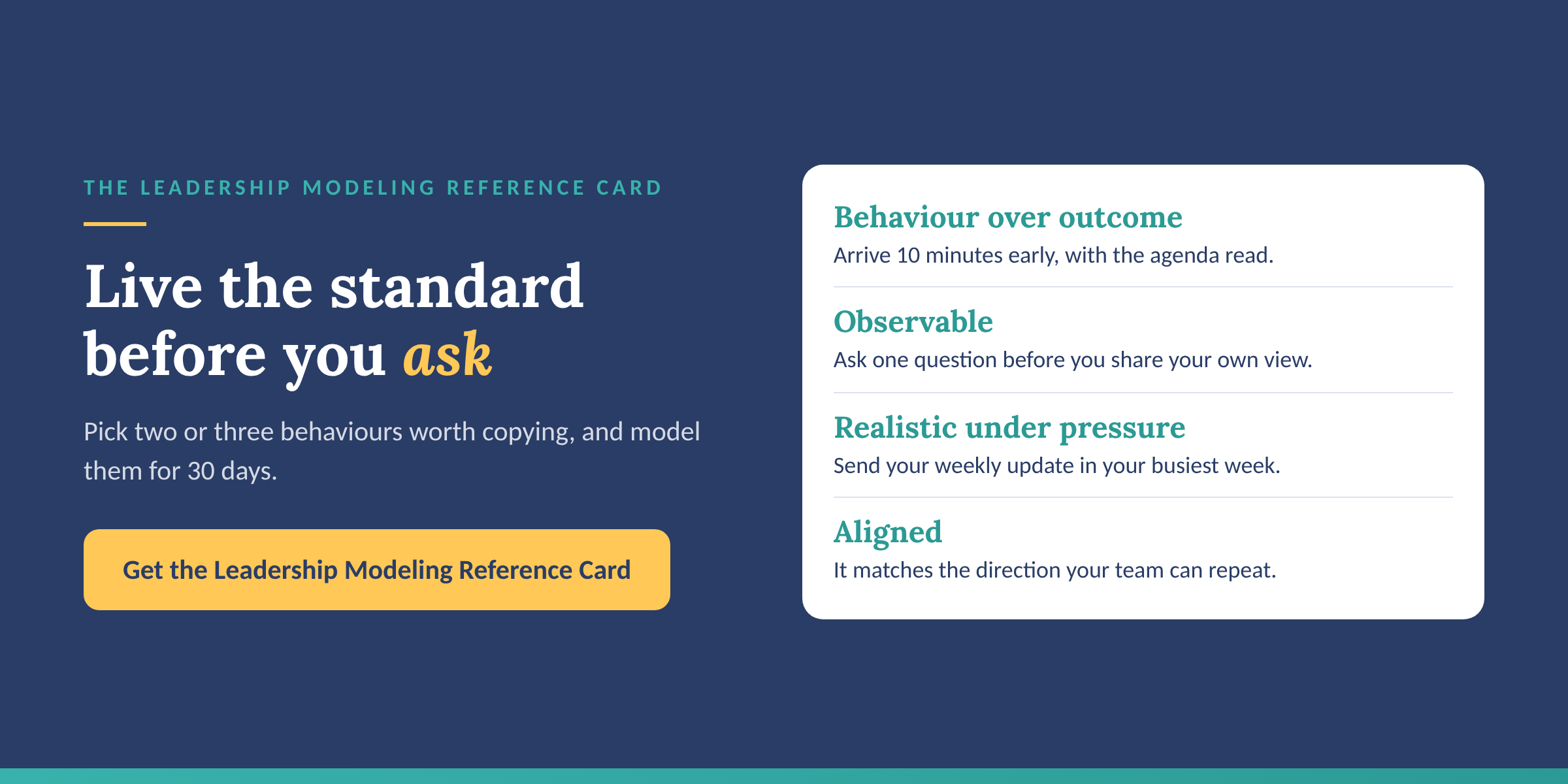
The Leadership Modeling Reference Card gives four rules for choosing a behaviour worth copying. Here’s how they apply to the examples in this post:
Behaviour over outcome. Arrive 10 minutes early, with the agenda read.
Observable. Ask one question before you share your own view.
Realistic under pressure. Send your weekly update in your busiest week.
Aligned. It matches the direction your team can repeat.
Model the behaviour in your own work for about 30 days before you ask anyone else to, and keep it in the weeks when your calendar is full, because those are the weeks your people watch most closely.
If you want to know how the people who work with you see these qualities in you, the Leadership Competency Assessment scores you from your own view and from observers, behaviour by behaviour, so you can see which one to practice first. 1:1 Leadership Development then develops you against the same competencies, practiced on your real work.
Frequently asked questions
What are good leadership qualities?
Good leadership qualities are the ones that make people want to follow a leader: clear direction, living the standards you expect of others, and building a team that learns and improves together. All three depend on trust, so being present, honest and good at the work matters as much as any single skill.
Do leadership qualities change in the AI era?
The core leadership competencies have stayed the same: setting direction, communicating, living the standards, asking for ideas and feedback, and improving. AI changes the day-to-day work leaders apply them to, and Gallup’s 2026 research shows clarity of expectations falling fastest among remote and hybrid employees in organizations adopting AI.
What is the trust triangle in leadership?
The trust triangle comes from Frances Frei and Anne Morriss, writing in Harvard Business Review in 2020. It names three drivers of trust: authenticity, logic and empathy. People trust a leader when they believe they’re seeing the real person, believe in the leader’s judgment, and believe the leader cares about them.
How can a leader show leadership qualities instead of claiming them?
Work backward from the quality. Ask what someone would need to see you do to believe you have it, such as setting clear priorities, keeping your commitments or asking for feedback, then do those things in your work this week. People judge leadership qualities by the behaviour they can see.
Become the leader people follow while the work keeps changing
If you’re working hard to lead well and you’re not sure which of these qualities your people see in you, a 30-minute discovery call helps you find the one to practice first. LoyaltyOps is a leadership development firm that develops individual leaders and leadership teams against clear leadership competencies, so performance improves across your organization.
Sources
Harter, J. “U.S. Employee Engagement Below 30% for First Time in 15 Years.” Gallup, October 28, 2026. Gallup Panel web survey of 21,648 US adults, August 5 to 19, 2026. https://www.gallup.com/workplace/716117/employee-engagement-below-30-first-time-years.aspx
Edelman, R. “Trust at Work: Transformation Triggering Trust Demise.” Edelman, October 6, 2026. Trust at Work study of more than 10,000 employees across ten markets. https://www.edelman.com/newsroom/richard-edelmans-6am-blog/trust-at-work-2026
Frei, F. X., and Morriss, A. “Begin with Trust.” Harvard Business Review, May to June 2020. https://hbr.org/2020/05/begin-with-trust
Video: Career Evolved, “Leadership in the AI Era: Do the Common Uncommonly Well (with Mickey Anderson),” November 24, 2026. https://www.youtube.com/watch?v=oRjT0DDOpIg
Related episode: UNLEASHED, “Why She Built Software for a Business Built on Trust | Olivia Gamber,” November 12, 2026. https://youtu.be/oChOzBxzowI