
How to Build Psychological Safety on Your Team
How to Build Psychological Safety on a Client-Service Team, So People Ask for Help Before Problems Become Crises
Quick answer: To build psychological safety on a client-service team, leaders explain the reasoning behind the work, respond to questions and mistakes with interest, share early drafts, and ask for disagreement before a decision is final. In a 2024 APA survey, workers with lower psychological safety were twice as likely to plan to look for a new job, 41% compared with 19%.
Key takeaways
Psychological safety is a shared belief that the team is safe for interpersonal risk, such as asking a question, admitting a mistake or disagreeing (Edmondson, 1999).
In a study of eight hospital units, the better-led units reported more errors, because people there were willing to say when something went wrong (Edmondson, 1996).
Workers with lower psychological safety were twice as likely to report emotional exhaustion, 34% compared with 17% (APA, 2024).
Psychological safety keeps high standards and accountability in place, and it’s built one interaction at a time (Edmondson and Kerrissey, HBR, 2025).
Four habits help a client-service team: a briefing before the work starts, a “what could go wrong?” review, a debrief after each deliverable, and blameless post-mortems.
The way you respond to the first mistake, hard question or disagreement teaches your team whether it’s safe to bring you the next one.
Watch a related episode of UNLEASHED, where Mickey Anderson, Co-Founder of LoyaltyOps, explains how leaders make room for real objections and how a premortem makes objecting part of the task.
Hear about the problem while you can still fix it
Your team will raise problems early when they see you act on what they tell you. The free Feedback Loops Blueprint helps your leadership team decide how you’ll ask, how you’ll listen and how you’ll tell people what changed because they spoke up.
Get the Feedback Loops Blueprint
Why does fear of speaking up hurt client service?
Fear of speaking up delays bad news until it’s expensive. When people on a client-service team don’t feel safe asking a question, admitting a mistake or questioning a deadline, the problem reaches the manager late, and often it reaches the client first.
A junior analyst notices two days before a deadline that a number in the model doesn’t reconcile, and decides to fix it quietly rather than admit they don’t understand the source data. A consultant knows the timeline the partner gave the client can’t be met, and says nothing because the last person who pushed back was told to “figure it out.” By the time either problem comes out, the deliverable is late or wrong, and the client is the one who finds the error.
Amy Edmondson, a professor at Harvard Business School, found this effect before it had a name. In a study of drug administration errors on eight hospital units in two hospitals, published in the Journal of Applied Behavioral Science in 1996, she expected the better-led units to have fewer errors. They reported more. Her reading was that people on those units were more willing to say when something went wrong, while people on the units with punitive managers kept mistakes to themselves, so fewer were caught and learned from.
Client-service work carries the same risk, because a mistake nobody mentions goes to the client uncorrected.
The cost reaches your people too. The American Psychological Association’s 2024 Work in America survey, conducted online by The Harris Poll with 2,027 employed U.S. adults in March and April 2024, compared workers who reported higher and lower psychological safety. The survey used an opt-in panel, and the answers are self-reported.
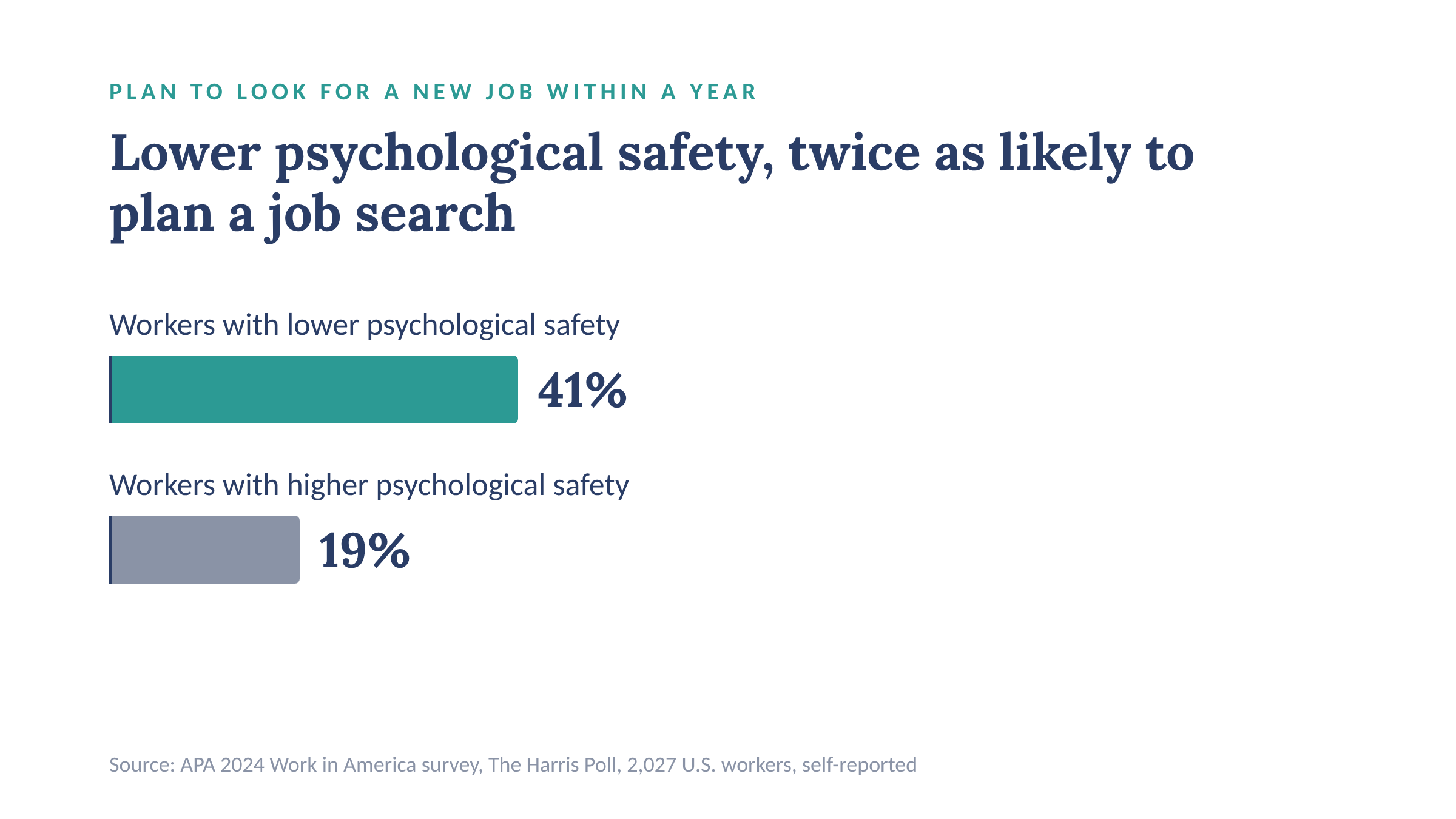
Workers with lower psychological safety were twice as likely to plan to look for a new job, 41% vs 19%, APA 2024.
41% of workers with lower psychological safety intended to look for a new job within a year, compared with 19% of workers with higher psychological safety.
34% of workers with lower psychological safety reported emotional exhaustion in the past month, compared with 17%.
Workers with higher psychological safety were more likely to say they had opportunities to give feedback, 62% compared with 39%.
What is psychological safety, and what doesn’t it mean?
Psychological safety is a shared belief among the members of a team that it’s safe to take interpersonal risks, such as asking for help, admitting an error or disagreeing with a more senior person. It describes the team, so two teams in the same organization can have very different levels of it.
Edmondson defined the term in a 1999 study of 51 work teams in a manufacturing company, published in Administrative Science Quarterly. Teams with more psychological safety showed more learning behaviour, such as asking questions, seeking feedback and talking about mistakes, and that learning behaviour was linked to team performance. Google’s re:Work research on 180 of its own teams, published in 2015, listed psychological safety first of the five dynamics it found in its most effective teams.
In the May to June 2025 issue of Harvard Business Review, Edmondson and Michaela Kerrissey of the Harvard T.H. Chan School of Public Health described the most common ways leaders misread it. Here’s what their research shows on each point:
Niceness. Candour and honest feedback are expected, even when the conversation is uncomfortable.
Agreement. Leaders listen to everyone’s view and still make the decision.
Accountability. Managers still address mistakes and performance.
Policy. The authors describe it as built in a group, one interaction at a time, so a policy can’t create it.
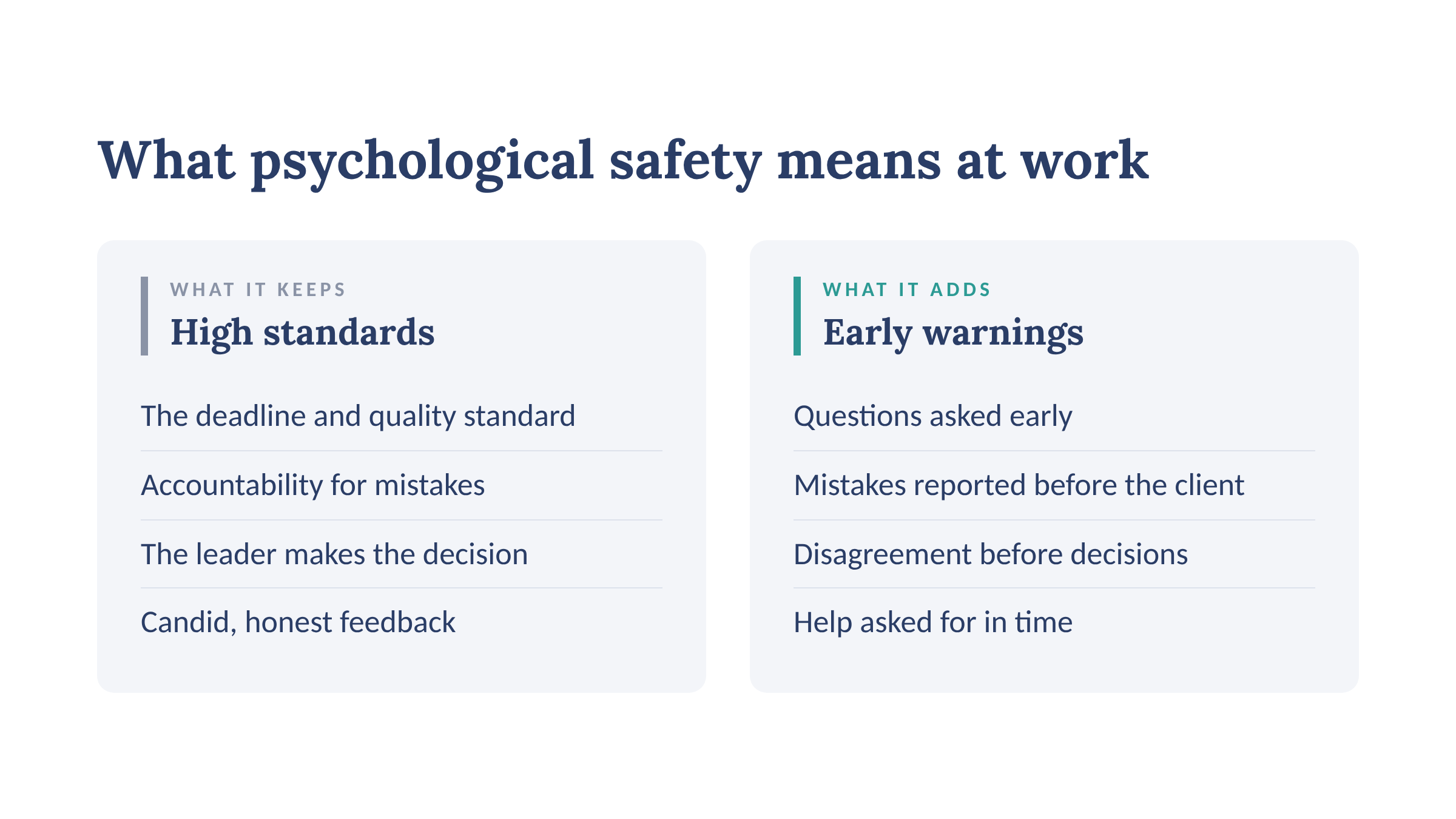
Psychological safety at work means candour, questions and early warnings, with high standards and accountability kept.
For a client-service team, that means the deadline, the quality standard and the client’s expectations stay the same. What changes is how early people tell you they’re at risk of missing them. Edmondson’s work pairs psychological safety with high standards, because a team needs both to learn quickly and do excellent work.
Which leadership behaviours create psychological safety?
Leaders create psychological safety through small, repeated behaviours that show people it’s worth speaking up. Five behaviours make the biggest difference on client-service teams.
Explain the why
When people know why the client wants something and what the deliverable is for, they can tell when something looks wrong, and they have a reason to say so. Give the context behind each assignment, including what the client will do with the work and what a good result looks like. Our post on how to give feedback to junior staff without taking over their work covers how to explain your reasoning when you review a draft.
Respond well to questions
The first question a new team member asks you decides whether they’ll ask a second one. Thank people for asking, answer the question they asked, and if the answer is in a document they missed, show them where it is without commenting on whether they should have found it.
Normalize early drafts
Ask for a rough version early, and say plainly that you expect it to be incomplete. A 30 percent draft reviewed on day two gives you time to correct the direction, while a polished draft that’s wrong on the deadline day gives you none.
Own your mistakes
When you get something wrong, say so in front of the team, describe what you’ll do differently, and move on. People learn how to handle their own mistakes by watching how their leader handles theirs.
Invite dissent
Ask for objections before a decision is final, and wait for an answer. Research by Charlan Nemeth, Keith Brown and John Rogers, published in 2001 and discussed on UNLEASHED, found that genuine disagreement produced new thinking on both sides of an issue, while an assigned devil’s advocate mostly led people to defend their first position. Ask “What would make this plan fail?” or “Who sees this differently?”, and give people a few minutes to write their answer before anyone speaks.
Which behaviours destroy psychological safety?
Psychological safety erodes quickly when people see that speaking up costs them something. These five behaviours do the most damage, and leaders who use them often don’t notice they’re doing it.
Blame. Asking “Whose fault is this?” before “What happened?” teaches people to hide the next problem.
Ridicule. A joke about a question or a mistake, even a mild one, tells everyone listening what happens when they ask.
Favouritism. When some people’s questions get patience and others’ get impatience, the second group stops asking.
Unpredictable reactions. If the same bad news gets a calm response one week and anger the next, people wait to see your mood before they tell you anything.
Punishing requests for help. When the person who asks for help is seen as weaker, or gets more work as a result, people stop asking and start guessing.
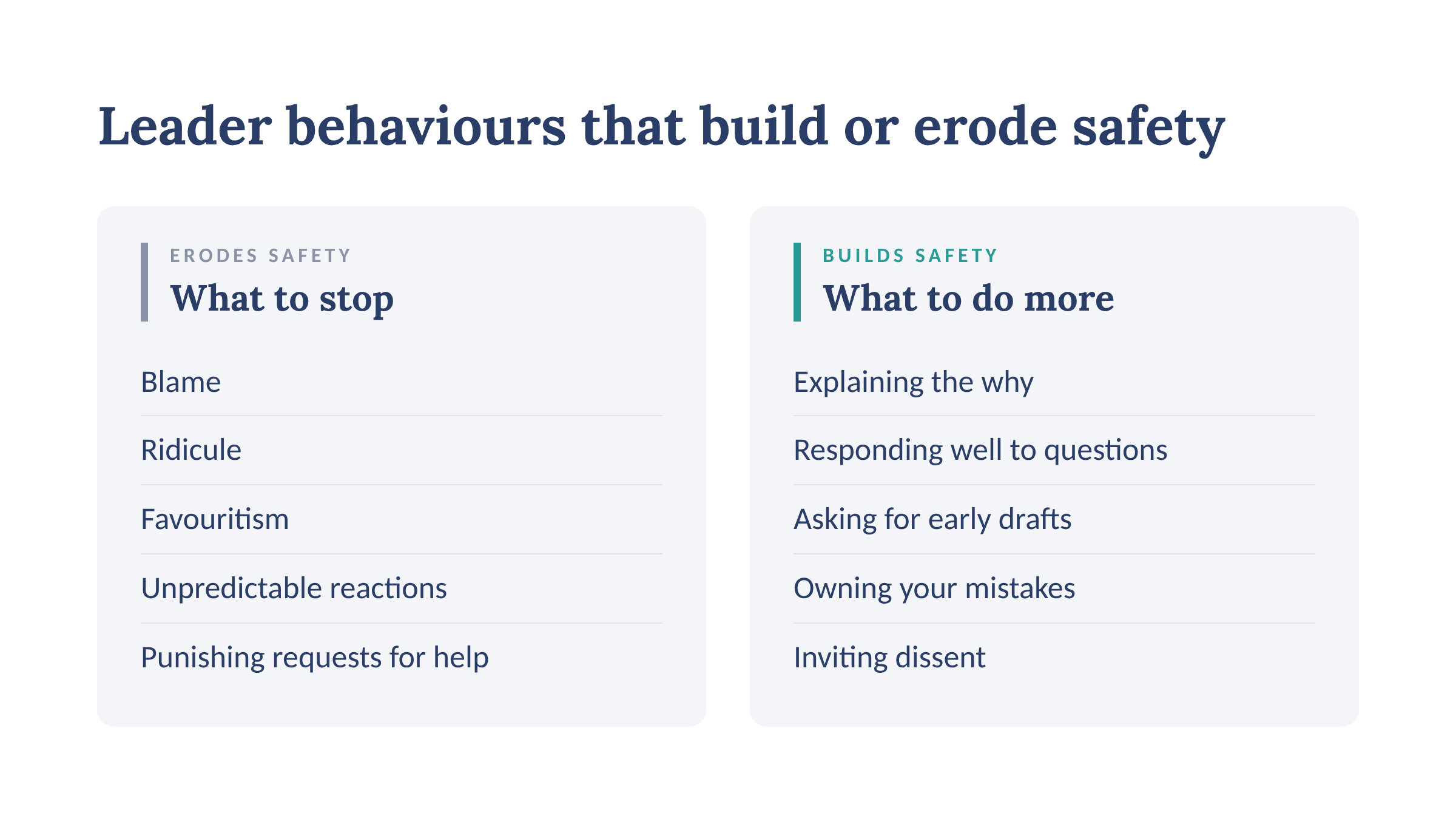
Five leader behaviours that build psychological safety in teams, and five that erode it.
The manager’s reaction matters most because it’s what people experience every day. Gallup found managers account for 70% of the variance in employee engagement across business units, in research published in 2015. In an organization of 30 to 300 people, each manager’s reaction to bad news shapes how a whole team works with clients, and the senior leaders set the example the managers copy. A Leadership Competency Assessment shows how each leader’s behaviour is seen by the people who work with them, which helps you see whether safety is a gap on one team or across your organization.
What rituals build psychological safety on a client-service team?
Rituals make speaking up a routine part of the work, so nobody has to decide whether it’s worth the risk. Four habits fit naturally into client delivery.
A briefing before the work starts
Before a deliverable starts, the manager explains the client’s goal, the deadline, the quality standard and the known risks, and then each person describes the task back in their own words. A Back Briefing takes about a minute and shows both of you where the understanding differs, before any work is done on a wrong assumption.
A “what could go wrong?” review
At the start of a large deliverable, ask the team to imagine it’s the deadline and the work has gone badly, and to write down why. Gary Klein called this a premortem in Harvard Business Review in 2007, and he cites research by Deborah Mitchell, Jay Russo and Nancy Pennington showing that imagining an event has already happened increases the ability to correctly identify reasons for future outcomes by 30 percent. The review makes raising a concern the assignment, so nobody has to volunteer it.
A retrospective debrief
After each major deliverable, spend 20 to 30 minutes on four questions: what we planned, what happened, why it was different, and what we’ll change next time. An After Action Review gives the team an agenda for it that ends in one real change.
Blameless post-mortems
When something goes wrong with a client, review it with the same four questions, and agree before you start that the review is about the work and the process. Start with what each person knew at the time, and look for the conditions that made the mistake likely, such as a missing review step or an unclear handoff. Our post on post-mortems and After Action Reviews explains why reviewing what went well matters as much as reviewing what failed.
What should you say when someone makes a mistake, asks a hard question or disagrees?
Say thank you first, then deal with the work. These scripts give you words for the three moments that teach your team the most about whether it’s safe to speak up.
When someone makes a mistake
“Thanks for telling me now. That gives us time to fix it before it goes to the client. Walk me through what happened, and then let’s agree on the fix and who’ll tell the client if we need to.”
Later, once the fix is in: “What would have helped you catch this sooner? I want to change that for the whole team.”
When someone asks a difficult question
“That’s a fair question, and I don’t have a full answer yet. Here’s what I know, here’s what I don’t, and I’ll come back to you by Thursday with the rest.”
If the question challenges a decision you made: “I’m glad you asked. Here’s the reasoning behind it. Tell me what you’re seeing that I might have missed.”
When someone disagrees with you
“Thank you for raising it. Tell me more about what you’re seeing. What would you do instead, and what would it cost us?”
If you decide to keep your original plan: “I’ve thought about what you said, and I’m keeping the plan because of the client’s date. You were right to raise it, and here’s what I’m changing because of your point.”
The second line in each script matters as much as the first. People keep speaking up when they see that what they said made a difference, even when the decision didn’t go their way. When the pressure behind the disagreement is a deadline the team can’t meet, our post on how to protect your team from unrealistic client deadlines covers how to renegotiate with the client or partner.
Frequently asked questions
What is psychological safety in a team?
Psychological safety is a shared belief among team members that it’s safe to take interpersonal risks, such as asking a question, admitting a mistake or disagreeing with a more senior person. Amy Edmondson defined it in a 1999 study of 51 work teams, and found that teams with more psychological safety showed more learning behaviour, which was linked to team performance.
Does psychological safety mean lowering standards?
Psychological safety keeps standards and accountability in place. Edmondson and Kerrissey wrote in Harvard Business Review in 2025 that it means candour is expected, leaders still make the decision after hearing from everyone, and managers still address mistakes and performance. On a client-service team, the deadline and quality standard stay the same, and people tell you sooner when they’re at risk.
How do you build psychological safety on a client-service team?
Explain the reasoning behind each assignment, respond well to questions, ask for early drafts, admit your own mistakes and ask for disagreement before decisions are final. Then add habits that make speaking up routine: a briefing before the work starts, a “what could go wrong?” review, a debrief after each deliverable and blameless post-mortems when something goes wrong.
How should a manager respond when someone makes a mistake?
Thank the person for telling you, because it gives you time to fix it. Ask them to walk you through what happened, agree on the fix and who’ll tell the client if needed, and later ask what would have helped them catch it sooner. Your response to the first mistake teaches the team whether it’s safe to report the next one.
How do you know if your team has psychological safety?
Look at what reaches you and when. On a team with psychological safety, people ask questions early, share rough drafts, tell you about mistakes before the client finds them and disagree with you in meetings. If problems usually come out at the deadline, or only the same few people speak up, your team likely doesn’t feel safe taking those risks.
Help your leaders become the people their teams bring problems to
If problems on your teams come out at the deadline, or your managers are the last to hear about a mistake, a conversation with us is a good place to start. LoyaltyOps is a leadership development firm that develops individual leaders and leadership teams against clear leadership competencies, so performance improves across your organization.
Sources
Amy C. Edmondson, Learning from Mistakes Is Easier Said Than Done: Group and Organizational Influences on the Detection and Correction of Human Error, Journal of Applied Behavioral Science, 32(1), eight patient care units in two hospitals, March 1996
Amy C. Edmondson, Psychological Safety and Learning Behavior in Work Teams, Administrative Science Quarterly, 44(2), 51 work teams in a manufacturing company, June 1999
Amy C. Edmondson and Michaela J. Kerrissey, What People Get Wrong About Psychological Safety, Harvard Business Review, May to June 2025, summarized by the Harvard T.H. Chan School of Public Health in Debunking misconceptions about workplace psychological safety, June 26, 2025
American Psychological Association, 2024 Work in America Survey: Psychological Safety in the Changing Workplace, conducted online by The Harris Poll with 2,027 employed U.S. adults, March 25 to April 3, 2024, opt-in sample, June 2024
Google re:Work, Guide: Understand team effectiveness, 180 Google teams (115 engineering teams and 65 sales teams), originally published 2015
Charlan Nemeth, Keith Brown and John Rogers, Devil’s advocate versus authentic dissent: stimulating quantity and quality, European Journal of Social Psychology, 31, pages 707 to 720, 2001
•Gary Klein, Performing a Project Premortem, Harvard Business Review, September 2007
•Randall Beck and Jim Harter, Gallup, Managers Account for 70% of Variance in Employee Engagement, April 21, 2015