
How to Give Feedback to Junior Staff
“This Is Wrong” Isn’t Feedback: How to Give Feedback to Junior Staff Without Taking Over Their Work
To give feedback to junior staff without taking over their work, review it against an agreed standard: name the standard, point to the issue, explain why it matters, ask how they’d fix it, and agree on the next step. Gallup found only 21% of US employees strongly agree they got meaningful feedback in the last week.
Key takeaways
Only 21% of US employees strongly agreed they had received meaningful feedback in the last week, in a Gallup report drawn from a February 2022 survey of 14,705 workers.
A 1996 meta-analysis of 607 effect sizes found that more than one in three feedback interventions made performance worse, and feedback worked less well when it drew attention to the person instead of the task.
Correction-only feedback fixes the draft in front of you and keeps the reasoning with the reviewer, so the same mistake comes back on the next file.
A five-step review (the standard, the issue, the reasoning, the person’s thinking and the next action) turns each review into teaching.
When the client deadline leaves no time to teach, fix the draft with tracked changes and hold a ten-minute debrief within two working days.
Related episode: Mickey Anderson on UNLEASHED, on why people guess at what’s expected and find out whether they guessed right when feedback arrives.
Hear about problems while there’s still time to fix them
Many weak drafts start earlier than the review, when a junior gets stuck and doesn’t say so. The Feedback Loops Blueprint shows you how to make it normal for your people to raise problems early, and to hear back on what you did about them.
Get the Feedback Loops Blueprint
Why does correction-only feedback lead to repeat mistakes?
Correction-only feedback fixes the draft in front of you and leaves the person without the reason behind each change. They learn what you changed this time, so when a similar problem comes up on the next file, they guess again and the same mistake returns.
Correction-only feedback causes three problems that build on each other:
Dependence. When every review ends with your edits, the person learns that the real standard is whatever you’ll write, so they check their own work less and wait for your version.
Anxiety. A page of corrections with no explanation reads as a judgment on the person, and some people respond by holding drafts back until they feel sure, which leaves less time to review them.
Repeat mistakes. The reasoning stays with the reviewer, so the person can fix this sentence but can’t spot the next one.
Meaningful feedback is less common than many managers expect. In a June 2022 report, Gallup said only 21% of US employees strongly agreed they had received meaningful feedback in the last week. The report’s methods note describes a February 2022 Gallup Panel web survey of 14,705 adults working full or part time for US organizations, and the answers are self-reported.
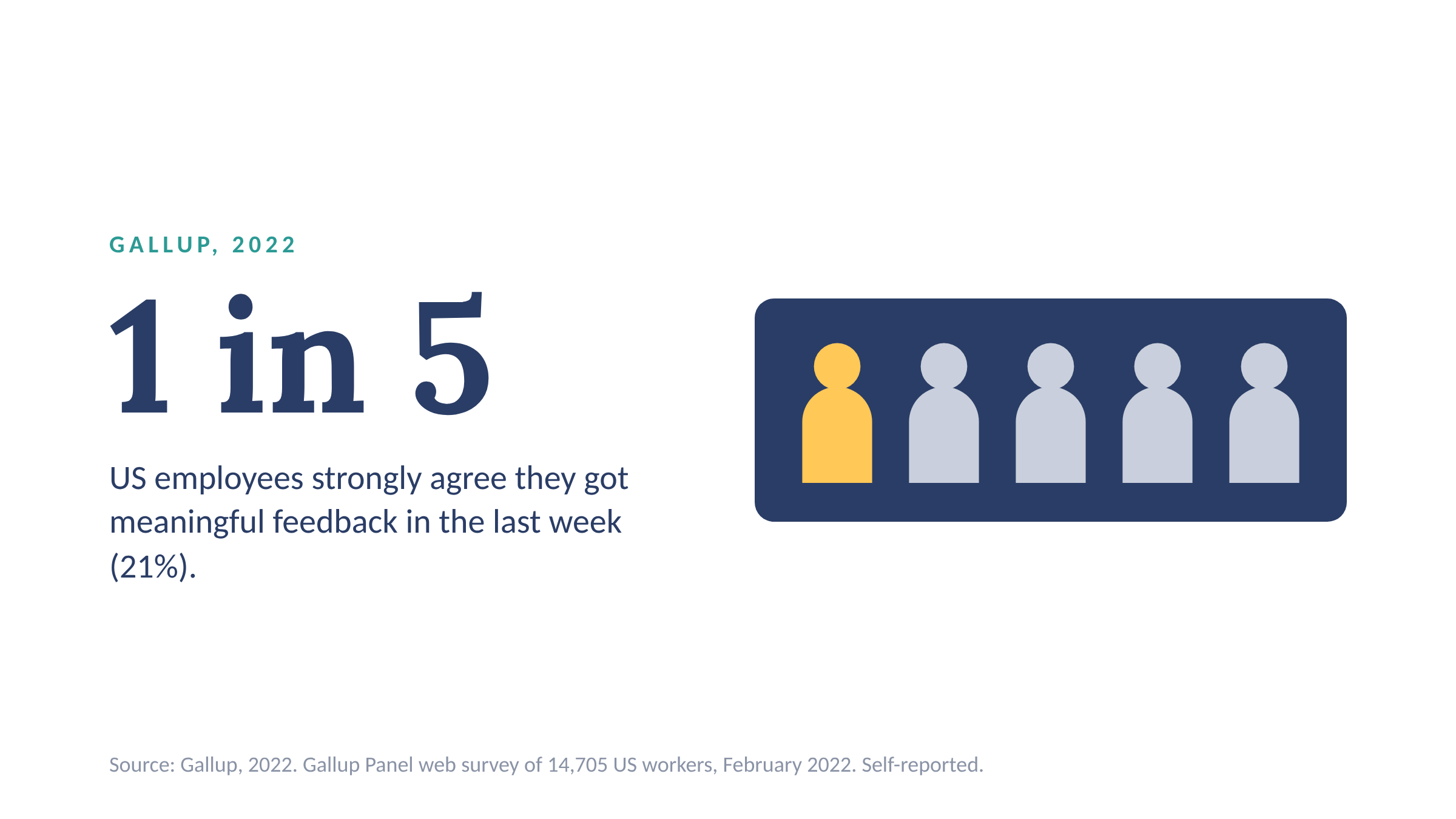
Gallup found only 21% of US employees strongly agree they got meaningful feedback in the last week.
Feedback can also make performance worse. In a 1996 meta-analysis in Psychological Bulletin, Avraham Kluger and Angelo DeNisi reviewed 607 effect sizes covering 23,663 observations. Feedback improved performance on average, yet more than a third of the feedback interventions they studied lowered it, and feedback became less effective the more it pulled attention toward the person and away from the task.
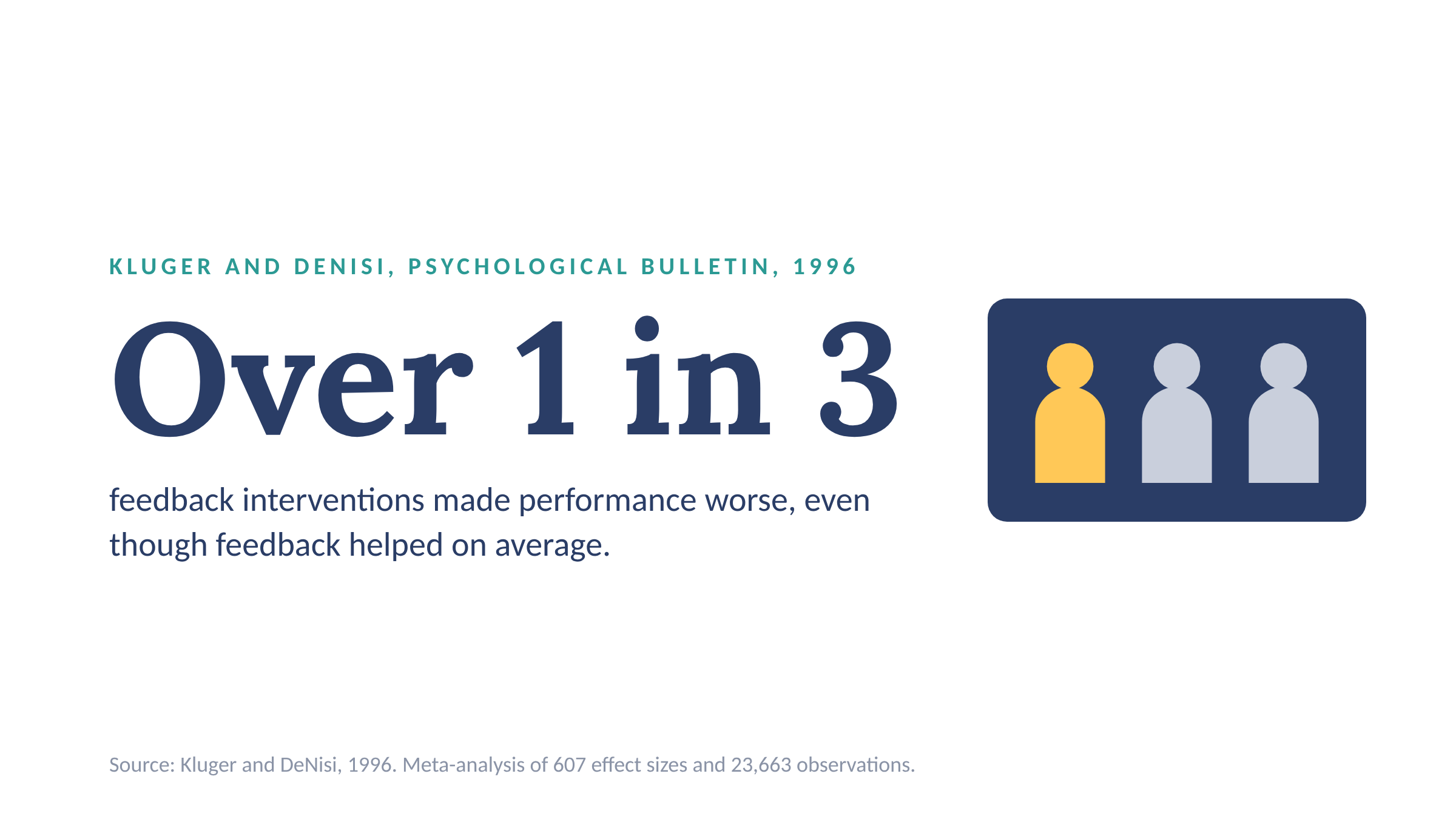
A 1996 meta-analysis of 607 effect sizes found more than 1 in 3 feedback interventions made performance worse.
What’s the difference between reviewing a deliverable, teaching a capability and coaching a person?
Reviewing a deliverable gets this piece of work ready for the client. Teaching a capability gives the person the skill to get it right next time without you. Coaching a person helps them think through their own work and judgment, so they can solve problems you haven’t seen yet.
Reviewing a deliverable
The focus is the work, and the question is whether it’s ready for the client. It’s the part managers already do, because the client’s deadline makes it happen.
Teaching a capability
The focus is one skill the person will use again, such as writing an executive summary that answers the client’s question in the first paragraph. You explain the reasoning, show a good example, and have them apply it to the next section while you watch how they do it.
Coaching a person
The focus is how the person thinks about their work. Coaching asks more than it tells, with questions such as “What would you check before sending this?” or “Where did you get stuck, and what did you try?”
A good fifteen-minute review often does all three. Problems start when every review ends at the first one, because the deliverable improves while the person’s skills stay where they were.
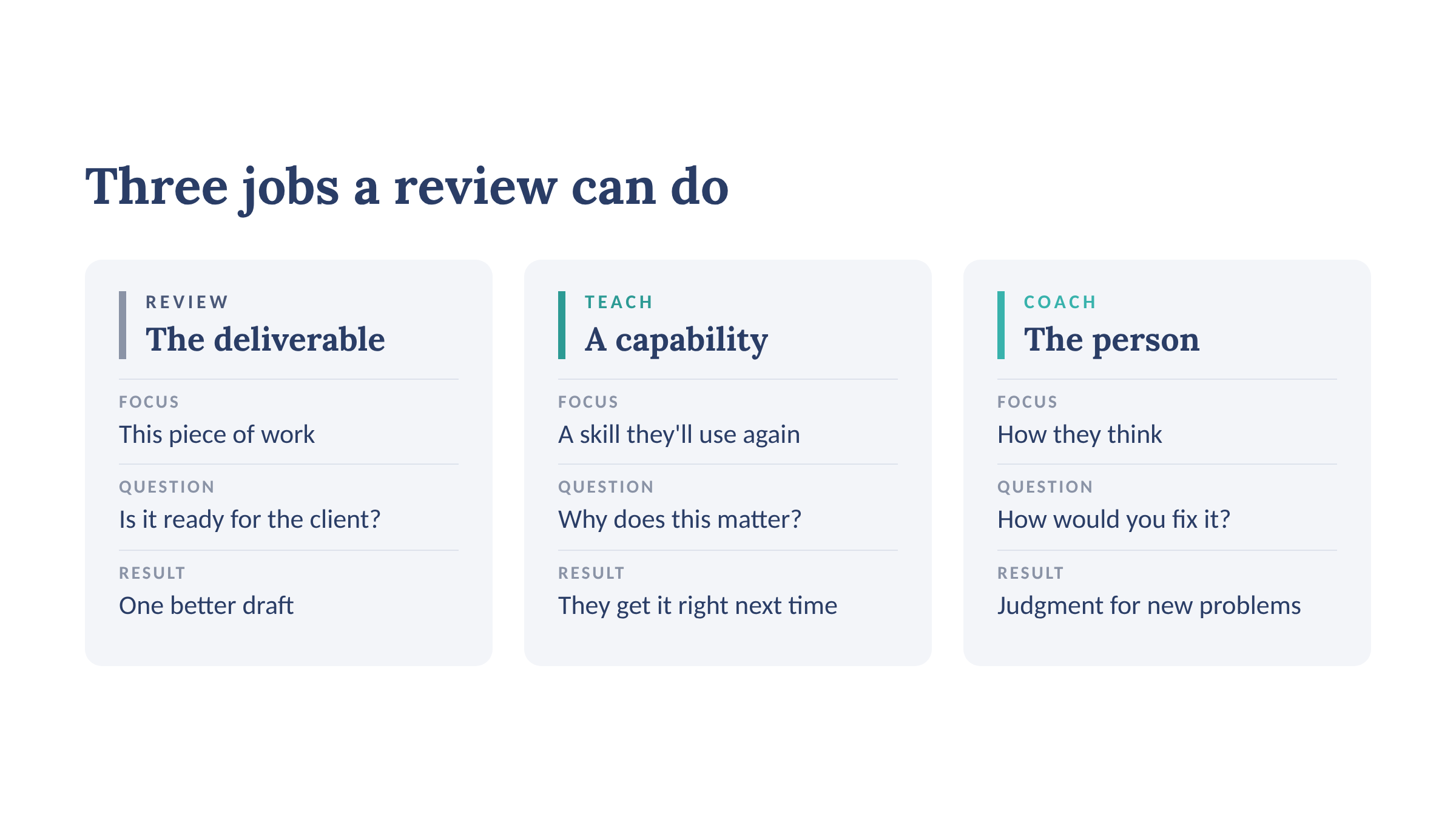
Three kinds of feedback compared: reviewing a deliverable, teaching a capability and coaching a person.
How do you give feedback to junior staff without taking over their work?
Use a five-step review: clarify the standard, identify the issue, explain the reasoning, invite the person’s thinking, and agree on the next action. The steps keep the work with the person who did it while making sure the client still receives a deliverable that meets the standard.
1. Clarify the standard
Start with what good looks like for this deliverable, ideally agreed before the work began. In a Gallup Panel survey of 21,648 US adults in August 2026, just 46% of employees strongly agreed they know what’s expected of them at work, so many weak drafts miss a standard the person didn’t fully understand. If the standard wasn’t clear, say so and own that part. Our post on how to set clear expectations for employees covers how to agree on the standard before work starts.
2. Identify the issue
Point to the specific place in the work and describe what you see, such as “The recommendation in section 2 doesn’t say which option we’d choose.” Keep to the two or three issues that matter most to the client, and leave matters of personal style out or label them as optional.
3. Explain the reasoning
Say why the issue matters: who will read the work, what they’ll do with it, and what goes wrong if it stays as it is. The reasoning is what the person takes to the next deliverable, so keep this step even when time is short.
4. Invite the person’s thinking
Ask before you suggest, with a question such as “What were you aiming for here?” or “How would you fix it?” Their answer tells you whether the gap comes from a missing skill, missing context or too little time, and each one needs a different response from you.
5. Agree on the next action
End with who does what by when: the revision, the date it’s due, and anything the person needs from you or the client. Then hand the draft back to the same person to revise.
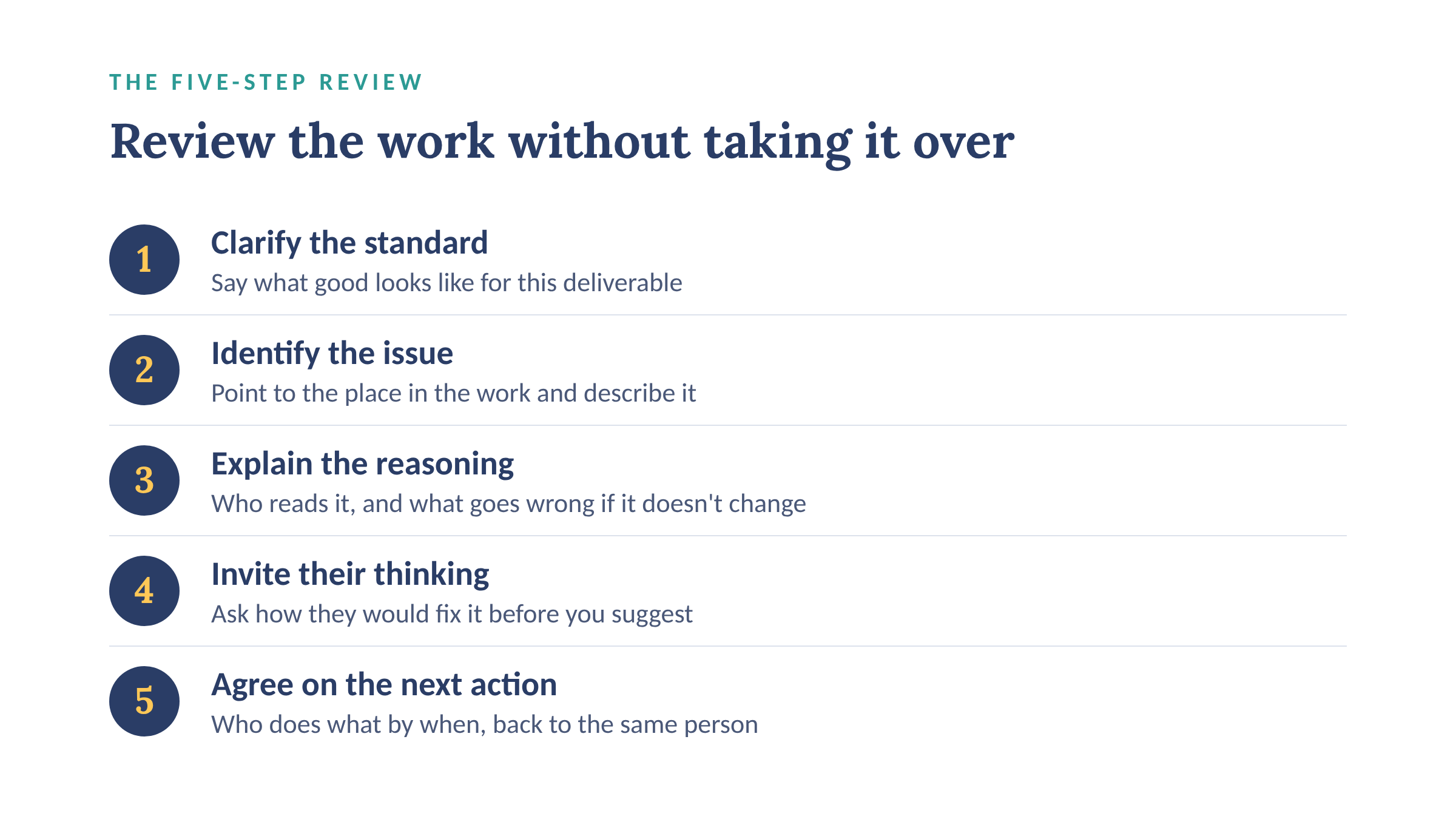
Five steps to review junior staff work: clarify the standard, issue, reasoning, their thinking, next action.
Before you open the draft
Take two minutes to answer five questions, so the review stays on what matters to the client:
What’s the standard for this deliverable, and did I explain it before the work started?
Which two or three issues matter most to the client?
Which of my comments are personal preference, and can I leave them out or label them as optional?
How much time is left before the client deadline?
What’s one specific thing in this work that I’d like the person to repeat?
What should you say when you review junior work?
Each script below follows the five steps. Replace the brackets with the specifics, and keep the questions, since they turn the review into teaching.
A weak first draft
“Thanks for sending this early, because it gives us time to improve it. Before I comment, tell me what you think the client most needs from this. [Listen.] For this report, good looks like [standard], and right now the draft [specific issue]. That matters because [reason for the client]. What would you change first? Send me a revised outline by [time] before you rewrite the rest.”
Early drafts are the cheapest ones to fix, so thanking people for sending them makes early drafts more likely next time.
Repeated errors
“This is the third time I’ve seen [specific error], so I’d like to look at it with you before I correct it again. When it reaches the client, [effect on the client or the work]. Walk me through how you check for this before you send a draft. [Listen.] What would make it easier to catch? Let’s add [agreed check] to your process, and I’ll look for it on the next two files.”
A repeated error usually means the reason or the check didn’t transfer, so this script looks at how the person checks the work.
A missed deadline
“The draft was due [date] and arrived [date], which shortened our review time before the client deadline. Help me understand what happened. [Listen.] Next time a date is at risk, tell me as soon as you can see it, so we can change the plan together. On the next deliverable, what checkpoint would help you see a delay sooner?”
The script treats the late warning as the bigger issue, because an early warning gives the manager options that a late one doesn’t.
A client-ready deliverable
“This is ready to send. The summary answers the client’s question in the first paragraph, and the figures reconcile on the first pass. That’s what I’d like on every report for this client. What did you do differently this time?”
Specific recognition tells the person exactly what to repeat, and the closing question helps them notice their own method.
Strong work that needs refinement
“The analysis is strong, and the client will trust it. To make it client-ready, I’d change two things: [first change] and [second change], because [reason]. The rest can go as it is. Which of the two would you like to start with?”
Naming a limit, two changes in this case, tells the person the work is close and keeps the review from growing into a rewrite.
How do you give feedback without damaging confidence or morale?
Keep the feedback about the work, explain why each point matters, be as specific about what worked as about what didn’t, and give corrections in private. Confidence drops when feedback sounds like a verdict on the person, and it grows when people leave the conversation knowing what to do next.
Gallup’s research shows how often conversations with managers fall short. In a study of nearly 15,000 employees, reported in May 2023, Gallup found that only 16% said their last conversation with their manager was extremely meaningful. The characteristics Gallup found most often in meaningful conversations, in order, were recognition or appreciation for recent work, collaboration and relationships, and current goals and priorities. The same article reports that 80% of employees who say they received meaningful feedback in the past week are fully engaged, without giving that figure’s sample size.
Describe the work. “The recommendation doesn’t name an option” gives the person something to act on, while “You missed the point” gives them a judgment to absorb.
Name what worked. Point to the specific paragraph, calculation or decision you’d like to see again.
Ask before you tell. The person’s thinking often shows the fix, and finding it themselves builds confidence.
Correct in private. Give corrections one-to-one, and save public comments for recognition.
Close the loop. Tell the person when their revision meets the standard, so they know the change worked.
How do you balance client urgency with a junior’s development?
Separate what the client needs today from what the person needs to learn. When the deadline allows, use all five steps and let the person revise. When it doesn’t, fix the draft yourself with tracked changes and hold a ten-minute debrief within two working days, so the client gets the work on time, and the person still gets the reasoning.
Time before the client deadline | What to do |
More than two working days | Use the full five-step review, and the person revises |
One to two working days | Name the must-fix issues and the reasons, the person revises, and you check it the same day |
Less than a day | Make the edits with tracked changes, send the work, and debrief within two working days |
Put the debrief in the calendar before you send the client’s version, since it’s the step that slips first. Setting an internal deadline two working days before the client’s, as our post on how to delegate client work without losing quality describes, keeps more reviews in the first row of the table. After a large deliverable, an After Action Review with the people who did the work captures what to change on the next one.
In organizations of 30 to 300 people, the manager reviewing a draft is often the client lead as well, and there’s rarely a separate training team to teach the reasoning later, so reviews are where juniors learn the work. It also helps when your managers agree on what a good deliverable looks like for each type of work, so juniors don’t get opposite corrections from two reviewers.
Where to start this week
Pick one review you have scheduled this week.
Write down the standard for that deliverable before you open the draft.
Use the five steps and keep to three comments or fewer.
Ask “How would you fix it?” before you suggest a change.
At the end, ask the person which part of the review helped most, and use the answer in the next one.
If you’d like to see where your managers stand on giving feedback and the leadership competencies connected to it, the Leadership Competency Assessment gives you a starting measure.
Frequently asked questions
How do you give feedback to junior staff without discouraging them?
Keep the feedback about the work, explain why each point matters to the client, and name what worked as specifically as what didn’t. Limit corrections to two or three, ask how they would fix the issue before you suggest a change, and give corrections in private. When they revise it, tell them the revision meets the standard.
How many points of feedback should you give on a draft?
Two or three points that matter most to the client are usually enough. Sort your comments into must-fix issues, such as accuracy, scope and risk, then clarity, then personal preference. Send the first two groups, and label preferences as optional or leave them out, so the person spends their revision time on what matters.
What should you do when a junior keeps making the same mistake?
Stop correcting it and look at how they check their work. Name the error and how often you’ve seen it, explain its effect on the client, and ask them to walk you through their checking process. Agree on one added check, and look for it on the next two pieces of work.
Should you fix a junior’s work yourself when the deadline is tight?
When less than a day is left before the client deadline, fixing it yourself is often the right call. Use tracked changes so every edit is visible, send the work, and hold a ten-minute debrief within two working days to explain the reasoning. With more time, return the draft to the person to revise.
What’s the difference between feedback and coaching?
Feedback tells the person how their work compares with the standard and what to change. Coaching helps them think through the work themselves, mostly by asking questions such as “What would you check before sending this?” A good review uses both, starting with the feedback the client needs and ending with a question that builds their judgment.
Ready for reviews that build your people’s skills?
If your managers are correcting the same issues on every draft, a conversation with us is a good place to look at how reviews work across your teams and what your leaders need to coach through them. LoyaltyOps is a leadership development firm that develops individual leaders and leadership teams against clear leadership competencies, so performance improves across your organization.
Sources
Marco Nink and Jennifer Robison, Gallup, Give Feedback Like a Coach, June 16, 2022. Methods note: Gallup Panel web survey of 14,705 adults working full or part time for US organizations, February 2022. Self-reported.
Gallup, A Great Manager’s Most Important Habit, May 29, 2023, updated February 16, 2026. Study of nearly 15,000 employees; no sample size given for the 80% figure. Self-reported.
Avraham N. Kluger and Angelo DeNisi, The Effects of Feedback Interventions on Performance: A Historical Review, a Meta-Analysis, and a Preliminary Feedback Intervention Theory, Psychological Bulletin, 119(2), 254 to 284, March 1996. 607 effect sizes, 23,663 observations.
Jim Harter, Gallup, U.S. Employee Engagement Below 30% for First Time in 15 Years, Gallup Panel of 21,648 US adults surveyed August 5 to 19, 2026, October 28, 2026.
UNLEASHED by LoyaltyOps, Only 46% Strongly Agree They Know What’s Expected, related episode, November 5, 2026.