
Delegate Client Work Without Losing Quality
How to Delegate Client Work Without Losing Quality: A Practical System for Professional-Services Managers
To delegate client work without losing quality, decide what you’re handing over (the task, the ownership or the decision), then name the outcome, constraints, quality standard, checkpoints and escalation path before work starts. Review against that standard instead of your own version. DDI found that only 19% of more than 70,000 manager candidates showed strong delegation skills.
Key takeaways
Only 19% of more than 70,000 manager candidates assessed by DDI showed strong delegation skills.
DDI’s Global Leadership Forecast 2025, based on 10,796 leaders, found that distributing work had five times the impact of any other method for reducing leader burnout.
Delegating a task, delegating ownership and delegating a decision are three different hand-offs, and naming which one you mean prevents most missed expectations.
A hand-off keeps its quality when it names five things: the outcome, the constraints, the quality standard, the checkpoints and the escalation path.
Reviewing a draft against the agreed standard, with two or three changes that matter to the client, develops the person and keeps the work theirs.
Related episode: Mickey Anderson on decision ownership, and how it differs from delegation, on UNLEASHED.
Plan your next hand-off on one page
The Decision Rights Map includes a fillable hand-off card that names the six things a new owner needs to do the work well, with a worked example. Use it to plan one real piece of client work you’ll delegate this week.
Why do managers keep doing client work they should delegate?
Managers keep client work because a mistake feels personal and immediate, while the cost of doing it themselves stays hidden until their week is full. Four pressures usually cause it: fear of errors, client expectations, time pressure and limited confidence in the people they’d hand it to.
Fear of errors. The client sees the work, and a mistake carries the manager’s name and the firm’s. Redoing it feels safer than explaining what good looks like.
Client expectations. Clients often expect the senior person they met at the start, and managers worry that a new name on the email reads as a downgrade.
Time pressure. Explaining a deliverable takes longer than doing it the first time, so under a deadline the manager does it, and the explanation still hasn’t happened the next time.
Confidence in juniors. When a junior’s last draft needed heavy edits, the manager stops sending similar work, so the junior gets less practice, and the gap stays.
The skill is less common than most leaders expect. In its Global Leadership Forecast 2025, based on 10,796 leaders worldwide, DDI reported that leaders’ ability to distribute work had five times the impact of any other burnout-reduction method it measured. In separate assessments of more than 70,000 manager candidates, DDI found that only 19% showed strong delegation abilities.
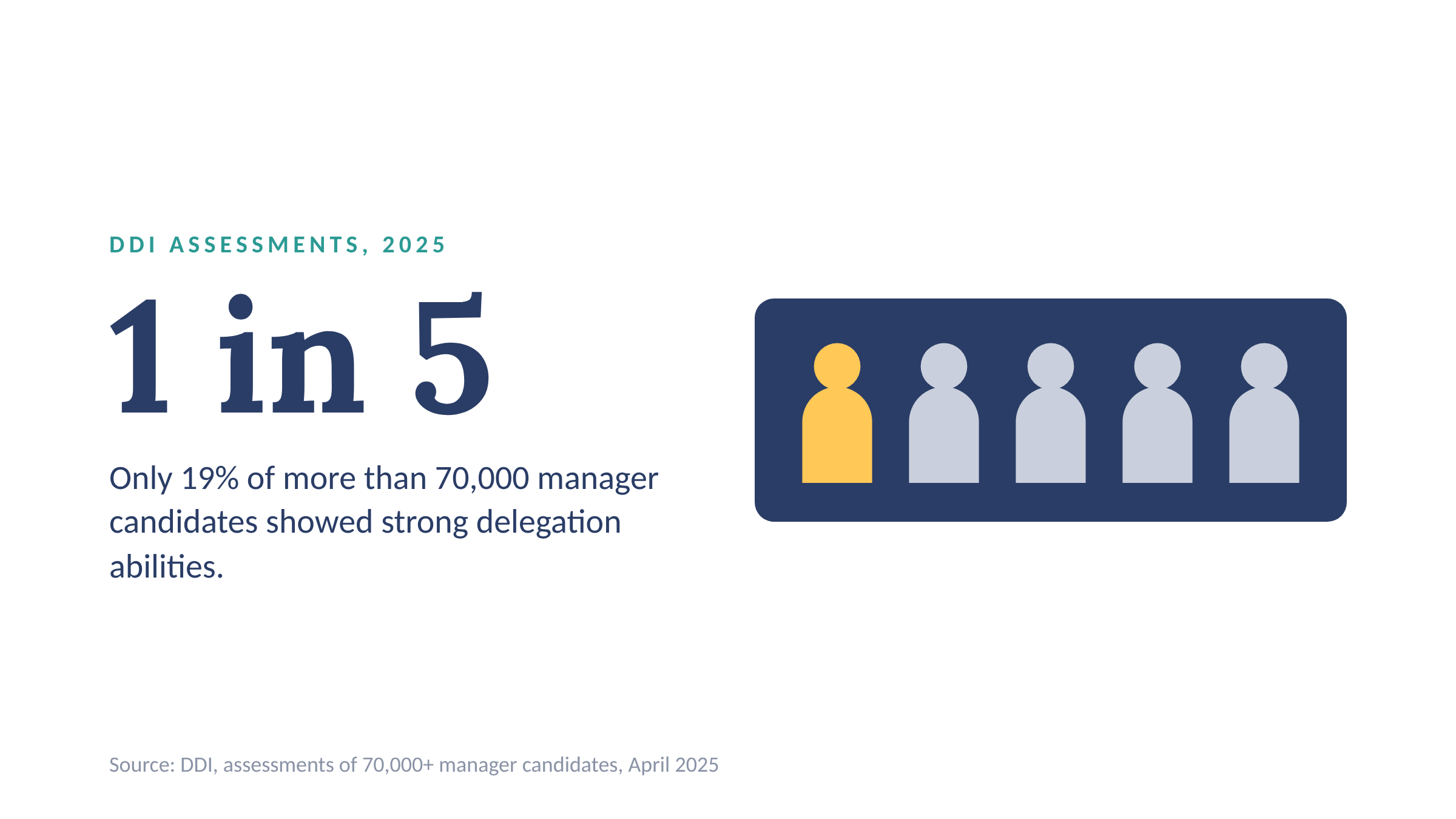
DDI found only 19% of more than 70,000 manager candidates showed strong delegation skills.
Gallup found a similar gap among founders. Its 2014 study of 1,446 U.S. employer entrepreneurs, measured with Gallup’s own talent assessment, found that 75% had limited-to-low levels of what Gallup calls Delegator talent. We see the same hesitation in managers who were promoted because they were the best at the client work itself.
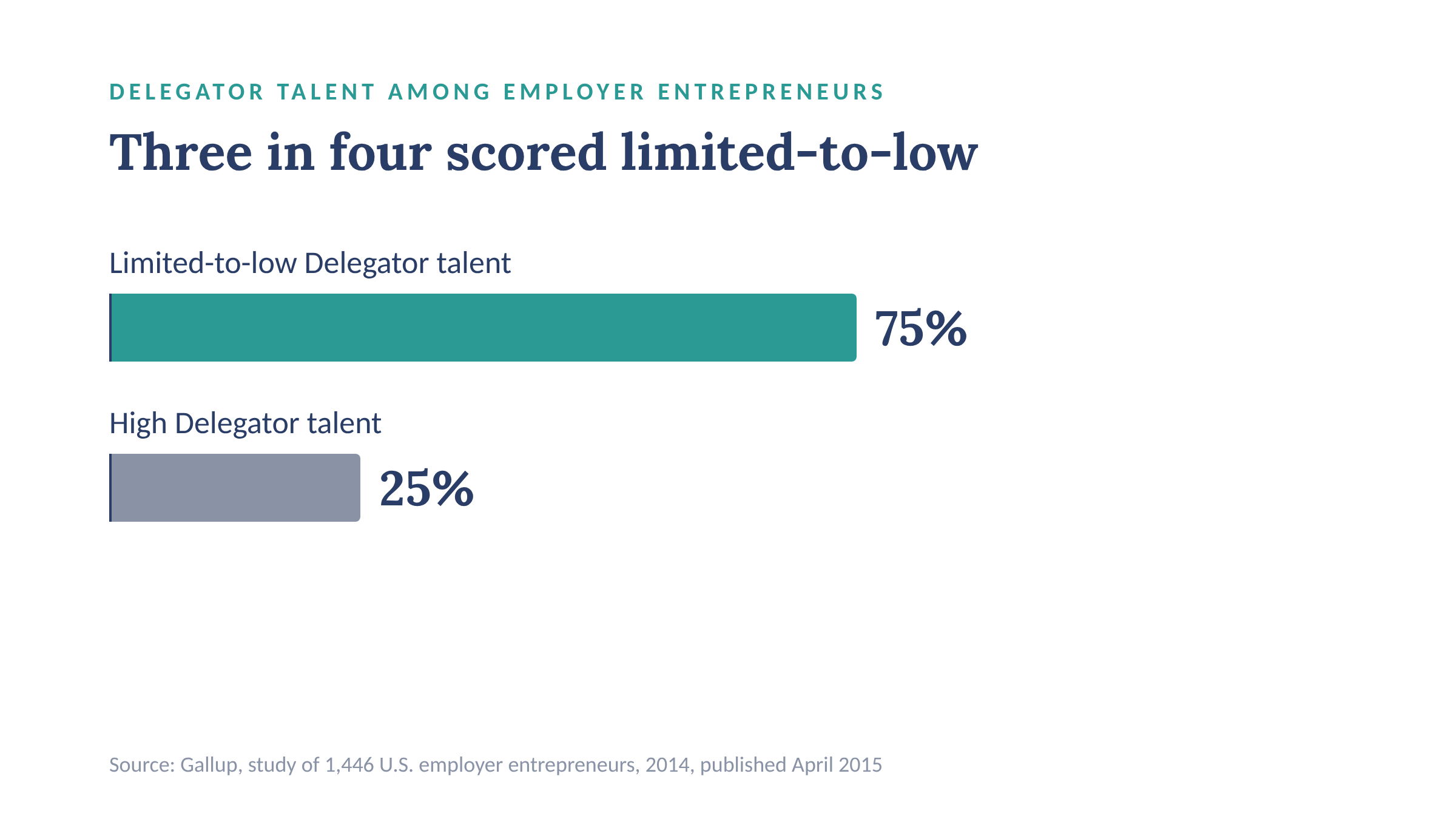
Gallup found 75% of 1,446 U.S. employer entrepreneurs had limited-to-low Delegator talent in 2014.
Each of these pressures is a leadership gap you can close. Each one eases once the hand-off names what good looks like and when you’ll check.
What’s the difference between delegating a task, ownership and a decision?
Delegating a task hands over the doing while you keep the result. Delegating ownership hands over the result, including the steps and the quality, while you keep the right to review. Delegating a decision hands over the call itself, within limits you’ve set, so the other person decides without checking with you first.
Delegating a task
You define the steps and the person completes them. For example: “Pull last quarter’s figures into the client template by Thursday.” It’s the right level for someone new to the work or for a piece where the method can’t change.
Delegating ownership
The person is responsible for the deliverable from first draft to the version the client receives. For example: “You own the quarterly variance report for this client, and I’ll review it before it goes out.” They choose how to get there, and they come to you with problems as they find them.
Delegating a decision
The person makes a specific call and tells you afterward. For example: “You decide which variances we explain in the cover note, as long as anything above the agreed threshold is included.” This level works once someone has owned the deliverable well a few times.
Many delegation problems start when the manager thinks they handed over ownership and the junior thinks they received a task. The junior waits for instructions, the manager waits for initiative, and the draft arrives late and incomplete. Saying the level out loud removes that confusion. Our post on giving every decision one owner covers the decision level in more depth.
How do you decide what to delegate, to whom, and how closely to check?
Ask four questions about every piece of client work: what’s the risk if it goes wrong, who’s ready for the next step, what level of oversight fits that person and that risk, and when the work needs to be finished. The answers tell you which level to delegate and how often to check.
What to delegate
Sort the work by client risk and how often it repeats. Recurring, lower-risk work, such as monthly reporting, first drafts and research summaries, can move to ownership right away. New or high-risk work, such as a pricing recommendation or a sensitive client message, can still be delegated in pieces while you keep the final decision. Recurring work is the best place to start, because the second hand-off takes far less time than the first.
To whom
Choose the person this work would develop, then confirm they have the time before the deadline. Gallup’s research on Delegators found that they assign work by learning what each person does best, and they give people the tools, resources and training to succeed.
How closely to check
Match the oversight to the person’s experience with this type of work and to the client risk.
Oversight | When it fits | What it looks like |
Close | New to this type of work, or high client risk | You review the outline before drafting, check at the midpoint, and review before it goes to the client |
Standard | Has done it before and needed edits | One midpoint check and a review before it goes to the client |
Light | Has done it well at least twice | They send it, and you read the final version |
By when
Set the client deadline and an internal deadline at least two working days earlier. That leaves time for the review and the corrections, so the manager isn’t rewriting the draft the night before it’s due.
How do you delegate client work without losing quality?
Client work keeps its quality when the hand-off names five things before work starts: the outcome, the constraints, the quality standard, the checkpoints and the escalation path. Each one replaces a guess the person would otherwise have to make.
The outcome. What the client will have and what they’ll use it for, such as a two-page memo the client’s finance lead can take to her board on the 14th.
The constraints. The budgeted hours, the scope, what can’t change, and anything sensitive about the client relationship.
The quality standard. What good looks like and what a common miss looks like, ideally with a past example of each. Gallup found that strong Delegators focus on outcomes and set clear expectations for timing, budget and deliverables.
The checkpoints. The dates you’ll look at the work and what you’ll look at each time, such as the outline on Tuesday and the full draft on Thursday.
The escalation path. What to bring to you the same day, such as a change in scope, a new client request or a number that doesn’t reconcile, and how to reach you.
Script for assigning the work
“I’d like you to own the [deliverable] for [client]. They need [outcome] by [date]. Keep to [constraints]. Good looks like [example], and the miss we see most often is [example]. Let’s look at the outline on [date] and the draft on [date]. If [trigger] happens, tell me the same day. Before you start, walk me through how you’ll approach it.”
The last line is a back brief. Hearing the plan in the other person’s words confirms they understood the outcome before they spend hours on it, and the Back Briefing Guide shows how to use it at other hand-offs.
Script for checking progress
“Where are you against the outline, what’s taking longer than you expected, and is there anything you need from me or the client before [next checkpoint]?”
Ask the question and hear the answer before you open the file. The answer tells you whether the work is on schedule and whether the person can see their own risks, which is the skill you’re developing.
How do you review a draft without rewriting it?
Review the draft against the standard you set, ask questions before you edit, and return it with the two or three changes that matter most to the client. Rewriting it yourself fixes one draft and teaches the person that the real standard is whatever you would have written.
Read the whole draft once before you mark anything.
Sort your comments into three groups: must-fix for the client (accuracy, scope, risk), should-fix (clarity and structure), and personal preference. Send the first two, and label preferences as optional or leave them out.
Ask before you correct. A question such as “What were you trying to show in section 2?” tells you whether the problem is a skill gap or missing context.
Return the draft to the same person to revise. When the deadline leaves no time, make the edits yourself and walk through them with the person afterward.
Name what worked, specifically, so they know what to repeat.
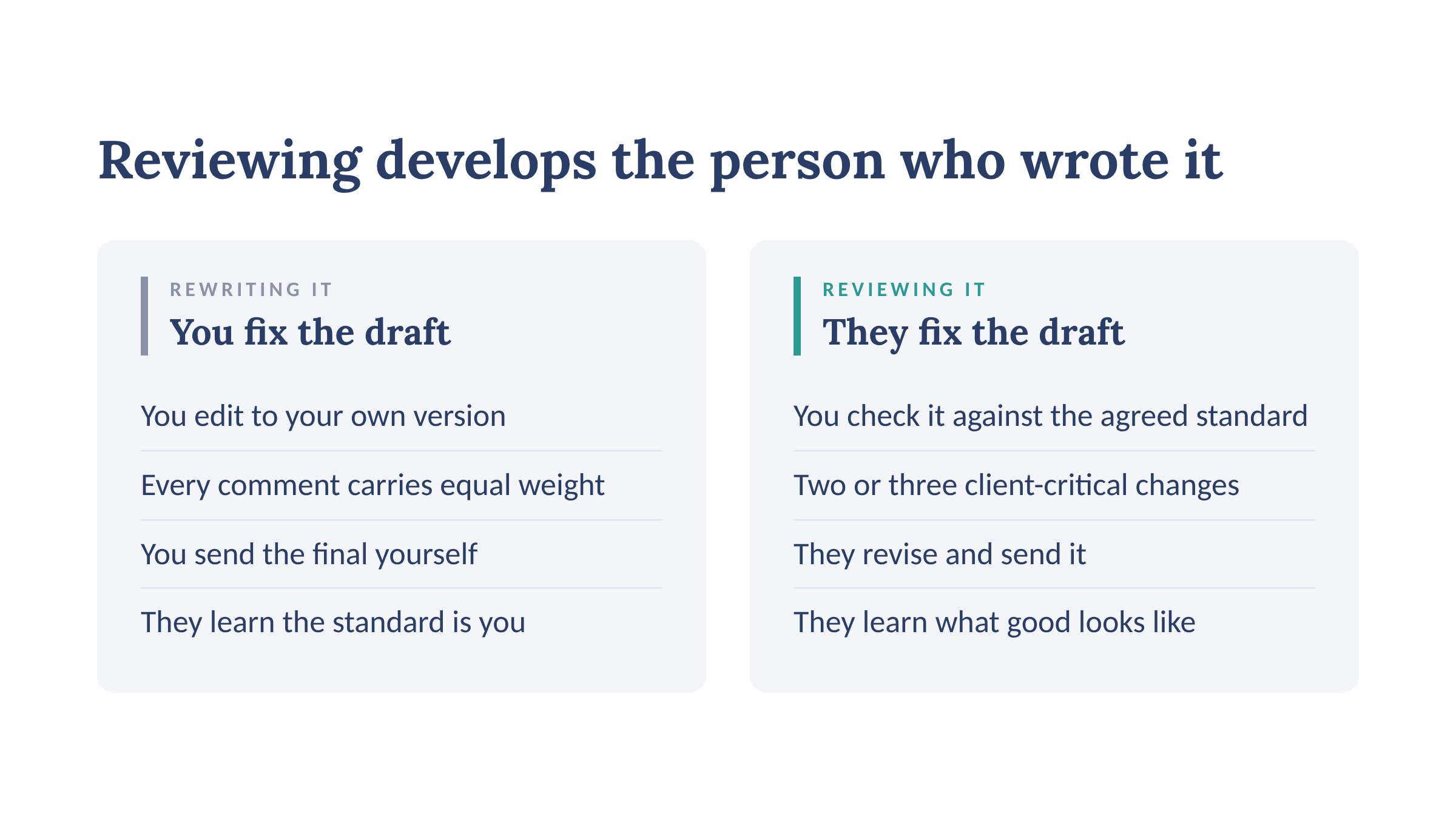
Comparison of rewriting a junior’s draft with reviewing it against the agreed quality standard.
Script for corrective feedback
“The analysis in section 3 is solid, and the client will trust it. The recommendation needs to answer the question they asked, which was [question]. What would you change so the first paragraph answers it directly? Send me the revised version by [time].”
After a large deliverable, a short After Action Review with the person who did the work captures what to change in the next hand-off.
What does delegation free up time for in organizations of 30 to 300 people?
Delegation gives managers back hours for the work only they can do: coaching their people, building client relationships and developing new business. In an organization of 30 to 300 people, the same manager is often the main client contact and the main reviewer, so every hour spent redoing a draft is an hour taken from clients and coaching.
Coaching. Reviews become development conversations, and juniors get the practice that builds the confidence their managers were waiting for.
Client relationships. Managers spend more time in client conversations, and clients get to know the juniors who do the work, which eases the expectation that only the senior person can deliver.
Business development. The hours freed from rework go to proposals, referrals and the conversations that bring in new work.
Where to start this week
List the client work you did yourself last week that someone else could do with a good hand-off.
Pick one recurring deliverable and decide the level: the task, the ownership or the decision.
Write the five-part hand-off and use the assignment script.
Set two checkpoints and an internal deadline two working days before the client’s.
Review against the standard and return the draft with no more than three changes.
If you want to see where your managers stand on delegation and the other leadership competencies connected to it, the Leadership Competency Assessment gives you a starting measure.
Frequently asked questions
What client work shouldn’t a manager delegate?
Keep the decisions that carry the highest client or firm risk, such as final pricing, a difficult conversation about scope or a judgment the client hired you personally to make. You can still delegate the preparation for those decisions, such as the research, the options and the first draft, which develops your people while you keep the final call.
How much oversight should I give a junior on client work?
Match oversight to the person’s experience with that type of work and to the client risk. For someone new to the work, review the outline, check at the midpoint and review before it goes out. Once they’ve done it well twice, move to light oversight and read the final version. Tell them which level you’re using and when it will change.
How do I stop rewriting my team’s work?
Set the quality standard before the work starts, then review the draft against that standard instead of your own version. Sort comments into must-fix, should-fix and preference, send only the first two, and return the draft to the same person to revise. When you have to edit it yourself, walk them through your changes afterward.
Is it faster to do client work yourself?
Doing it yourself is usually faster the first time, because explaining the work takes longer than doing it. Recurring work changes that, since a clear hand-off can be reused every month. Start with one recurring deliverable, write the five-part hand-off once, and use the same version each time with small updates.
Ready to build managers who delegate client work well?
If your managers are still doing the client work they’d like to hand off, a conversation with us is a good place to look at where delegation is breaking down and what your leaders need to do it well. LoyaltyOps is a leadership development firm that develops individual leaders and leadership teams against clear leadership competencies, so performance improves across your organization.
Sources
DDI. “New DDI Data Shows Only 19% of Rising Leaders Have the Delegation Skills Needed To Prevent Burnout.” Press release on the Global Leadership Forecast 2025 (10,796 leaders) and DDI assessments of more than 70,000 manager candidates. April 8, 2025. https://www.prnewswire.com/news-releases/new-ddi-data-shows-only-19-of-rising-leaders-have-the-delegation-skills-needed-to-prevent-burnout-302422396.html
Badal, Sangeeta Bharadwaj, and Bryant Ott. “Delegating: A Huge Management Challenge for Entrepreneurs.” Gallup, based on a 2014 study of 1,446 U.S. employer entrepreneurs. April 14, 2015. https://news.gallup.com/businessjournal/182414/delegating-huge-management-challenge-entrepreneurs.aspx
UNLEASHED by LoyaltyOps. “Decision Ownership: The Missing Layer.” Related episode. March 27, 2026.