
Protect Your Team From Unrealistic Deadlines
How to Protect Your Team From Unrealistic Client Deadlines Without Damaging the Client Relationship
Quick answer: To protect your team from unrealistic client deadlines, check capacity, scope, deadline and quality risk before you commit, then go back to the client or partner early with two or three workable options. Gallup reports 27% of U.S. full-time employees feel burned out very often or all the time, with workload and time pressure among the main causes.
Key takeaways
Gallup reports 27% of U.S. full-time employees felt burned out at work very often or all the time in the second quarter of 2026.
Gallup found that employees who have enough time to do all their work most of the time are 70% less likely to experience high burnout.
PMI’s 2018 Pulse of the Profession found 52% of projects completed in the previous 12 months experienced scope creep.
A request is a genuine client priority when the client can name the date, the reason and what a delay would cost them.
Renegotiate with options, such as a smaller first version, a later date or more people, and escalate early with a recommendation.
Watch a related episode of UNLEASHED, where Mickey Anderson, Co-Founder of LoyaltyOps, talks with Bryce North, founder of the PR agency Don’t Be a Little Pitch, about turning down new work when his team is at capacity.
Agree on how your team says a commitment is at risk
A deadline gets harder to renegotiate every day nobody says it’s slipping. The free Accountability Standards Builder helps your team agree how to make a commitment, how to raise a risk early and how to own a miss, so you hear about the pressure while there’s still time to do something about it.
Get the Accountability Standards Builder
Why isn’t managing the team better enough when the work is unrealistic?
Better management can’t fix work that was sold, staffed or scheduled without enough hours, because a manager can only divide the hours their team has.
In client-service work, the deadline, the budget and the team are often agreed before the manager who leads the work sees the plan. A partner promises a fast turnaround to win the engagement, or the budget assumes a senior who has since left, and the manager is asked to keep the team motivated through work that didn’t fit from the start.
In a 2018 study of nearly 7,500 U.S. full-time employees, Gallup named five workplace conditions most linked to burnout: unfair treatment, an unmanageable workload, unclear roles, a lack of communication and support from the manager, and unreasonable time pressure. Three of the five are about how much work people have and how much time they get to do it.
Gallup’s article How Employee Wellbeing Affects Workplace Productivity, updated November 10, 2026, reports that 27% of U.S. full-time employees felt burned out at work very often or all the time in the second quarter of 2026. Employees who strongly agree they have too much to do all the time are 2.2 times as likely to feel burned out frequently, and employees who have enough time to do all their work most of the time are 70% less likely to experience high burnout. The data comes from Gallup’s U.S. surveys, is self-reported, and the article doesn’t give a sample size.
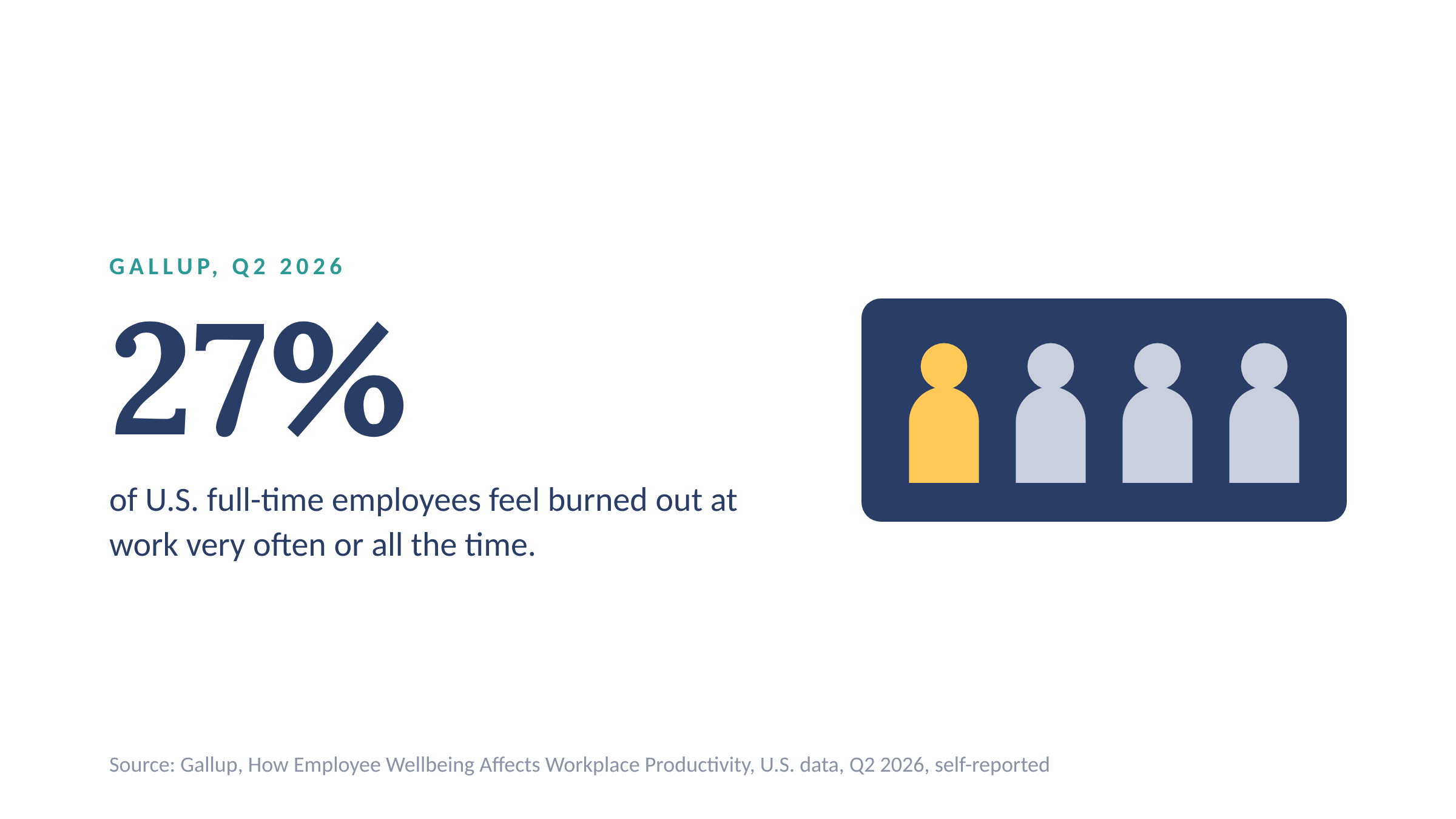
27% of U.S. full-time employees feel burned out at work very often or all the time, Gallup, Q2 2026.
That makes overload a leadership gap at two levels. The manager decides what the team agrees to and how early a risk gets raised, and the leaders above them decide what gets sold and how it’s staffed. In an organization of 30 to 300 people, those are often the same few people, so a change in how they decide affects every team quickly. Our post on why new managers in professional services can’t coach, delegate or develop their teams covers the firm-level side of manager workload.
How do you tell a genuine client priority from internally created urgency?
A genuine client priority has a date, a reason and a cost of missing it that the client can name, and internally created urgency usually starts with a date set inside your own organization that nobody can explain.
Ask four questions before the team reorganizes its week:
Who set the date, and what is it tied to on the client’s side?
What happens for the client if the work arrives a week later?
Did the scope, budget or staffing change when the deadline did?
Is this the third urgent request on this engagement this month?
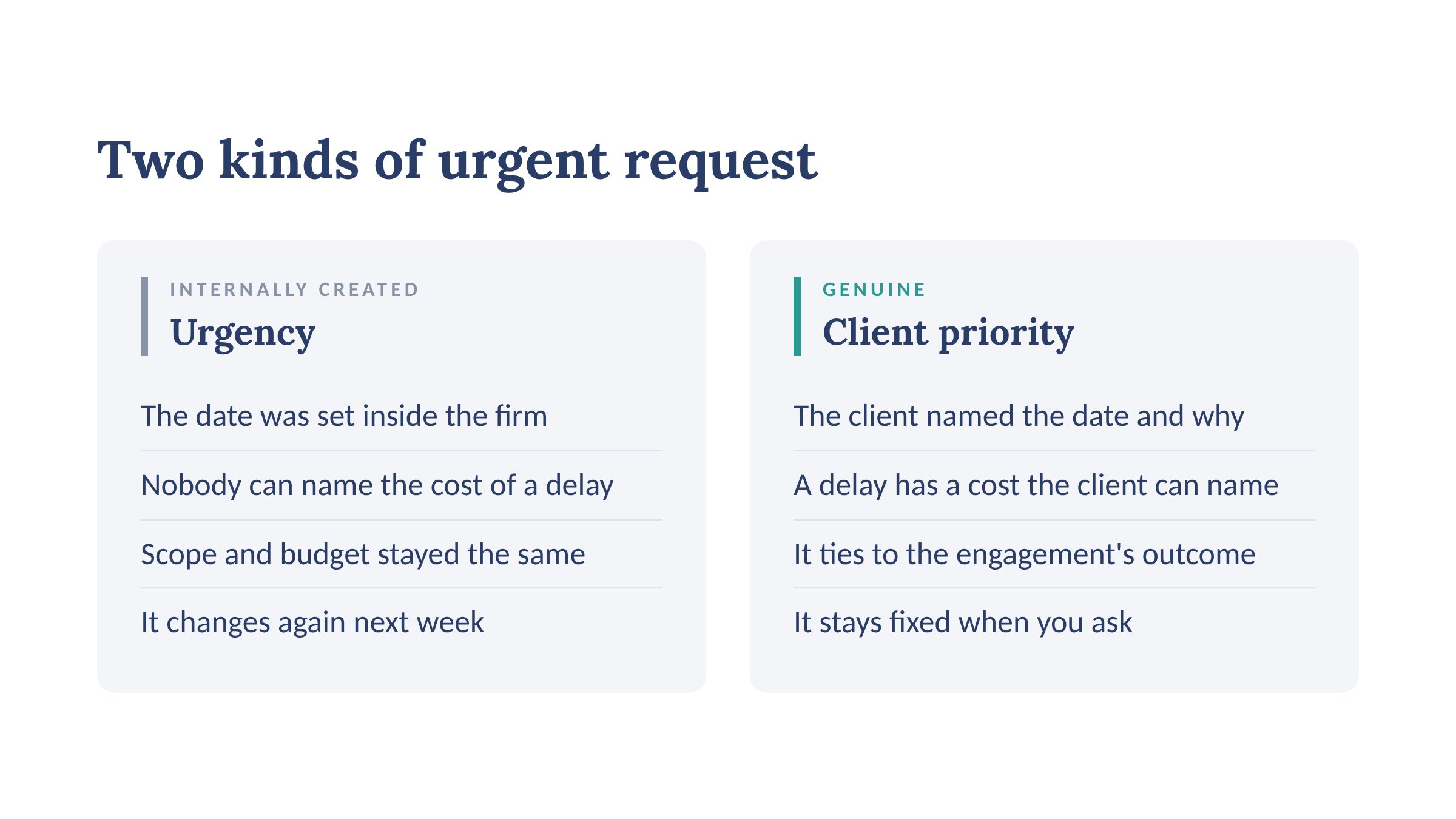
A genuine client priority has a named date, reason and cost, and internally created urgency usually doesn’t.
Internal urgency often comes from good intentions, such as a partner offering a faster turnaround to impress a client, or a review step that adds three days nobody planned for. Your own people can fix these, and the client may not have asked for the speed.
When the priority is genuine, protect it by moving other work, and tell the people whose work moved why. When the urgency is internal, ask the person who set the date what it’s tied to, and offer a date your team can meet. Our post on how to delegate client work without losing quality covers how to hand off the work once you’ve agreed what the team is committing to.
How do you assess capacity, scope creep, deadline risk and quality risk before you commit your team?
Check four risks before you say yes: whether the team has the hours, whether the request is part of the agreed scope, what could move the date, and what will get cut if time gets short.
Capacity
Count the hours the work needs against the hours the team has after reviews, other engagements and holidays, and ask the person who will do the work to estimate it.
Scope creep
Compare the request to what was agreed in the engagement letter or statement of work, since small additions arrive one email at a time and each one feels too small to raise. The Project Management Institute’s 2018 Pulse of the Profession, a global survey of project professionals conducted in October 2017, found 52% of projects completed in the previous 12 months experienced scope creep or uncontrolled changes to scope. The figures are respondents’ estimates of their own organizations’ projects.
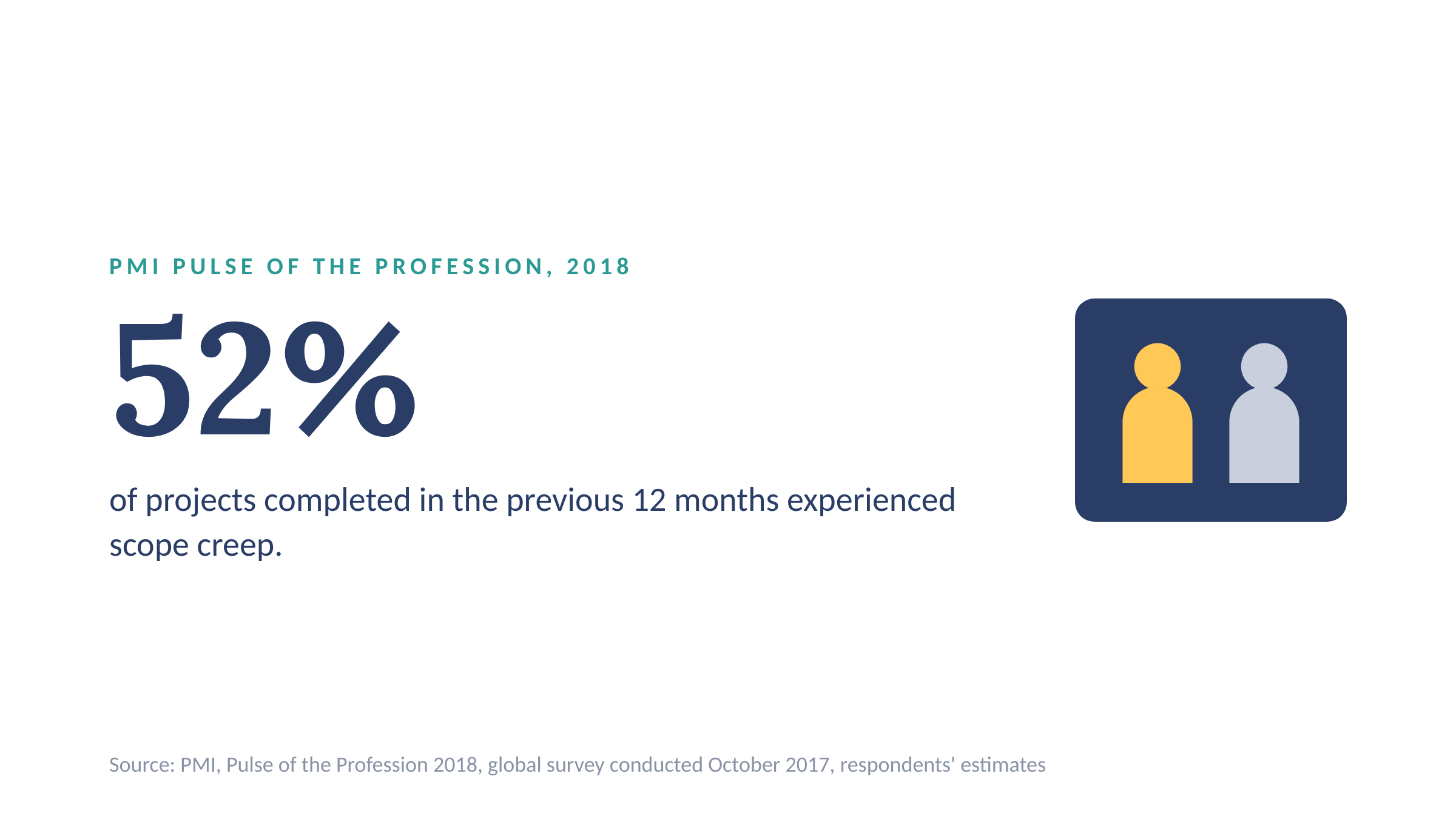
52% of projects completed in the previous 12 months experienced scope creep, PMI Pulse of the Profession, 2018.
Deadline risk
List what the date depends on, such as client data, a partner’s review or a client sign-off, and treat each dependency with no owner or date as a risk.
Quality risk
Name what gets cut first when time gets short. If the plan only works by dropping the second review, the check on the numbers or the coaching a junior needed, the client will feel it later.
What should you say when you need to renegotiate or escalate?
Start with what your team can deliver, give two or three options with what each one changes, and ask the client or partner to choose, as early as you know there’s a problem.
Language for clients
Timeline: “We can deliver the full analysis by the 14th, or a first version with the three main findings by the 9th and the rest by the 14th. Which matters more for your board meeting, the date or the full detail?”
Scope: “That’s outside what we agreed for this engagement, and we’re glad to add it. Here’s what it changes in the timeline and the fee, and we can confirm by Thursday.”
Staffing: “To meet that date, we’d add a second analyst for two weeks. Here’s what that adds, or we can keep the team as it is and deliver on the 21st.”
Deliverable expectations: “Before we start, can we agree on what a finished version looks like for you? A ten-page summary and a forty-page report take very different amounts of time.”
Language for partners and senior leaders
Before new work is accepted: “We can take on the new client in March with the current team if the current engagement closes on time. If it slips, we’d need one more senior or a later start. Which would you prefer?”
When a risk appears: “I want to raise a risk on the audit before it reaches the client. We’re about forty hours short for the 30th. I have two options and a recommendation.”
How to escalate without appearing unable to lead
Escalating well is part of leading, and it reads that way when you bring the decision with the problem. A useful escalation includes:
What changed, in one or two sentences
The facts: hours needed, hours available, and the date
What you’ve already tried
Two or three options with what each one costs
Your recommendation, and when you need a decision
Escalate to the person who owns the decision as soon as you know the work won’t fit. Agree in advance which decisions belong to the engagement manager, and which go to a partner, such as adding people, changing the fee or moving a client date, so nobody has to guess under pressure. The Decision Rights Map helps a leadership team give each of those decisions one owner.
How do you create recovery time after an intense delivery period?
Plan the recovery before the intense period ends, so the next piece of work doesn’t start the day after the last one finishes.
Give time back
Give people back some of the hours they worked, such as a lighter week, a day off or a later start on the next engagement, and put it in the schedule before the next request arrives.
Slow the next assignment
Start the next engagement with work that has more lead time, and avoid putting the same people on two high-pressure deadlines in a row.
Debrief the work
Within two weeks of the deadline, ask what was planned, what happened, why it was different, and what you’ll change next time. An After Action Review gives the team a blameless agenda, and the changes you agree on often shape how work is scoped or staffed.
Thank people specifically
Name what each person did and what it made possible for the client, so people know the extra effort was noticed.
What’s the manager’s role in preventing burnout, disengagement and attrition?
Managers shape how the workload feels to their team: what gets agreed, how it’s divided, and whether people feel able to say they’re overloaded before it shows in their work.
Gallup estimates managers account for at least 70% of the variance in employee engagement across business units, and in the same 2026 article on wellbeing, Gallup reports that employees whose manager is willing to listen to their work-related problems every time are 62% less likely to experience burnout. In Gallup’s 2018 study, employees who felt burned out very often or all the time were 2.6 times as likely to be actively looking for a different job and 63% more likely to take a sick day.
Senior leaders often see more workload support for managers than for vice presidents. Culture Amp, an employee experience software company, published Performance Culture benchmarks on November 5, 2026, based on survey data from up to 3,807 companies and about 2.3 million employees. 55% of vice presidents said their managers organize workloads and resources to support high performance without burnout, compared with 78% of C-suite employees. The data is self-reported and comes from companies that use Culture Amp’s survey.
A manager can do five things every week to protect their team:
Ask about workload in every one-on-one, and ask what would help. Our post on effective one-on-one meetings includes a weekly workload check.
Watch for early signs, such as cancelled one-on-ones, late-night messages and more errors in drafts.
Spread the hardest deadlines across the team, so the same strong performer isn’t on every one.
Say no, or not yet, on the team’s behalf when the work doesn’t fit, and tell the team you did.
Follow up on every escalation, so people see that raising a problem led to a change.
Senior leaders make these habits possible by checking capacity before work is sold and supporting the manager who renegotiates. A Leadership Competency Assessment shows where each leader stands, from the leader and the people who see their work, which helps you see whether workload problems come from one team or from how your organization decides.
Frequently asked questions
How do you tell a client a deadline is unrealistic?
Tell the client as early as you know, start with what your team can deliver, and offer two or three options, such as a smaller first version by the original date, the full work by a later date, or more people at a higher fee. Ask which matters most to them. Clients usually accept changes better when they hear about them early and can choose.
What causes burnout on client-service teams?
Gallup’s research names five workplace conditions most linked to burnout: unfair treatment, an unmanageable workload, unclear roles, a lack of communication and support from the manager, and unreasonable time pressure. On client-service teams, workload and time pressure often come from deadlines and budgets agreed before the team’s capacity was checked, and from small scope additions that nobody raised.
How do you handle scope creep without upsetting the client?
Compare each new request to what was agreed in the engagement letter, and raise it when it arrives, while it’s still small. Tell the client you’re glad to add it, then explain how it affects the timeline or fee, and ask them to choose. PMI’s 2018 Pulse of the Profession found 52% of projects experienced scope creep.
When should a manager escalate a workload problem?
A manager should escalate as soon as they know the work won’t fit the hours, the date or the budget, and before the client feels it. The escalation should go to the person who owns the decision and include the facts, what’s been tried, two or three options and a recommendation, so the leader can decide quickly.
Give your managers the support to protect their teams
If your managers are agreeing to deadlines their teams can’t meet, or hearing about the risk too late to renegotiate, a conversation with us is a good place to start. LoyaltyOps is a leadership development firm that develops individual leaders and leadership teams against clear leadership competencies, so performance improves across your organization.
Sources
Gallup, How Employee Wellbeing Affects Workplace Productivity, U.S. burnout data from the second quarter of 2026, published July 27, 2026, updated November 10, 2026
Ben Wigert and Sangeeta Agrawal, Gallup, Employee Burnout, Part 1: The 5 Main Causes, nearly 7,500 U.S. full-time employees, July 12, 2018
Catherine Elton, Project Management Institute, Scope Patrol, PM Network, reporting PMI’s 2018 Pulse of the Profession survey conducted in October 2017, July 1, 2018
Randall Beck and Jim Harter, Gallup, Managers Account for 70% of Variance in Employee Engagement, April 21, 2015
Culture Amp, Culture Amp’s New Performance Culture Data: Organizations are Setting Expectations, but Aren’t Following Through, press release via PR Newswire, employee survey data from up to 3,807 companies and about 2.3 million employees, July 2025 to July 2026, November 5, 2026