
Effective One-on-One Meetings for Managers
Effective One-on-One Meetings That Develop Your Team: A Practical Structure for Professional-Services Managers
Quick answer: Effective one-on-one meetings develop people when they follow a repeatable structure: a short weekly check-in on workload, priorities, and support, then one development focus, such as a capability, feedback, or career direction. Gallup found only 16% of employees said their last conversation with their manager was extremely meaningful, and 15 to 30 minutes is enough when it happens often.
Key takeaways
In a Gallup study of nearly 15,000 employees, only 16% said their last conversation with their manager was extremely meaningful.
Gallup found that 15 to 30 minutes is enough for a meaningful conversation when it happens frequently, so a weekly 30-minute one-on-one gives you time for development.
A six-part structure keeps the meeting practical: workload and wellbeing, progress and priorities, and support needed every week, then one rotating focus on capability, feedback or career direction.
Just 46% of US employees strongly agree they know what’s expected of them, and 37% strongly agree someone at work cares about them as a person, both of which a weekly one-on-one checks.
Development goals work best when they’re based on the criteria for the person’s next role and practised on real client work over the next month or two.
Related episode: Mickey Anderson on UNLEASHED, on why career support shapes whether people want to lead, and one question to ask in your next one-on-ones.
Turn a quarter of one-on-ones into real progress
Weekly conversations add up when you and each person look back at them together. The Quarterly Performance Cadence Template walks you both through reflecting on the quarter, agreeing on what matters next, and choosing two or three behaviours to work on.
Get the Quarterly Performance Cadence Template
Why do one-on-ones turn into status updates?
One-on-ones turn into status updates because status is the most urgent thing a manager needs from the meeting, and without an agreed structure, the urgent topics use up the time. Client deadlines add to it, since the engagement’s progress feels like the safest use of thirty minutes.
Four reasons development gets skipped:
Client work sets the agenda. When a deliverable is due this week, the manager asks about the deliverable, and development waits for a quieter week.
The manager has no time to prepare. A manager who reviews work, manages clients and delivers their own files often starts the meeting with nothing written down, so the conversation follows whatever happened most recently.
The meeting is the first thing moved. One-on-ones are easy to postpone, and each postponement tells the person their development comes after everything else.
Status questions need no preparation. A question about judgment or career direction has to be ready before the meeting starts.
Conversations with managers often fall short of what people need. Gallup reported in May 2023, from a study of nearly 15,000 employees, that only 16% said their last conversation with their manager was extremely meaningful, and the answers are self-reported.
Gallup found that the topics most often discussed in meaningful conversations were recognition for recent work, collaboration and relationships, and current goals and priorities. People found discussing weaknesses the least meaningful, which Gallup suggests may be because managers often discuss weaknesses.
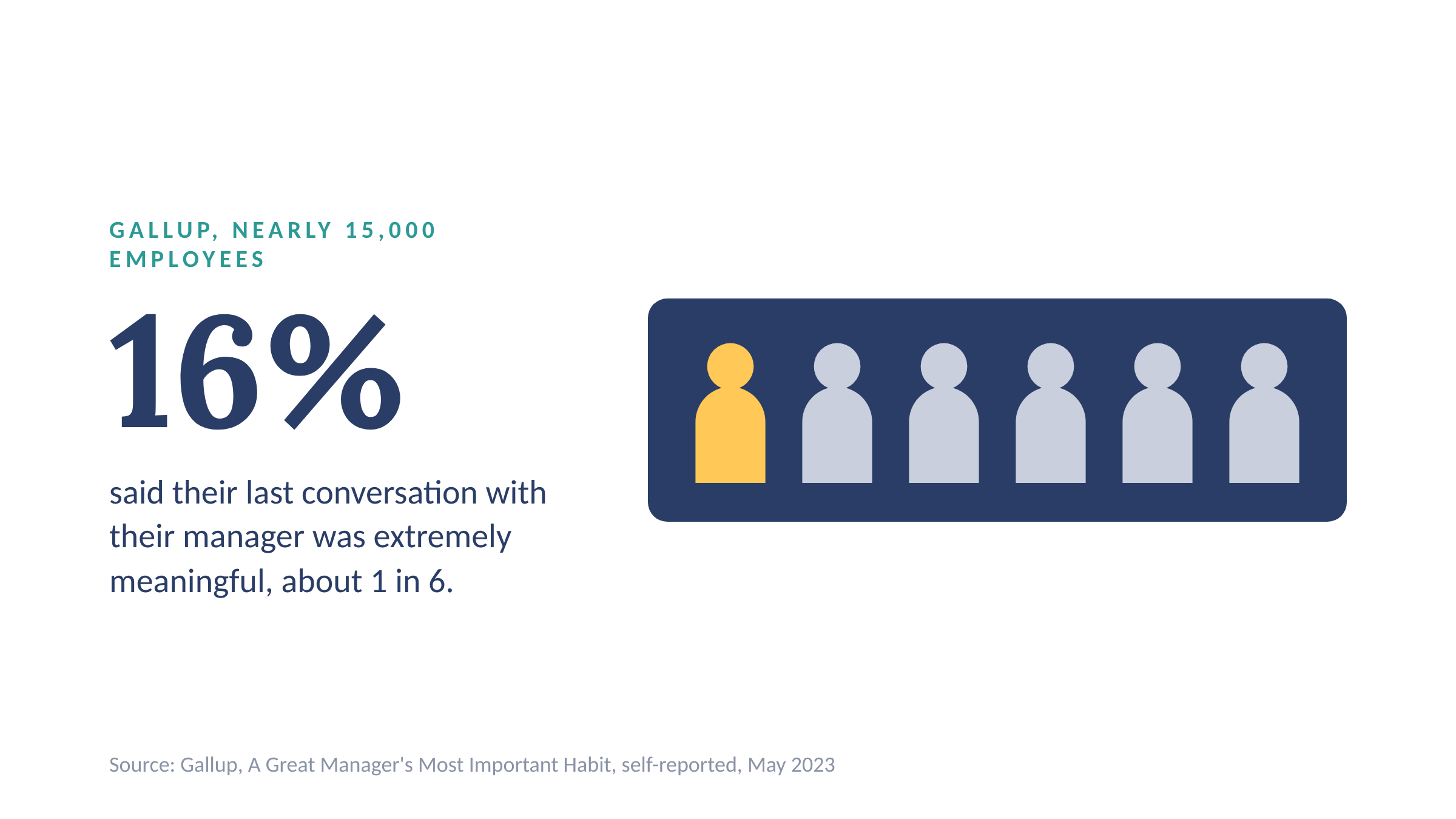
Gallup found only 16% of employees said their last conversation with their manager was extremely meaningful.
In an organization of 30 to 300 people, with no learning team or formal program, the one-on-one is often the only regular development conversation a person has. Gallup estimates managers account for at least 70% of the variance in employee engagement across business units, which makes those conversations one of the most useful hours in a manager’s week.
What’s the difference between a status update and a development conversation?
A status update reports on the work: what’s done, what’s late and what comes next. A development conversation is about the person doing the work, including what they’re learning, how their judgment is growing, what gets in their way and where they want to go next.
Both have a place, and trouble starts when status takes up the whole meeting every week, because development then depends on whatever the next engagement happens to teach. Status can also be covered faster in a shared tracker, a team stand-up, or a two-line written note, leaving the one-on-one for the person.
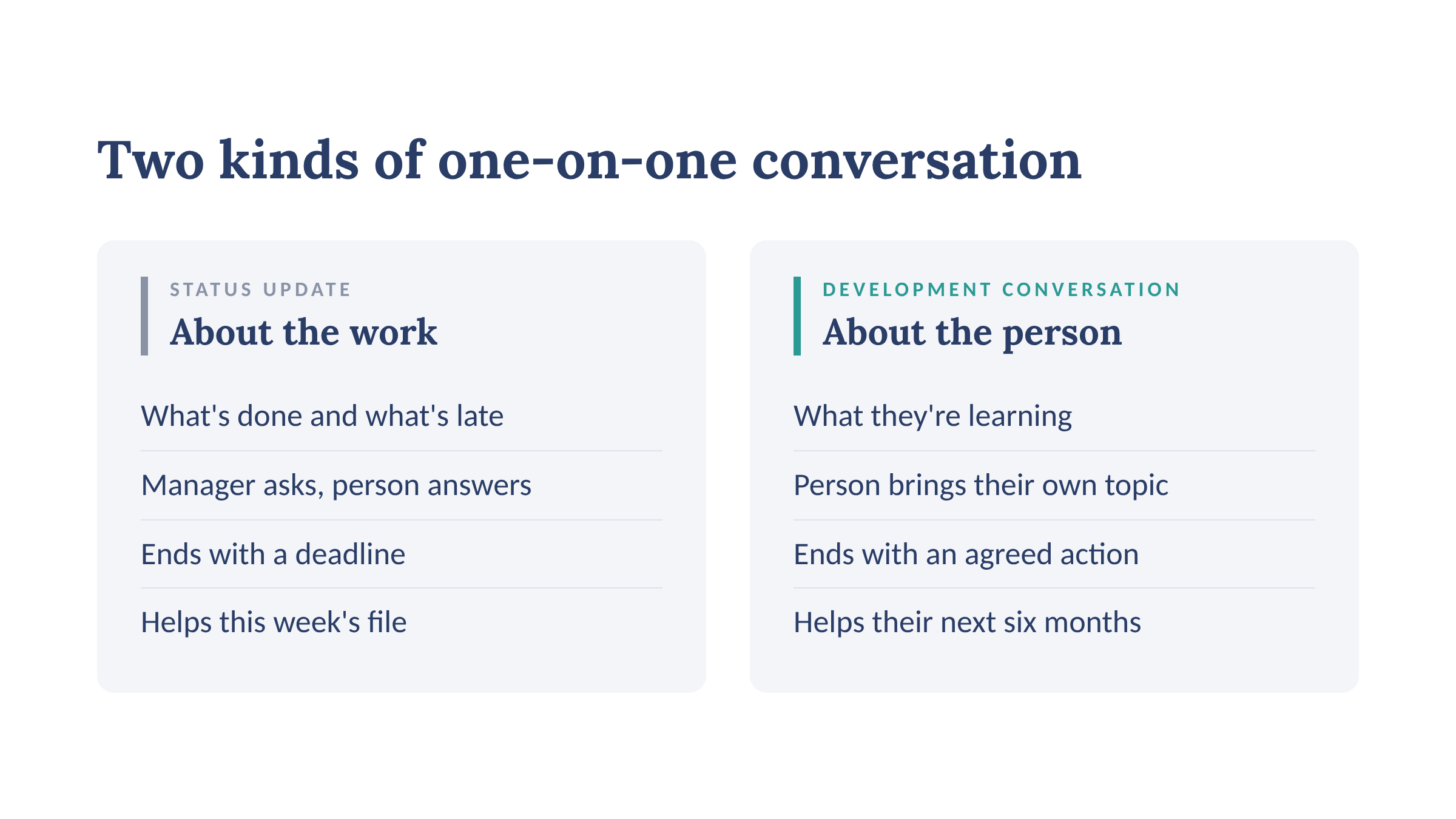
A status update reports on the work, while a development conversation builds the person doing it.
What should an effective one-on-one meeting cover?
An effective one-on-one meeting covers six areas: workload and wellbeing, progress and priorities, support needed, capability development, feedback, and career direction. Cover the first three briefly each week, and use the rest of the time on one of the last three, so a 30-minute meeting stays practical.
Two of these areas match measures Gallup tracks closely. Gallup reported on October 28, 2026, from a panel survey of 21,648 US adults in August, that just 46% strongly agreed they knew what was expected of them at work, down from 49% in the first half of the year. In the same survey, 37% strongly agreed their supervisor or someone at work cares about them as a person, down from 40%. Both measures are self-reported, and Gallup describes clear expectations as “the most basic and fundamental employee need.”
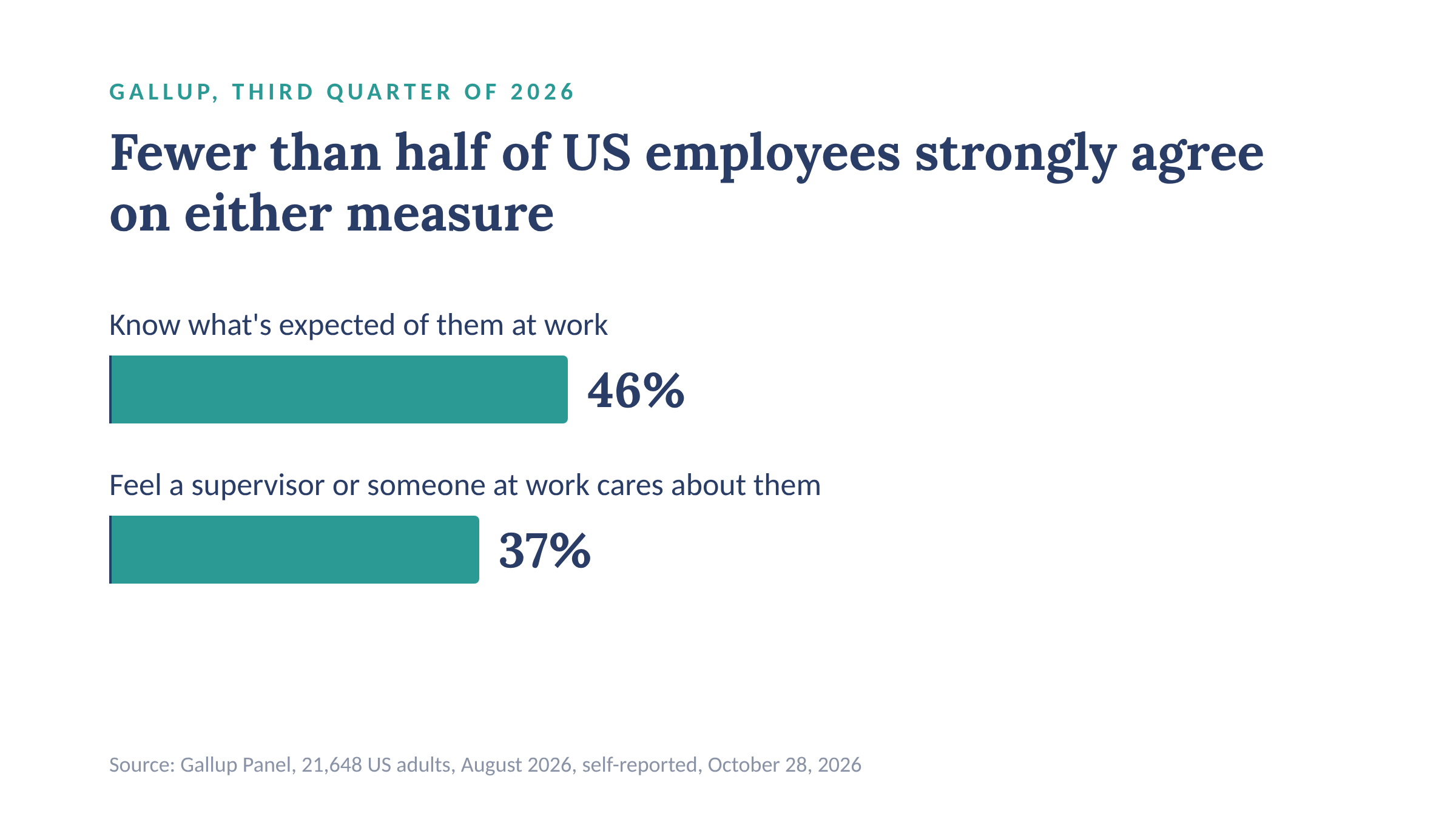
Gallup found 46% of US employees know what’s expected of them and 37% feel someone at work cares, Q3 2026.
1. Workload and wellbeing (every week, about 5 minutes)
Ask how the person is doing, how full their week is and what’s competing for their time. In client work, this is where you learn about overload early enough to move a deadline or a task.
2. Progress and priorities (every week, about 5 minutes)
Cover status quickly from the tracker you both see, then agree what comes first when two pieces of client work compete, and confirm the person knows what’s expected of them on each file.
3. Support needed (every week, about 5 minutes)
Ask what they need from you before the next meeting, such as a decision, a client introduction or a review slot, and write each one down as your action, with a date.
4. Capability development (rotating focus)
Pick one skill the person is building, such as structuring an analysis or leading a client call, and talk about where they practiced it recently and what they’d do differently.
5. Feedback, in both directions (rotating focus)
Give one or two specific pieces of feedback on recent work, starting with what went well and why. Then ask for feedback on how you’re leading them, for example, “What’s one thing I could do differently that would help you most?” Our post on how to give feedback to junior staff without taking over their work covers the review side in detail.
6. Career direction (rotating focus)
Talk about where the person wants to be in one to three years and what they’d need to learn to get there. Ipsos, the global market research company, published The Workplace Reality in October 2026, drawing on 9,100 employees in 32 countries, and found career support was the factor most consistently linked to employees planning to stay, recommending their employer and wanting to take on a people manager role. The findings are self-reported. In a smaller organization, career support usually comes from the person’s own manager, which is why we cover it in our post on why employees don’t want to be managers.
A simple rotation works for most people: capability development in weeks one and three, feedback in week two, and career direction in week four, with the order changed when a promotion conversation or a hard client week needs attention sooner.
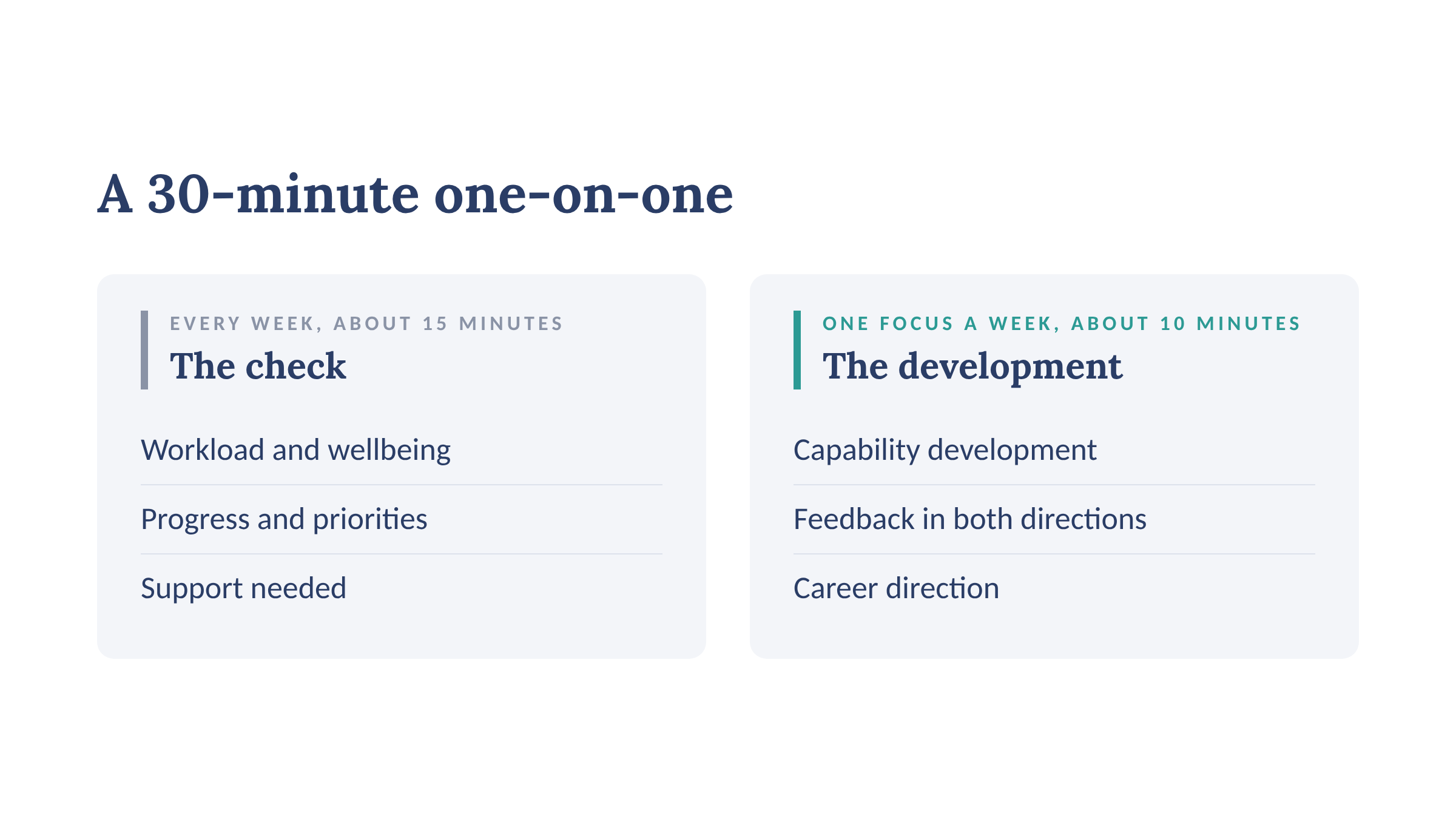
A 30-minute one-on-one meeting template: a weekly check on workload, priorities and support, then one focus.
A 30-minute one-on-one meeting template
Their topic first (2 minutes): “What do you most want to talk about today?”
Last meeting’s actions (3 minutes): what each of you agreed to and whether it’s done.
Workload and wellbeing (5 minutes).
Progress and priorities (5 minutes).
This week’s focus (10 minutes): capability, feedback or career direction.
Support needed and actions (5 minutes): who does what, by when, said back in the person’s own words.
Which one-on-one meeting questions uncover blockers, build ownership and develop judgment?
Open questions about specific work help most: ask what’s in the way, what the person would do, and how they’d know it worked. Ask one or two per meeting, and let the person finish before you share your view.
Questions that uncover blockers
“What’s taking longer than you expected this week?”
“What are you waiting on, and from whom?”
“Where are you guessing at what the client or I want?”
“What’s one thing you’ve meant to ask me and haven’t yet?”
Questions that build ownership
“What do you think the next step is?”
“What would you recommend, and what would change your mind?”
“Which part of this engagement would you like to own next?”
"What will you have done by our next one-on-one?”
Questions that develop judgment
“What did you consider and decide against?”
“What would you check before this goes to the client?”
“If you were reviewing this for the partner, what would you flag?”
"What did that client meeting teach you about how they make decisions?”
Questions about growth and career
“What part of your work do you want more of next quarter?”
“Which skill would make the biggest difference in your next role?”
“What piece of work coming up would let you practise it?”
When the person asks what to do, ask which options they’re weighing first, then give your view with the reasoning if they’re still stuck.
How do you discuss performance in a one-on-one without making it feel punitive?
Keep the conversation about the work and the expectation you agreed on, raise it early while it’s small, and ask for the person’s view before you give yours. When you bring up performance every week in small, specific ways, a harder conversation later doesn’t come as a surprise.
Compare the work with the agreed expectation
Name the expectation, then what happened, in plain facts. “We agreed the draft would include the sensitivity analysis, and it came in without it” keeps the focus on the work, where the person can act.
Raise it the first time you see it
A small issue raised the same week is easier to fix and easier to hear than three months of issues raised at once.
Ask what happened from their side
Ask “What got in the way?” before you suggest a cause. You may learn about a client change, a missing input or a workload problem you can fix as their manager.
Agree on one change and a date
End with one specific change, how you’ll both know it happened, and when you’ll look at it again. Name what’s going well with the same detail, since recognition for recent work was the most common topic in the conversations Gallup found most meaningful.
Give a bigger concern its own meeting
If the same issue has come up across several weeks, book a separate conversation and tell the person its purpose in advance. That keeps the one-on-one a place where they can bring problems early.
How do you connect individual development goals to client work and promotion criteria?
Choose one or two development goals from the criteria for the person’s next role, then find the client work in the next month or two where they can practise each one. Use the one-on-one to plan the practice beforehand and to debrief it afterwards.
Start from the criteria for the next role. Use your firm’s promotion criteria, or the leadership competencies expected at the next level, and ask the person to rate themselves against each one. Pick one or two where the gap is clearest. If your firm hasn’t measured those competencies yet, a Leadership Competency Assessment gives each leader a starting measure.
Match each goal to real work. Look at the next six to eight weeks of client work and find one piece where the person can practice the goal with you watching.
Agree what good looks like. Describe what you’d see if they did it well, so you’re both judging the same thing.
Debrief and keep the evidence. In the next focus conversation, ask what went well and what they’d change, and note the example in your shared notes so it’s ready when their promotion is discussed.
Development goal | Client work to practice on | What good looks like |
Lead a client meeting | Next month’s steering committee update | Sets the agenda, presents the findings and answers one difficult question without help |
Review a junior’s work | The new analyst’s first draft | Comments explain the reasoning, and the second draft needs fewer changes |
Scope a piece of work | The follow-on proposal for the current client | The estimate and staffing plan are approved with minor edits |
How often should you hold one-on-ones, and what should you document?
Hold one-on-ones every week, or every two weeks at most, for about 30 minutes. Gallup found that 15 to 30 minutes is enough for a meaningful conversation when it happens frequently, and that managers who don’t give feedback every week need longer conversations to catch up.
How often to meet
Weekly suits new team members and people on demanding engagements, and every two weeks can suit experienced people with steady work. When a client deadline clashes with the meeting, move it within the same week and keep it short.
What to document
Keep one shared page of notes for each person that you both can read and add to:
Agreed actions, each with an owner and a date
The current development goal and recent practice on it
Feedback given and received, one line each
Career goals, updated each quarter
Support you’ve promised
Keep the notes factual, since the person reads everything written about them.
How to follow through
Open with last meeting’s actions, so nothing waits a month to come up.
Close with a back-brief. Ask the person to say back the actions in their own words. The Back Briefing Guide shows how to do it in about a minute.
Finish your own actions first. A manager who doesn’t do what they promised teaches the person that the meeting doesn’t change anything.
Review the quarter together. Every three months, read back through the notes with the person and agree on what to focus on next, which is what the Quarterly Performance Cadence Template is for.
Frequently asked questions
How long should a one-on-one meeting be?
About 30 minutes is enough for most one-on-ones when they happen every week or every two weeks. Gallup found that 15 to 30 minutes is enough for a meaningful conversation if it happens frequently, and that longer conversations are needed to catch up when managers don’t give feedback every week. Meet less often, and you’ll usually need more time.
How do you stop one-on-ones from becoming status updates?
Move status to a shared tracker or a short written note, and give each one-on-one a structure. Spend about 15 minutes on workload, priorities and support, then about 10 minutes on one development focus: capability, feedback or career direction. Start by asking what the person most wants to talk about, and cover it first.
What questions should a manager ask in a one-on-one?
Ask open questions about specific work. “What are you waiting on, and from whom?” uncovers blockers. “What would you recommend?” builds ownership. “What would you check before this goes to the client?” develops judgment. “Which skill would make the biggest difference in your next role?” connects the conversation to their career. One or two questions per meeting is enough.
Should you cancel a one-on-one when client work is busy?
Move it within the same week instead, and keep it short if you need to. Busy client weeks are when people are most likely to be overloaded or stuck, and a 15-minute check on workload, priorities and support helps you hear about problems in time to act. Repeated cancellations tell the person their development comes last.
Want one-on-ones that develop your next leaders?
If your managers’ one-on-ones have turned into status updates, a conversation with us is a good place to look at what your managers need to lead development conversations and how your firm makes time for them. LoyaltyOps is a leadership development firm that develops individual leaders and leadership teams against clear leadership competencies, so performance improves across your organization.
Sources
Gallup, A Great Manager’s Most Important Habit, May 29, 2023, updated February 16, 2026. Study of nearly 15,000 employees. Self-reported.
Jim Harter, Gallup, U.S. Employee Engagement Below 30% for First Time in 15 Years, Gallup Panel of 21,648 US adults surveyed August 5 to 19, 2026, October 28, 2026.
Randall Beck and Jim Harter, Gallup, Managers Account for 70% of Variance in Employee Engagement, April 21, 2015.
Ipsos, The Workplace Reality, 9,100 employees in 32 countries, October 2026.
UNLEASHED by LoyaltyOps, Only 1 in 4 Employees Say Managing Looks Attractive, related episode, October 29, 2026.