

Why Strategic Plans Fail by March
Why Strategic Plans Fail by March, and What to Do Differently This Year
Strategic plans usually fail for five reasons: missing context, too many priorities, leaders who can’t name the same ones, decisions without one owner and no rhythm for checking the plan. In one analysis of 124 organizations, only 28% of leaders executing strategy could name three priorities. Each reason is about how the leadership team plans and works.
Key takeaways
Most plans that break by spring break because of how the leadership team built them and works with them.
Plans written without the people closest to the work miss the information and insight needed to deliver them.
In a 2018 analysis of 124 organizations, only 28% of executives and middle managers responsible for executing strategy could name three of their company’s strategic priorities.
Executives in one survey estimated 64% of their employees knew the company’s top three priorities, and 2% did.
The five fixes are bringing the right people into planning, fewer priorities every leader can repeat, one owner for every decision, a monthly check against the plan and leaders who model the priorities first.
The test is simple: ask each leader to write down the top priorities without looking, and compare the lists.
Related UNLEASHED episode: Mickey Anderson on why every leader belongs to two teams, and why the leadership team has to come first for a company plan to hold.

Write the direction your leaders can repeat
A plan holds when every leader can say where the organization is going in the same words. The free Clear Intent Builder helps your leadership team write four short statements, who you are, what you do, why you do it and where you’re going, and test whether each leader can repeat them.
Why do strategic plans fail by March?
By March, the plan agreed in January is competing with everything else the organization is doing. If the plan was written without the people who’ll deliver it, and the leadership team left planning with a long list, different versions of the priorities, decisions nobody owns and no date to check progress, the plan has nothing holding it in place when the first surprise arrives.
In the leadership teams we work with, the signs show up in the same order. Priorities drift as each function goes back to its own targets. Decisions made in January come back to the table, because nobody owned them. Teams end up working on different things, each sure it’s following the plan.
What are the five reasons strategic plans fail?
The five reasons are missing context, too many priorities, leaders who can’t name the same ones, decisions without one owner and no rhythm for checking the plan. Each one makes the next one worse.
1. Missing context
Many plans are written by the leadership team alone, without the people who have the information and insight the plan depends on: the managers and specialists closest to customers, operations and the numbers. The plan then rests on assumptions nobody tested, misses risks the people doing the work could see, and asks for things they know can’t be delivered with what they have. When the gaps appear in February, the people delivering the plan don’t know why it was shaped the way it was, so every change goes back to the leadership team.
2. Too many priorities
A plan with eight priorities gives every leader permission to work on the two that suit their function. When everything is a priority, the work that gets done is the work each team was already doing, and the leadership team finds out in March that the company-wide priorities moved least.
3. Leaders who can’t name the same ones
A priority only guides decisions if the people making them can name it. In a 2018 analysis of 124 organizations, published in MIT Sloan Management Review, Donald Sull, Charles Sull and James Yoder found that only 28% of executives and middle managers responsible for executing strategy could name three of their company’s strategic priorities. In one company the authors describe, a third of the leaders responsible for carrying out the strategy couldn’t name even one.
Leaders usually think the priorities are clearer than they are. In The Culture Code, Daniel Coyle describes a survey in which executives at 600 companies estimated that 64% of their employees could name the company’s top three priorities. When the employees were asked, 2% could.
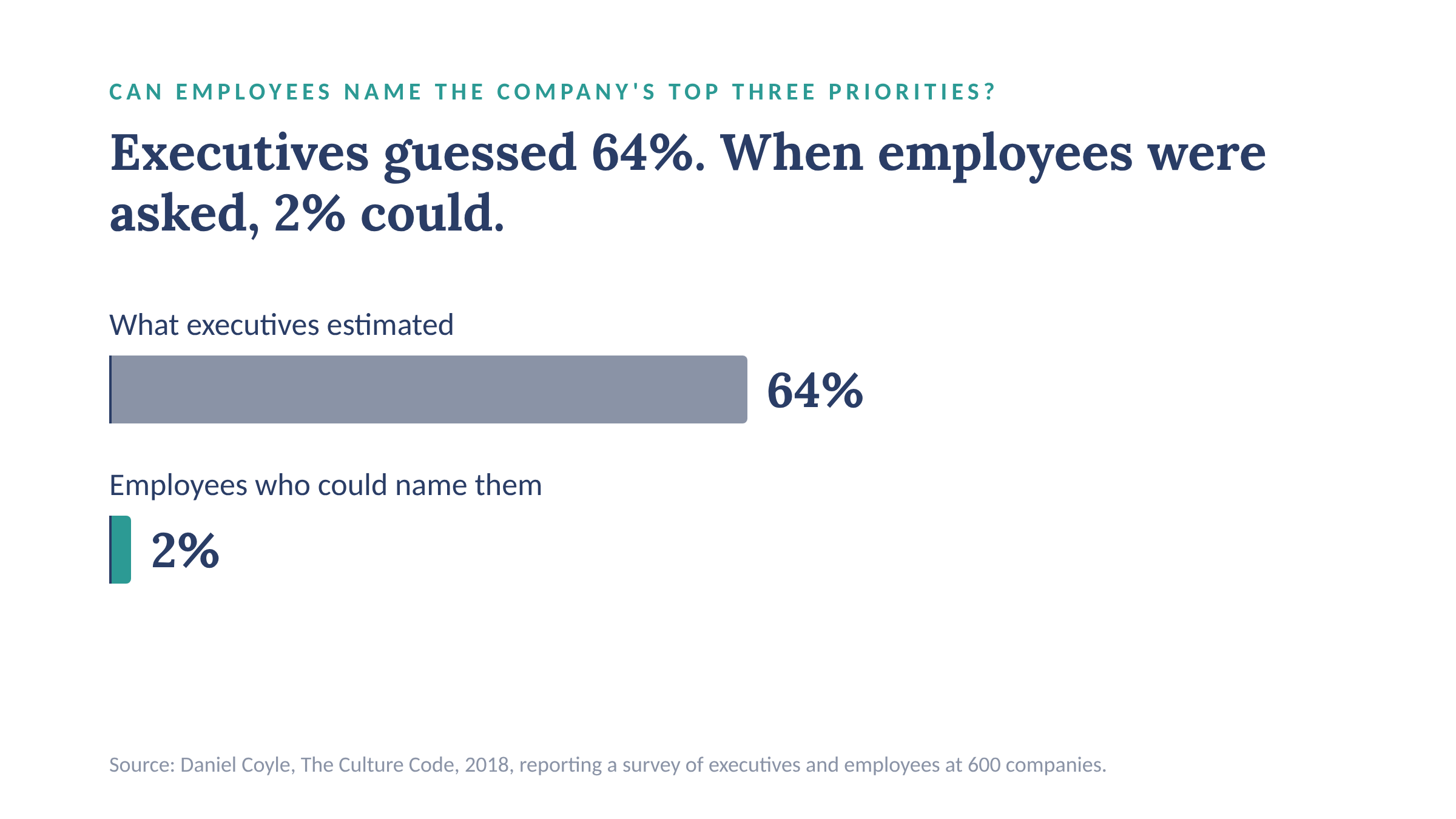
Executives estimated 64% of employees could name the top three priorities, and 2% could, in a survey Coyle describes.
The gap reaches the people doing the work. In a survey of more than 2,100 full-time employees in the United States, the United Kingdom and Germany, conducted by Skillsoft, which sells workplace learning, in October and November 2024, fewer than half (48%) had been told their organization’s strategic goals and priorities for the coming year. Of those who had been told, only 40% were extremely clear about their role in achieving them.
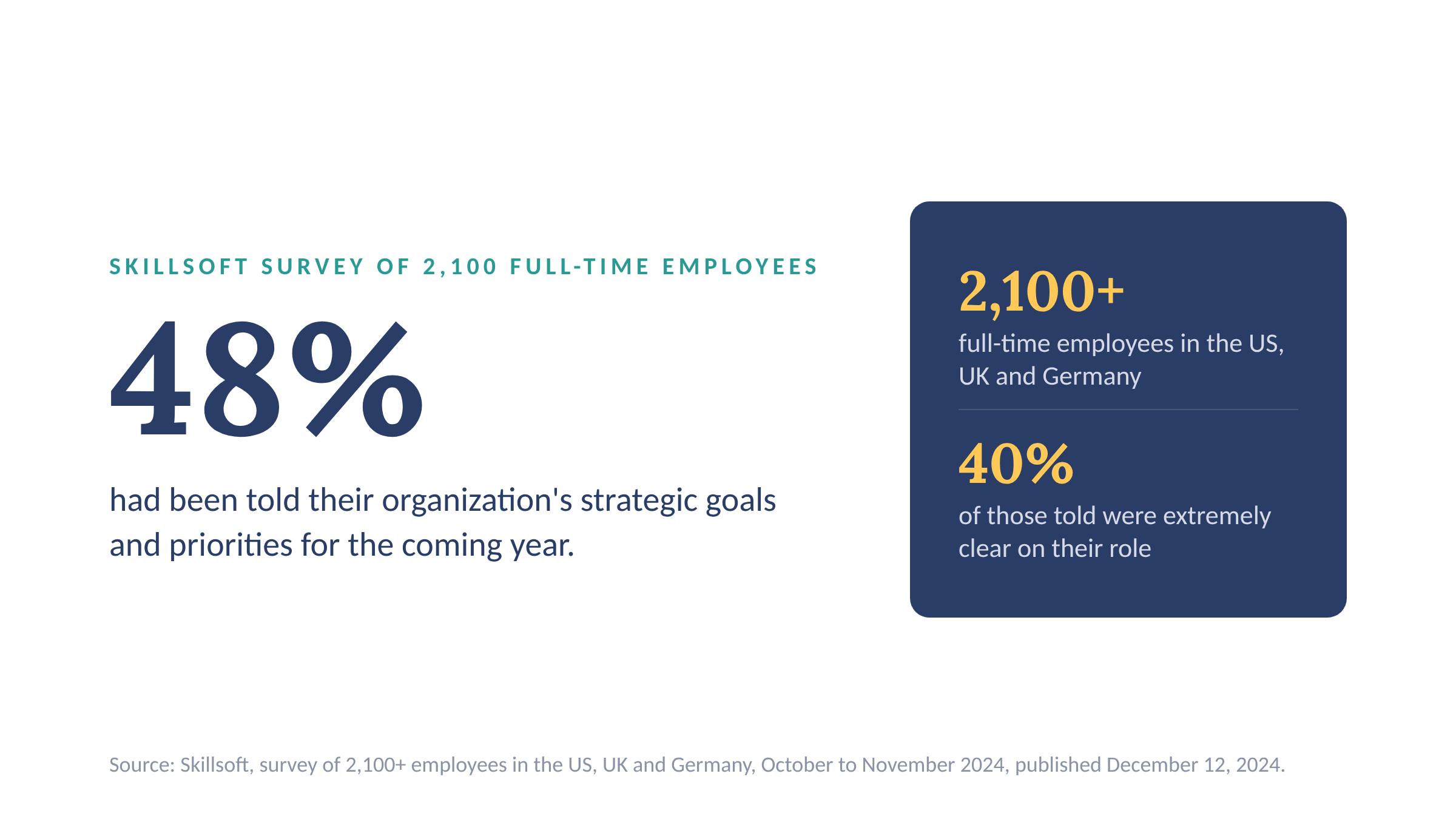
48% of 2,100 employees had been told their organization’s goals, and 40% of those were extremely clear on their role.
4. Decisions without one owner
A decision that everyone agreed to and nobody owns gets reopened the first time it becomes inconvenient. By spring, the leadership team is spending its meetings debating calls it made in January, and the teams waiting on those calls stall or make their own.
5. No rhythm for checking the plan
A plan that’s only reviewed at the next planning session drifts for eleven months. Without a regular check, nobody notices a priority slipping until it’s too late to recover it this year, and the leadership team ends up writing the same priorities into next year’s plan.
Why is the leadership team usually the cause?
All five reasons are habits of the leadership team: who it brings into planning, how many priorities it agrees on, how clearly it repeats them, how it owns decisions and how often it checks progress. A better-written plan doesn’t change any of them.
Most leaders on a leadership team were promoted for leading a function well, and their function is the team they know best. When the plan comes under pressure, each leader protects their own function’s priorities first, which is the problem the related episode covers. The fixes below work because they change what the leadership team does together each month.
What should your leadership team do differently this year?
Bring the right people into planning, set fewer priorities that every leader can repeat, give every decision one owner, check the plan every month and have leaders model the priorities first.
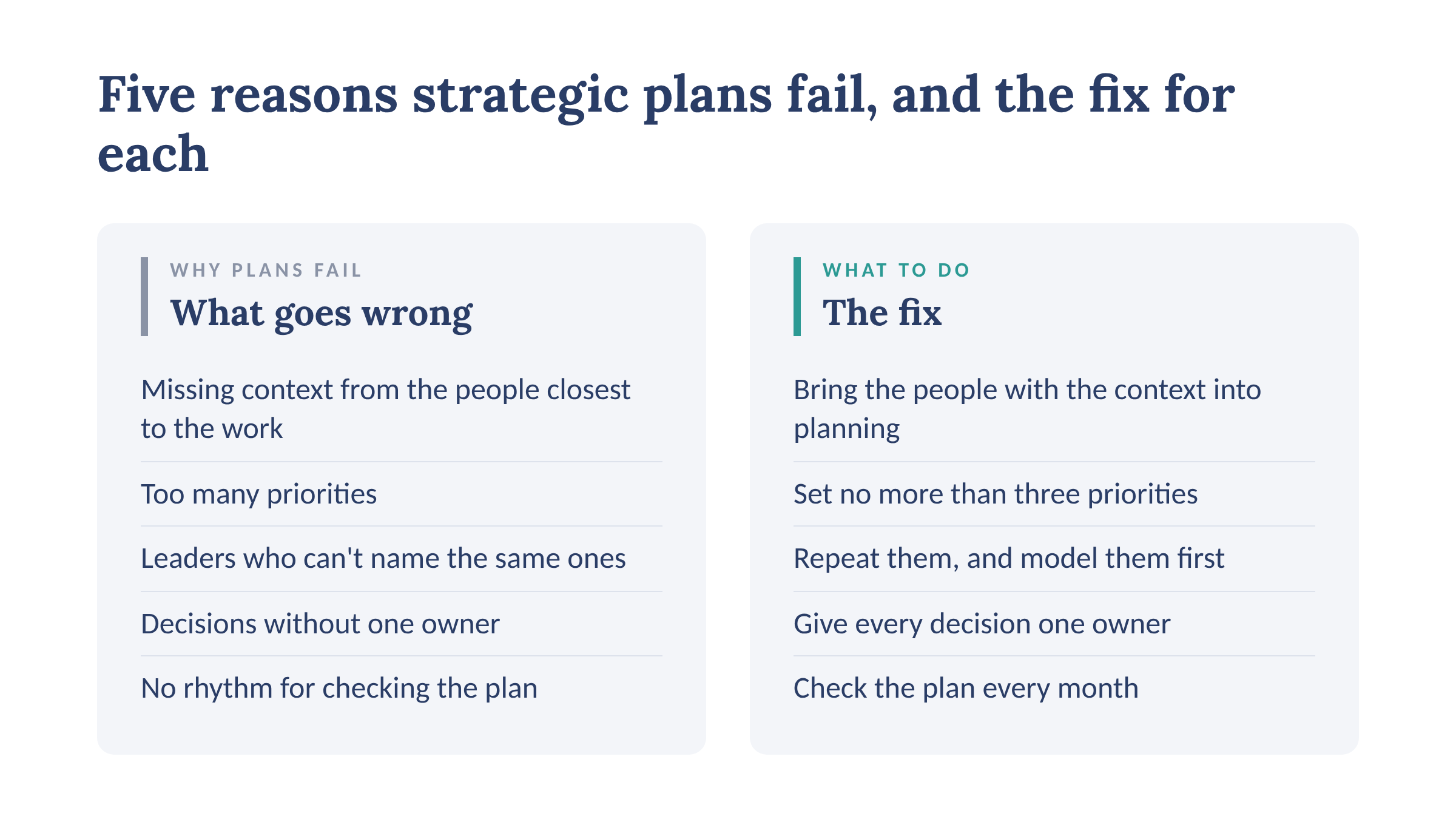
Five reasons strategic plans fail, each matched to a fix, from bringing in the people with context to leaders going first.
Bring the people with the context into planning
Before the plan is written, ask the managers and specialists closest to each priority what’s been done, what’s working, what isn’t and what they’d need to deliver it. Better still, have the leadership team frame each objective, with the measure, the limits and how it will judge the options, and let the teams closest to the work build the plans and brief them back. Our post on what to do before your leadership team’s planning offsite covers how to frame an objective so a team can plan it.
Set fewer priorities every leader can repeat
Choose no more than three company-wide priorities, and write each in words a leader could repeat to their team without notes. Then test it: at your next leadership meeting, ask each leader to write the top priorities on a card without looking, and compare the cards. If they don’t match, the priorities aren’t clear yet. Our post on clear intent covers four statements that give your leaders the same words for where the organization is going.
Give every decision one owner
For every decision in the plan, name one owner and how the decision gets made: by the owner alone, by the owner after checking with the people affected, by a group with the owner making the final call, or by someone more senior. When a decision has one owner and a known way of being made, it isn’t reopened just because someone disagrees later. Our post on decision ownership covers the four decision types and when to escalate.
Check the plan every month
Hold a monthly check of 60 minutes against the plan. For each priority, the owner reports progress against the measure, names any decision they need from the leadership team and says what has changed since last month. The leadership team decides what it needs to decide in the meeting, and every decision leaves with one owner and a date.
Model the priorities first
People copy what their leaders spend time on. If the priorities say one thing and the leaders’ calendars say another, the calendars win. Ask each leader to look at last month’s calendar and count the hours that went to the company-wide priorities, then agree on one change each leader will make so their time matches the plan.
Where should your leadership team start this January?
Start before the plan is written. A planning process that brings in the people with the context, sets fewer priorities, names an owner for every decision and books the monthly checks before anyone leaves gives the plan a far better chance of holding past March.
If you’d like the teams closest to the work to build the plan with you, our War Games planning sessions take a leadership team through that process on a real objective.
Frequently asked questions
Why do strategic plans fail?
Strategic plans usually fail for five reasons: missing context from the people closest to the work, too many priorities, leaders who can’t name the same ones, decisions without one owner and no rhythm for checking the plan. In one analysis of 124 organizations, only 28% of leaders executing strategy could name three priorities.
How many priorities should a leadership team have?
Most leadership teams do better with no more than three company-wide priorities. Fewer priorities are easier for every leader to repeat in the same words, which makes them more likely to guide the decisions people make each week. Test them by asking each leader to write the priorities down without looking, and compare the lists.
How often should a leadership team review the plan?
Review the plan every month, in a check-in of about 60 minutes. For each priority, the owner reports progress against the measure, names any decision needed and says what has changed. A deeper review each quarter helps too. A plan reviewed only at the next planning session drifts for most of the year.
What’s the difference between a strategy and a plan?
A strategy is the choice of where the organization is going and the few priorities that will get it there. A plan turns those priorities into steps, owners, dates and measures. A strategy every leader can repeat makes the plan easier to build and easier to check each month.
Plan a year your leadership team delivers
If last year’s plan broke by spring, a conversation with us can help you see which of the five reasons applied and what to change before this year’s planning. LoyaltyOps is a leadership development firm that develops individual leaders and leadership teams against clear leadership competencies, so performance improves across your organization.
Sources
Sull, D., Sull, C., and Yoder, J. “No One Knows Your Strategy, Not Even Your Top Leaders.” MIT Sloan Management Review, February 12, 2018. https://sloanreview.mit.edu/article/no-one-knows-your-strategy-not-even-your-top-leaders/
Coyle, D. (2018). The Culture Code: The Secrets of Highly Successful Groups. Bantam. The book reports the survey second-hand. https://danielcoyle.com/the-culture-code/
Skillsoft. “Skillsoft Research Reveals Misalignment Between Organizations’ Strategic Goals and Workforce Skills Entering 2025.” Press release, December 12, 2024, from an online survey run in October and November 2024. https://www.skillsoft.com/press-releases/skillsoft-research-reveals-misalignment-between-organizations-strategic-goals-and-workforce-skills-entering-2025
Related episode: UNLEASHED by LoyaltyOps, “Every Executive Has Two Teams,” September 10, 2026. https://youtu.be/TTXxza6jtHI