

Leadership Offsite Agenda and 4-Week Checklist
What to Do Before Your Leadership Team’s Planning Offsite, With a Sample Leadership Offsite Agenda
Most of a leadership offsite’s results are set before anyone arrives. Use the four weeks before to agree on your biggest objectives and get every leader current. Then use the offsite to frame each objective, name three directions for it and agree how you’ll choose, so your teams can build the plans and your leadership team can decide.
Key takeaways
Agree on your two or three biggest objectives before the offsite, each with a measure, a date and the reason it matters.
Share what’s been done, what’s working and what isn’t beforehand, so the offsite doesn’t turn into an information session.
In a 2018 analysis of 124 organizations, only 28% of executives and middle managers responsible for executing strategy could name three of their company’s strategic priorities.
A leadership offsite should frame each objective, name three directions for it and set the criteria for choosing, and the teams closest to the work should build the plans.
Within 72 hours, every leader should brief their team on the frame, the three directions and the date the plans are due back.
Related UNLEASHED episode: Mickey Anderson on building a full plan for each option, so the decision becomes a choice between plans the team understands.
Make every offsite session end in a decision
A leadership offsite is a series of meetings, and each one needs someone leading it, someone recording it and a clear type for every decision. The free Meeting Standards Checklist gives your leadership team a before, during and after checklist to use at the offsite and in every meeting that follows it.
Get the Meeting Standards Checklist
Why is most of an offsite’s result decided before anyone arrives?
An offsite only has time to think and decide. When leaders arrive with different ideas of what the objectives are and different information about what’s already happened, the first day goes to catching up, and the offsite turns into an information session.
The cost shows up for the rest of the year. In a 2018 analysis of 124 organizations, published in MIT Sloan Management Review, Donald Sull, Charles Sull and James Yoder found that only 28% of executives and middle managers responsible for executing strategy could name three of their company’s strategic priorities.
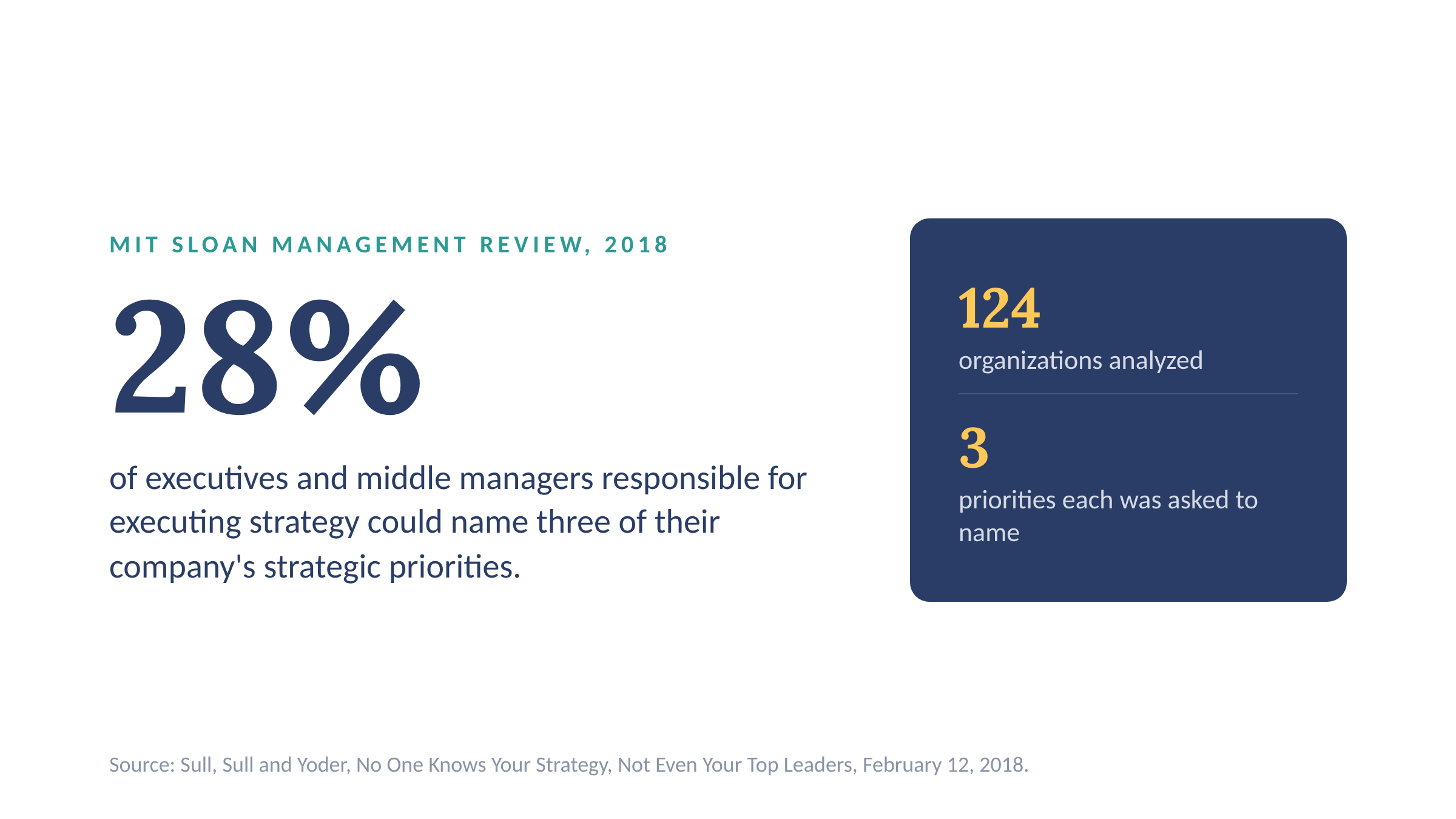
In a study of 124 organizations, 28% of leaders executing strategy could name three of their company’s priorities.
An offsite that ends with a long list of priorities makes that number worse. In the leadership offsites we’ve worked on with clients, the ones that used the time well had done the alignment and the catching up beforehand, so the leadership team spent its days on the few things only it can decide.
What should a leadership offsite produce?
For each of your biggest objectives, a leadership offsite should produce a clear frame, three directions worth exploring and the criteria you’ll use to choose between them. It shouldn’t produce the detailed plan, because the people closest to the work know things the leadership team doesn’t, and they’re the ones who’ll deliver it.
That split is the core of how we teach planning. A plan written at the top misses what the people closest to the work know. When the leadership team frames the objective and sets the limits, and the teams build a plan for each direction, the leaders choose between real plans instead of approving the first idea. Our post on choosing a strategic planning facilitator covers why plans break and what each kind of help fixes.
A frame for each objective
A frame tells a team everything it needs to plan without coming back to ask. It has five parts:
The objective: what must be achieved, with a measure, a date and the reason it matters.
Resources: the budget, time, people and tools the team has access to.
Constraints: what the team must do or must use, such as a launch date that can’t move.
Restraints: what the team must not do or must not use, such as no new hires.
Assumptions: what you’re treating as true, labelled so everyone can see it.
Three directions for each objective
A direction is a sentence the team will turn into a full plan:
“We will achieve ___ by ___ because ___.”
Give each one a different focus, such as the fastest route, the most careful route with the least risk, and the route that uses the least money and effort. If two of your “because” lines say the same thing, the two directions are probably the same idea.
For an objective to grow recurring revenue from $4 million to $5 million by December 31, three directions might be: expanding with existing clients because they already trust you, launching a new service because clients keep asking for it, or raising prices at renewal because the work has grown in value. Each one leads to a very different plan.
Decision criteria for each objective
Decide now how you’ll choose between the plans your teams bring back, such as speed, cost, risk or client impact, and agree a simple way to compare them, like a quick score for each plan on each criterion. Teams that know how their plans will be judged build plans that can be compared, and your leadership team can decide quickly when they come back.
What should you do in the four weeks before a leadership offsite?
Four things: agree the objectives, find out how the team leads today, ask each leader what the team avoids discussing, and get everyone current on what’s been done and what’s working.
Four weeks before: agree your biggest objectives
Choose the two or three objectives that matter most for the year, and agree them with your leaders before anyone arrives. Write each one with a measure, a date and the reason it matters. If the leaders are still debating what the objectives are when they arrive, that debate will use the first day.
Four weeks before: find out how the team leads today
The plans depend on how your leaders work together to deliver them, so give the team evidence about that before the offsite. Our Team Assessment, part of the Leadership Competency Assessment, is completed by each leader and by the people who work with them, and the results show where the team leads well and where the gaps are. Start it four weeks out, so the results are back in time.
Three weeks before: ask each leader what the team avoids discussing
Ask each leader privately what the leadership team avoids discussing and what they think will stop the year’s plans working. Gallup’s September 2026 guide to leadership alignment lists six common causes of misalignment, including unclear behavioural expectations, no effective forum for raising and resolving disagreements about priorities, inconsistent accountability and leadership changes. Your leaders’ answers will usually point to one or two of them, and those topics need time on the agenda.
Two weeks before: get everyone current
For each objective, collect what’s been done, what’s happening now, what’s working and what isn’t. Send it as short pre-reading a week before, and ask every leader to come having read it. When every leader arrives with the same information, the offsite time goes to framing and deciding.
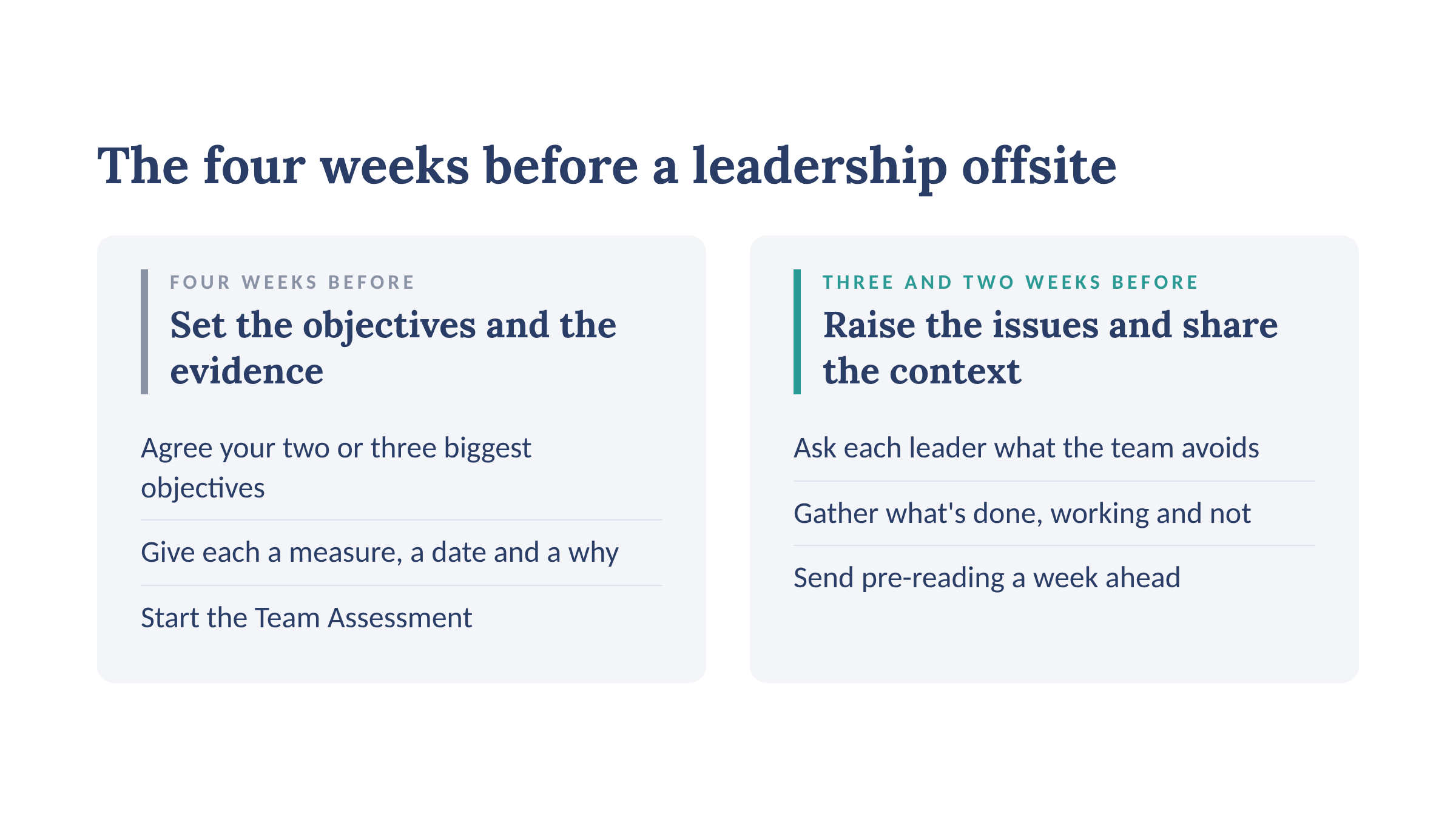
A four-week checklist: choose the objectives, assess how the team leads, ask what it avoids, then share the context.
What does a sample leadership offsite agenda look like?
This two-day agenda fits a leadership team of four to eight working on two or three objectives. Every session ends with something written down that a team could start planning from.
When | Session | Ends with |
Day 1, morning | What’s true now: the pre-reading, the Team Assessment results and the topics leaders said the team avoids | An agreed picture of where each objective stands |
Day 1, afternoon | Frame each objective: the measure, date and why, the resources, constraints, restraints and assumptions | A written frame for each objective |
Day 2, morning | Name three directions for each objective, each with its focus and its “because” | Three directions for each objective |
Day 2, afternoon | Set the decision criteria and a simple way to compare the plans, then agree which leader briefs which team, the time box and when the plans come back | Criteria for each objective, and a date for every brief back |
Last 30 minutes | Read back every frame, direction and date | Each leader confirms what they’ll brief to their team |
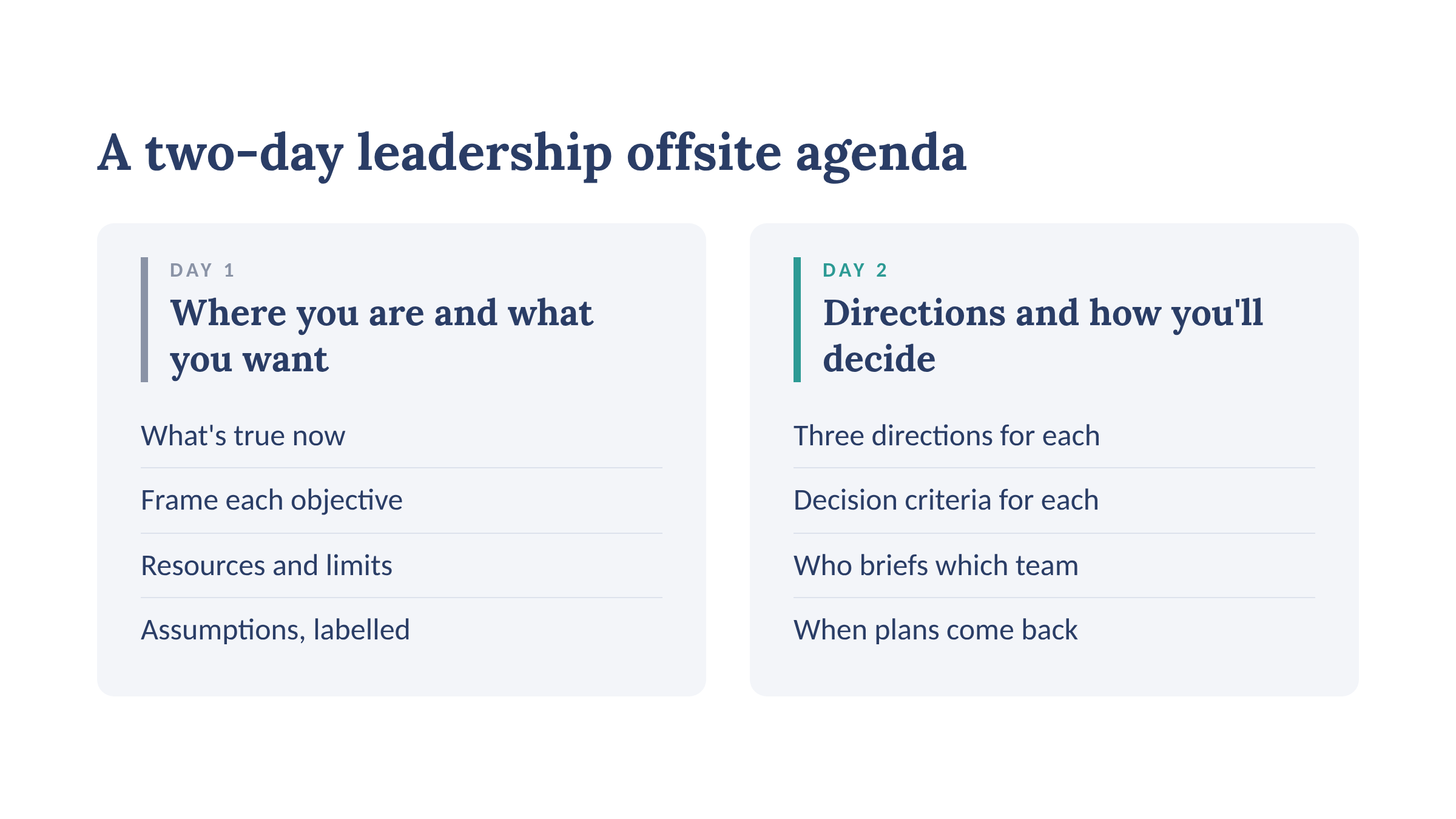
A two-day leadership offsite agenda: frame each objective, name three directions, then set how you’ll decide.
With one objective, the same agenda fits in one day.
What should happen in the 72 hours after a leadership offsite?
Each leader briefs their team, the teams start building the plans, and the dates for the brief-backs and the decision go in the calendar. This is when an offsite’s work either reaches the people who’ll deliver it or stays in the leadership team’s notes.
Within 24 hours: the person who recorded the offsite sends every frame, direction, set of criteria and brief back date to the leadership team, in the words agreed at the offsite.
Within 72 hours: each leader briefs their team on the frame and the three directions, and sets the time box and the date the team briefs its plans back.
At the brief backs: each team walks the leadership team through a full plan for each direction, with steps, owners, dates and risks.
Within 48 hours of the brief backs: the leadership team decides against the criteria it set at the offsite, and tells the team what it chose, why, and what it’s giving up.
Each step in the chosen plan should have one owner, and our post on giving every decision one owner explains how to choose them. If you’d like help taking a team through the whole process on a real objective, from the frame to the rehearsal of the finished plan, that’s what our War Games planning sessions are for.
Frequently asked questions
How do you prepare for a leadership offsite?
Start four weeks out. Agree your two or three biggest objectives with a measure, a date and a reason; find out how the leadership team leads today; ask each leader privately what the team avoids discussing; and send short pre-reading on what’s been done and what’s working. When everyone arrives current, the offsite time goes to framing and deciding.
What should a strategic planning offsite agenda include?
A strategic planning offsite agenda should include a session on what’s true now, a frame for each objective, three directions for each, and the criteria the leadership team will use to choose between the plans. It should end with which leader briefs which team and the date each team brings its plans back.
How long should a leadership team offsite be?
One day is enough for one objective. Two days fit a leadership team of four to eight working on two or three objectives, with the first day on what’s true now and framing each objective, and the second on naming directions and setting decision criteria. The length should follow the number of objectives.
What should happen after a planning offsite?
Within 24 hours, every frame, direction and date goes to the leadership team in writing. Within 72 hours, each leader briefs their team on the frame and the three directions. The teams build a plan for each direction and brief it back, and the leadership team decides against the criteria it set at the offsite.
Leave your next offsite ready for your teams to plan
If your leadership team has an offsite coming and last year’s plan didn’t hold, a conversation with us can help you decide what to prepare and how to use the time. LoyaltyOps is a leadership development firm that develops individual leaders and leadership teams against clear leadership competencies, so performance improves across your organization.
Sources
Sull, D., Sull, C., and Yoder, J. “No One Knows Your Strategy, Not Even Your Top Leaders.” MIT Sloan Management Review, February 12, 2018. https://sloanreview.mit.edu/article/no-one-knows-your-strategy-not-even-your-top-leaders/
Gallup. “How to Improve Leadership Alignment.” September 24, 2026. https://www.gallup.com/workplace/715013/leadership-alignment-at-work.aspx
Related episode: UNLEASHED by LoyaltyOps, “Your Decision Problem Is Actually a Planning Problem,” June 3, 2026. https://youtu.be/rsfwS8JXkXM