
Strategic Planning Facilitator or Team Coach?
Strategic Planning Facilitator or Team Coach: Which Does Your Leadership Team Need?
A strategic planning facilitator leads one or two days of structured planning so your leadership team leaves with an agreed plan. Team coaching develops how the leadership team works together over several months. In a 2024 randomized trial, teams given a coaching approach gained more in psychological safety and cohesion than teams given facilitation. Many teams need both, in order.
Key takeaways
A facilitator’s work ends when the plan is agreed, and team coaching continues for months while the team delivers it.
If the same problems come back after every plan, such as reopened decisions or priorities that drift by spring, the plan probably wasn’t the cause.
A 2017 meta-analysis of 72 controlled teamwork interventions, with 8,439 participants, found medium-sized gains in both teamwork and team performance.
In a small 2024 randomized trial of six workplace teams, a coaching approach raised psychological safety and cohesion more than facilitation did.
Whichever you choose, agree before you start how you’ll know the team works differently afterwards.
Related UNLEASHED episode: Mickey Anderson explains why a decision that keeps stalling is often a planning problem.
Start planning with direction every leader can repeat
The first thing a facilitated session should produce is a direction your leaders explain the same way. The free Clear Intent Builder helps your leadership team write four statements that name where you’re going before anyone builds the plan around it.
What’s the difference between a strategic planning facilitator and team coaching?
A strategic planning facilitator helps your leadership team produce a plan in one or two days of structured work. Team coaching develops how your leadership team works together, usually in monthly sessions over six to twelve months, while the team does its real work.
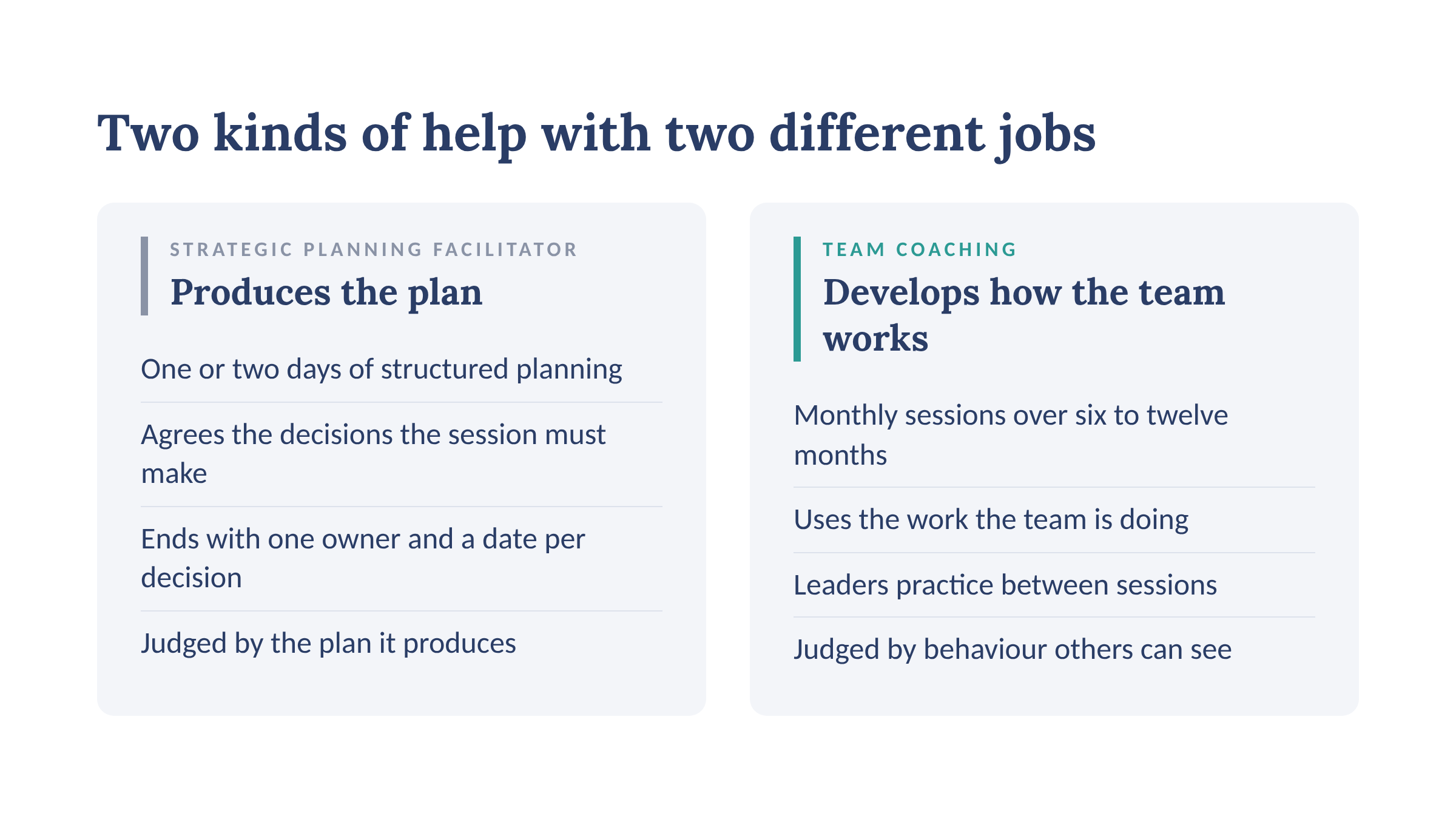
A facilitator helps a leadership team produce a plan in a day or two, and team coaching develops how it works over months.
A good facilitator agrees beforehand which decisions the session has to make, prepares the pre-work, keeps the discussion on those decisions and makes sure every leader is heard. They stay neutral on the content, so the CEO can take part as a member of the team. The session is judged by what it produces: a short list of priorities, a decision for each open question, and one owner and a date for each decision.
Team coaching works on the habits behind the plan. That includes how leaders make decisions together, how they disagree, whether they raise problems early and whether they hold each other to what they agreed. Each session uses the work the team is doing that month, and leaders practice new behaviours between sessions. It’s judged by whether the leaders behave differently, as the people who work with them see it.
When does a leadership team need a facilitator, and when does it need team coaching?
You need a facilitator when the problem is the plan itself. You need team coaching when the plan was sound, and the same problems keep coming back while the team tries to deliver it.
A facilitator fits when
one major objective needs a plan the whole leadership team owns
it’s time for the yearly plan and last year’s session ended without clear owners
new leaders have joined who haven’t planned with the team before
the CEO wants to take part in the discussion instead of leading it
Team coaching fits when
decisions made at planning get reopened a few months later
leaders defend their own function’s priorities first
disagreement comes out after the meeting instead of during it
the same issues come back after every plan, whoever wrote it
Researchers have compared the two directly. In 2024, Jonathan Passmore, David Tee and Richard Gold published a randomized controlled trial in the Journal of Work-Applied Management with six workplace teams in the UK, 51 people in total. Each team was randomly assigned a one-day team coaching session, which used LEGO Serious Play, or a one-day facilitated session on its objectives and priorities. By the end of the day, people in the coaching group had made greater gains in psychological safety and team cohesion.
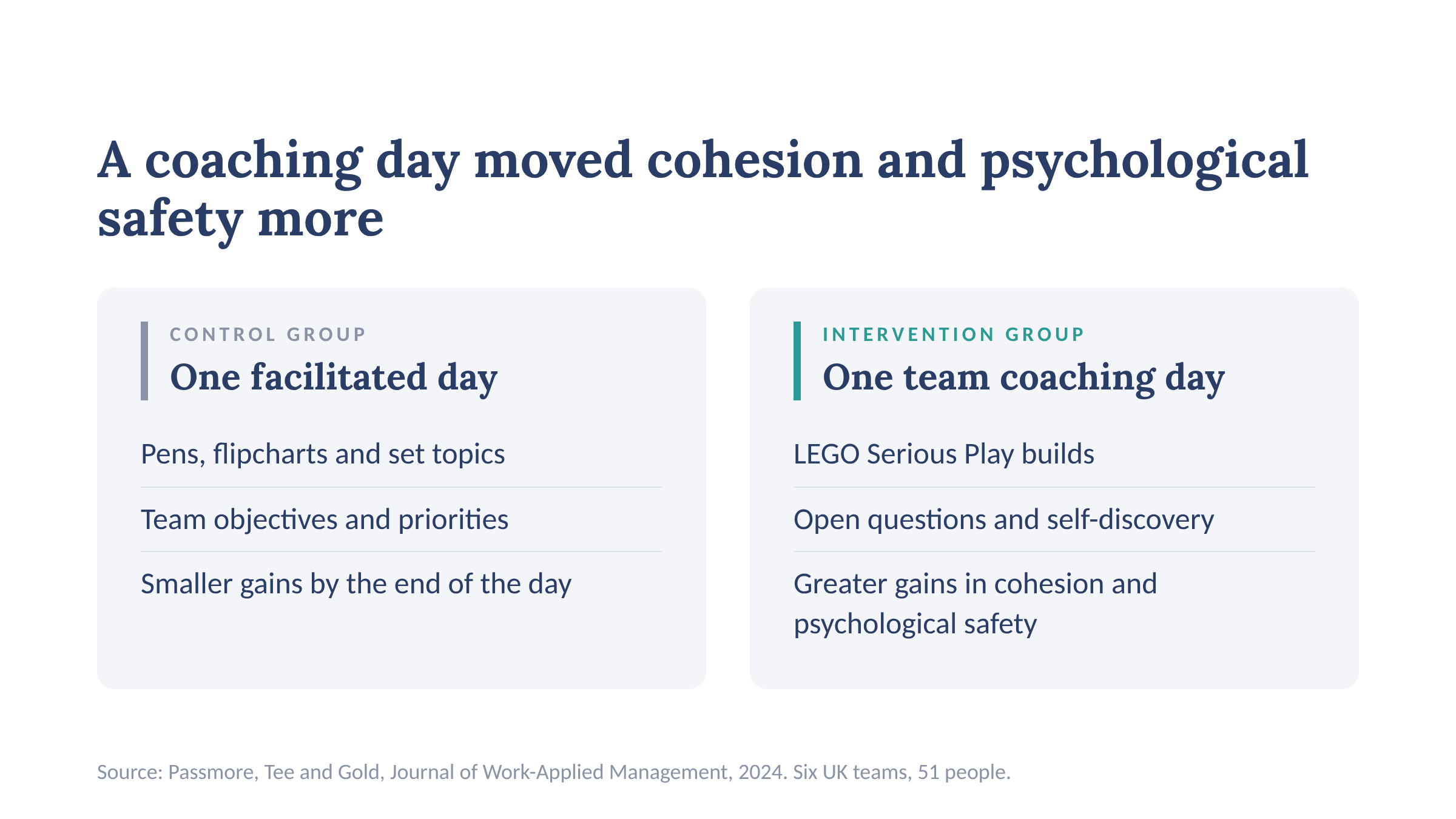
In a 2024 trial of six teams, a coaching day raised psychological safety and cohesion more than a facilitated day did.
The authors describe it as the first randomized trial evidence for team coaching in the workplace, and they’re plain about its limits. It’s a small study of six teams, four facilitators and one country, and the coaching method is hard to separate from the LEGO materials it used. It’s still useful for a leader choosing between the two, because it tested both approaches on real teams under the same conditions.
Which questions tell you whether you need a facilitator or a coach?
Five questions about last year’s plan will usually tell you. If most of your answers point to the plan, start with a facilitator, and if most point to how the team worked on it, look at team coaching.
Did last year’s plan break because of the plan, or because of how we worked on it?
Can every leader on the team name the same top priorities today?
Were the decisions we made at planning still standing by spring?
When leaders disagreed, did they say so in the meeting or after it?
Did each priority have one owner with the authority to decide?
A team that answers yes to questions 2 to 5 and still missed its plan probably set the wrong priorities, or too many of them, and a better planning session will help. A team that answers no to two or more of them has a problem a better plan won’t fix, because the plan depends on leaders who decide, disagree and follow through together.
Why do many leadership teams need both, and in what order?
A plan and the team that delivers it fail in different ways, so many teams need both. The plan comes first, because it gives the team agreed decisions to work from, and team coaching then uses the work of delivering that plan as its material through the year.
In an organization of 30 to 300 people, the leadership team is often four to eight people, and most of them were promoted for leading a function well. A facilitated session in December or January sets the year’s priorities. Monthly team sessions then work on what gets in the way of them, such as a decision that needs one owner or a disagreement that keeps coming back. The next planning cycle starts from what the team learned.
The research on developing teamwork supports doing the second part on purpose. A 2017 meta-analysis in PLOS ONE by Desmond McEwan and colleagues pooled 51 articles, covering 72 controlled teamwork interventions and 8,439 participants, and found positive, medium-sized effects on both teamwork and team performance.
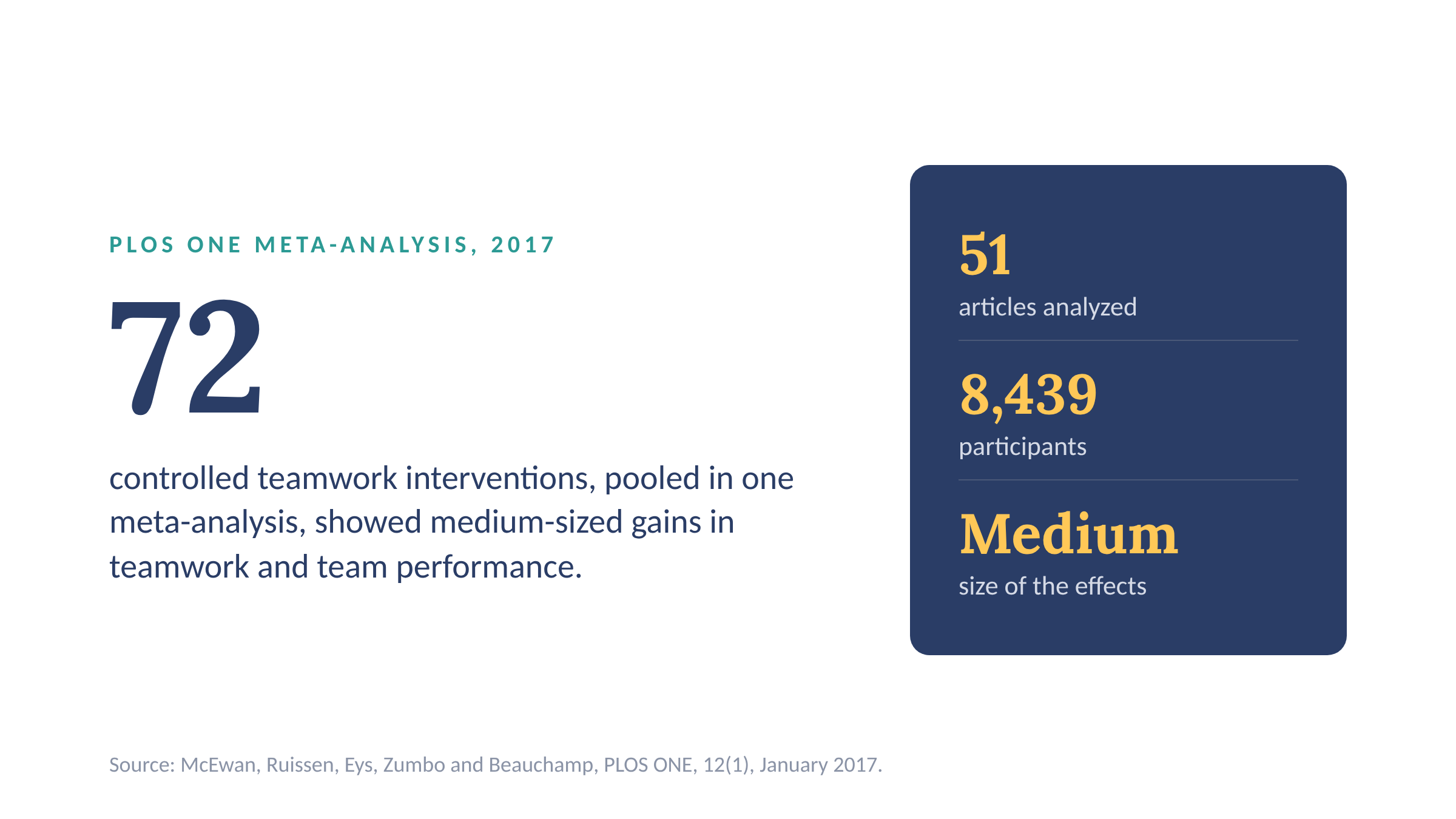
A 2017 PLOS ONE meta-analysis of 72 controlled interventions found medium-sized gains in teamwork and team performance.
Both halves have a LoyaltyOps version. Our War Games planning sessions give a leadership team two days on-site, one to learn a planning process and one to use it on a real objective, so the team leaves with a plan it built. Leadership Team Development is six or twelve months of monthly sessions for a leadership team of four to eight, CEO included. If you’d like the team closest to the work to build more of the plan, bottom-up planning explains how leadership sets the problem and the limits while the team builds the plan.
What should you look for in a facilitator or a team coach?
Look for someone who can tell you, before you start, what will be different afterwards and how you’ll both know.
In a strategic planning facilitator
They ask which decisions the session must make before they write the agenda.
They send pre-work, so the session time goes to deciding.
They stay neutral on the content and keep every leader in the discussion.
They end with one owner and a date for every decision, and check in during the first weeks after.
In a team coach
They work from your team’s real work, with exercises only where they help.
They describe good leadership as behaviours people can see.
They measure at the start and at the end, using the people who work with your leaders as well as the leaders themselves.
The measurement test
Ask both of them: how will we know the team works differently afterwards? A good answer names the behaviours that should change, who will score them and when. A facilitator might point to decisions still standing three months later. A coach should be able to show scores from the start and the end, with the leaders assessed by the people who see their work as well as by themselves.
Where should a leadership team start before planning season?
Start with evidence about how your leadership team leads today, so you know which problem you’re paying to solve. That evidence comes most reliably from the people who work with each leader.
The Team Assessment, part of our Leadership Competency Assessment, is completed by each leader on your team and by the people who work with them, the observers. The results show where the team is strong and where the gaps are. A team that scores well on setting direction and lower on following through on decisions has learned something a planning session won’t change. We offer the Team Assessment as pre-work before facilitated planning sessions, so the team plans with evidence about how it leads.
Frequently asked questions
What does a strategic planning facilitator do?
A strategic planning facilitator designs and leads one or two days of structured planning for a leadership team. They agree beforehand which decisions the session must make, prepare pre-work, keep the discussion on those decisions and make sure every leader is heard. The session ends with an agreed plan, with one owner and a date for each decision.
What’s the difference between team coaching and facilitation?
Facilitation helps a team produce something in a session, usually a plan or a set of decisions. Team coaching develops how the team works together over months, using its real work, such as how leaders decide, disagree and follow through. In a small 2024 randomized trial of six teams, a coaching approach raised psychological safety and cohesion more than facilitation did.
Do we need an outside facilitator for our planning session?
An outside facilitator helps when the CEO wants to take part as a member of the team, when leaders are likely to defend their own functions, or when past sessions ended without clear owners. A team that already plans well together can use an internal facilitator. In both cases, agree beforehand which decisions the session must make.
How long does leadership team coaching take?
Leadership team coaching usually takes six to twelve months, with one session a month, because new habits need time and real work to practice on. Our Leadership Team Development is six or twelve months for a leadership team of four to eight, CEO included, with every leader assessed at the start and again at the end.
Plan the year with a leadership team ready to deliver it
If you’re deciding what your leadership team needs before planning season, a conversation with us can help you tell whether the gap is in the plan or in how the team works on it. LoyaltyOps is a leadership development firm that develops individual leaders and leadership teams against clear leadership competencies, so performance improves across your organization.
Sources
McEwan, D., Ruissen, G. R., Eys, M. A., Zumbo, B. D., and Beauchamp, M. R. (2017). “The Effectiveness of Teamwork Training on Teamwork Behaviors and Team Performance: A Systematic Review and Meta-Analysis of Controlled Interventions.” PLOS ONE, 12(1), e0169604. January 13, 2017. https://journals.plos.org/plosone/article?id=10.1371/journal.pone.0169604
Passmore, J., Tee, D., and Gold, R. (2024). “Team coaching using LSP and team facilitation: a randomized control trial study measuring team cohesion and psychological safety.” Journal of Work-Applied Management. https://doi.org/10.1108/JWAM-12-2023-0137
Related episode: UNLEASHED by LoyaltyOps, “Your Decision Problem Is Actually a Planning Problem,” June 3, 2026. https://youtu.be/rsfwS8JXkXM