
Promotion Readiness: Senior Manager or Director
Promotion Readiness: How to Prepare for a Senior Manager or Director Promotion in Professional Services
Quick answer: Promotion readiness at senior manager or director level means showing evidence that you already lead people, clients and the commercial part of the work. Start 12 to 18 months ahead. In a study of 214 firms, top sellers were more likely to be promoted, and the teams they went on to manage tended to sell less.
Key takeaways
In a study of 214 firms, doubling a salesperson’s sales raised their chance of promotion by 14.3%, and was linked to a 7.5% drop in sales on the team they went on to manage (Benson, Li and Shue, 2019).
In the same study, people who had sold as part of a team made better managers on average, so helping others succeed counts as evidence of readiness.
DDI found only 19% of more than 70,000 manager candidates showed strong delegation skills, and only 12% showed high proficiency in managing conflict.
46% of UK managers told the Chartered Management Institute that colleagues won promotions on relationships and profile ahead of ability and performance, which is why written criteria and real evidence matter.
Build your case in six areas: delivery, client management, team development, communication, commercial awareness and leadership behaviour.
Watch a related episode of UNLEASHED, where Mickey Anderson, Co-Founder of LoyaltyOps, looks at Ipsos research on why fewer people want to lead others, and why career support makes the difference.
Choose the leadership behaviours your promotion case will show
Promotion panels look at how you lead, and the people who work with you notice what you do consistently far more than what you say. The free Leadership Modeling Reference Card helps you pick two or three behaviours, show them for 30 days and see what changes on your team.
Get the Leadership Modeling Reference Card
Why isn’t technical excellence enough to show you’re ready?
Technical excellence shows you can do the work, and a senior manager or director role asks whether you can get excellent work done through other people, keep clients and grow the business. If most of your evidence is your own deliverables, you’re showing the panel the job you already have.
The research on promotion decisions explains why this matters. Alan Benson, Danielle Li and Kelly Shue studied sales workers at 214 firms in manufacturing, information technology and professional services, including more than 1,500 people promoted into management, and published the results in The Quarterly Journal of Economics in 2019. Doubling a salesperson’s sales raised their chance of promotion by 14.3% relative to their starting chance. Once they were promoted, doubling their pre-promotion sales was associated with a 7.5% drop in the sales of the people they managed.
The leadership skills themselves are less common than most firms expect. DDI, the leadership development company, has assessed more than 70,000 manager candidates worldwide. In results published in April 2025, only 19% showed strong delegation skills, and in results published in September 2024, only 12% showed high proficiency in managing conflict and 60% had trouble empowering others.
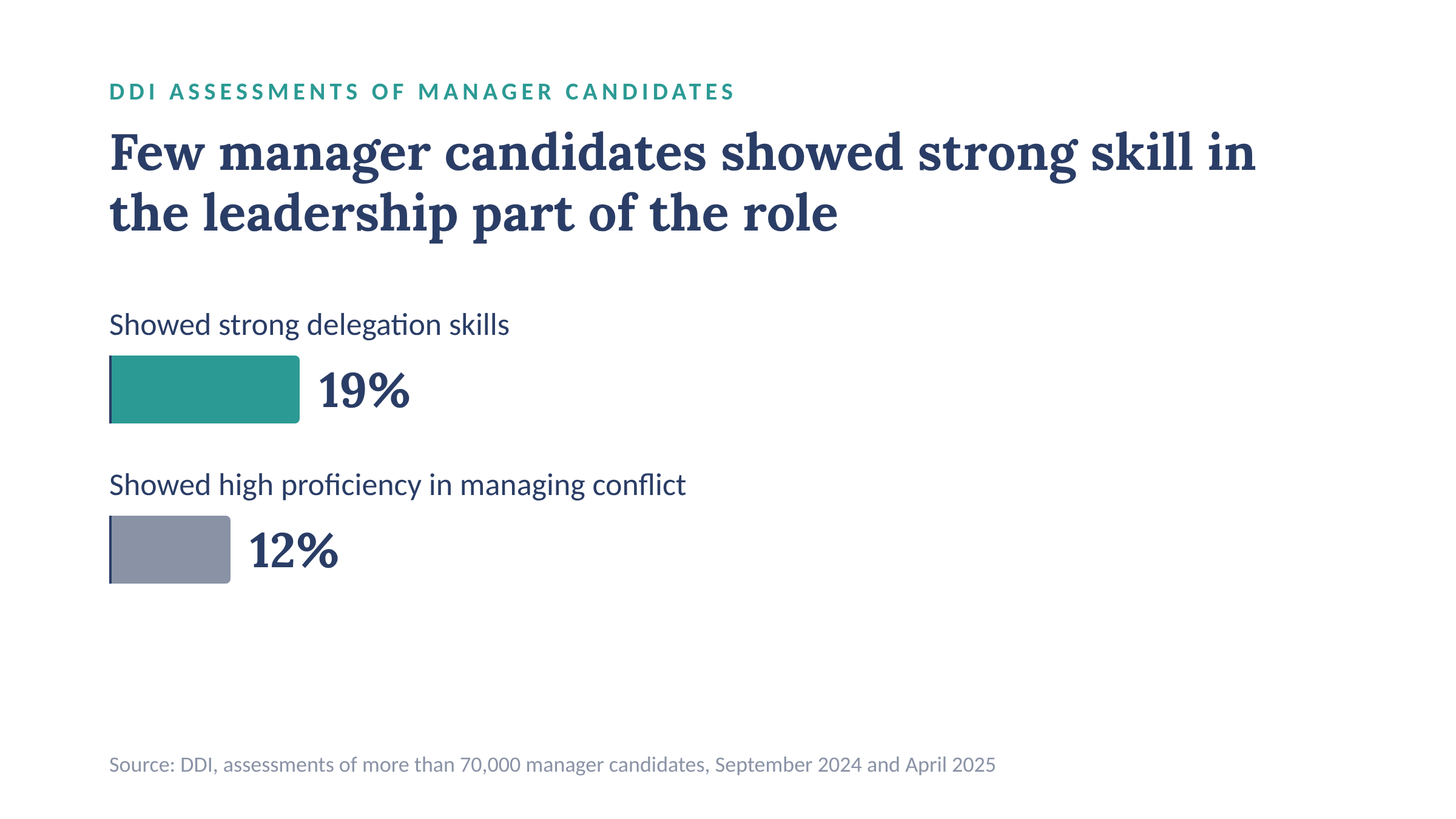
DDI found 19% of over 70,000 manager candidates showed strong delegation and 12% high proficiency in managing conflict.
Many people step into a bigger role with no preparation at all. The Chartered Management Institute, the UK professional body for managers, surveyed more than 4,500 UK workers and managers with YouGov in June 2023, and found 82% of people entering management roles had no formal management and leadership training. The survey is self-reported, so read it as directional.
What do promotion panels look for at senior manager and director level?
Promotion panels at this level look for evidence in six areas, and the weight shifts from what you produce to what your team, your clients and your firm get because you lead them. The exact criteria differ by firm, so treat these as the questions to ask about, and get your firm’s own version in writing.
Area | What the panel wants to see | Evidence that shows it |
Delivery | Engagements that finish on time, on budget and to standard while you do less of the work yourself | Engagements you led, and how much of the work your team did |
Client management | Clients who trust you with the relationship, including when something goes wrong | A client who asks for you by name, an escalation you handled, a scope change you agreed |
Team development | People who got better because they worked with you | A junior you developed who now does work you used to do |
Communication | Clear direction for your team, and clear updates for partners and clients | Briefings, proposals and partner updates that didn’t need rework |
Commercial awareness | Understanding of how engagements make money, and how new work comes in | Budgets you managed, margin you protected, a proposal you wrote or helped win |
Leadership behaviour | Someone people want to work for and with | What your team, peers and partners say when they’re asked |
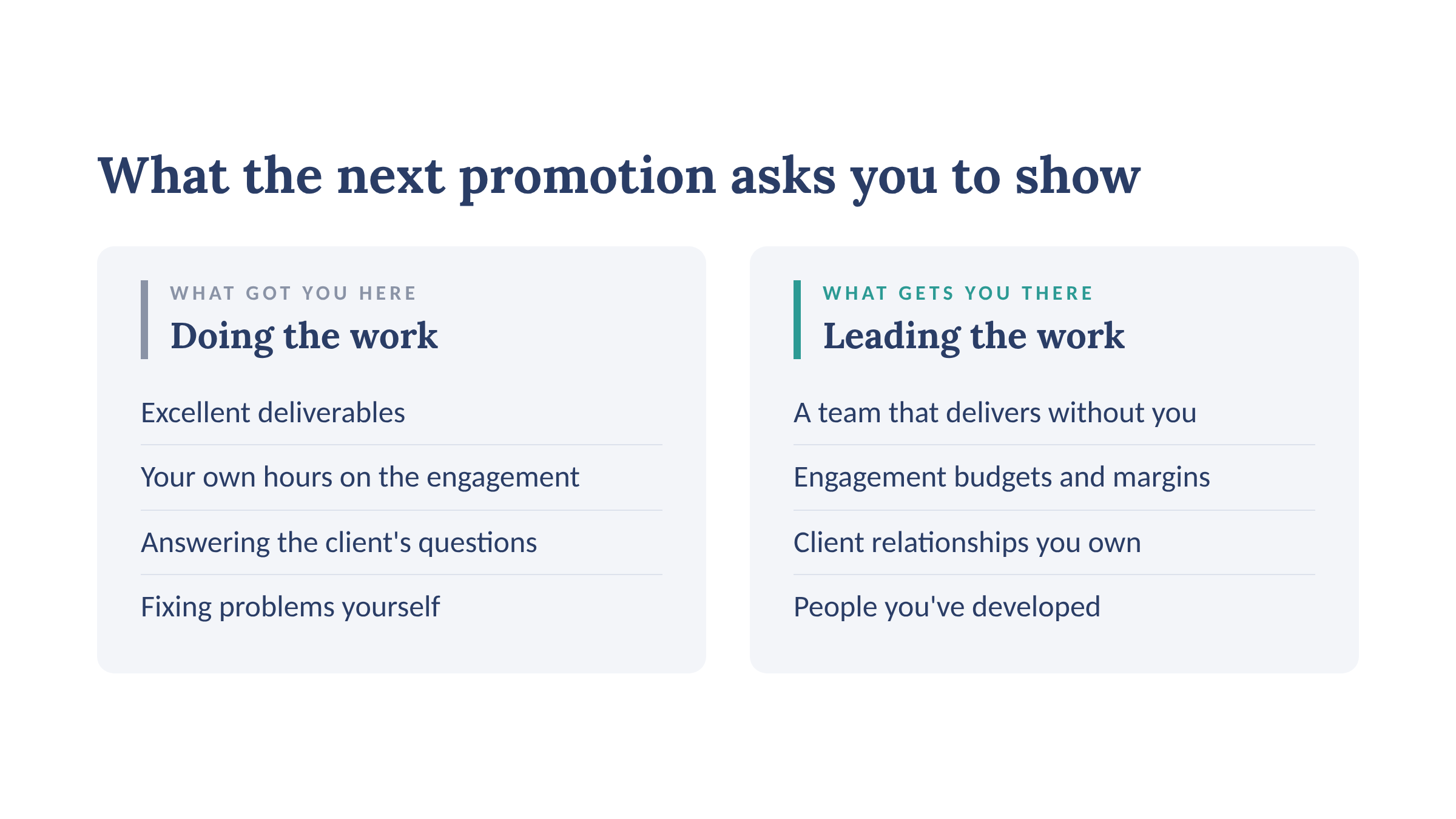
A senior manager promotion asks for evidence of leading the work: a team, clients, margins and people you’ve developed.
Delivery still matters, and at this level panels judge it through your team. A candidate who stays up until midnight fixing everyone’s drafts is showing the panel that the team’s output depends on them.
How do you build a promotion case with evidence instead of self-assertion?
Build your case from things other people can see and confirm: outcomes, observations from the people you work with, and the progress of the people you’ve developed. Three engagements where your team delivered and the client renewed will persuade a panel far more than a statement that you’re ready to lead.
Get the criteria in writing first
You can’t collect evidence against criteria you’re guessing at. In the third quarter of 2026, Gallup found that just 46% of US employees strongly agreed they know what’s expected of them at work. At senior levels, expectations are often described in general terms like “partner presence” or “commercial maturity.” Ask your partner, director or performance manager this:
“I’d like to be ready for senior manager in the next 12 to 18 months. What would you need to see from me, in each part of the role, to say I’m ready? Can you give me an example of someone who showed it well?”
Confirm what you heard by email, and use it as the list you collect evidence against.
Keep an evidence log
Once a month, add a few lines for each piece of leadership work: the situation, what you did, what happened and who saw it. Keep it to facts, such as “Handed the client model to Priya with a checkpoint at the midpoint, she presented it to the client, and the client approved it without changes.” When the promotion conversation comes, you’ll have specific examples from 12 to 18 months of work.
Ask the people who work with you
Your own view of your leadership is the weakest evidence you have. In a 2005 meta-analysis of 24 studies in Personnel Psychology, James Smither, Manuel London and Richard Reilly found that after leaders got feedback from the people who work with them, scores from direct reports and supervisors improved a little, and the leaders’ own scores didn’t improve on average. Ask your team, peers and partners what you do well and what you should do more of, and add their words to your log.
A Leadership Competency Assessment gives you that view in a structured way, scored by you and the people who work with you against clear leadership competencies. The results belong to you and aren’t used for pay, promotion or performance reviews, so use them to decide where to focus your development, and let the evidence from your work make the case.
How do you get exposure, responsibility, mentoring and feedback on purpose?
Ask for them specifically, tie each one to the criteria you agreed and ask early, so the evidence exists before the promotion conversation does.
Career support makes a measurable difference. Ipsos, the global market research company, published The Workplace Reality in October 2026, drawing on 9,100 employees in 32 countries, and found career support is the factor most consistently linked to people wanting to take on a people manager role. Ipsos describes management as “increasingly viewed as a burden rather than a reward” where that support is missing.
Exposure
Ask to present your team’s work to the client instead of handing it to the partner to present, and ask to join one partner or practice meeting a quarter.
Responsibility
Ask for one stretch responsibility at a time from your criteria: managing an engagement budget, leading a proposal, owning a client relationship or managing staffing for a team. Agree what success looks like and when you’ll review it together, so it becomes evidence once it’s done.
Mentoring
Find one mentor a level or two above the role you want, and ask for a short conversation once a month. Bring a real situation each time, such as a difficult client email, and ask how they’d handle it.
Feedback
Ask one specific question after real work, such as “What’s one thing I could have done to make that client meeting go better?” A specific question gets a specific answer, while “Any feedback for me?” usually gets “You’re doing great.”
How do you develop followership?
Followership is the evidence that people want to work for you and do their best work when you lead them. You develop it by helping others succeed, sharing credit, developing juniors and being consistent in how you treat people.
The Benson, Li and Shue study found that people who had sold as part of a team went on to produce better results as managers, on average, than people who had sold on their own. Helping others succeed is a skill panels can see in your track record long before you’re promoted.
Help others succeed. Offer your time when a colleague is stuck, and make sure clients and partners see their good work.
Share credit. Name the person who did the work, in front of the client and the partner, every time it’s true.
Develop juniors. Hand over work you’re good at, with a clear standard and a checkpoint, and review it without taking it back. Our post on how to delegate client work without losing quality covers what to hand over and how closely to check.
Be someone people want to work with. Keep your reactions predictable under pressure, protect your team when a deadline is unrealistic and follow through on what you say you’ll do.
Gallup found in research published in 2015 that managers account for 70% of the variance in employee engagement across business units, so the way you lead a small team today is one of the clearest signs of how you’ll lead a larger one.
What does a 12 to 18 month promotion readiness plan look like?
A 12 to 18 month promotion readiness plan has four stages: agree the criteria, take on stretch responsibility, lead through others while you collect evidence, and then make the case. Twelve months suits someone already doing parts of the next role.
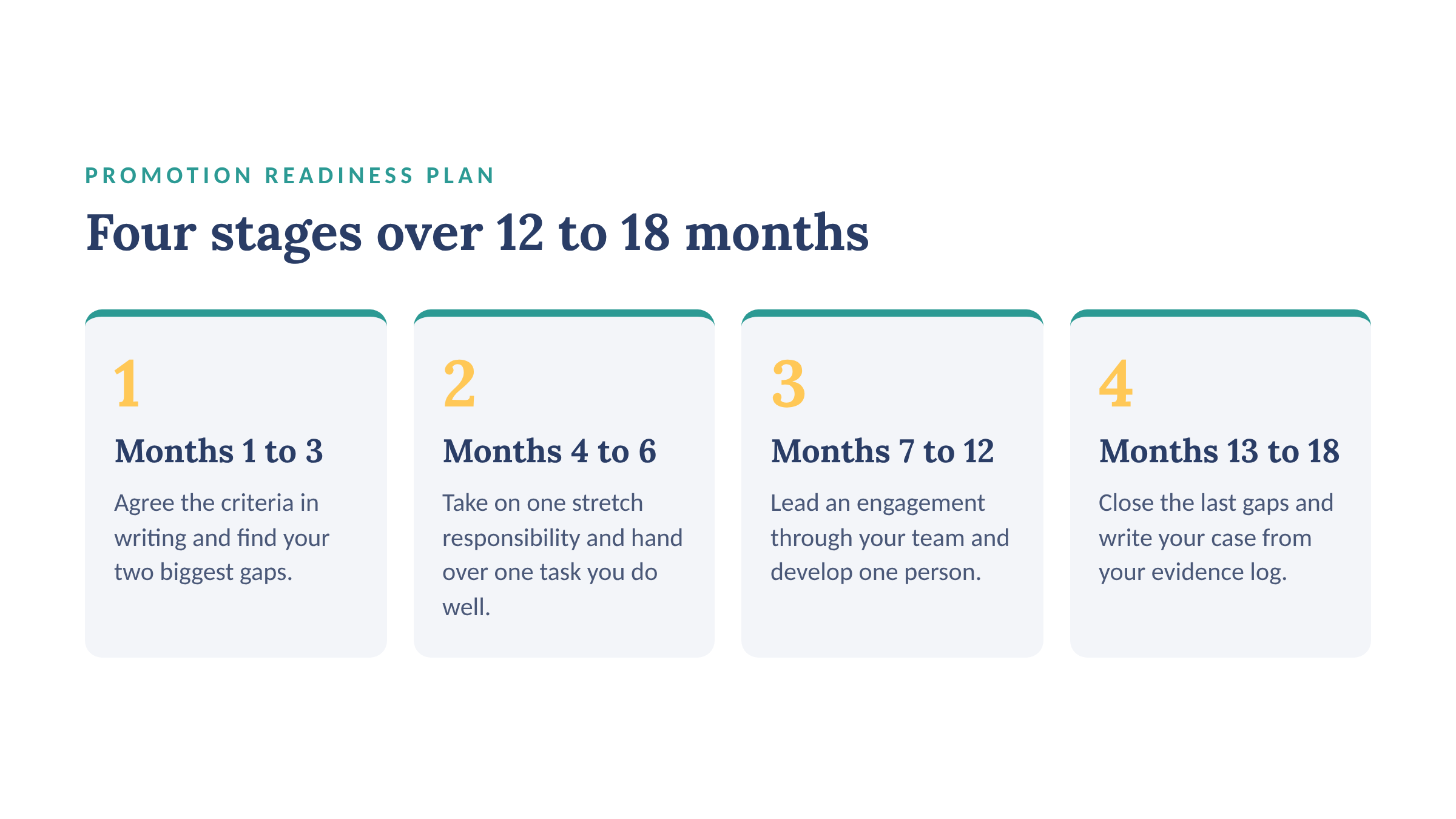
A 12 to 18 month promotion readiness plan in four stages, from agreeing the criteria to making the case.
Months 1 to 3: Agree the criteria and find your gaps
Ask your partner or director for the criteria in writing, and confirm them by email.
Score yourself in each of the six areas, then ask three people who work with you for their view.
Pick the two areas with the biggest gap, find a mentor and start your evidence log.
Months 4 to 6: Take on one stretch responsibility
Ask for one responsibility from your two gap areas, such as an engagement budget or a proposal.
Hand over one piece of work you’re good at to someone junior, with a clear standard and a checkpoint.
Review progress with your partner or director at the end of month 6.
Months 7 to 12: Lead through others and collect evidence
Lead a full engagement, or a large part of one, mostly through your team.
Develop one person until they can do work you used to do.
At month 12, compare your log with the criteria and agree with your partner or director whether you’re ready or which gaps remain.
Months 13 to 18: Make the case and keep doing the role
Close the remaining gaps with one more stretch responsibility.
Write your promotion case from the log: one or two examples per area, each with what happened and who saw it.
Keep leading at the level you’re asking for, because the months before a decision are often when panels watch most closely.
The Quarterly Performance Cadence Template is built for a leadership team’s quarterly review, and the same rhythm works for one person: reflect on the last quarter, agree what matters most and choose two or three visible behaviours for the next one. Our post on the first 90 days as a manager covers how to start well once the promotion comes through.
What can leaders at your firm do to make promotion readiness clearer?
Leaders at your firm can write down what good leadership looks like at each level, share it with everyone working toward a promotion and support people as they build evidence against it. In organizations of 30 to 300 people, one or two senior leaders often decide promotions, so unwritten criteria quickly become personal preference.
The Chartered Management Institute found that 46% of UK managers believed colleagues won promotions based on internal relationships and profile ahead of ability and performance. Written criteria give your people a fair chance, and leaders decide on a shared standard. Betterworks, a performance management software company, surveyed 521 HR and business leaders in the US and the UK in August 2026, and 48% named leadership expectations as the biggest source of friction for managers. Our post on leadership expectations for managers shows how a leadership team can define good leadership in a short exercise.
Give each person working toward a promotion a mentor, one stretch responsibility at a time and regular conversations about their development, and make developing successors part of how your current leaders are judged. For leaders who want structured support outside the firm, 1:1 Leadership Development works on the leadership competencies a bigger role asks for over six or twelve months.
Frequently asked questions
How do I know if I’m ready for a senior manager promotion?
You’re likely ready when you can show evidence in six areas: delivery through your team, client management, team development, communication, commercial awareness and leadership behaviour. A good test is whether engagements you lead finish well with you doing less of the work yourself. Ask your partner or director for the written criteria and compare your evidence against them.
How long does it take to prepare for a director promotion?
Plan for 12 to 18 months. Twelve months suits someone already doing parts of the director role, such as managing budgets or owning client relationships. Eighteen months gives you time for a second full cycle of client work, so you can close the gaps you find and show the panel evidence from more than one engagement.
What should I include in a promotion case?
Include one or two specific examples for each area your firm assesses, each with the situation, what you did, what happened and who saw it. Add what your team, peers and partners said about your leadership. Panels give more weight to evidence other people can confirm than to your own description of your strengths.
How do I ask my manager what I need to do to get promoted?
Ask directly and name a timeframe: “I’d like to be ready for senior manager in the next 12 to 18 months. What would you need to see from me, in each part of the role, to say I’m ready?” Ask for an example of someone who showed it well, then confirm what you heard by email.
Why do strong performers get passed over for promotion?
Strong performers are often passed over at senior levels when most of their evidence shows their own work, while the role asks for leading people, clients and the commercial part of the business. In a study of 214 firms, firms put less weight on individual sales in promotion decisions when the management role came with more responsibility.
Get your next senior managers and directors ready before the decision
If you’re preparing for a bigger leadership role, or your firm’s promotions keep rewarding the best individual work and leaving new leaders to learn the rest alone, a conversation with us is a good place to start. LoyaltyOps is a leadership development firm that develops individual leaders and leadership teams against clear leadership competencies, so performance improves across your organization.
Sources
Alan Benson, Danielle Li and Kelly Shue, Promotions and the Peter Principle, The Quarterly Journal of Economics, 134(4), pages 2085 to 2134, 2019. Sales workers at 214 firms, including more than 1,500 employees promoted into management. Findings summarized in the NBER Digest, The Peter Principle Isn’t Just Real, It’s Costly, May 2018
DDI, New DDI Data Shows Only 19% of Rising Leaders Have the Delegation Skills Needed To Prevent Burnout, assessments of more than 70,000 manager candidates, April 8, 2025
DDI, New DDI Data Shows 49% of Emerging Leaders Struggle With Managing Conflict in the Workplace, assessments of more than 70,000 manager candidates, September 24, 2024
Chartered Management Institute, New study: Bad managers and toxic work culture causing one in three staff to walk, Taking Responsibility report with YouGov, more than 4,500 UK workers and managers surveyed in June 2023, October 16, 2023
Jim Harter, Gallup, U.S. Employee Engagement Below 30% for First Time in 15 Years, Gallup Panel of 21,648 US adults surveyed August 5 to 19, 2026, October 28, 2026
James W. Smither, Manuel London and Richard R. Reilly, Does Performance Improve Following Multisource Feedback? A Theoretical Model, Meta-Analysis, and Review of Empirical Findings, Personnel Psychology, 58(1), pages 33 to 66, 2005
Ipsos, The Workplace Reality, 9,100 employees in 32 countries, October 2026
Randall Beck and Jim Harter, Gallup, Managers Account for 70% of Variance in Employee Engagement, April 21, 2015
Betterworks, 2026 manager effectiveness survey: The multiplier most orgs haven’t turned on, 521 HR and business leaders in the US and UK, fielded August 2026, October 14, 2026
UNLEASHED by LoyaltyOps, Only 1 in 4 Employees Say Managing Looks Attractive, related episode, October 29, 2026