
New Executive Onboarding: What Decides a New Leader’s First 18 Months
New Executive Onboarding: What Decides a New Leader’s First 18 Months
New executive onboarding decides whether a senior leader succeeds. According to McKinsey, 27 to 46 percent of executive transitions are considered failures or disappointments after two years. In week one, agree on expectations, the decisions they own and how you define good leadership, then have them learn the team before changing it.
Key takeaways
As McKinsey reports, 27 to 46 percent of moves into senior roles are regarded as failures or disappointments two years later.
Most struggle with politics, culture and people, among leaders who’d already shown results in earlier roles.
In week one, the new leader needs the leadership team’s expectations, the decisions they own and your definition of good leadership.
The new leader learns the team before changing it, through one-on-ones, skip-level conversations and a what-we-heard update.
Plan for 18 months, with CEO check-ins at 30, 90 and 180 days and a baseline score at about day 90.
Why does new executive onboarding go wrong so often?
New executive onboarding goes wrong when a company treats it as a first week of meetings, while the hard part of a senior role is learning the people, the culture and how decisions get made. The leaders who struggle have usually shown strong results in earlier roles.
In “Successfully transitioning to new leadership roles,” published by McKinsey on May 23, 2018, Scott Keller reports that two years after executive transitions, between 27 and 46 percent are regarded as failures or disappointments, citing other studies. As reported in the same article, 68 percent of moves into senior roles struggle with issues of politics, culture and people; as many as 74 percent of US leaders and 83 percent of global leaders think they’re unprepared for their new roles, and only 29 and 32 percent feel their organizations support new leaders well.
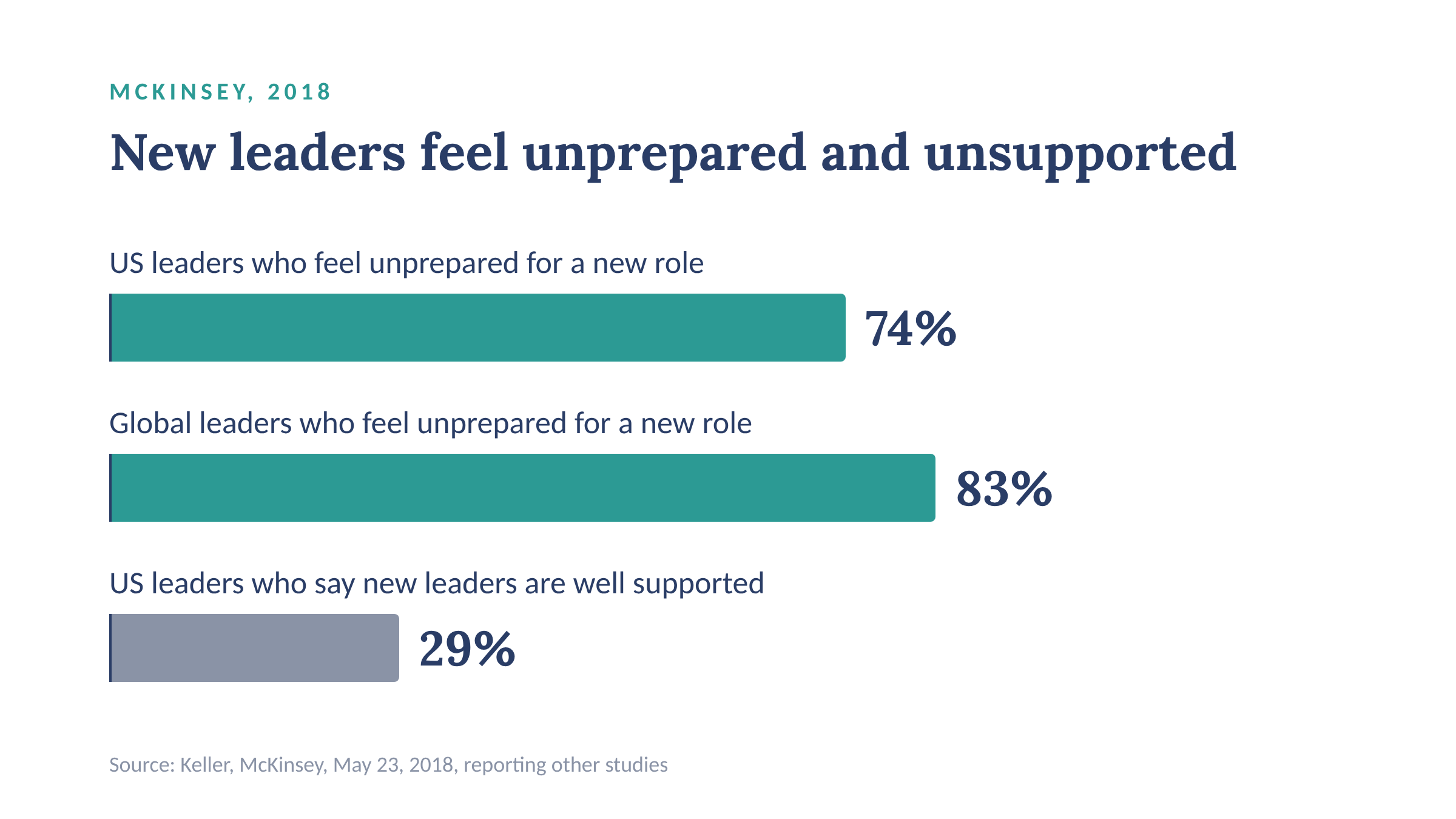
As reported by McKinsey, 74% of US leaders and 83% of global leaders feel unprepared for their new roles.
Promoted leaders need onboarding too. McKinsey reports that 69 percent of internal hires and 79 percent of external hires find changing the culture difficult. A leader you promote from inside has new peers, new decisions and a team that knew them in their old role, all from the same day.
Get the free Feedback Loops Blueprint
What does it cost when a new leader stalls or leaves?
When a new leader struggles, the cost reaches their whole team, and the company pays it again if it hires a replacement. Few companies plan or budget for it.
McKinsey reports that when new leaders struggle, their direct reports perform 15 percent lower than they would with high-performing leaders and are 20 percent more likely to be disengaged or to leave. It also cites an estimate that the direct costs of a senior-executive hire, such as searches, relocation and sign-on bonuses, reach 213 percent of annual salary. When the move goes well, the article reports, nine out of ten teams whose new leader succeeded met their three-year performance goals.
On UNLEASHED, Jorge Chavez, founder of Topaz Sales Consulting, estimated that a bad hire costs a company anywhere from $20,000 to $500,000, and asked business owners which budget that cost comes from. Most have no budget line for it, so a senior hire who leaves after a year shows up only as lost months, a team that waited for decisions, and a second search.
Related UNLEASHED episode: Mickey Anderson with Jorge Chavez on what a bad hire costs, and why almost no company has a budget line for it.
What does a new leader need in the first weeks?
In the first weeks, a new leader needs three things from the CEO: what the leadership team expects of them, which decisions they own, and how your company defines good leadership. Agree all three in writing before day one, so the leader can check their first moves against them.
What the leadership team expects of them
Name the two or three outcomes the leader owns in their first year, what a good result looks like for each, and what comes first when priorities compete. Ask each leadership team member what they need from the new leader’s function, and share the answers with the leader before they start.
Which decisions they own
List the decisions that belong to the new leader from day one, such as hiring within their team or approving spending within their budget, and the ones that stay with the CEO for now. Keep the list short and set a review date so the team knows who to ask.
How your company defines good leadership
Share the behaviours your company expects of every leader, the same ones you’ll score them on later. A leader hired from outside brings habits from another company, and a promoted leader brings habits from their old role, so a written description gives both of them the same standard to work from.
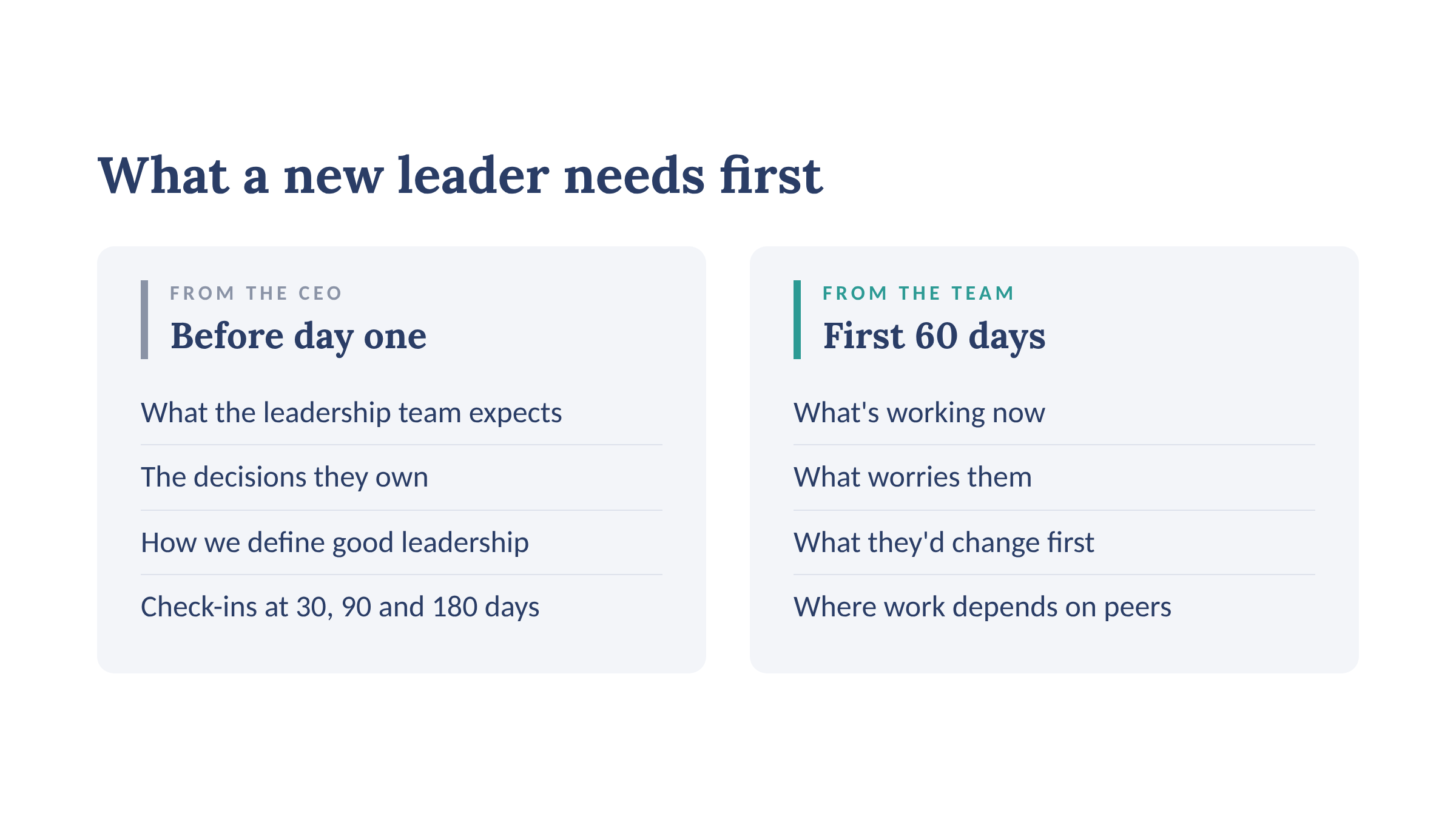
What a new leader needs first: expectations, decisions and good leadership from the CEO, and what the team knows.
What is new leader assimilation, and how does a new leader learn the team before changing it?
New leader assimilation is a planned way for a new leader to learn the team, the work, and the culture in their first months, so their first changes build on what the team already knows. The new leader listens first and makes changes once the team has seen them listen.
McKinsey reports that tailored coaching and customized assimilation plans have been shown to double the likelihood of a new leader’s success, yet only 32 percent of organizations use them. A good plan gives the new leader ways to hear from people in three directions:
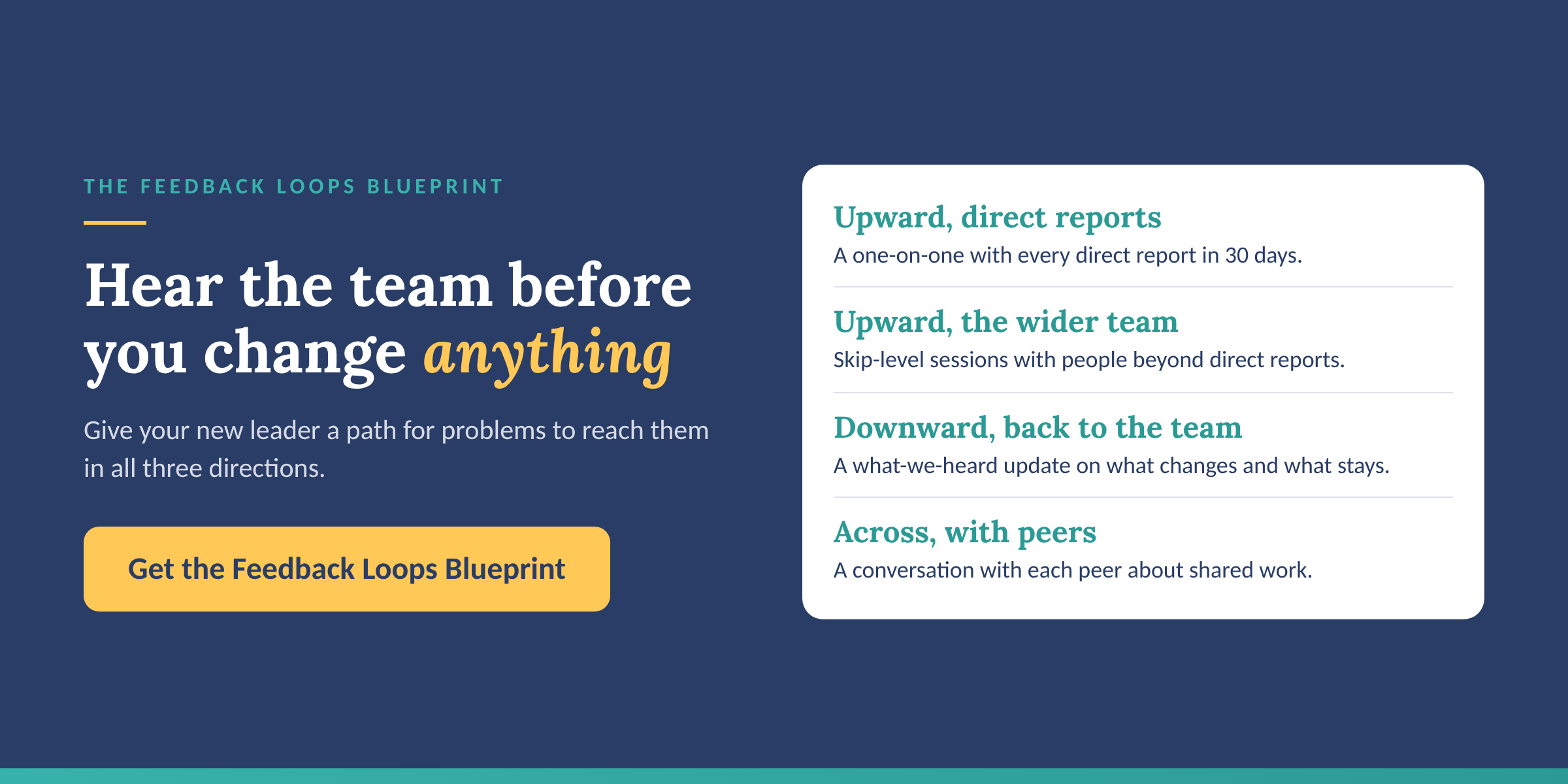
Upward, from direct reports. A one-on-one with every direct report in the first 30 days, asking what’s working, what worries them and what they’d change first.
Upward, from the wider team. Skip-level sessions with people beyond their direct reports by day 60.
Downward, back to the team. A what-we-heard update that names the themes the leader heard and what they’ll change and keep as it is for now.
Across, with peers. A conversation with each peer on the leadership team about how their teams’ work depends on each other.
When people raise an issue, ask them to bring the problem, its impact and a recommendation, so the new leader hears it early enough to act. Our post on effective one-on-one meetings that develop your team gives a structure for the weekly one-on-ones that follow. McKinsey also reports that successful leaders are 1.8 times more likely to say what they’ll stop as well as what they’ll start, which makes the what-we-heard update a good place to name both.
What do leadership competencies have to do with onboarding a new leader?
A leadership competency describes one part of good leadership as behaviours other people can see. Naming the competencies a new leader needs first tells them what to practice while they learn the role, and tells the CEO what to watch for.
Our Leadership Competency Model describes ten competencies, and the Leadership Competency Assessment scores each leader on them, from the leader’s own view and from observers who work with them. Naming the competency turns “the new leader changed things too fast” into something the leader can practice and score again in six months. For a new leader, a first score around day 90 provides a baseline from people who’ve worked with them long enough to answer. Four competencies matter most in the first months:
Listens and Adjusts. The new leader finds out how the work and the team are going before changing plans, and changes their first ideas when what they hear shows it’s needed.
Communicates Often and Openly. The new leader tells the team what they’re learning and deciding every week or two, including what they haven’t decided yet.
Makes It Safe to Be Honest, Try and Learn. People bring the new leader problems early, and the leader thanks the person who raised the issue before asking about the fix.
Makes Expectations Clear. The CEO tells the new leader what the leadership team expects, and by day 90 the new leader has done the same for each person on their team.
What should a new leader’s first 30, 90 and 180 days look like?
Plan the first 180 days in three stages, learn, agree and act, with a CEO check-in at the end of each, and keep developing the leader through month 18. As McKinsey reports, 92 percent of external hires and 72 percent of internal hires take far more than 90 days to reach full productivity, so a 90-day plan covers only the start.
Before day one
The CEO writes down expectations, the decisions the leader owns, and the company’s definition of good leadership, then tells the leadership team and the new leader’s team what the role covers. Book the check-ins at 30, 90 and 180 days now.
Days 1 to 30: learn
The new leader holds one-on-ones with every direct report, meets each peer, and makes no major changes yet. At the 30-day check-in, the CEO asks what they’ve learned, what surprised them and what they need from the CEO.
Days 31 to 90: agree
The new leader holds skip-level sessions, shares a what-we-heard update and agrees on their priorities and what they’ll stop with the CEO. At about day 90, they’re scored by themselves and the people who work with them, and the 90-day check-in agrees on one competency to practice.
Days 91 to 180: act
The new leader makes their first changes and tells the team why. The CEO checks in monthly and, at 180 days, reviews progress on the priorities and the competency with the leader.
Months 7 to 18: keep developing
Score the leader again at about month nine, check in every quarter, and agree whether the decisions they own should grow.
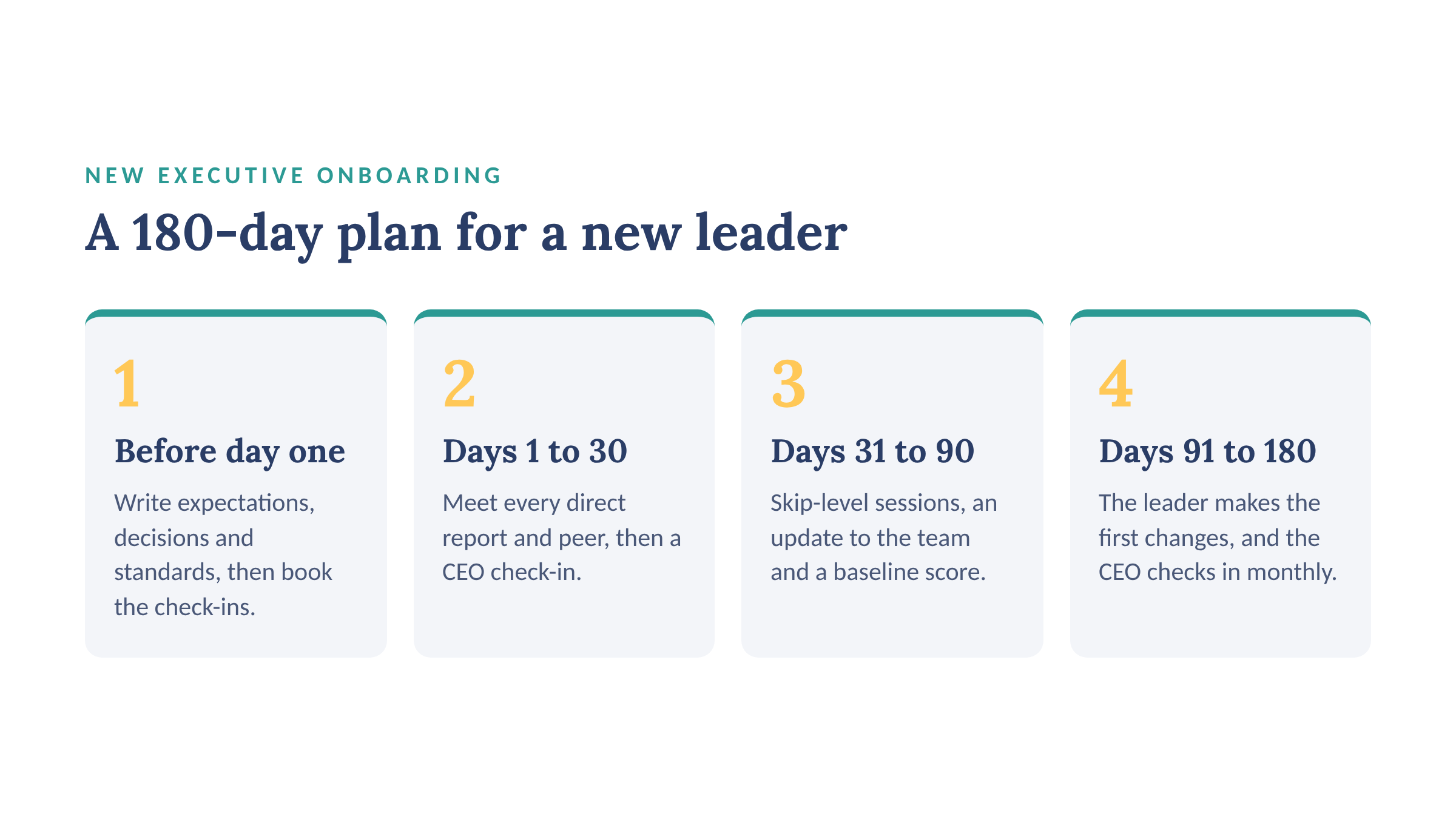
A 180-day new executive onboarding plan: learn the team, agree priorities, then act, with CEO check-ins.
What does new executive onboarding look like in an organization of 30 to 300 people?
In an organization of 30 to 300 people, a new senior leader often joins a leadership team of four to eight people and takes over a function the CEO previously led. When people keep bringing the CEO questions that belong to the new leader, the CEO sends them to the leader and tells the team that’s the new way. Our post on the first 90 days as a manager is for first-time managers, and this one is for senior leaders joining or being promoted to the leadership team. Our 1:1 Leadership Development works with individual leaders over months on the competencies their scores show they most need, including senior leaders in their first year in a role.
Frequently asked questions
How long does it take a new executive to be effective?
Most new executives take longer than 90 days. According to McKinsey, 92 percent of external hires and 72 percent of internal hires take far more than 90 days to reach full productivity, and 62 percent of external hires say it took at least six months to have real impact. Plan for 18 months, with CEO check-ins at 30, 90 and 180 days.
What should a new leader do in the first 90 days?
In the first 30 days, a new leader learns the team through one-on-ones with every direct report and conversations with each peer. By day 90, they’ve held skip-level conversations, shared what they heard and what they’ll change, agreed priorities with the CEO and received a baseline score from the people who work with them.
Why do new executives fail?
New executives struggle most with politics, culture and people. As McKinsey reports, 68 percent of moves into senior roles struggle with those issues, and as many as 74 percent of US leaders feel unprepared for their new roles. Unclear expectations, unclear decisions and changes made before the leader knows the team all add to the risk.
How do you onboard a senior leader?
Before day one, agree in writing what the leadership team expects of them, which decisions they own and how your company defines good leadership. Then give them a new-leader assimilation plan with one-on-ones, skip-level conversations, a what-we-heard update, a baseline score at about 90 days, and CEO check-ins at 30, 90, and 180 days.
Plan your new leader’s first 18 months
If you’ve hired or promoted a senior leader, a conversation with us can help you agree on what they need in their first months and how you’ll both see their progress. LoyaltyOps is a leadership development firm that develops individual leaders and leadership teams against clear leadership competencies, so performance improves across your organization.
Sources
Keller, S. “Successfully transitioning to new leadership roles.” McKinsey and Company, May 23, 2018. Figures reported from other studies cited in the article. https://www.mckinsey.com/capabilities/people-and-organization/our-insights/successfully-transitioning-to-new-leadership-roles
Related episode: UNLEASHED by LoyaltyOps, “Why a Bad Hire Can Cost You $500,000 | Jorge Chavez,” August 20, 2026. https://youtu.be/i_0qr9Ia3-0