

Adding a Management Layer: How to Set Up Your New Managers and the Managers Who Lead Them
Adding a Management Layer: How to Set Up Your New Managers and the Managers Who Lead Them
Adding a management layer changes two jobs at once: people become managers of their former peers, and the leaders they report to start managing managers. Promote in pairs or small groups, agree which decisions the new managers own and what good leadership looks like, and give each layer a 90-day plan, because almost 60% of first-time managers reported no training.
Key takeaways
Adding a management layer starts two new jobs at once: new managers who lead teams, and the leaders who now manage them.
Research on young firms found shared tasks and experience delay the need for managers, so job variety is one sign the layer is due.
In a survey reported by the Center for Creative Leadership, almost 60% of first-time managers reported no training.
New managers struggle first with leading former peers, handing their own work to the team and leading the team’s results.
Promote in pairs or small groups, and give each layer its own 90-day plan.
When is it time to add a management layer?
It’s time to add a management layer when decisions wait for one person, leaders have more people than they can coach, and the work has split into more kinds of jobs than one leader knows well. No headcount decides it for you.
Megan Lawrence of Vanderbilt and Christopher Poliquin of UCLA Anderson studied when young firms add their first manager, using Brazilian payroll data on companies founded between 2003 and 2014, in a 2023 Strategic Management Journal paper summarized by UCLA Anderson Review on November 8, 2023. Firms with employees spread across more occupations were roughly 25% more likely to add managers, and firms whose employees shared more tasks, or had worked together before, were less likely to.
Most firms in the study were very small, so use it as a guide to the signs. While your people know each other’s work well enough to coordinate among themselves, you can wait, and once they can’t, the layer is due. Our guide to what changes for your leaders at 50, 100, 150 and 200 people covers the wider changes as a company grows.
Get the free Cultural Standards Builder
What does middle management mean in a growing company?
Middle management is the managers who lead teams and report to a more senior leader. When you add it, people who did the work start leading teams, and the leaders who managed them start managing managers.
Both groups start their roles on the same day. If you plan only for the new managers, their leaders keep answering the team’s questions, and the new managers get few chances to lead. Our post on managing managers covers that change from the promoted leader’s side, and this post covers what you do as the leader adding the layer.
What do new managers struggle with first?
New managers struggle first with leading former peers, handing their own work to the team and leading the team’s results.
In a 2014 white paper by William Gentry, Paige Logan and Scott Tonidandel, the Center for Creative Leadership reported the biggest challenges named by 664 managers in its leadership program between May 2012 and December 2013. The three most often named were adjusting to managing people and showing authority, by 59.3%, developing their own effectiveness as a manager, by 46.1%, and leading the team’s results, by 43.4%. The same paper reports a CareerBuilder survey from 2011, in which 26% of first-time managers felt they weren’t ready to lead others and almost 60% said they’d received no training when they moved into their first leadership role.
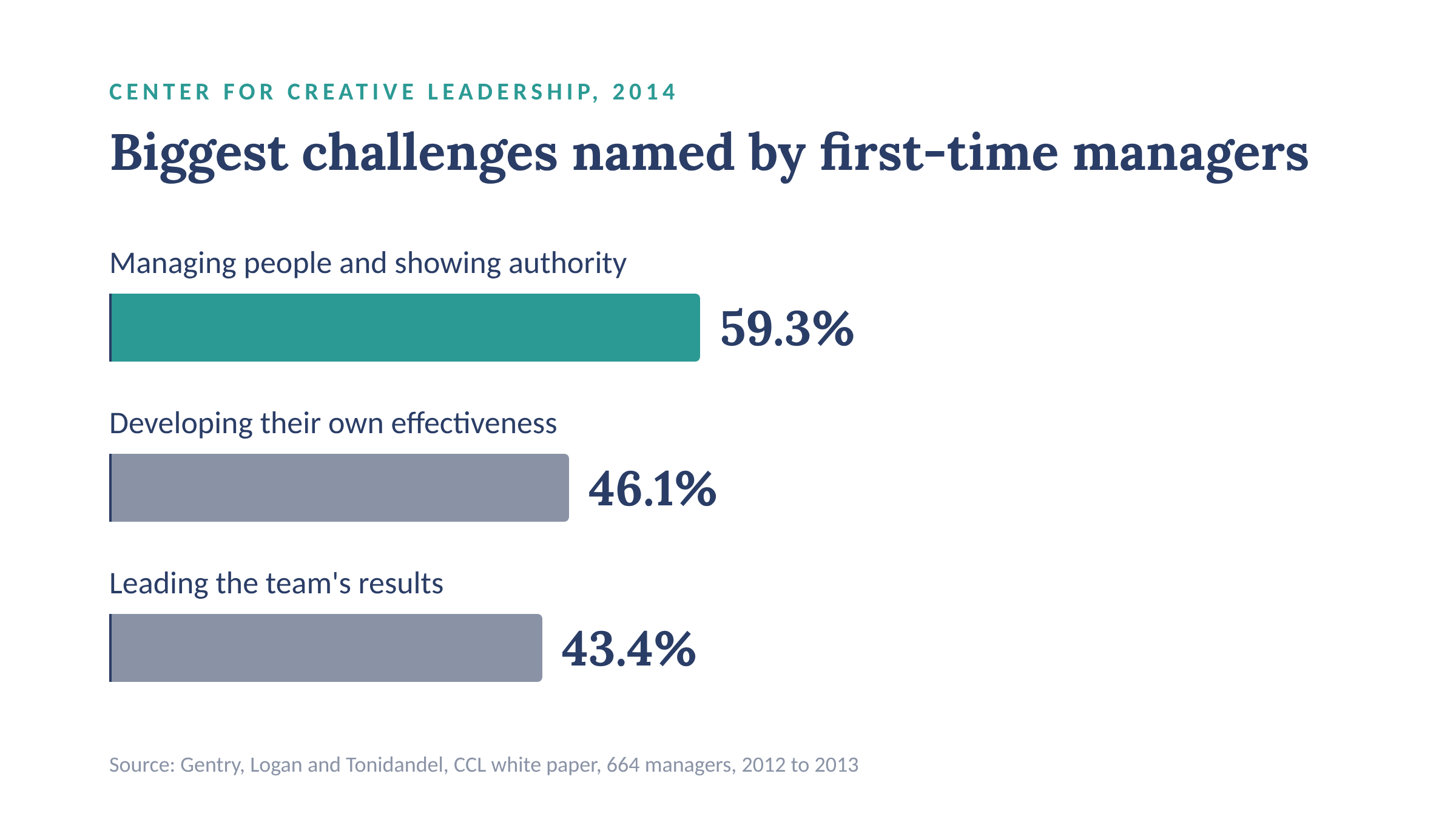
In CCL research, 59.3% of first-time managers named managing people and authority among their biggest challenges.
Leading former peers
Moving from coworker to manager means earning respect from people who were friends the week before. A new manager may avoid hard conversations with a former peer, or overcorrect and give orders they wouldn’t have accepted themselves.
Handing their own work to the team
CCL’s second challenge is becoming a better leader while still being a productive employee. Many new managers keep doing their old work because they’re good at it, and the hours for leading disappear.
Leading the team’s results
A new manager who was judged on their own output is now judged on the team’s, which means giving direction, checking the work and meeting deadlines through other people. Our post on the first 90 days as a manager gives new managers their own plan for these weeks.
What do the managers who lead them need from you?
The managers who lead your new managers need three things from you: decisions to give the new managers, a clear description of good leadership to develop them against, and coaching on how to develop managers. Few of them have managed managers before, so they’re learning their own role while teaching the new one.
Start with the decisions. Before the promotions, ask each manager of managers to list the decisions their team brings them most often and agree which ones move to the new managers, such as assigning work within the team or approving time off. Keep the list short at first, so the new managers have real decisions to make in their first week.
Next, agree the description of good leadership both layers develop against, which our post on leadership expectations for managers explains comes before any training. Write three to five standards, each with aligned behaviours people can see and misaligned behaviours to avoid. For a new manager, an aligned behaviour is asking the team for a plan before offering one, and a misaligned one is redoing a former peer’s work at night. For their leader, an aligned behaviour is coaching the new manager and leaving the decision with them, and a misaligned one is answering a team member’s question that belongs to the new manager.
Finally, coach your managers of managers every week on how they’re developing the new managers: which decisions the new managers made, what they’re practicing and where they needed help.
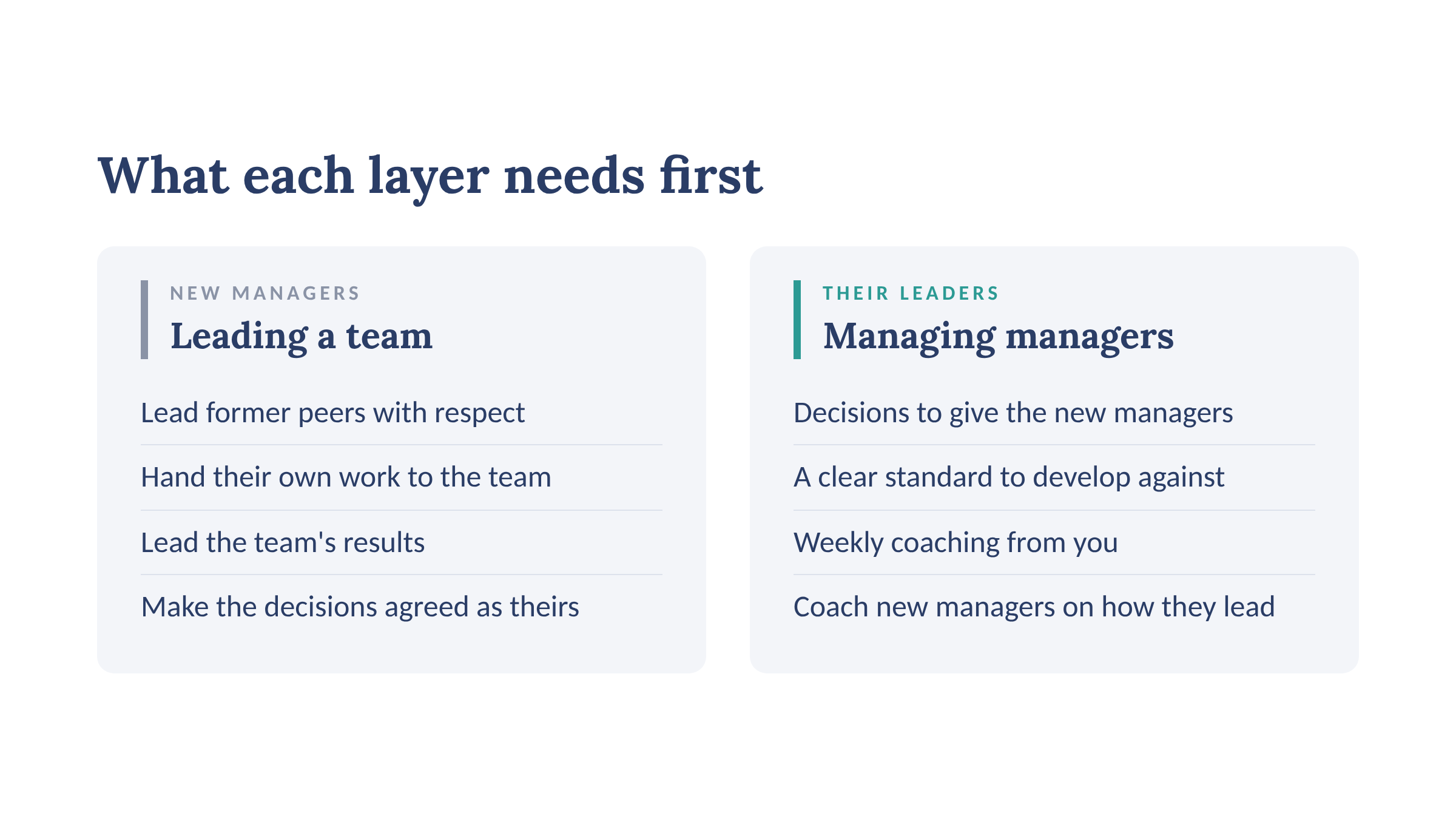
What each layer needs first: new managers lead former peers, and their leaders coach them on how to lead.
Why promote new managers in pairs or small groups?
Promote new managers in pairs or small groups so each new manager has peers in the same role, and so their leaders can develop them together. A single new manager has no one at their own level to compare notes with.
A group of two to four new managers can meet every two weeks to talk through what’s working, such as how each one handled a hard conversation with a former peer, and their leader can coach the group on one topic at a time. Several teams also hear about the change on the same day, from the same leader.
People watch how the first managers are treated. In The Workplace Reality, a 2026 global survey of 9,100 employees in 32 countries, Ipsos found just 1 in 4 say becoming a people manager looks attractive, based on what they see in their organization today. A first group that gets support shows the people who’d lead next what the role offers them.
Related UNLEASHED episode: Mickey Anderson on why only 1 in 4 employees say managing looks attractive, and what the manager role now asks of the people in it.
What do leadership competencies have to do with adding a management layer?
A leadership competency describes one part of good leadership as behaviours other people can see. When you add a management layer, both groups build new competencies at the same time, and naming them tells each person what to practice first.
Our Leadership Competency Model describes ten competencies, and the Leadership Competency Assessment scores each leader on them, from the leader’s own view and from observers who work with them. Naming the competency turns “the new managers still wait for us to decide” into something each manager can practice and score again in six months. Four competencies matter most when you add a layer:
•Develops the Next Leaders. Each manager of managers coaches each new manager weekly on one named competency, and you do the same for them.
•Makes Expectations Clear. Each new manager knows the outcome their team owns, what a good result looks like, which decisions are theirs and what comes first when two priorities compete.
•Builds Ownership and Accountability. When a new manager’s team misses a deadline, their leader asks the new manager for a plan and leaves the fix with them.
•Lives the Standards First. The managers of managers show the behaviours you agreed before asking the new managers to, such as bringing problems to you with a plan of their own.
What should the first 90 days look like for each layer?
The first 90 days for each layer follow three stages: set up the role, practice it with real decisions, then score it and agree the next quarter. Start before day one, because what you agree before the announcement decides how the first weeks go.
Before day one
Choose the group of new managers, agree which decisions move to them, and write the standards both layers will develop against. Tell the teams together who leads each team and which decisions their new manager now makes.
Days 1 to 30: set up the role
Each new manager holds a one-on-one with every team member, former peers included, and chooses which of their own work to hand to the team first. Each manager of managers meets each new manager weekly about how they’re leading, and you meet the managers of managers weekly about how the new managers are doing.
Days 31 to 60: practice with real decisions
The new managers make the decisions agreed as theirs, and their leaders coach each one on one competency. You check which decisions still come to you, and ask the right manager to decide them.
Days 61 to 90: score it and agree the next quarter
Both layers get scored, from their own view and from the people who work with them, and each person agrees one competency to practice next quarter. Then decide with your managers of managers whether the company is ready to promote the next group.
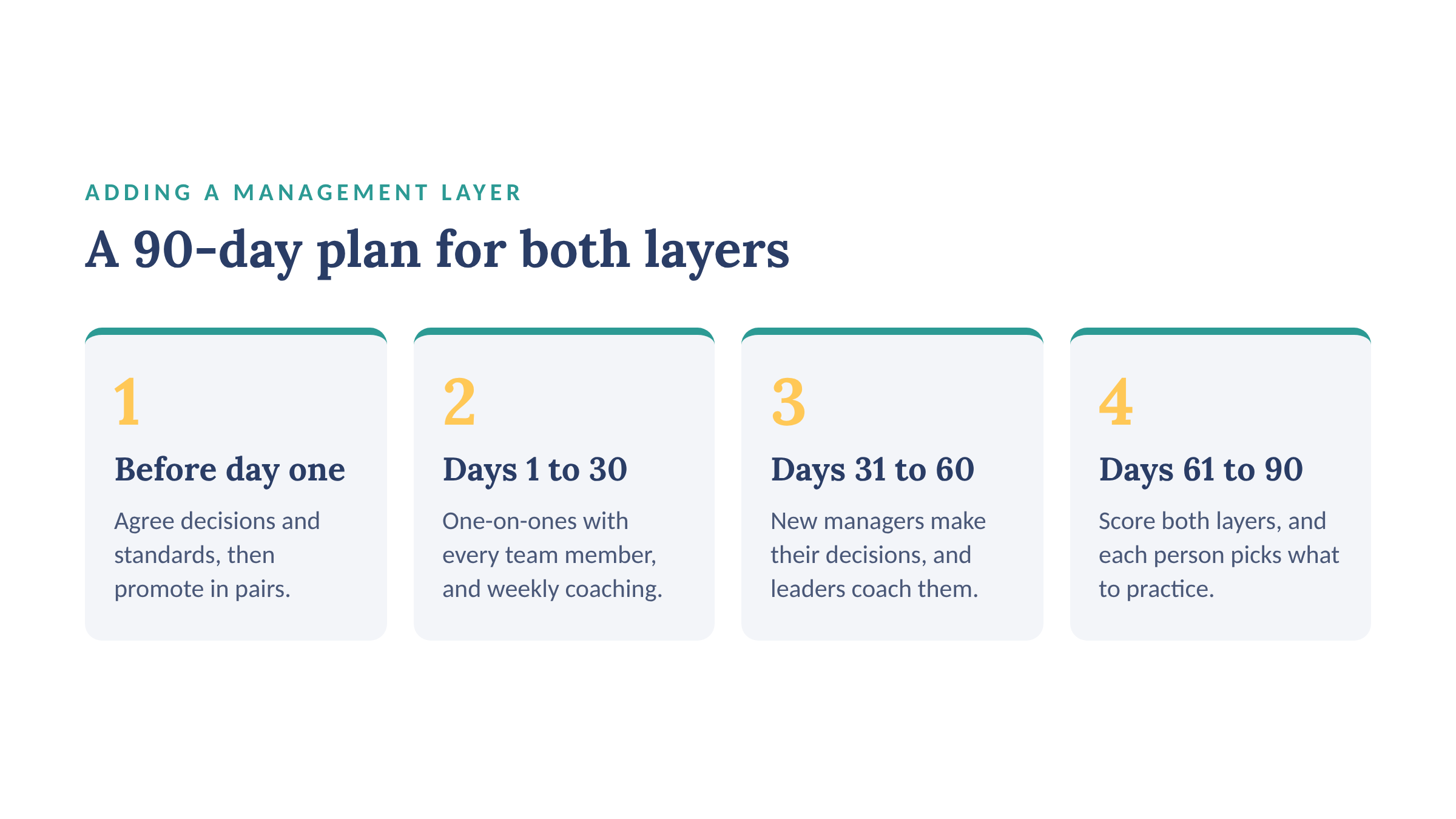
A 90-day plan for adding a management layer, from agreeing decisions before day one to scoring both layers.
What does adding a management layer look like in an organization of 30 to 300 people?
In an organization of 30 to 300 people, adding a management layer often means promoting several of your best people at once, and each new manager leads a large share of the company. The managers of managers are often early employees whom people are used to asking for answers, so the first 90 days decide whether the new managers learn to lead or learn to wait. Our 1:1 Leadership Development works with individual leaders over months on the competencies their scores show they most need, including leaders taking on a new layer of managers.
Frequently asked questions
When should a small business add middle management?
Add middle management when decisions wait for one person, leaders have more people than they can coach, and the work has split into more kinds of jobs than one leader knows well. Research on young firms found shared tasks can delay the need, so watch those signs, and add the layer when coordinating among yourselves stops working.
How do you prepare a first-time manager?
Before the promotion, agree what the new manager owns, which decisions are theirs and what good leadership looks like at your company. Then give them a weekly one-on-one with their own leader, peers in the same role and one competency to practice, and score how they lead at 90 days, from their own view and from their team’s.
Who should develop new managers?
The leader each new manager reports to does most of the developing, through weekly coaching on how they lead. That leader needs development too, because coaching managers is new for them, so the CEO or senior leader adding the layer coaches the managers of managers on how they’re developing the new managers.
What’s the difference between a manager and a manager of managers?
A manager leads a team of people who do the work, and their results come from how well that team delivers. A manager of managers leads people who lead teams, so their results come from how well those managers lead. Their job is setting direction, giving decisions to their managers and developing them as leaders.
Give both layers a clear start
If you’re about to promote your first managers, a conversation with us can help you decide what each layer needs to develop first. LoyaltyOps is a leadership development firm that develops individual leaders and leadership teams against clear leadership competencies, so performance improves across your organization.
Sources
Totty, M. “Complexity Begets Management Layers: How Some Small Firms Avoid That.” UCLA Anderson Review, November 8, 2023. Summary of Lawrence, M., and Poliquin, C. (2023), “The growth of hierarchy in organizations: Managing knowledge scope,” Strategic Management Journal. https://anderson-review.ucla.edu/complexity-begets-management-layers-how-some-small-firms-avoid-that
Gentry, W. A., Logan, P., and Tonidandel, S. “Understanding the Leadership Challenges of First-Time Managers: Strengthening Your Leadership Pipeline.” Center for Creative Leadership white paper, 2014. Challenge data from 664 managers in CCL’s Maximizing Your Leadership Potential program, May 2012 to December 2013; readiness and training figures from a CareerBuilder survey, March 2011, cited in the paper. https://www.ccl.org/wp-content/uploads/2026/02/leadership-challenges-first-time-managers-research-paper-center-for-creative-leadership.pdf
Ipsos. “The Workplace Reality.” October 20, 2026. Global survey of 9,100 employees in 32 countries. https://www.ipsos.com/en-ca/the-workplace-reality
Related episode: UNLEASHED by LoyaltyOps, “Only 1 in 4 Employees Say Managing Looks Attractive,” October 29, 2026. https://youtu.be/B2u7dpH9UWY