
Leadership Challenges in Growing Companies: What Changes for Your Leaders at 50, 100, 150 and 200 People
Leadership Challenges in Growing Companies: What Changes for Your Leaders at 50, 100, 150 and 200 People
The leadership challenges in growing companies change at rough headcounts. At about 50 people, the founder stops knowing everyone’s work, and at about 100, people learn good leadership from their own manager. Past about 150, relationships stop keeping everyone aligned, and at about 200, leaders lead leaders. Gallup estimates managers account for at least 70% of the variance in engagement.
Key takeaways
The headcounts 50, 100, 150 and 200 are rough points where the way leaders worked at one size stops working, and each company reaches them at its own pace.
At about 50 people, the founder stops seeing every person’s work, and the first managers are usually the people who were best at the work.
At about 100, most people learn what good leadership looks like from their own manager, and Gallup estimates managers account for at least 70% of the variance in team engagement.
Past about 150, Dunbar’s number is a useful heuristic for when personal relationships stop keeping people aligned, so direction and decision owners need to be written down.
At about 200, many of your leaders lead other leaders, and the leadership team has to work as a team.
Four moves help before each point: agree how leaders lead, make direction repeatable, give decisions owners, and develop managers before promoting more of them.
Related UNLEASHED episode: Mickey Anderson on why every executive has two teams, the function they lead and the leadership team they belong to.
Why do leadership challenges in growing companies change at each size?
Leadership challenges change as a company grows because the ways leaders kept everyone informed and aligned at one size stop working at the next. The headcounts in this guide are rough points, and your company may reach each one earlier or later depending on how your work is organized.
Small companies work through personal contact. The founder knows each person, hears about problems directly and makes most of the decisions, and people learn what good work looks like by watching. As the company adds people, each of those habits reaches a smaller share of them.
Chris Cox, then Facebook’s chief product officer, said at the 2016 Aspen Ideas Festival that many startup CEOs he’d spoken with saw problems appear once their companies passed about 150 people, and that those companies needed more structure for communication and decision-making. Kevin J. Delaney, co-founder of Quartz, reported his comments in a December 12, 2016 article published with the World Economic Forum, alongside what changed at Quartz as it grew.
Our post on why execution breaks down as you grow covers the general idea. This guide goes size by size, so you can see what changes for your leaders at each point and what to agree before you reach the next one.
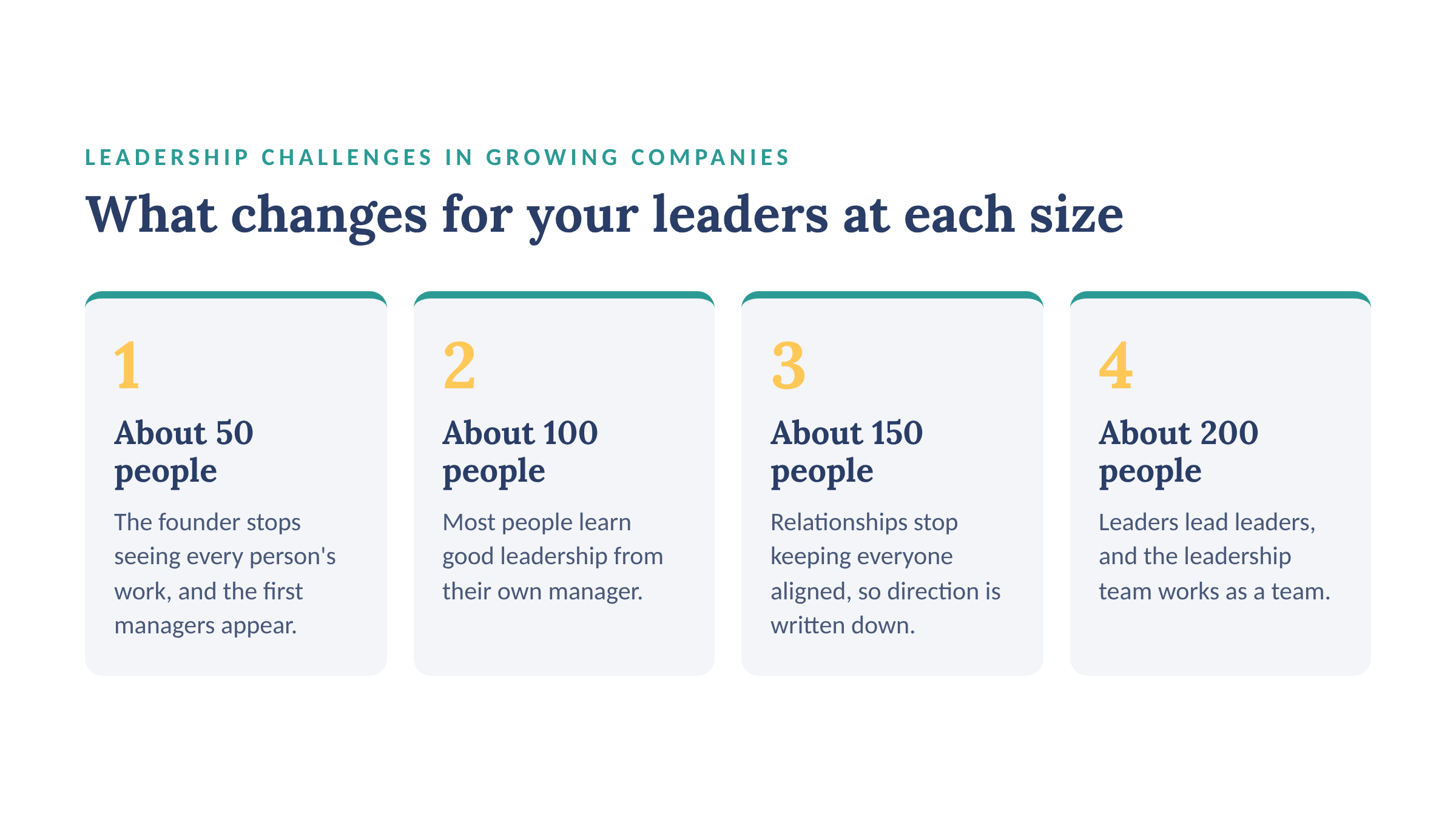
What changes for leaders at about 50, 100, 150 and 200 people, from the first managers to leaders who lead leaders.
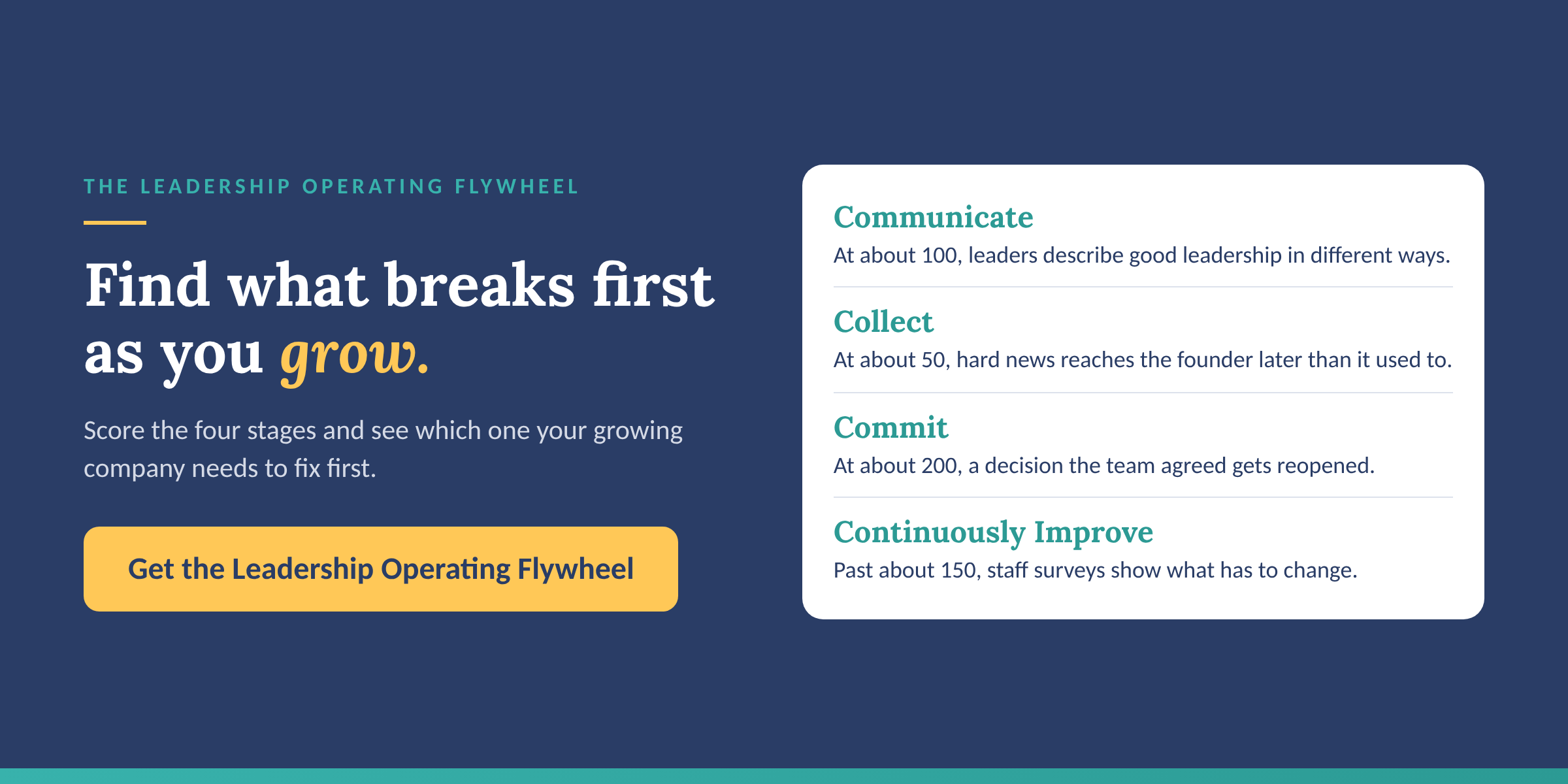
Get the free Leadership Operating Flywheel
What changes for leaders at about 50 people?
At about 50 people, the founder stops knowing what every person is working on, and the first managers appear. Problems that used to reach the founder the same day now reach a manager first, and some don’t reach the founder at all.
The first managers are usually the people who were best at the work, promoted because they were trusted and knew the company well. Few of them have led people before, and they learn how to lead mostly by copying the founder. If the founder answers every question personally, the new managers learn to do the same with their own teams, and decisions keep waiting for the person who used to make them.
Gallup’s research on span of control, published by Jim Harter on January 13, 2026, found the median US manager leads about five to six people. At that ratio, a company of 50 people needs several managers, and each one becomes the main way their team hears about the company’s direction. If your own team grew faster than your managers did, our post on what to change first when your span of control grows covers that problem.
What changes at about 100 people?
At about 100 people, most employees learn what good leadership looks like from their own manager, so the company’s standard for leadership has to be written down and explained. Many people now rarely work with the founder directly, so they see the founder’s habits only in the managers who copied them.
Gallup has estimated that managers account for at least 70% of the variance in employee engagement scores across business units, a finding from its State of the American Manager research, reported by Randall Beck and Jim Harter in April 2015. The finding is a decade old, and it describes a problem many growing companies notice at this size: two teams in the same company can have very different experiences of work, depending on who leads them.
This is when new people start getting mixed signals. One manager expects people to raise problems early, another expects them to solve problems before mentioning them, and a new hire who works with both can’t tell which one the company wants. A short description of how leaders at your company are expected to lead, agreed by the leadership team and practiced by its members first, gives every manager the same standard.
What changes at about 150 people, and does Dunbar’s number apply to companies?
Past about 150 people, personal relationships stop being enough to keep everyone aligned, so direction, decision owners and the company’s standards need to be written down and repeated. Dunbar’s number is a useful heuristic for this point, as long as you treat it as a rough guide.
Robin Dunbar, an evolutionary psychology professor at Oxford University, theorized that people can maintain personal relationships with about 150 others. In Delaney’s article, Dunbar said the dynamics of organizations change once they pass about 150 people, because a group that size can be managed through peer pressure while a larger one needs more formal management. Your company may feel the change at 120 people or at 180, so watch for the signs as well as the number.
Delaney described what changed at Quartz after it passed 150 people. Its anonymous staff surveys showed work waiting because it wasn’t clear who was responsible for moving a decision forward, employees wanting more feedback and career development than their managers had time to give, and the company’s strategy and values not shared widely enough. Quartz responded by simplifying its leadership structure so fewer people had clearer responsibility, setting up a 10-person operating committee of senior managers that met weekly to share information and decide matters affecting several teams, and writing down its values and history for new staff.
Patty McCord, Netflix’s chief talent officer from 1998 to 2012, told Delaney that growing from 150 to 300 people was a conversation she’d had with every CEO she knew who’d been through it. Her advice was that leaders at this size need to explain regularly where the company is going, what it’s doing and what it has decided against doing.
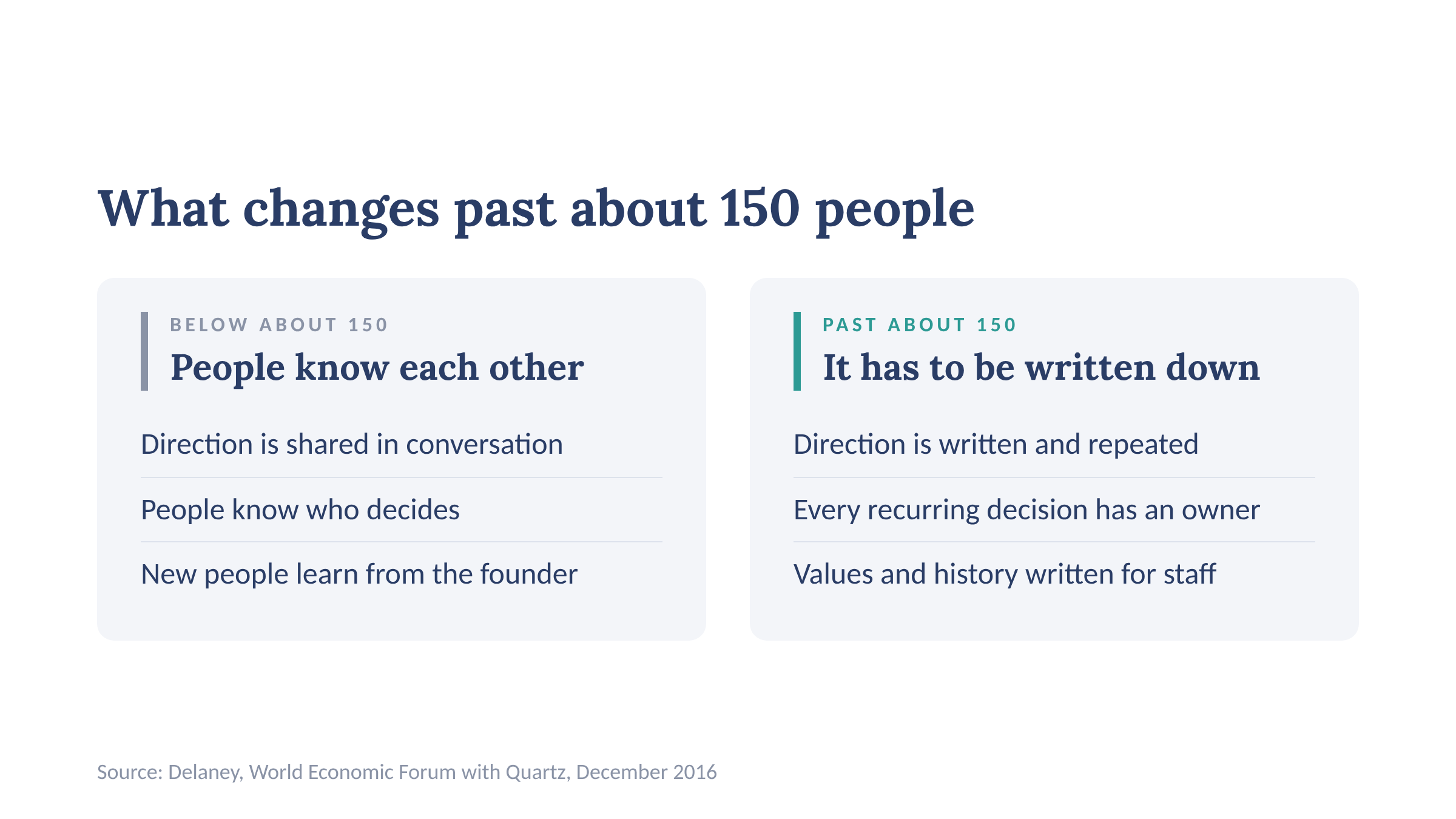
Below about 150 people, relationships keep a company aligned. Past 150, direction and decision owners need writing down.
What changes at about 200 people?
At about 200 people, many of your leaders lead other leaders, and the leadership team has to work as a team to keep the company’s direction consistent across every function. Each senior leader’s results now depend on how well the managers who report to them lead, and those managers copy how they’re led.
This is also when differences between members of the leadership team reach the rest of the company. If two senior leaders set different priorities, or one reopens a decision the team agreed, every manager who reports to them hears the difference and repeats it to their own teams. Our post on managing managers covers what changes for a leader whose reports now lead teams of their own, and our Leadership Team Development works with leadership teams on how they lead together.
What do leadership competencies have to do with a growing company?
A leadership competency describes one part of good leadership as behaviours other people can see. As your company grows, the competencies your leaders need most change with each size, because more of the company learns how to lead by watching managers instead of the founder.
Our Leadership Competency Model describes ten competencies, and the Leadership Competency Assessment scores each leader on them, from the leader’s own view and from observers who work with them. Naming the competency turns a complaint like “our managers all lead differently” into something each leader can practice and score again in six months. Four competencies matter most as a company grows:
Develops the Next Leaders. At about 50 people, the founder and early leaders coach the first managers on how to lead, and each new manager knows which part of leading they’re working on before their team grows.
Lives the Standards First. At about 100, the leadership team follows the company’s agreed standards for leading before asking managers to, so new people see the same behaviour from senior leaders and from their own manager.
Sets Clear Direction. Past about 150, every leader can explain where the company is going, what matters most this quarter and why, in words their own team can repeat when the founder isn’t there to explain it.
Builds a Team That Succeeds and Fails Together. At about 200, members of the leadership team commit to decisions together, support each other’s priorities with their own managers and share the wins and the misses, so the whole company hears one direction.
What should you put in place before your company reaches the next size?
Put four things in place before you reach the next size: agree how leaders lead, make direction repeatable, give decisions owners, and develop managers before promoting more of them. Each one is easier to start before the problems at the next size appear.
1. Agree how leaders lead
Write a short description of how leaders at your company are expected to lead, with five to eight behaviours people can see, such as raising problems early or explaining the reason for a decision. Agree it as a leadership team, practice it yourselves first, and use it when you hire, promote and coach managers.
2. Make direction repeatable
Write the company’s direction for the year and the priorities for the quarter in a few sentences each. Ask every leader to explain them in their own words and say what they mean for their team. If two leaders describe the priorities differently, fix the wording before their teams hear it.
3. Give decisions owners
List the decisions that wait for the founder or the leadership team most often, such as approving a hire, changing a price or moving a deadline. Give each one an owner and agree when it comes to the leadership team instead. At Quartz, work waiting on decisions with no clear owner was one of the first problems staff raised past about 150 people.
4. Develop managers before promoting more of them
Before you promote the next group of managers, make sure the ones you have know how they’re expected to lead, get regular coaching and are scored on how they lead as well as on their team’s results. New managers learn from the managers they see, so the first group sets the example for everyone promoted after them. Our post on three gaps more hiring can’t fill covers why adding people doesn’t solve these problems on its own.
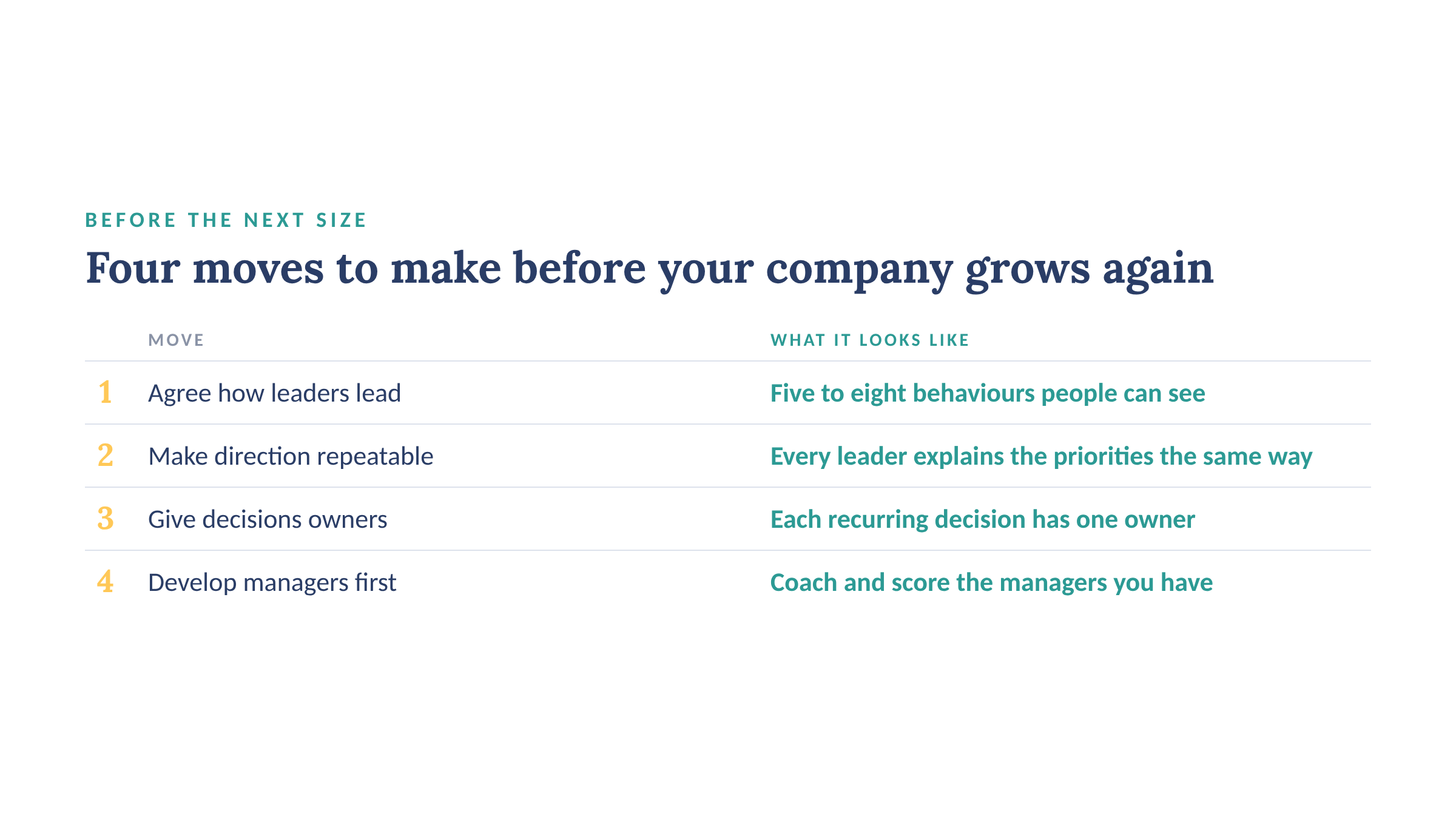
Four moves before your company reaches its next size, from agreeing how leaders lead to developing managers first.
What does growth mean for leaders in an organization of 30 to 300 people?
In an organization of 30 to 300 people, you’ll likely reach all four of these points within a few years, often with the same leaders who built the company when it had 30 people. The habits that worked for those leaders at one size need to change at the next, and leaders can learn the new ones with practice, coaching and a clear description of what good leadership looks like at your company.
To find out where your leaders are today, start by asking each member of your leadership team which of the four points your company has passed and what has changed for them since. The Leadership Competency Assessment is one way to see it in the scores, because it scores each leader from their own view and from the people who work with them, so you can see which competencies to develop first. Our 1:1 Leadership Development works with individual leaders over months on the competencies their scores show they most need.
Frequently asked questions
What changes when a company reaches 100 employees?
At about 100 employees, most people rarely work with the founder directly, so they learn what good leadership looks like from their own manager. Managers start leading in different ways, and new people get mixed signals. Writing down how leaders are expected to lead, and having the leadership team practice it first, gives every manager the same description to follow.
What is Dunbar’s number, and does it apply to companies?
Dunbar’s number is about 150, the number of personal relationships the evolutionary psychologist Robin Dunbar theorized a person can maintain. In companies, it’s a useful heuristic for when personal relationships stop keeping everyone aligned. Your company may notice the change earlier or later, so treat 150 as a rough point and write down direction and decision owners before you reach it.
When should a growing company add managers?
No fixed headcount tells you when to add managers. The usual signs are decisions waiting for one person, leaders with more people than they can coach and problems reaching leaders late. Gallup found the median US manager leads about five to six people. Develop each new manager on how to lead as they start, because the first group sets the example for the next.
How do you keep your culture as your company grows?
Write down how leaders at your company are expected to lead, with behaviours people can see, and have the leadership team practice them first. As the company grows, most people learn the culture from their own manager, so coach managers against that description, explain the direction often and score how each leader leads, from their own view and from the people who work with them.
Prepare your leaders for the company’s next size
If your company has passed one of these points and your leaders still work the way they did at the last one, a conversation with us can help you see which leadership competencies to develop first. LoyaltyOps is a leadership development firm that develops individual leaders and leadership teams against clear leadership competencies, so performance improves across your organization.
Sources
Delaney, K. J. “The magic number: this is what happens when companies hit a certain number of employees.” World Economic Forum, published in collaboration with Quartz, December 12, 2016. Including comments from Chris Cox, Robin Dunbar and Patty McCord. https://www.weforum.org/stories/economic-growth/the-weird-thing-that-happens-when-companies-get-bigger-than-150-people/
Beck, R., and Harter, J. “Managers Account for 70% of Variance in Employee Engagement.” Gallup Business Journal, April 21, 2015. From Gallup’s State of the American Manager research. https://news.gallup.com/businessjournal/182792/managers-account-variance-employee-engagement.aspx
Harter, J. “Span of Control: What’s the Optimal Team Size for Managers?” Gallup, January 13, 2026. US data. https://www.gallup.com/workplace/700718/span-control-optimal-team-size-managers.aspx
Related episode: UNLEASHED by LoyaltyOps, “Every Executive Has Two Teams,” September 10, 2026. https://youtu.be/TTXxza6jtHI