
Your Span of Control Just Grew: What to Change First When You Have Too Many Direct Reports
Your Span of Control Just Grew: What to Change First When You Have Too Many Direct Reports
Span of control is how many people report directly to one manager. Gallup found the US average rose from 10.9 in 2024 to 12.1 in 2025, while the median stayed near six. When your team grows, change four things first: clear expectations, understanding checks at handoffs, named decision owners and protected time for the people who need you most.
Key takeaways
Gallup found the average number of people reporting to a US manager rose from 10.9 in 2024 to 12.1 in 2025, nearly 50% more than in 2013.
The median stayed at about five to six, so a minority of very large teams drives the average, and a wider span changes some managers’ jobs much faster than others.
Global manager engagement fell from 27% in 2024 to 22% in 2025, Gallup’s State of the Global Workplace 2026 report found.
One-on-ones, early warning of problems and decisions that wait for you are usually the first things to break.
Four changes come first: make expectations clear, confirm understanding at handoffs, name who decides what, and protect time for the people who need it most.
Related UNLEASHED episode: Mickey Anderson on why only 1 in 4 employees say managing looks attractive, and what the manager role now asks of the people in it.
Check understanding in one minute at every handoff
On a wide team, the costliest mistakes come from work that was handed off and misunderstood, because you see less of each person’s work from day to day. The free Back Briefing Guide gives you one question that confirms what each person heard before they start, and the four moments when asking it saves the most rework.
What is span of control?
Span of control is the number of people who report directly to one manager.
Jim Harter’s January 2026 Gallup article “Span of Control: What’s the Optimal Team Size for Managers?” reported that the average number of people reporting to a US manager rose from 10.9 in 2024 to 12.1 in 2025, nearly 50% more than when Gallup first measured in 2013. Gallup tied much of the past year’s rise to a two-point increase in teams of 25 or more people.
The median stayed at about five to six direct reports, which means a minority of very large teams drives the average up. Gallup found 37% of managers lead fewer than five people, 22% lead 10 to 24, and 13% lead 25 or more.
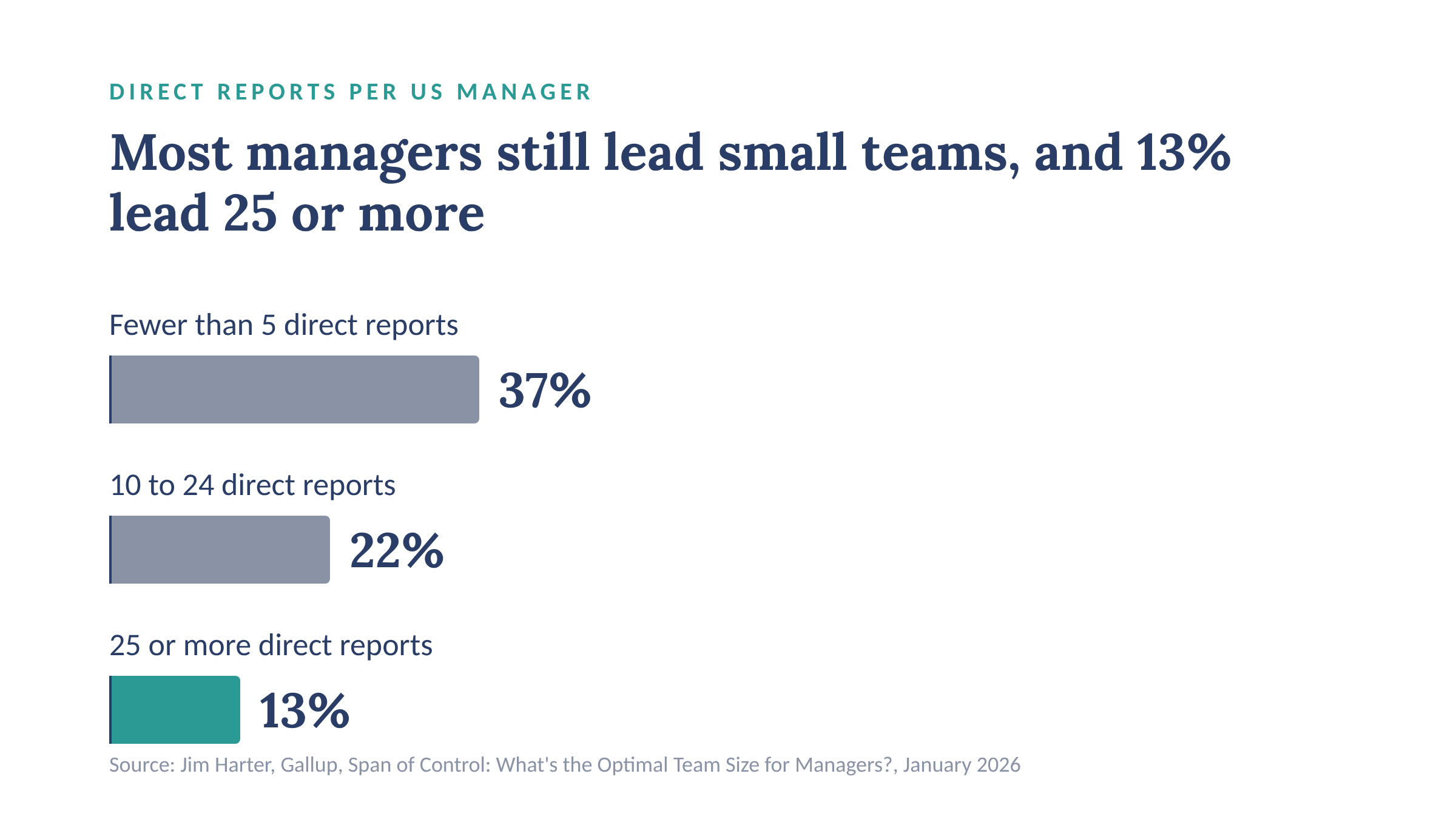
Gallup found 37% of US managers lead fewer than five people, 22% lead 10 to 24 and 13% lead 25 or more.
Why is span of control growing?
Span of control is growing because many organizations have removed management roles or kept hiring without adding managers, and the managers who remain are expected to lead more of the change their teams go through. Gallup’s article describes large employers cutting middle-management roles and widening the number of people each remaining manager leads.
The leadership part of the role is growing at the same time. Korn Ferry’s survey of more than 1,300 talent and senior leaders across more than 75 countries, released October 22, 2026, found 66% expect managers to spend more time guiding their teams through change than managing their day-to-day work.
Gallup’s State of the Global Workplace 2026 report found global manager engagement fell from 27% in 2024 to 22% in 2025, and that lower engagement among managers accounts for most of the recent drop in employee engagement. The report also points to Gallup’s study of US managers, which found manager engagement declines as spans of control widen, though manager talent and training can offset it.
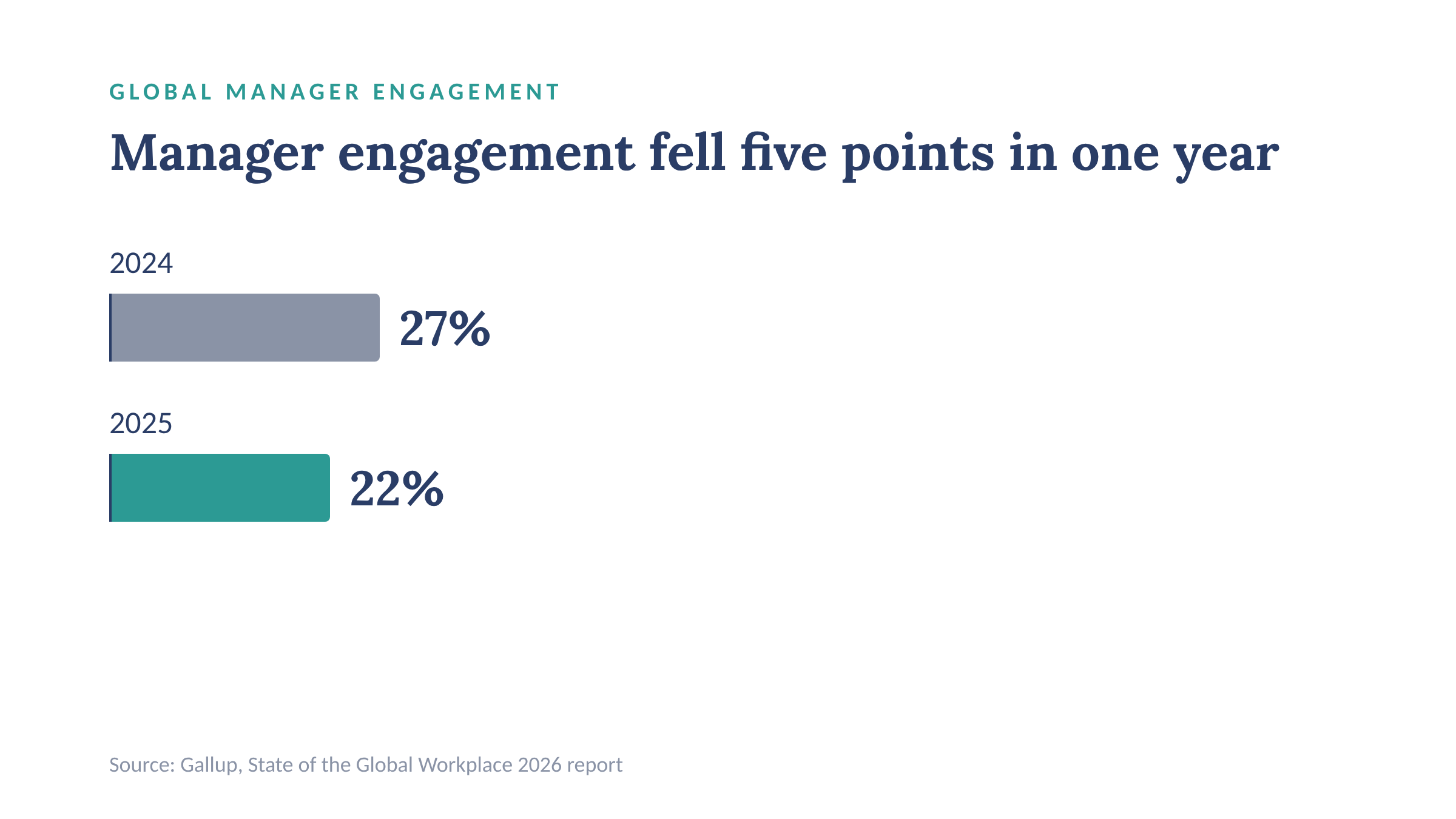
Global manager engagement fell from 27% in 2024 to 22% in 2025, Gallup’s State of the Global Workplace 2026 report found.
The people who report to managers notice the strain. In The Workplace Reality, a 2026 global survey of 9,100 employees in 32 countries, Ipsos found that just 1 in 4 say becoming a people manager looks attractive, based on what they see in their organization today. When the managers people watch have more work than time, the leaders you’ll need next become harder to develop.
What breaks first when you have too many direct reports?
Three things usually break first: one-on-ones, early warning of problems, and decisions that wait for you. Each one depends on your time with each person, and a wider team gives you less of it.
One-on-ones get shorter or skipped
Gallup found that giving each person meaningful feedback at least once a week matters more than most other manager habits. Across seven Gallup studies with 44,025 responses, about seven in 10 employees who strongly agreed they’d received meaningful feedback in the past week were engaged, regardless of team size, compared with one in four of those who didn’t. Those conversations can take 15 to 30 minutes, which matters when you have twelve or fourteen of them to hold.
Problems reach you later
With six people, you hear about a slipping deadline in a quick conversation the same day. With fourteen, you may hear about it when the client does. Gallup found 97% of US managers also do some individual contributor work, a median of 40% of their time, and managers above that level have lower engagement, which gets worse as their teams grow.
Decisions wait for you
When people aren’t sure what they’re allowed to decide, they wait for you, and fourteen people’s questions arrive faster than you can answer them. The work slows down, and the people who would have grown by making the call don’t get the practice.
What do leadership competencies have to do with a wider span of control?
A leadership competency describes one part of good leadership as behaviours other people can see, such as making expectations clear or developing the people who’ll lead next. A wider span of control changes which behaviours matter most, because what worked with six people through daily contact now has to work with fourteen through clearer expectations and better handoffs.
Our Leadership Competency Model describes ten competencies, and the Leadership Competency Assessment scores each leader on them, from the leader’s own view and from observers who work with them. Naming the competency turns “I don’t have time for my team” into something you can practice and score again in six months. Four competencies matter most when your span of control grows:
Makes Expectations Clear. Each person can tell you the result they’re responsible for, how they’ll know it’s good, and which calls are theirs to make without asking you.
Builds Ownership and Accountability. You leave the work with the person who owns it, coach them when they’re stuck, and respond calmly when a commitment slips, so people bring problems to you early.
Listens and Adjusts. You have a deliberate way to hear about workload, risks and disagreement from every person, including the quiet ones you no longer see each day, and you change the plan when what you hear calls for it.
Develops the Next Leaders. You know which of your people could lead part of the team, and you give them real decisions and regular coaching so the team’s development doesn’t depend on you alone.
What should you change first when your span of control grows?
Change how the work is set up before you change how many hours you work. Four changes come first, and each one lets people act without waiting for you.
1. Make expectations clear so people decide more on their own
For each person, write down the outcome they own, what good looks like, and what comes first when two things compete. Then add the decisions they can make without asking you, such as moving an internal deadline by up to two days. People who know these things check with you less, and the questions that still come to you are the ones that need you.
2. Confirm understanding at every handoff
When you hand off work, ask the person to tell you what they’re going to do, why it matters and what they’ll do first. It takes a minute, and it catches a misunderstanding while it’s cheap to fix, before it shows up in a finished draft two weeks later.
3. Name who can decide what
List the decisions that wait for you most often, and give each one a single owner on your team, with a clear point at which they bring it to you. Our post on giving every decision one owner covers four decision types and when a decision should come back to you.
4. Protect time for the people who need it most
You can’t give fourteen people the time you gave six, so decide where your time goes. Keep a short weekly conversation with everyone, and set aside longer time for people who are new, in a stretch role or showing early signs of trouble. Our post on one-on-one meetings that develop your team has a 30-minute structure and a question bank you can use.
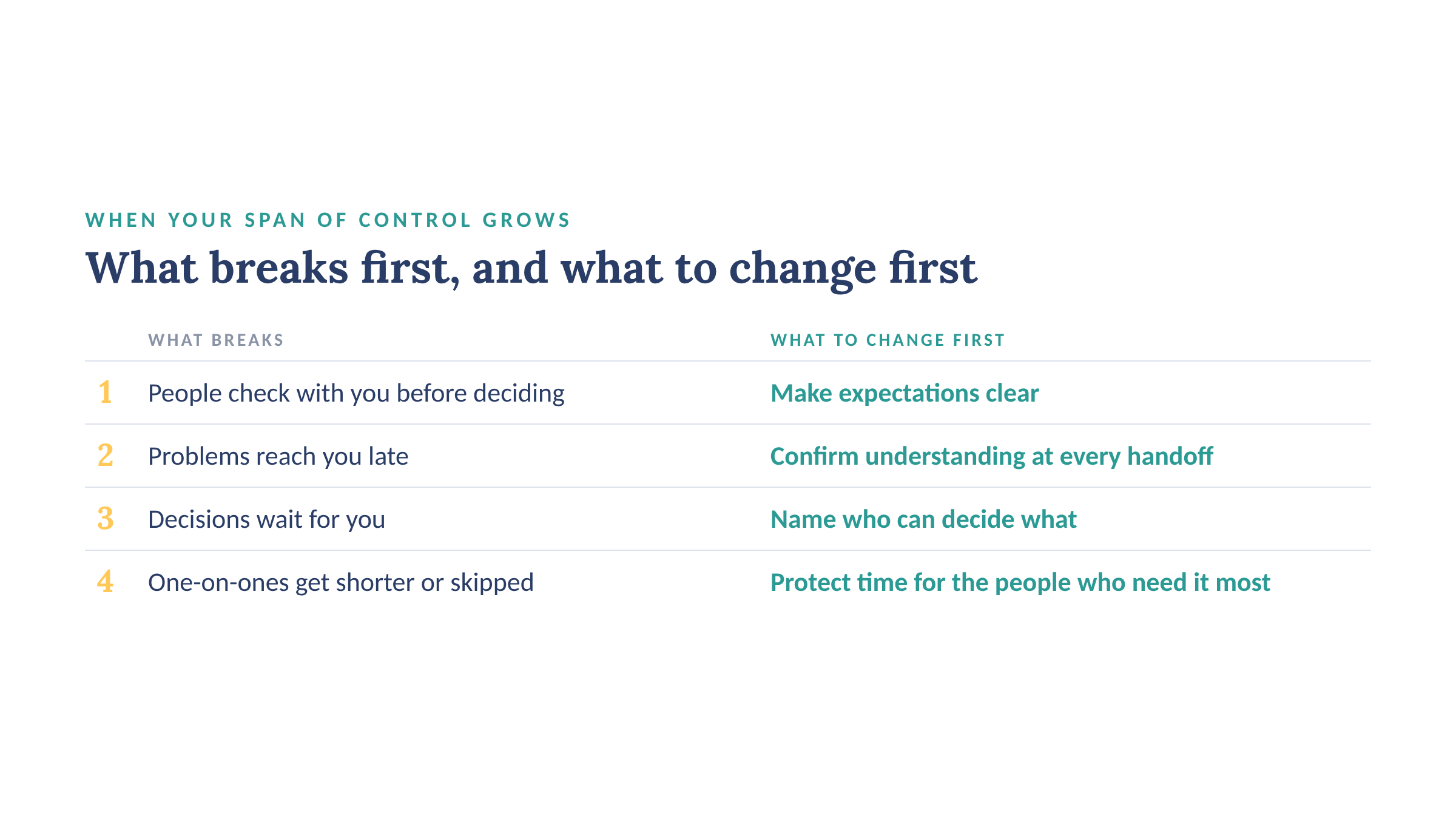
Four things that break when a team grows, each paired with the change to make first, from expectations to protected time.
When should you raise span of control with your own leader?
Raise it when the four changes are in place, and you still can’t hold a meaningful conversation with each person every week, or when your own individual work keeps taking more than the 40% median Gallup found.
Bring facts to the conversation: how many people report to you, how much of your week goes to your own client or project work, and who hasn’t had a meaningful conversation with you in the past month. Gallup’s article suggests that before widening spans further, leaders ask whether managers have the talent and support to lead larger teams, and whether weekly meaningful feedback is an expected practice. Answering those questions for your own team gives your leader something specific to decide, such as moving some of your individual work to someone else or naming a team lead. Our post on the capacity gap new managers face covers how organizations can protect development time and set a workload limit for each manager.
What does a wider span of control mean in an organization of 30 to 300 people?
In an organization of 30 to 300 people, a span of control usually grows because the company kept hiring and nobody added a manager, so the person who once knew everyone’s work now leads twice as many people. At this size, one senior person who takes on part of the coaching can change how the whole team works, and developing that person is a leadership decision as much as a staffing one.
Our 1:1 Leadership Development works with individual leaders over months on the competencies their scores show they most need, including the ones a wider team asks for, with the assessment at the start and the end so you can see what changed.
Frequently asked questions
What is span of control?
Span of control is the number of people who report directly to one manager. Gallup found the average for US managers rose from 10.9 in 2024 to 12.1 in 2025, nearly 50% more than in 2013. The median stayed at about five to six, so a minority of very large teams drives the average up.
How many direct reports is too many?
No single number fits every team. Gallup found the right span of control depends on how engaged the team is, how much individual work the manager does, the manager’s talent and whether each person gets meaningful feedback every week. If you can’t hold a short, meaningful conversation with each person weekly, your team is likely too large for how it’s set up.
What happens when a manager has too many direct reports?
One-on-ones get shorter or skipped, problems reach the manager later, and decisions wait for an answer. Gallup found manager engagement declines as spans of control widen, and global manager engagement fell from 27% in 2024 to 22% in 2025. People notice the strain too, and in a 2026 Ipsos global survey just 1 in 4 employees said becoming a manager looks attractive.
How do you manage a large team well?
Set the work up so people can act without waiting for you. Make expectations clear, including what each person can decide, confirm understanding at every handoff, give each recurring decision one owner, and protect your time for the people who need it most. Then develop one or two people to lead part of the team, so coaching doesn’t depend on you alone.
Find out what to change first on your team
If your team has grown and your conversations with each person are getting shorter or skipped, a conversation with us can help you see which leadership competencies to develop first, for you and for the people who could lead part of your team. LoyaltyOps is a leadership development firm that develops individual leaders and leadership teams against clear leadership competencies, so performance improves across your organization.
Sources
Harter, J. “Span of Control: What’s the Optimal Team Size for Managers?” Gallup, January 13, 2026. Analysis by Sangeeta Agrawal, Mary Page James and Sabrina Yu. US data. https://www.gallup.com/workplace/700718/span-control-optimal-team-size-managers.aspx
Gallup. “State of the Global Workplace 2026.” Report page, which shows no author or publication date. https://www.gallup.com/workplace/349484/state-of-the-global-workplace.aspx
Korn Ferry. “Korn Ferry Report: AI and Capability Gaps Will Reshape Talent in 2027.” Press release, October 22, 2026. Survey of more than 1,300 talent and senior leaders across more than 75 countries. https://www.kornferry.com/about-us/press/korn-ferry-report-ai-and-capability-gaps-will-reshape-talent-in-2027
Ipsos. “The Workplace Reality.” October 20, 2026. Global survey of 9,100 employees in 32 countries. https://www.ipsos.com/en-ca/the-workplace-reality
Related episode: UNLEASHED by LoyaltyOps, “Only 1 in 4 Employees Say Managing Looks Attractive,” October 29, 2026. https://youtu.be/B2u7dpH9UWY