
Managing Offshore Teams: One Leadership Standard for Every Country and Time Zone
Managing Offshore Teams: One Leadership Standard for Every Country and Time Zone
Managing offshore teams- your own employees in another country- works best when every leader follows one leadership standard. Two-tier teams form when decisions happen in head office’s hours, and the offshore team hears about them later. Share decisions at the same time, develop the offshore team’s own leaders, and make decisions in meetings with a named owner.
Key takeaways
In Deloitte’s 2024 survey of more than 500 leaders, 78% of organizations use global in-house centres, teams they own in other countries.
Two-tier teams form when decisions are made during head office hours, and the offshore team hears about them afterward.
In a 2024 Gallup study, clarity of expectations fell twice as fast for hybrid and remote employees over five years.
Hold every leader, at head office and in the offshore team, to one leadership standard, scored the same way.
Develop the offshore team’s own leaders, so decisions in their part of the work don’t wait for head office.
Make each decision in the meeting with a named owner, and send the notes to everyone within 24 hours.
What does managing offshore teams involve?
Managing offshore teams means leading your own employees in another country as part of one organization, with the same direction, information and leadership standard as head office. Much of it applies to any leader of a team in another location.
Many organizations now have teams like this. In its Global Outsourcing Survey 2024, Deloitte surveyed more than 500 business and technology leaders, including more than 150 C-suite executives, and found that 78% of their organizations use global in-house centres, the teams an organization owns and staffs with its own people in other countries. In the United States, they’re often called global capability centers. The report doesn’t break its results out by company size, so read the figure as a direction for your own organization.
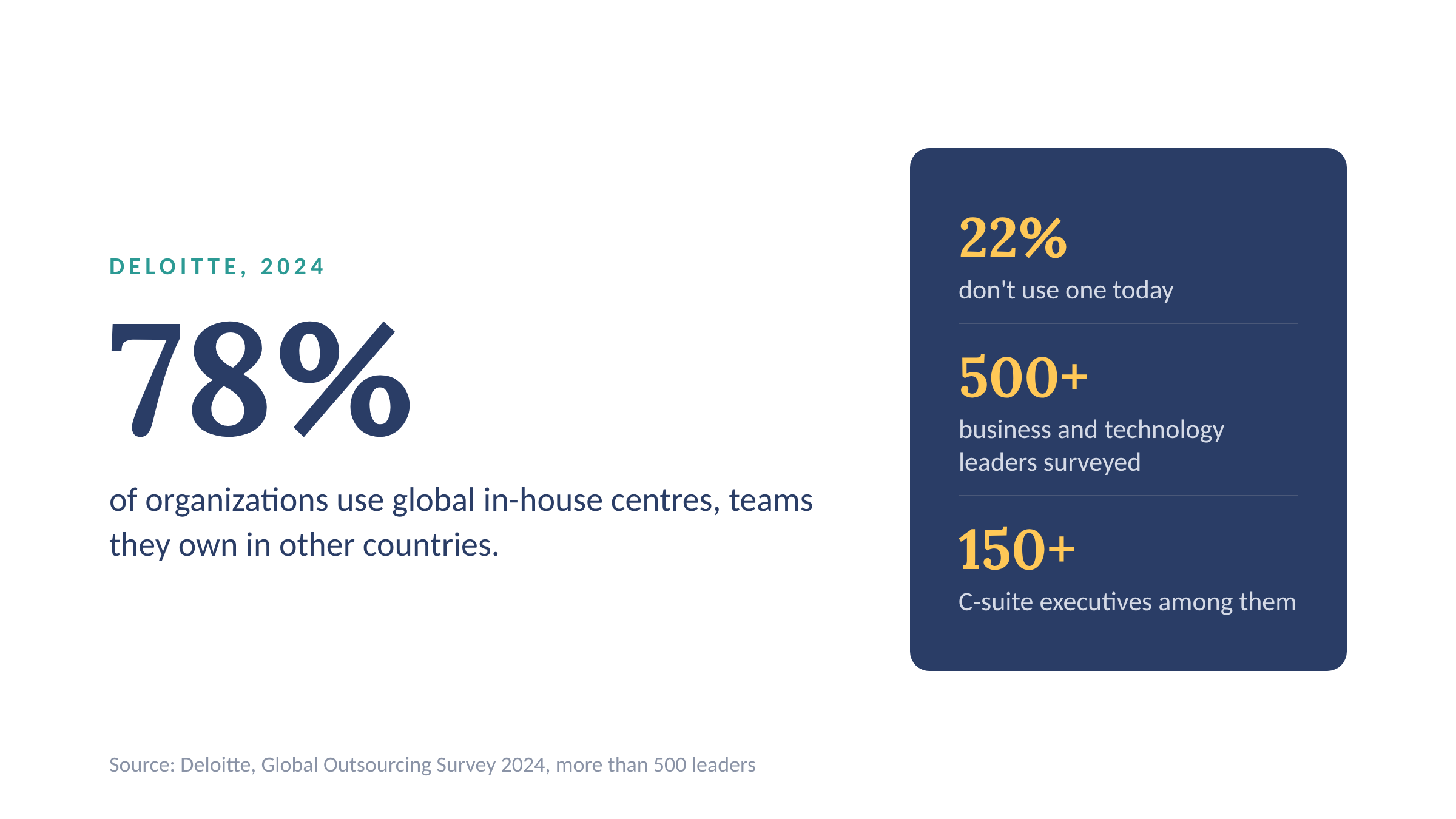
Deloitte, 2024: 78% of organizations use global in-house centres, teams they own in other countries.
A team your company employs needs a different approach from a team a provider employs. Your leaders hire, pay and develop the offshore team directly, so the leadership standard they follow at head office applies to the offshore team too. If a provider employs the team, our post on managing a BPO team covers who leads what.
Get the free Meeting Standards Checklist
How do two-tier teams form on an offshore team?
Two-tier teams form when decisions are made in head office’s working hours and the offshore team hears about them after head office. Over months, the two groups have different information, different expectations and different ideas of what good leadership looks like, though they work for one company.
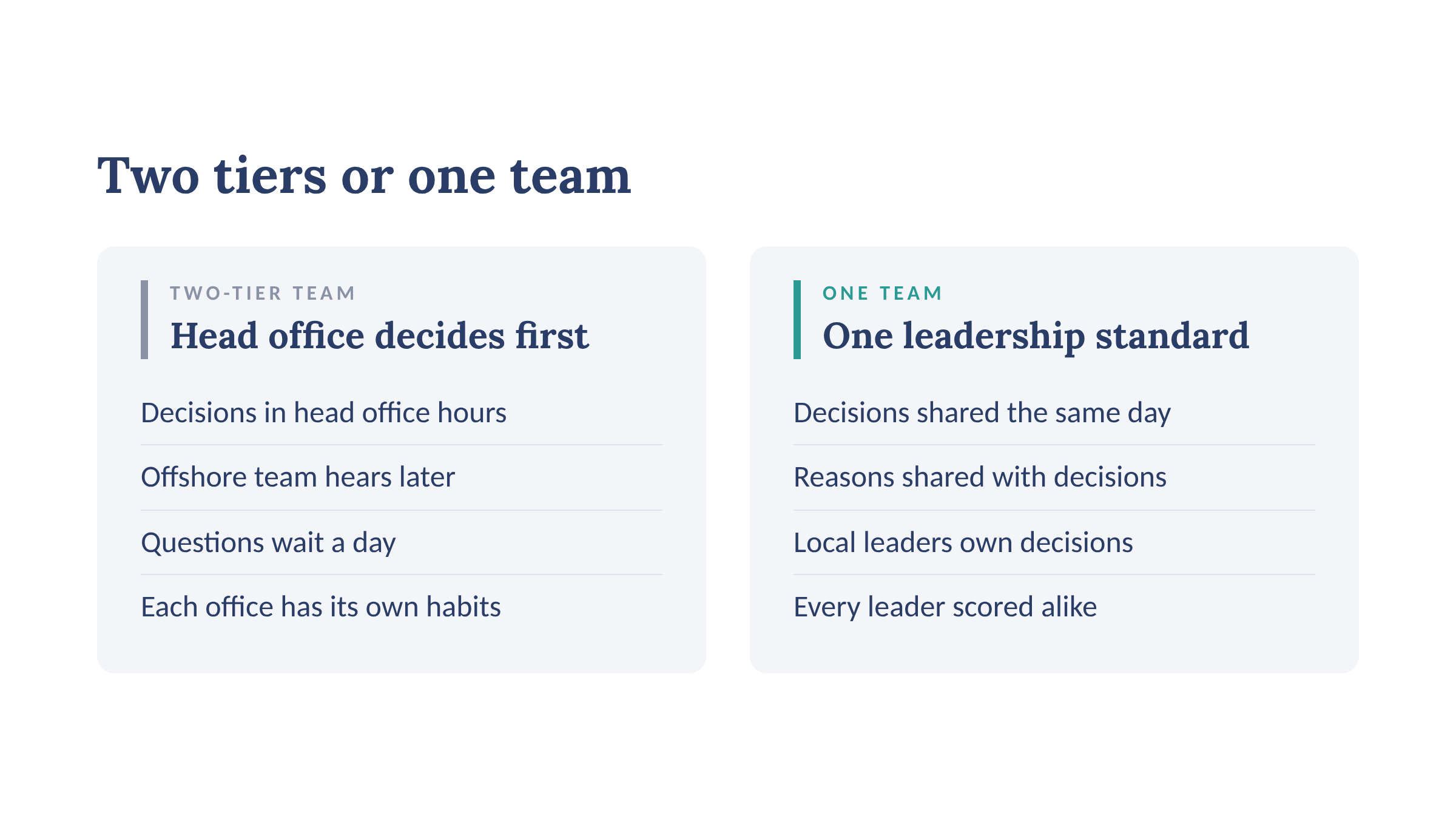
A two-tier team makes decisions during head office hours, and one team shares decisions and reasons in every country.
It often starts with ordinary habits. A decision gets made in a hallway conversation or a late-afternoon call at head office, when the offshore team has finished for the day. The offshore team learns about it the next morning from a short message or a change in the work, without any explanation. Questions wait a day for an answer, so the offshore team’s leaders send more of them to head office and decide less on their own.
Distance makes expectations harder to keep clear. In a 2024 study of 4,439 US employees by Gallup and Workhuman, reported by Andy Kemp, clarity of expectations had declined over five years, twice as fast for hybrid and remote employees. Employees who strongly agreed they knew what was expected of them were 47% less likely to experience frequent burnout. The study covered US employees, and a team in another country has a time difference to deal with, too.
Our post on leading remote teams covers the habits that help any leader whose team works in another location.
Related UNLEASHED episode: Mickey Anderson on why fewer than half of employees strongly agree they know what’s expected, and the four parts of a clear expectation.
Why should every leader follow one leadership standard?
One leadership standard means every leader, at head office and in the offshore team, is expected to lead in the ways your company has agreed and is scored on them in the same way. Without one, people’s experience of the company depends on which country they work in.
Gallup has estimated that managers account for at least 70% of the variance in employee engagement scores across business units, a finding from its State of the American Manager research, reported by Randall Beck and Jim Harter in April 2015. The finding is a decade old, and offshore teams make it easy to see: two teams in one company can have very different work experiences, depending on who leads them.
Write down how leaders in your company lead, as behaviours people can see, and use it for every leader in every country. That includes how quickly leaders answer questions, how they share decisions, how they give feedback and how they respond to a problem someone raises. Leaders at head office follow it first, since the offshore team learns the real standard from what head office leaders do.
How do you develop the offshore team’s own leaders?
Give the offshore team’s leaders decisions to own, the context to make them and regular coaching, so decisions in their part of the work don’t wait for head office.
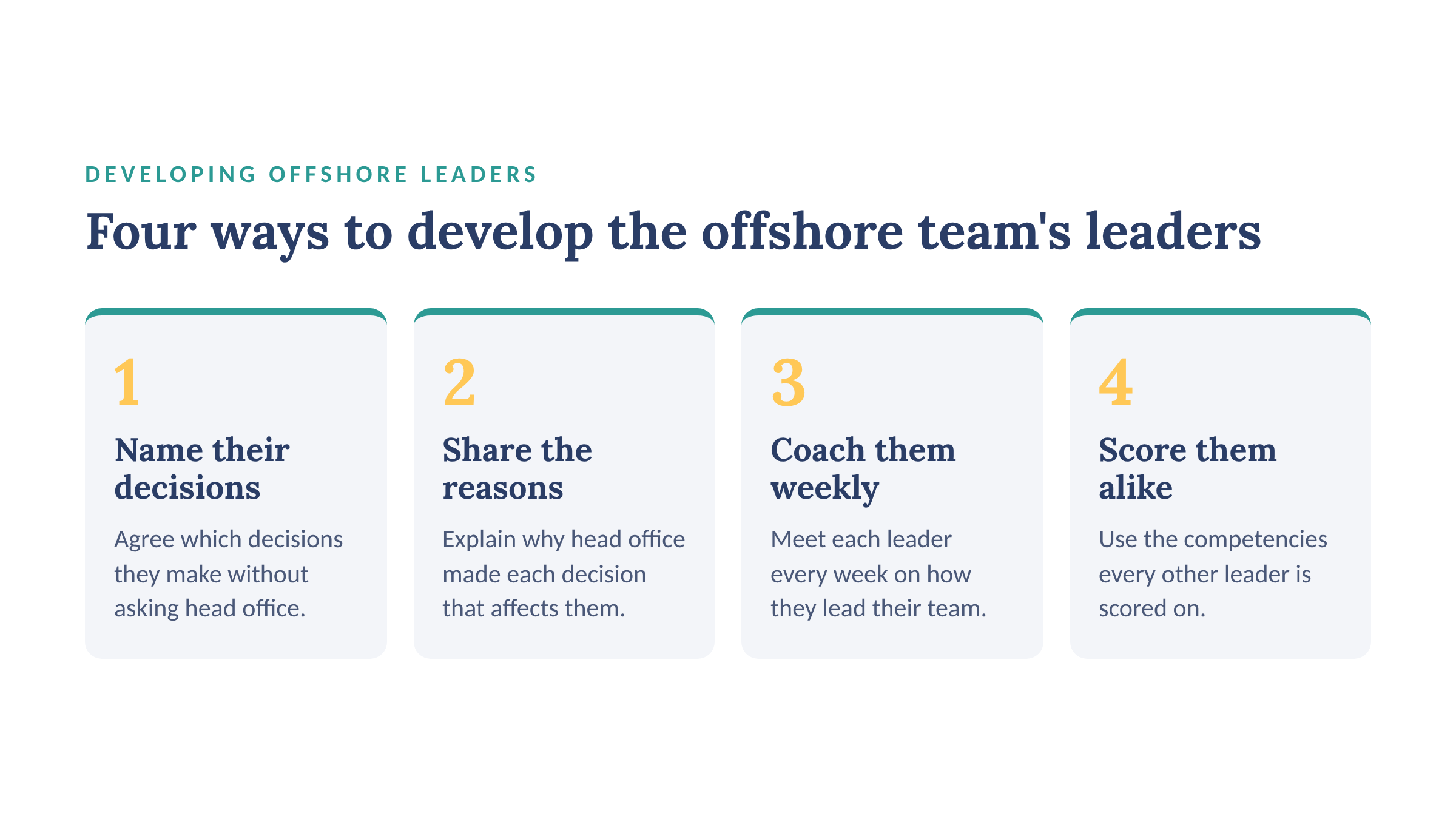
Four ways to develop an offshore team’s leaders: name their decisions, share reasons, coach weekly, score them.
Name the decisions they own. Agree which decisions the offshore team’s leaders make without asking head office, and which ones they bring to head office.
Share the reasons. Explain why head office made each decision that affects their team, so they can apply it to cases the decision didn’t mention.
Coach them weekly. Meet with each leader weekly to discuss how they lead their team and what the team delivered.
Score them in the same way. Use the competencies every other leader is scored on, so their development is measured like everyone else’s.
Our post on decentralized command covers how leaders set direction clearly enough that the people doing the work can decide.
How do you hold meetings and make decisions with a team in another time zone?
Make each decision in the meeting, assign a named owner, and write it down for those who couldn’t attend. When working days overlap for only an hour or two, the meeting must produce decisions, and preparation and follow-up can happen in writing.
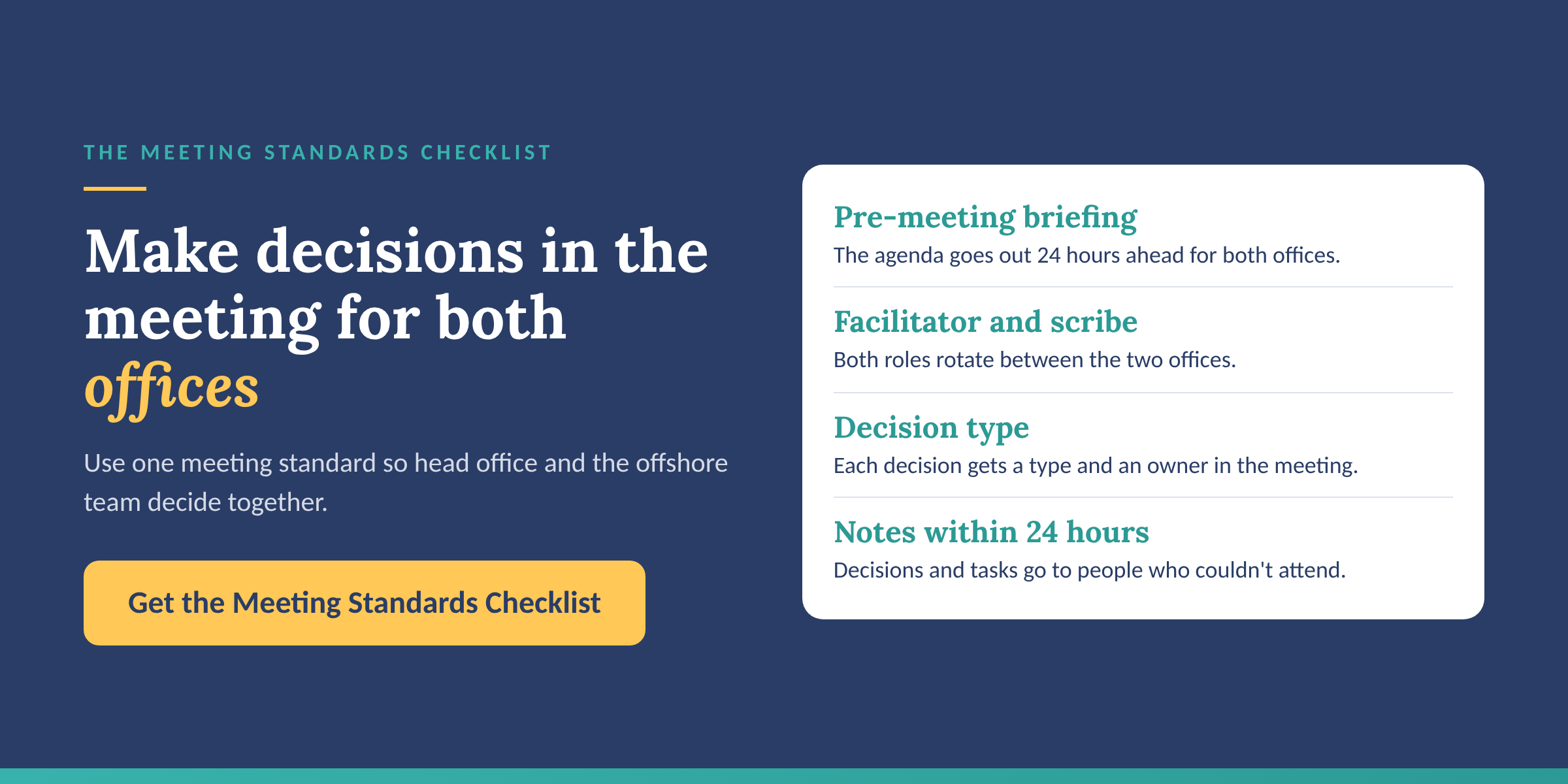
Pick meeting times that share the inconvenience, so both offices take turns joining early or staying late. If the overlap is short, rotate the meeting time each month. Then agree four standards for every meeting with the offshore team:
Pre-meeting briefing. Send the agenda 24 hours ahead to both offices, so each office can read it during its own working hours.
Facilitator and scribe. Both roles rotate between the two offices, so the offshore team leads and joins meetings.
Decision type. Each decision gets a type and an owner in the meeting, before anyone leaves the call.
Notes within 24 hours. Decisions and tasks go to people who couldn’t attend, as well as everyone who did.
Our post on giving every decision one owner covers how to name the owner and when a decision should go to someone more senior.
How do you make it safe for people in every country to raise problems?
Ask for problems directly, in more than one way, and respond well when someone raises one. People have different habits around disagreeing with a leader, so a leader who waits for problems to come up in a meeting may hear about them late.
In some workplaces, people raise a problem with their leader openly in a group. In others, people raise it privately, in writing, or with their own manager first, or they wait until a leader asks. These habits vary by person and country, so ask each person how they prefer to raise a concern. Then make each way easy:
Ask a specific question, such as “What could stop this from working?”, in place of “Any questions?”
Give people a way to raise concerns in writing before or after a meeting.
Ask the offshore team’s own leaders to gather concerns and bring them to head office each week.
Thank the person who raised the problem, and tell them what changed because of it.
A leader at head office who reacts badly to bad news teaches the offshore team to stay quiet, and a leader who thanks people for it teaches the opposite.
What do leadership competencies have to do with managing offshore teams?
A leadership competency describes a part of good leadership as behaviours others can see. Naming the competencies that matter for an offshore team tells every leader, in every country, what to practice.
Our Leadership Competency Model describes ten competencies, and the Leadership Competency Assessment scores each leader on them, from the leader’s own view and from observers who work with them. Naming the competency turns “the offshore team hears about decisions too late” into something a leader can practice and score again in six months. Four matter most for leaders of an offshore team:
Communicates Often and Openly. The offshore team hears about decisions and changes at the same time as head office, with the reasons, including the bad news.
Develops the Next Leaders. Each leader in the offshore team knows which competencies they’re working on and gets regular coaching, so they make more of the team’s decisions themselves.
Makes It Safe to Be Honest, Try and Learn. People in every country raise problems and admit mistakes to leaders at head office, and those leaders respond in a way that makes the next person more willing to speak.
Lives the Standards First. Head office leaders follow the leadership standard they ask of the offshore team’s leaders, including how quickly they answer and how they share decisions.
What does offshore team management look like in an organization of 30 to 300 people?
In an organization of 30 to 300 people, an offshore team may be a few people led by one manager or a department as large as any at head office, and its most senior leader often reports to a head office leader who also leads a function. Agree as a leadership team who leads the offshore team, which decisions its leaders own and how they’ll hear the leadership team’s decisions on the day they’re made. Our Leadership Team Development work develops the leadership team together against clear leadership competencies, and the offshore team’s most senior leader can take part.
Frequently asked questions
How do you manage an offshore team?
Manage an offshore team as part of one organization. Share decisions with the offshore team at the same time as head office, hold every leader in every country to one leadership standard, and develop the offshore team’s own leaders so decisions don’t wait for head office. Make decisions in meetings with a named owner, and send notes within 24 hours to the people who couldn’t attend.
How do you build one company culture with an offshore team?
Write down how leaders in your company lead, as behaviours people can see, and use it for every leader in every country. Leaders at head office follow it first, since the offshore team learns from what they do. Share decisions and the reasons behind them at the same time in each office, and regularly ask the offshore team what’s getting in the way.
How do you hold meetings with a team in another time zone?
Send the agenda at least 24 hours ahead so each office can read it during its working hours. Rotate the meeting time if the overlap is short, and rotate the facilitator and scribe between offices. Name the type and owner of each decision before the meeting ends, and send decisions and tasks to everyone within 24 hours.
Should offshore teams have their own leaders?
Yes, in most cases. An offshore team with its own leaders can make decisions in its own working hours, and its people get coaching from someone who knows their work. Agree which decisions those leaders own, share the reasons for decisions made at head office, coach them regularly and score them on the same leadership competencies as every other leader.
Lead your offshore team as part of one organization
If your offshore team hears about decisions after head office, or its leaders wait for head office to decide, a conversation with us can help you agree one leadership standard for every country you work in. LoyaltyOps is a leadership development firm that develops individual leaders and leadership teams against clear leadership competencies, so performance improves across your organization.
Sources
Aneja, K., Coronado, J., and Stoler, M. “Global Outsourcing Survey 2024: Multidimensional sourcing: Orchestrating the extended workforce ecosystem.” Deloitte, 2024 (no date shown on the page). https://www.deloitte.com/us/en/services/consulting/articles/global-outsourcing-survey.html
Kemp, A. “Employee Wellbeing Hinges on Management, Not Work Mode.” Gallup, August 14, 2024. Gallup and Workhuman, 4,439 US employees. https://www.gallup.com/workplace/648500/employee-wellbeing-hinges-management-not-work-mode.aspx
Beck, R., and Harter, J. “Managers Account for 70% of Variance in Employee Engagement.” Gallup Business Journal, April 21, 2015. From Gallup’s State of the American Manager research. https://news.gallup.com/businessjournal/182792/managers-account-variance-employee-engagement.aspx
Related episode: UNLEASHED by LoyaltyOps, “Only 46% Strongly Agree They Know What’s Expected,” November 5, 2026. https://youtu.be/IPrxQT95VIQ