
Leading Remote Teams: How to Lead a Remote or Hybrid Team When You Can’t See the Work
Leading Remote Teams: How to Lead a Remote or Hybrid Team When You Can’t See the Work
Leading remote teams well depends more on the manager than on where people work. In a randomized trial published in Nature in 2024, two days a week at home cut quitting by one-third with no effect on performance reviews. Make expectations explicit, agree as a team what in-person time is for, and plan how newer people learn.
Key takeaways
In a randomized trial of 1,612 employees, two days a week at home cut quitting by one-third, with no effect on reviews or promotions.
Globally, fully remote workers are the most engaged (30%), and fewer are thriving (33%) than hybrid workers (45%).
87% of employees say they’re productive, and 85% of leaders say hybrid work makes it hard to be confident they are.
Hybrid schedules a team sets together were called fair by 91% of employees, against 73% for schedules set by leadership.
Newer people lose the most when they’re far from their team, so plan how they’ll learn.
What does the research say about leading remote teams and hybrid work?
The research on remote and hybrid work shows real gains and real costs. The gains are clearest for retention, and the costs are highest for well-being and for people still learning the job.
In a six-month randomized trial at a Chinese technology company in 2021 and 2022, Nicholas Bloom, Ruobing Han and James Liang assigned 1,612 employees at random to work from home two days a week or to come in all five days. Published in Nature in June 2024, the study found that quitting in the hybrid group fell by one-third, from 7.2% to 4.8%, and that hybrid working had no effect on performance reviews or promotions over the next two years. It’s one firm, so treat it as strong evidence from one setting.
Gallup’s State of the Global Workplace 2026 data show the other side. Globally, fully remote employees are the most engaged, at 30%, against 25% for hybrid employees. Fewer of them are thriving in their lives, at 33%, compared with 45% for hybrid workers and for on-site workers whose jobs could be done remotely.
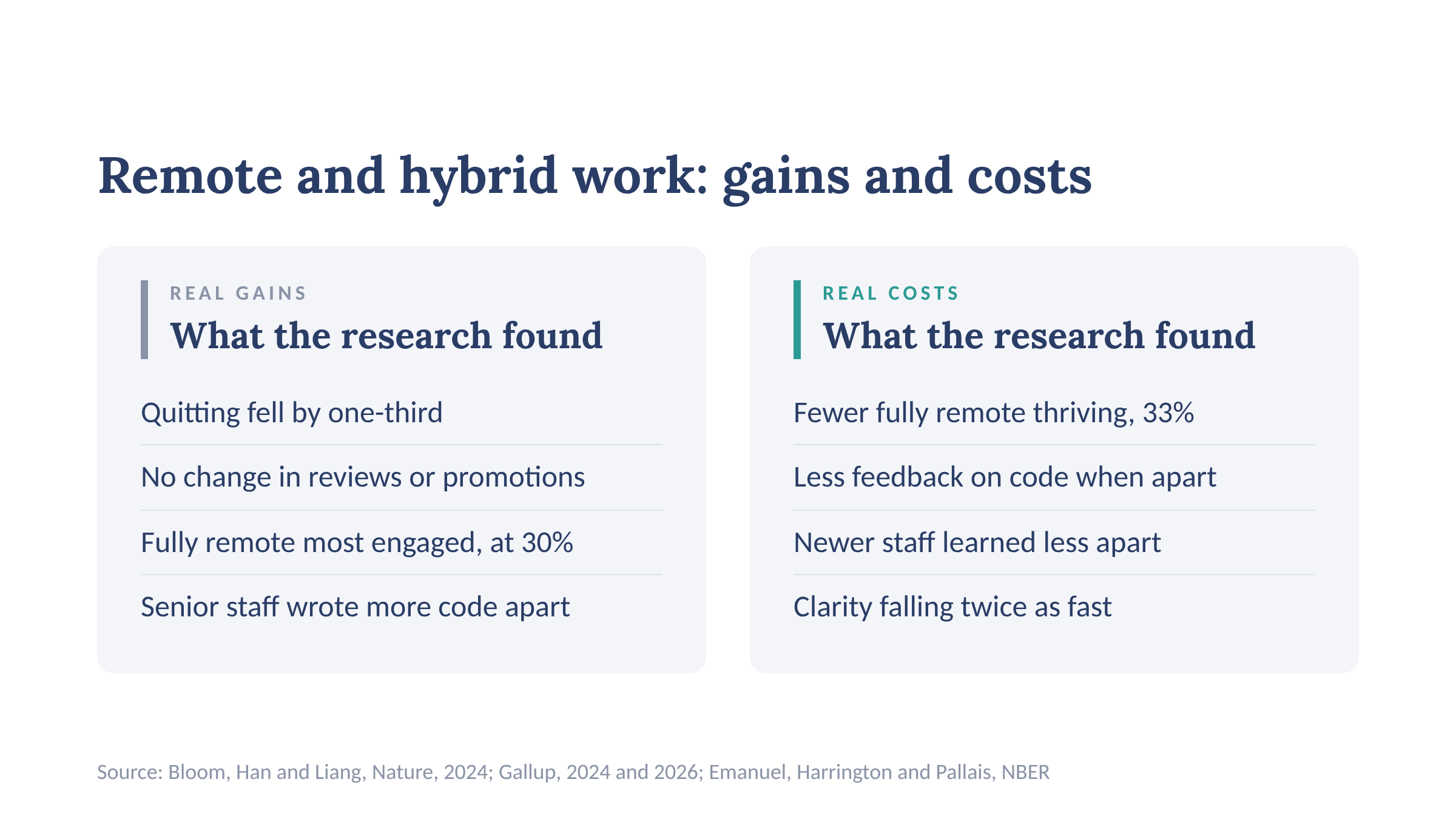
Remote and hybrid work research: quitting fell by one-third, and fewer fully remote workers are thriving.
Get the free Back Briefing Guide
Why does the manager shape remote and hybrid work more than the location does?
Remote and hybrid work remove many of the small moments where people learn what’s expected, so the manager has to plan what the office used to provide without anyone planning it. The research points to the manager more often than to the number of office days.
Gallup’s summary of its hybrid research, “Hybrid Work and Productivity: What the Data Show,” updated November 10, 2026, reports that an effective manager leads to four times higher engagement and well-being, regardless of how often employees work remotely. In a 2024 Gallup and Workhuman study of 4,439 US employees, clarity of expectations had declined over five years, twice as fast for hybrid and remote employees. Employees who strongly agreed they knew what was expected of them were 47% less likely to experience frequent burnout.
Few managers have been prepared for this. Gallup found in 2024 that only 28% of hybrid managers had been trained to lead a hybrid team. Our post on how to set clear expectations for employees covers the four parts of a clear expectation, and a team that works in more than one place needs all four written down.
Related UNLEASHED episode: Mickey Anderson on why fewer than half of employees strongly agree they know what’s expected at work, and what leaders can do about it.
Why is the return to office debate often a debate about trust?
Many return to office arguments start with a leader who isn’t confident the work is getting done. That’s a question about trust and clear expectations, and more office days answer only part of it.
In its Work Trend Index report “Hybrid Work Is Just Work,” published September 22, 2022, Microsoft surveyed 20,000 people in 11 countries. Of those, 87% of employees said they were productive at work, and 85% of leaders said hybrid work had made it hard to be confident that employees were being productive.
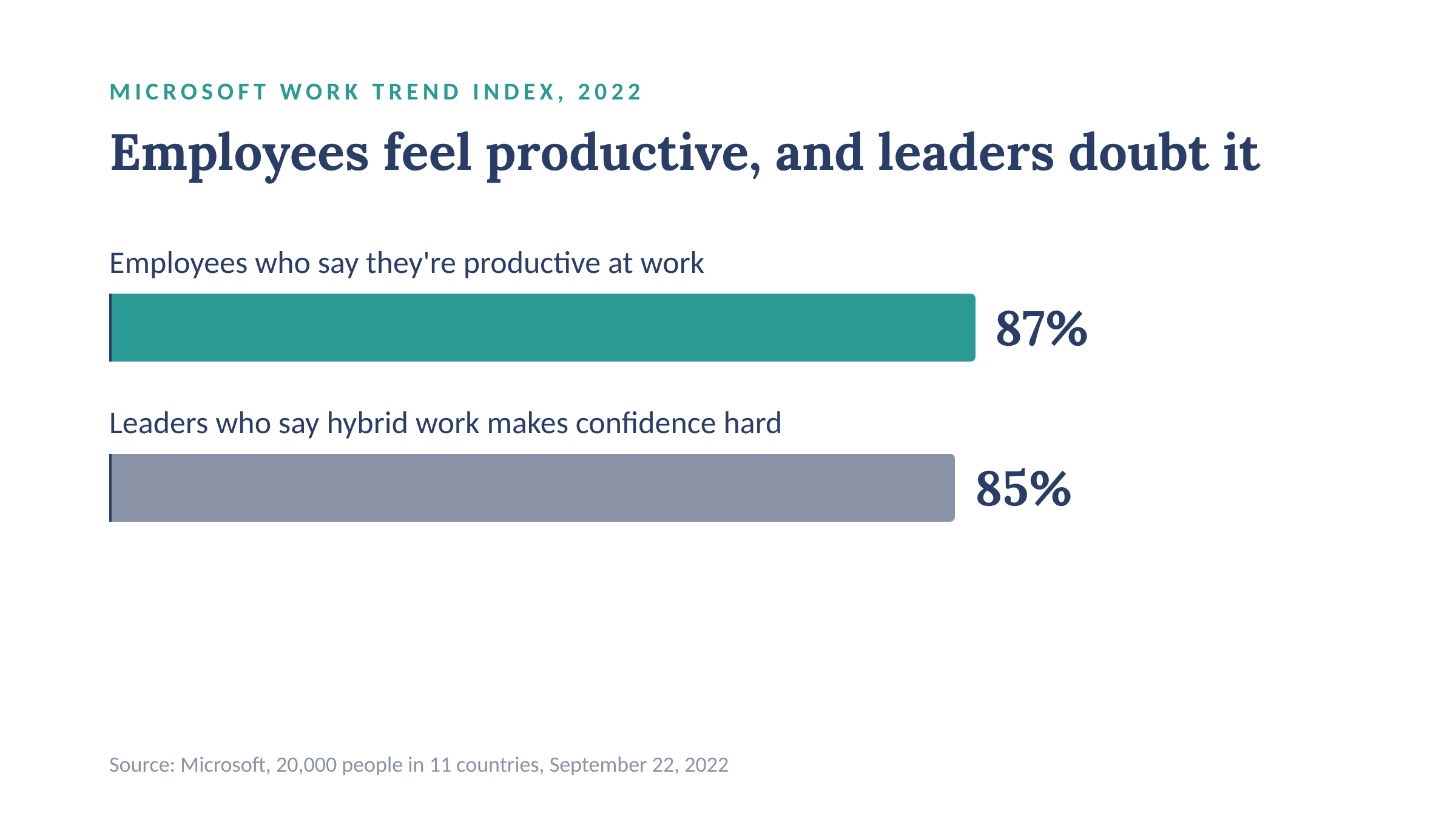
Microsoft, 2022: 87% of employees say they’re productive, and 85% of leaders find it hard to be confident.
Managers’ views can change with experience. In the Nature trial, the 395 managers involved expected hybrid work to cut productivity by 2.6% before the experiment and expected a 1.0% gain after it. Gallup reports that in 2025, 54% of managers of remote workers strongly agreed that they trust their teams to be productive remotely, and 57% of employees felt trusted. Employees felt more trusted with timely communication across locations, a strong sense of team community, clear accountability for performance expectations, and equal chances for feedback and development wherever they worked.
The reasons for in-person time are real, including learning, connection and work across teams. Doubts about effort are a separate question, and clear expectations answer it better than a count of days.
How does a team decide what in-person time is for?
Ask the team to agree what its in-person days are for and which work happens on them, following any limits the company sets. Gallup’s data favour schedules set by the team over schedules set by one person.
Gallup reports that 91% of employees called a hybrid schedule fair when their team set it, against 73% when leadership set it. Fully self-set schedules had their own risk: compared with team-set schedules, employees who set their own were 76% more likely to name burnout or fatigue as their greatest challenge. Yet in 2024, 48% of hybrid workers said their team hadn’t discussed a plan for working together, and teams with a plan were 66% more likely to be engaged.
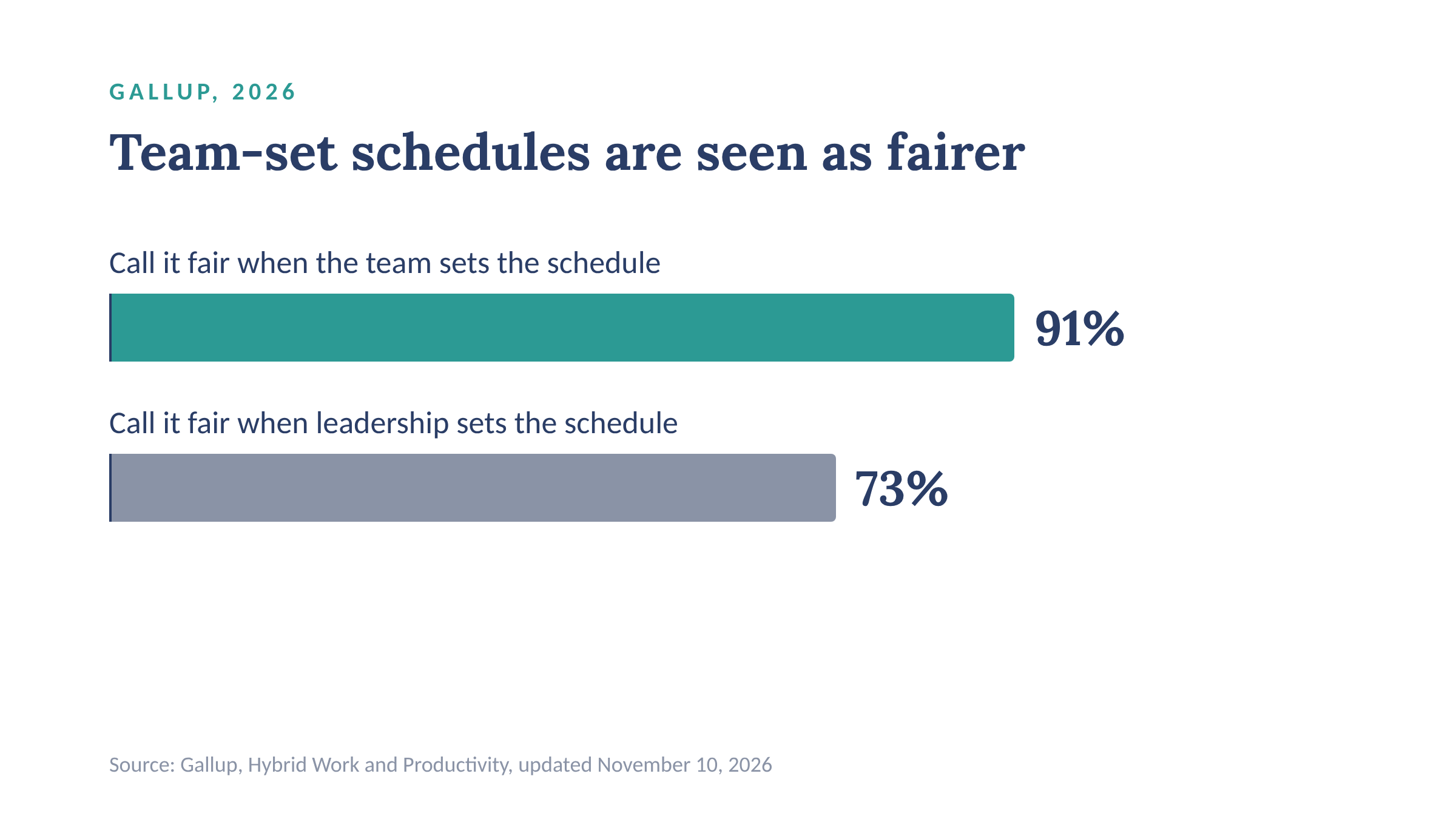
Gallup, 2026: 91% call a hybrid schedule fair when the team sets it, against 73% when leadership sets it.
Gallup names four reasons for coming in: connection, collaboration, creativity and culture, which includes mentoring and coaching. A team can use those four to decide which meetings, reviews and learning happen in person, then write the answers down and review them each quarter.
Why do newer people lose the most when they’re far from their team?
Newer people learn much of the job from feedback and from watching others work, and distance cuts how much of both they get. Their learning has to be planned.
In “The Power of Proximity to Coworkers,” NBER Working Paper 31880, first issued in November 2023 and revised in June 2026, Natalia Emanuel, Emma Harrington and Amanda Pallais studied software engineers at a Fortune 500 firm from 2019 to 2024. Sitting near teammates increased feedback on code by 18.3%, with the gains concentrated among less-tenured and younger engineers. There was a cost too, since experienced engineers wrote less code when they sat near their teammates.
To plan how newer people learn:
Pair each new person with a named colleague, and agree when they’ll review work together.
Use in-person days for feedback on real work, so newer people see how others do the job.
Protect time for experienced people who teach, since teaching takes time from their own work.
Give weekly feedback in every location, wherever the person works that day.
Gallup reports that only 21% of employees strongly agree they got meaningful feedback from their manager in the past week. Our post on effective one-on-one meetings that develop your team gives a weekly structure that works on video or in person.
What do leadership competencies have to do with leading remote teams?
A leadership competency describes one part of good leadership as behaviours other people can see. Naming the competencies that matter for a distributed team tells a leader what to practice when they can’t see the work.
Our Leadership Competency Model describes ten competencies, and the Leadership Competency Assessment scores each leader on them, from the leader’s own view and from observers who work with them. Naming the competency turns “I can’t tell if my remote people are working” into something the leader can practice and score again in six months. Four matter most for a leader of a remote or hybrid team:
Makes Expectations Clear. Each person can name the outcome they own this month, what a good result looks like and what they can decide without asking.
Communicates Often and Openly. People working from home hear about a change in priorities from their leader at the same time as people in the office, good news and bad.
Listens and Adjusts. The leader asks about workload, problems and wellbeing in every one-on-one, since they can’t see them during the day, and changes plans when what they hear shows it’s needed.
Builds a Team That Succeeds and Fails Together. The team agrees together what its in-person days are for and follows that agreement, so no one decides alone how the rest of the team works.
What does leading a remote or hybrid team look like in an organization of 30 to 300 people?
In an organization of 30 to 300 people, the leadership team usually sets the office policy, and each manager decides how their own team applies it. If leaders describe the policy differently to their teams, people hear mixed messages about what’s expected, so agree as a leadership team what in-person time is for before each team sets its own days. Our 1:1 Leadership Development works with individual leaders over months on the competencies their scores show they most need, including leaders whose teams work in more than one place.
What’s one thing to try this week with a remote or hybrid team?
Try a back brief: write down what good looks like for your top three priorities, then ask each person who reports to you to play it back in their own words. You’ll hear any difference before the work starts.
Before your next one-on-ones, write the outcome, the date and how you’ll know it’s done for each priority. Each playback that differs from what you wrote is a misunderstanding caught early. A back brief helps most at four moments for a distributed team: work handed to someone you won’t see until it’s done, a deadline changed in a message instead of a meeting, work passed between people on different days or sites, and what the team agreed its in-person days are for.
Get the free Back Briefing Guide
Frequently asked questions
How do you lead a remote team well?
Lead a remote team well by making expectations explicit, since people can’t learn them by watching. Agree each person’s outcomes and decisions in writing, hold weekly one-on-ones, share changes with everyone at the same time, and ask people to play priorities back in their own words. Gallup reports that effective managers lead to four times higher engagement and well-being, wherever people work.
Is hybrid work better than remote work?
Each has real gains and real costs. Gallup’s 2026 global data show fully remote workers are the most engaged, at 30%, compared with 25% for hybrid workers, while 33% of fully remote workers are thriving, compared with 45% of hybrid workers. In both arrangements, how well people are managed matters more than how many days they spend in the office.
Should we bring people back to the office?
Decide what in-person time is for before deciding how many days. In a randomized trial published in Nature in 2024, working from home two days a week cut quitting by one-third with no effect on performance reviews. Gallup reports that 91% of employees called a schedule their team set fair, against 73% for one leadership set, so involve teams in the answer.
How do you build trust with a remote team?
Build trust with clear expectations and regular contact. Gallup found employees feel more trusted with timely communication across locations, a strong sense of team community, clear accountability for performance expectations, and equal chances for feedback and development, and these four practices can raise trust by nearly 30 percentage points. A back brief also confirms people understood a priority before the work starts.
Lead your remote and hybrid team with clear expectations
If your leadership team keeps returning to the office debate, a conversation with us can help you agree on what your leaders expect of their teams wherever they work. LoyaltyOps is a leadership development firm that develops individual leaders and leadership teams against clear leadership competencies, so performance improves across your organization.
Sources
Bloom, N., Han, R., and Liang, J. “Hybrid working from home improves retention without damaging performance.” Nature, 630, 920 to 925, June 12, 2024. https://www.nature.com/articles/s41586-024-07500-2
Gallup. “State of the Global Workplace 2026: Global Data Summary.” No author shown, updated May 19, 2026. https://www.gallup.com/workplace/697904/state-of-the-global-workplace-global-data.aspx
Kemp, A. “Employee Wellbeing Hinges on Management, Not Work Mode.” Gallup, August 14, 2024. https://www.gallup.com/workplace/648500/employee-wellbeing-hinges-management-not-work-mode.aspx
Gallup. “Hybrid Work and Productivity: What the Data Show.” No author shown, July 27, 2026, updated November 10, 2026. https://www.gallup.com/workplace/713093/hybrid-work-productivity.aspx
Microsoft. “Hybrid Work Is Just Work. Are We Doing It Wrong?” Work Trend Index Special Report, September 22, 2022. https://www.microsoft.com/en-us/worklab/work-trend-index/hybrid-work-is-just-work
Emanuel, N., Harrington, E., and Pallais, A. “The Power of Proximity to Coworkers.” NBER Working Paper 31880, November 2023, revised June 2026. https://www.nber.org/papers/w31880
Related episode: UNLEASHED by LoyaltyOps, “Only 46% Strongly Agree They Know What’s Expected,” November 5, 2026. https://youtu.be/IPrxQT95VIQ