
Leadership Development Training vs Leadership Training: Which Do Your Managers Need?
Leadership Development Training vs Leadership Training: Which Do Your Managers Need?
Leadership training teaches a skill in a session or short course. Leadership development training changes how a leader leads over months, through agreed leadership competencies, practice in real work and scores at the start and the end. In a 2026 survey of 521 HR and business leaders, a lack of manager training came last among the barriers named, at 25%.
Key takeaways
Leadership training teaches a skill in a session, and leadership development changes how a leader leads over months, with practice and measurement.
Training on its own rarely shows up in day-to-day behaviour when there’s no shared definition of good leadership, no practice in real work and nothing measured.
In a 2026 Betterworks survey of 521 HR and business leaders, 48% named leadership expectations as the biggest source of friction for managers, and a lack of manager training came last among barriers, at 25%.
Gallup estimates that managers account for at least 70% of the variance in employee engagement scores across business units.
Training is the right choice for a defined skill, a new process or the basics a new manager needs in the first months.
Five questions tell you whether any program will change behaviour before you commit your budget to it.
Related UNLEASHED episode: Mickey Anderson on how Loblaw defined good leadership for about 220,000 people, and why the definition has to come before the training.
Give your managers something worth copying
Development starts with what managers see their own leaders do each week. The free Leadership Modeling Reference Card helps each leader on your leadership team pick one behaviour worth copying and practice it where their people can see it, so the training your managers take has an example to follow.
Get the Leadership Modeling Reference Card
Why does leadership training often change nothing a month later?
Training often changes little a month later because a session teaches the skill and the rest of the month decides whether anyone uses it. Three things are usually missing: a shared definition of good leadership, practice in real work and a measure of whether behaviour changed.
The managers liked the workshop and the feedback forms were strong, yet a month later one-on-ones still turned into status updates and decisions still came back up to the leadership team. Nobody did anything wrong. The program taught the skills, and nothing around it asked managers to use them.
No shared definition of good leadership
A manager can only practice a skill toward a standard they know. In the 2026 Manager Effectiveness Survey by Betterworks, a performance management software company, 521 HR and business leaders at director level or above in the US and the UK were asked where friction against manager effectiveness was greatest, and 48% named leadership expectations. In a separate question about what most prevents managers from being more effective, a lack of manager training came last among the barriers named, at 25%. The survey is self-reported. Our post on leadership expectations for managers covers how to write down what good leadership looks like before anyone is trained against it.
No practice in real work
A session gives a manager the idea and perhaps one role play. Behaviour changes through repeated attempts in real conversations, with someone who notices and gives feedback. When the workshop ends and the next week is full of client work and deadlines, the new skill competes with habits the manager has practiced for years, and the habits win.
Nothing measured
The feedback form at the end of a course measures how the day felt. It can’t show whether a manager gives clearer direction three months later, because nobody asked the people who work with that manager. Without a measure at the start and the end, nobody can tell which part of the program worked, so the next program is chosen the same way as the last one.
The cost of training that doesn’t change behaviour falls on the people who work for those managers. Gallup estimates that managers account for at least 70% of the variance in employee engagement scores across business units, from its research for State of the American Manager.
What’s the difference between leadership training and leadership development?
Leadership training teaches a skill or a body of knowledge in a set number of hours. Leadership development changes how a leader leads over months, against an agreed definition of good leadership, with practice in real work and a measure of what changed.
Management training usually covers the processes of the role, such as performance reviews, hiring, budgets and policies. Leadership training covers skills such as giving feedback, delegating and holding a coaching conversation. Both are taught, and both end when the course ends.
Leadership development is longer work with a different goal. It starts with the leadership competencies your organization expects, finds where each leader stands against them, and gives each leader a few behaviours to practice in their own job between sessions. It finishes with the same measure it started with, scored by the leader and by the people who work with them.
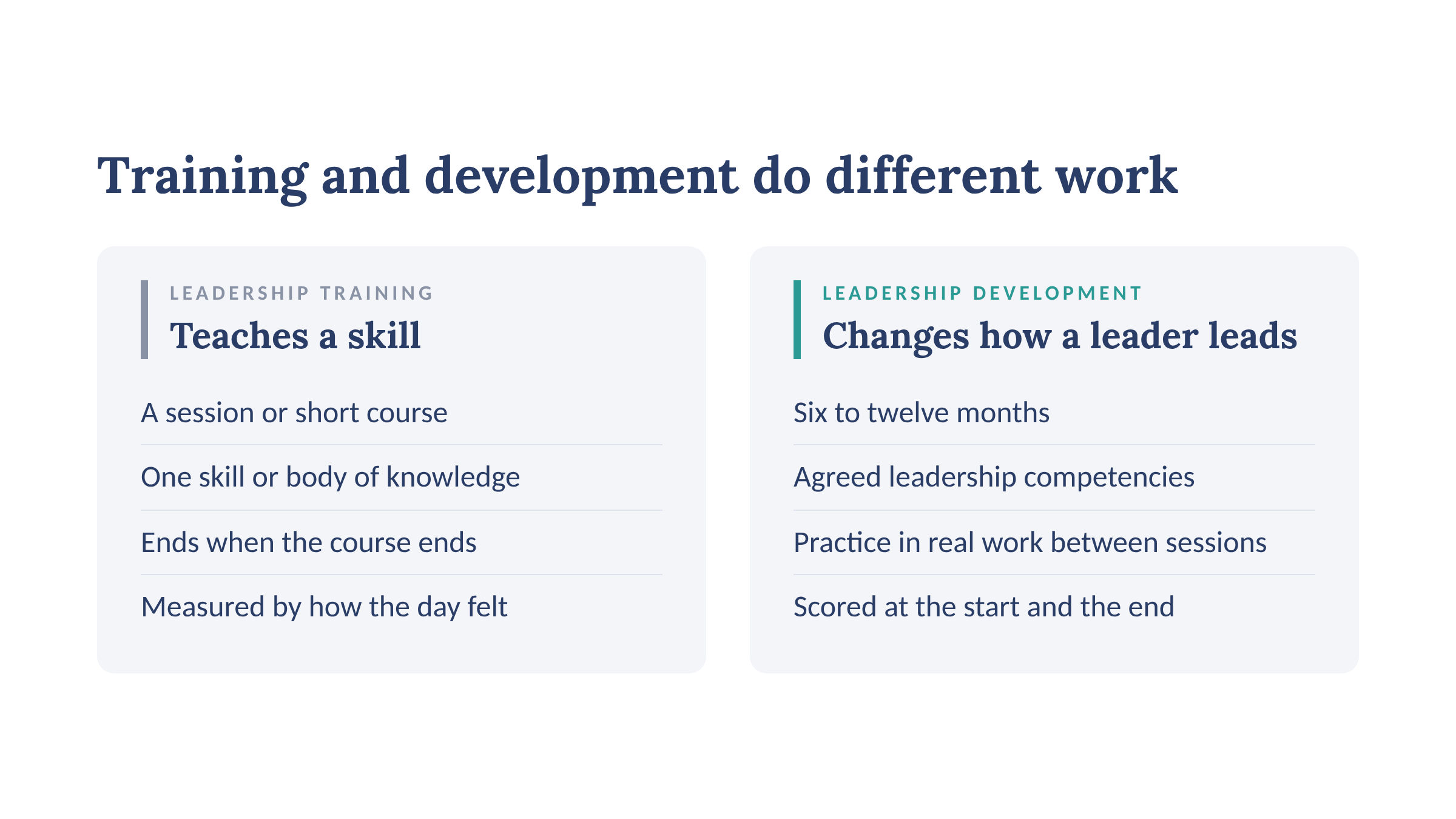
Leadership training teaches a skill in a session, and leadership development changes how a leader leads over months.
When is leadership training the right choice?
Training is the right choice when the gap is a specific skill or piece of knowledge, and when the organization already agrees what good leadership looks like. In those cases, a well-designed course is faster and cheaper than development.
Training fits well when:
A manager needs a skill with a clear right way, such as a new performance review process, a structured interview method or a legal requirement.
New managers need the basics of the role in their first months.
Your organization has a written definition of good leadership, and each manager’s own leader follows up after the session.
A whole group needs the same information at the same time, such as a change to a policy.
Training works best as one part of development. A course on feedback is far more useful when the manager leaves it with one behaviour to practice, a date to try it and a leader who asks how it went.
What should leadership development training include?
Leadership development training needs three parts to change behaviour: agreed leadership competencies, practice between sessions and a measure at the start and the end. A program missing any one of them is closer to training, however long it lasts.
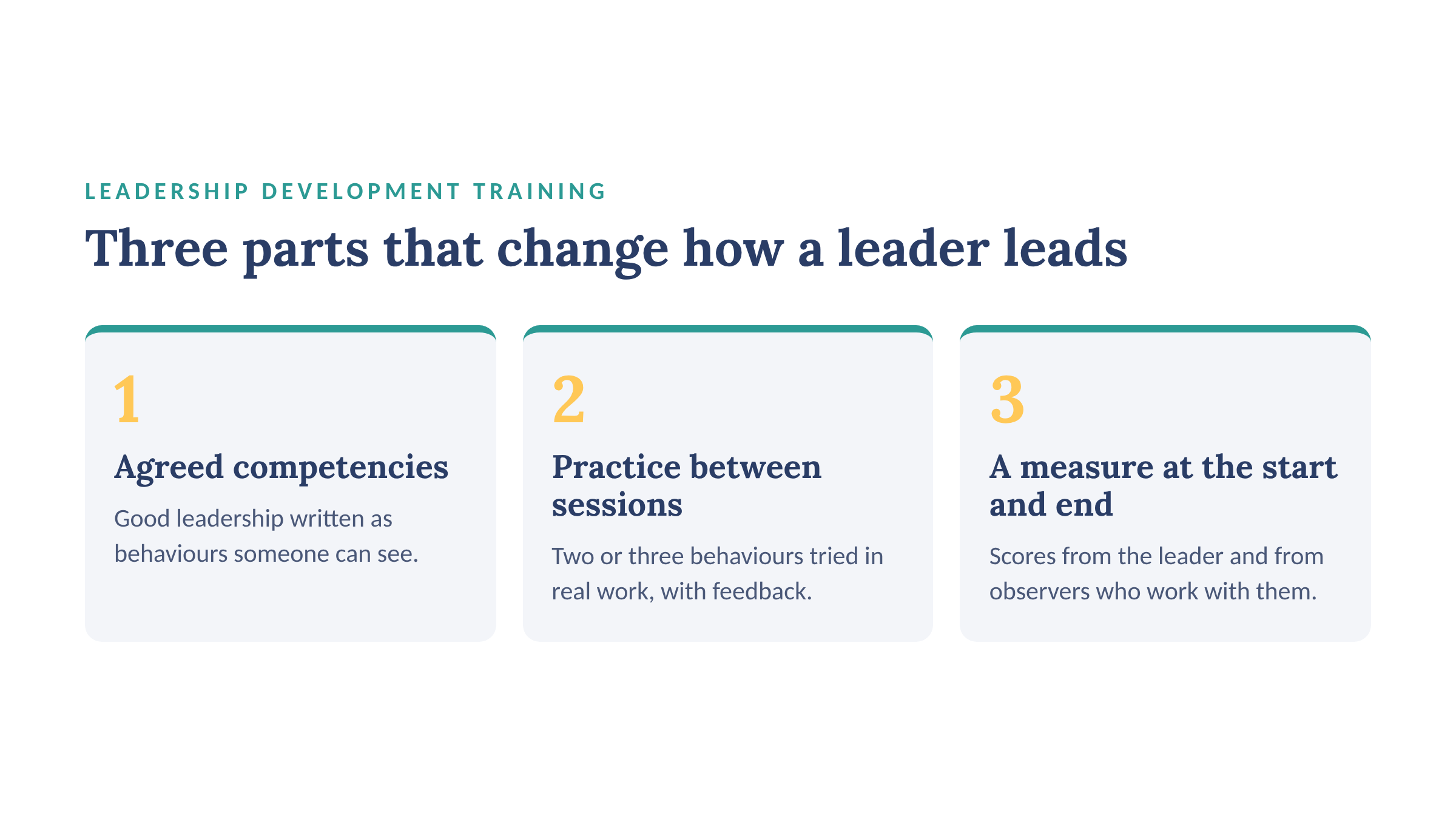
Three parts of leadership development: agreed competencies, practice between sessions and scores at the start and end.
Agreed leadership competencies
Every leader needs to know what good leadership looks like in your organization, written as behaviours someone can see. In an organization of 30 to 300 people, a short list for two levels, leaders of teams and leaders of leaders, is usually enough. Your leadership team agrees it and goes first, because managers copy what they see their own leaders do.
Practice between sessions
Each leader chooses two or three behaviours to practice in real work, such as starting every one-on-one with the person’s priorities or asking a team member to brief back a decision before acting on it. The sessions are where leaders plan the practice, look at what happened and adjust. Most of the change happens in the weeks between them.
A measure at the start and the end
Each leader is assessed against the same competencies before the first session and again at the end, with scores from the leader and from observers who work with them every week. The scores show which behaviours changed and which still need work. Our post on how to measure leadership development covers who should score a leader and what counts as a real change.
Our 1:1 Leadership Development and Leadership Team Development are built on these three parts. Every leader takes the Leadership Competency Assessment before the first session and again before the final review, and the work between sessions is practice in the leader’s own job.
How can you test a leadership program before you commit to it?
Ask five questions about what leaders will do differently, whose standard it uses, what they’ll practice, who gives feedback and how change is measured. A program that answers only the first is training, which can be the right purchase if that’s what you need.
The test matters more as budgets for outside training get tighter. SHRM’s 2026 Learning and Development Executives Benchmarking report, with data from more than 4,600 organizations, found that organizations spent a median of 15% of their learning and development budgets on external training in 2026, down from 25% in 2025, with the largest decreases among small and midsize organizations.
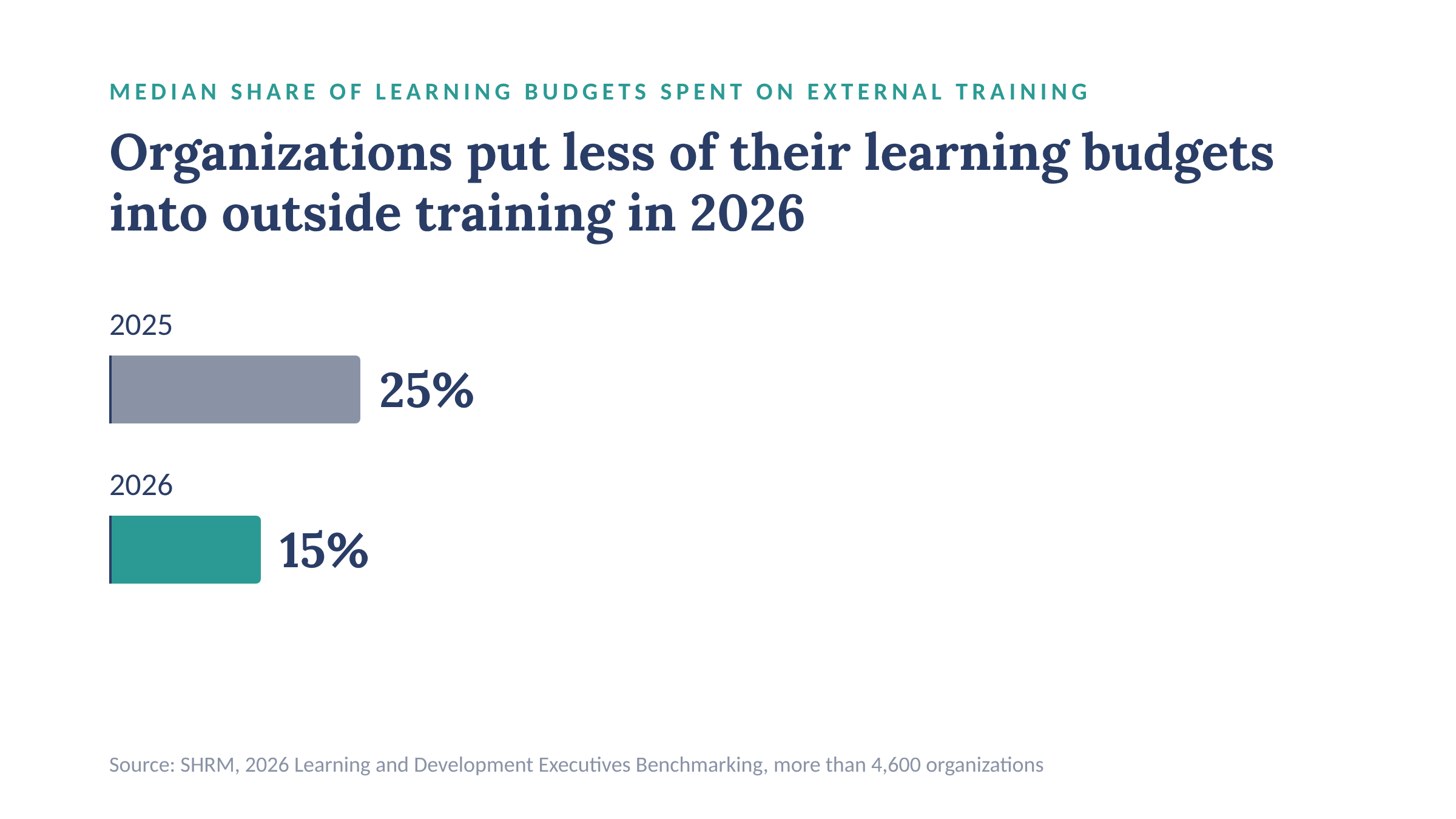
Organizations spent a median 15% of learning budgets on external training in 2026, down from 25% in 2025, SHRM found.
Before you commit to a program, ask the provider and your own leadership team:
What will our leaders do differently when it’s over, in words someone else could see?
Whose definition of good leadership is it built on, and does it match the behaviours we expect?
What will each leader practice between sessions, and in which part of their real work?
Who will notice that practice and give feedback, and how often?
How will we know behaviour changed, and who scores it at the start and the end?
If the answers to questions three to five are vague, plan the follow-up yourself. Ask each manager’s own leader to agree one behaviour with them after the course, check it in their next three one-on-ones and ask the manager’s team what they’ve noticed.
Frequently asked questions
What’s the difference between leadership training and leadership development?
Leadership training teaches a skill or body of knowledge in a set number of hours, such as a workshop on feedback. Leadership development changes how a leader leads over months, against agreed leadership competencies, with practice in real work between sessions and scores at the start and the end from the leader and the people who work with them.
Why doesn’t leadership training work?
Leadership training works for teaching a skill, and it often doesn’t change day-to-day behaviour on its own. The usual reasons are no shared definition of good leadership, no practice in real work after the session and nothing measured beyond how the day felt. Adding those three parts turns a course into development.
What should a leadership development program include?
A leadership development program should include agreed leadership competencies written as behaviours people can see, practice in real work between sessions with someone giving feedback, and a measure at the start and the end scored by the leader and by observers who work with them. A program missing one of these is closer to training.
How long does leadership development take?
Leadership development usually takes six to twelve months for one leader or a leadership team. Behaviour changes through repeated practice in real work, and the people around a leader need time to see the change before a second assessment can show it. A single course can start the work, and the months after it are where most of the change happens.
Find out what your managers need before the next course
If your last program was well liked and changed little, a conversation with us can help you sort out which of your leaders need training, which need development and where to start. LoyaltyOps is a leadership development firm that develops individual leaders and leadership teams against clear leadership competencies, so performance improves across your organization.
Sources
Betterworks (Lim, A.). “2026 Manager Effectiveness Survey: The Multiplier Most Orgs Haven’t Turned On.” October 14, 2026, a self-reported survey of 521 HR and business leaders, director level or above, in the US and the UK, run in August 2026. https://www.betterworks.com/magazine/2026-manager-effectiveness-survey
Beck, R., and Harter, J. “Managers Account for 70% of Variance in Employee Engagement.” Gallup Business Journal, April 21, 2015. https://news.gallup.com/businessjournal/182792/managers-account-variance-employee-engagement.aspx
SHRM. “2026 Learning and Development Executives Benchmarking: Developing Critical Talent.” 2026, data from more than 4,600 organizations. The page shows no publication date or author. https://www.shrm.org/mena/topics-tools/research/2026-ld-executives-benchmarking–developing-critical-talent
Related episode: UNLEASHED by LoyaltyOps, “How Loblaw Defined Good Leadership for 220,000 People,” October 22, 2026. https://youtu.be/1Im8_mlpIec