
How to Measure Leadership Development
How to Measure Leadership Development When Training Scores Can’t Tell You What Changed
To measure leadership development, measure whether leaders behave differently, as the people who work with them see it. Trace each leader’s problem to the competencies and behaviours behind it, score those behaviours at the start and the end, and read the change by competency. Only 16% of organizations measured the return on their learning and development in 2026.
Key takeaways
Satisfaction scores and attendance show whether people liked a program, and they can’t show whether anyone leads differently.
85% of HR and learning leaders say measuring the impact of leadership development is important, and 48% aren’t satisfied with how they measure it.
Measure the chain from a problem the leader names, to the competencies behind it, to behaviours people can see, to scores at the start and the end.
In a meta-analysis of 24 studies, scores from direct reports, peers and supervisors improved a little over time, while leaders’ own scores didn’t improve on average.
A change of about half a point on a five-point scale, scored by the people who work with a leader on a whole competency, is worth paying attention to.
Business results belong in the numbers your company already tracks, and behaviour change is what you can measure directly.
Related UNLEASHED episode: Mickey Anderson on why defining good leadership comes before training or measuring it, and how Loblaw did it for about 220,000 people.
Give your measures a rhythm between the start and the end
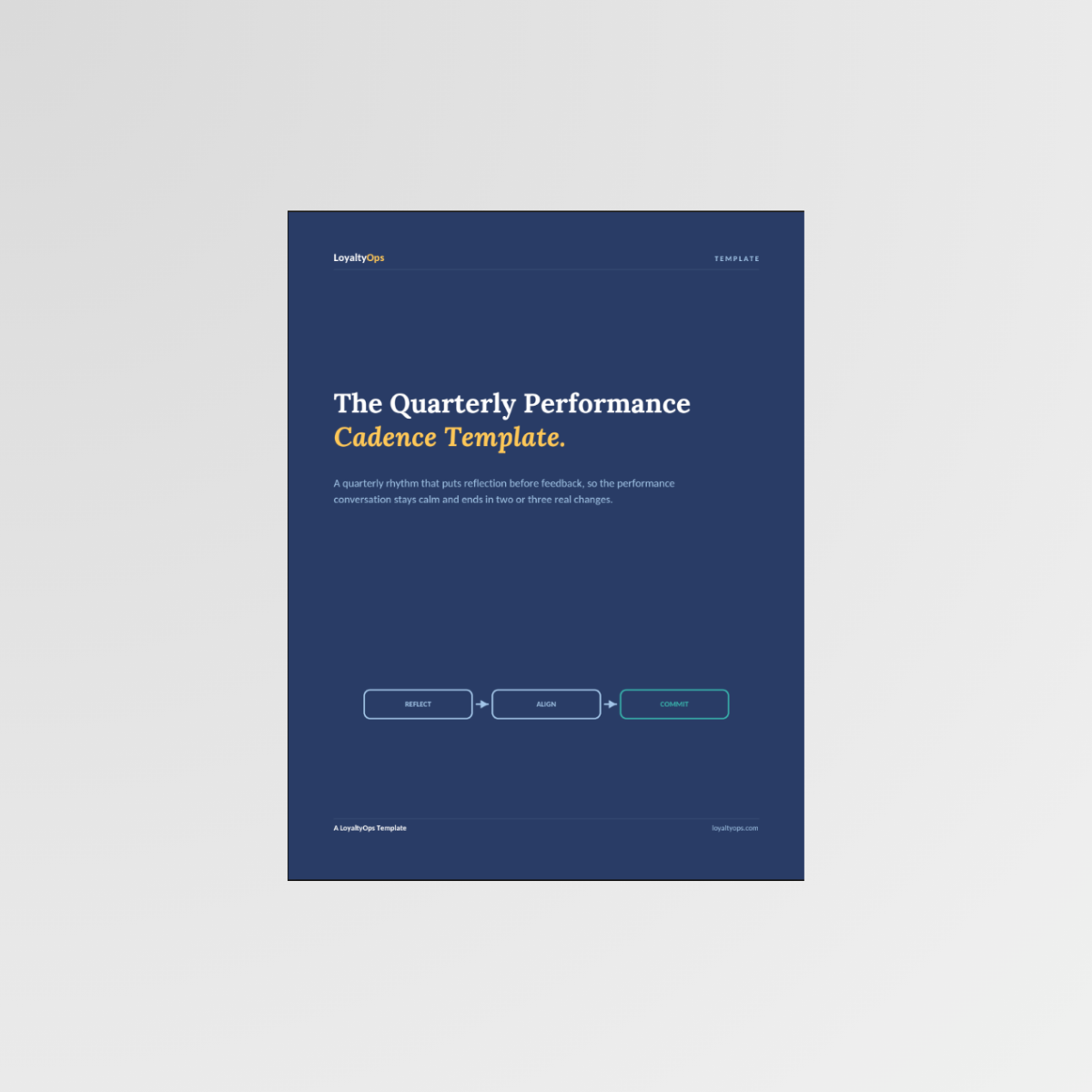
Measuring at the start and the end tells you what changed, and a quarterly check in between keeps the behaviours in front of your leaders. The free Quarterly Performance Cadence Template gives your organization a quarterly review that starts with reflection and ends with two or three behaviours to practice next.
Get the Quarterly Performance Cadence Template
Why don’t satisfaction scores show whether anyone leads differently?
Satisfaction scores measure how people felt about a program on the day it ended. Whether a leader leads a better meeting, decides at the right level or raises a problem early shows up weeks and months later, in front of the people they lead, and a feedback form doesn’t see it.
Most organizations stop at the feedback form. A widely used model measures leadership development at four levels: reaction, learning, behaviour and results. Regis Chasse and Steven Krupp of Heidrick and Struggles report that even companies that say they measure impact rarely go beyond the first level, participant reactions. In the firm’s survey of HR and learning leaders, 85% said measuring the impact of leadership development programs is important, and 48% weren’t satisfied with how they measure it.
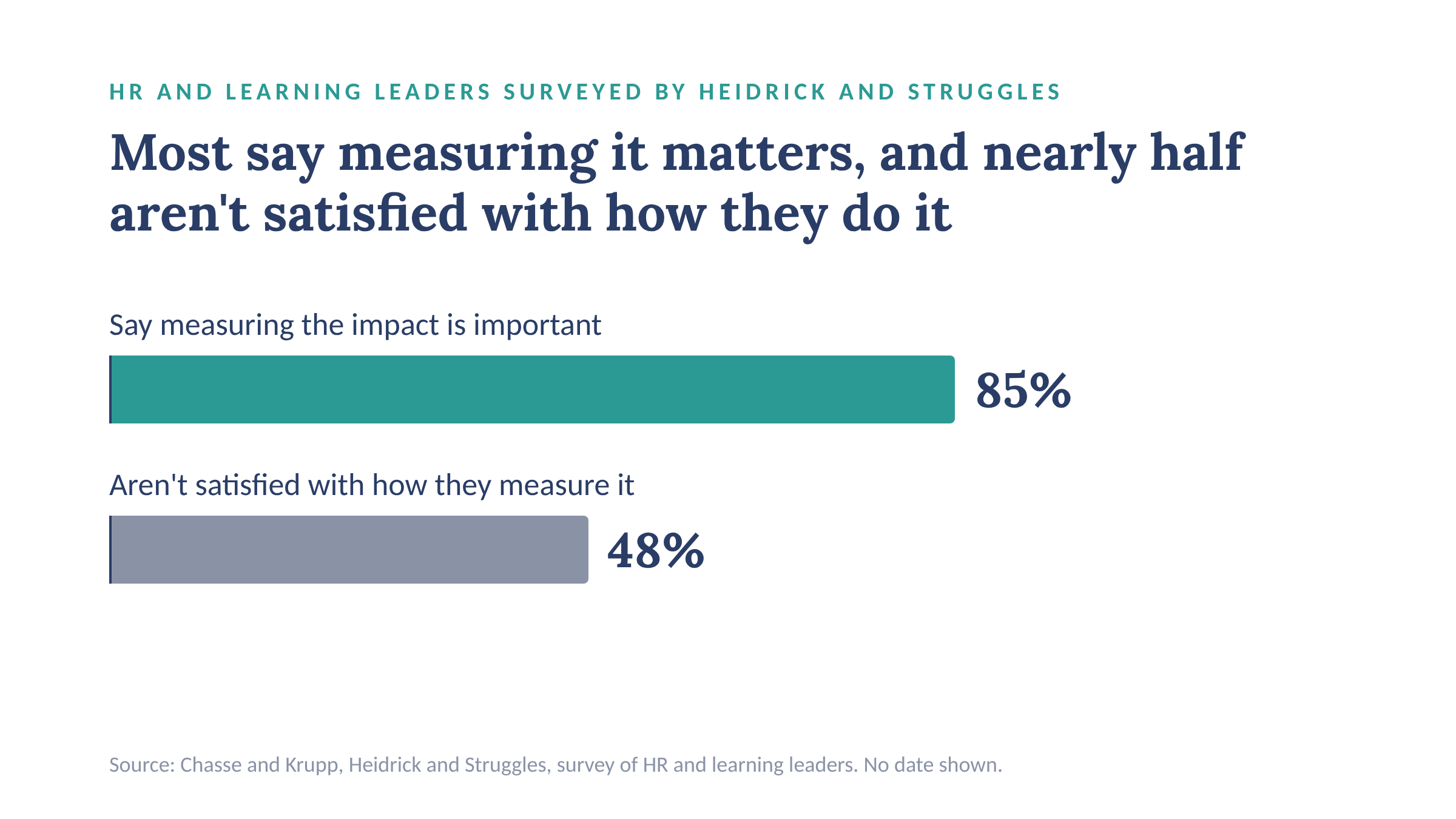
85% of HR and learning leaders say measuring leadership development matters, and 48% aren’t satisfied with how they do it.
The gap has a cost. In a 2026 survey by Abilitie, which sells leadership programs, 56% of learning leaders said they find it hard to measure the impact of leadership development, which leads to poor buy-in and inadequate budgets. SHRM’s 2026 benchmarking of more than 4,600 organizations found that only 16% measured the return on investment of their learning and development that year.
What should you measure instead?
Measure behaviour: what each leader does, week to week, that the people around them can see. It’s the level between learning something and the business results you hope follow, and it’s the one leadership development can change directly.
HR leaders agree. A DDI article from August 2026, citing the firm’s Global Leadership Forecast 2025, reports that 78% of HR leaders say behaviour change is the most valuable measure of success for leadership development. DDI sells leadership development, and the finding matches what Gartner recommended in October 2026: measure leadership development by connecting the outcomes you want to leadership capabilities, leadership behaviours, team performance and organizational performance.
Behaviour can only be measured against a definition of good leadership, and many organizations haven’t written one down. In the 2026 Manager Effectiveness Survey by Betterworks, a performance management software company, 48% of HR and business leaders named leadership expectations as the biggest source of friction for managers, and a lack of training came last at 25%. Our post on leadership expectations for managers covers how to define good leadership before you train or measure it.
How do you connect a leader’s problem to scores you can measure?
Start with the problem the leader wants to fix, and work down to something people can see and score. Each link makes the next one specific.
The problem, in the leader’s own words. Such as “My managers bring me decisions they should be making themselves.”
The leadership competency behind it. In that example, making expectations clear, so people know what they can decide on their own.
The behaviours people can see. Such as making sure each person knows what they’re allowed to decide and use to deliver their outcome, including the budget, the tools and the limits they work within.
Scores at the start and the end. The people who work with the leader score how often they see each behaviour, before the development starts and again after it.
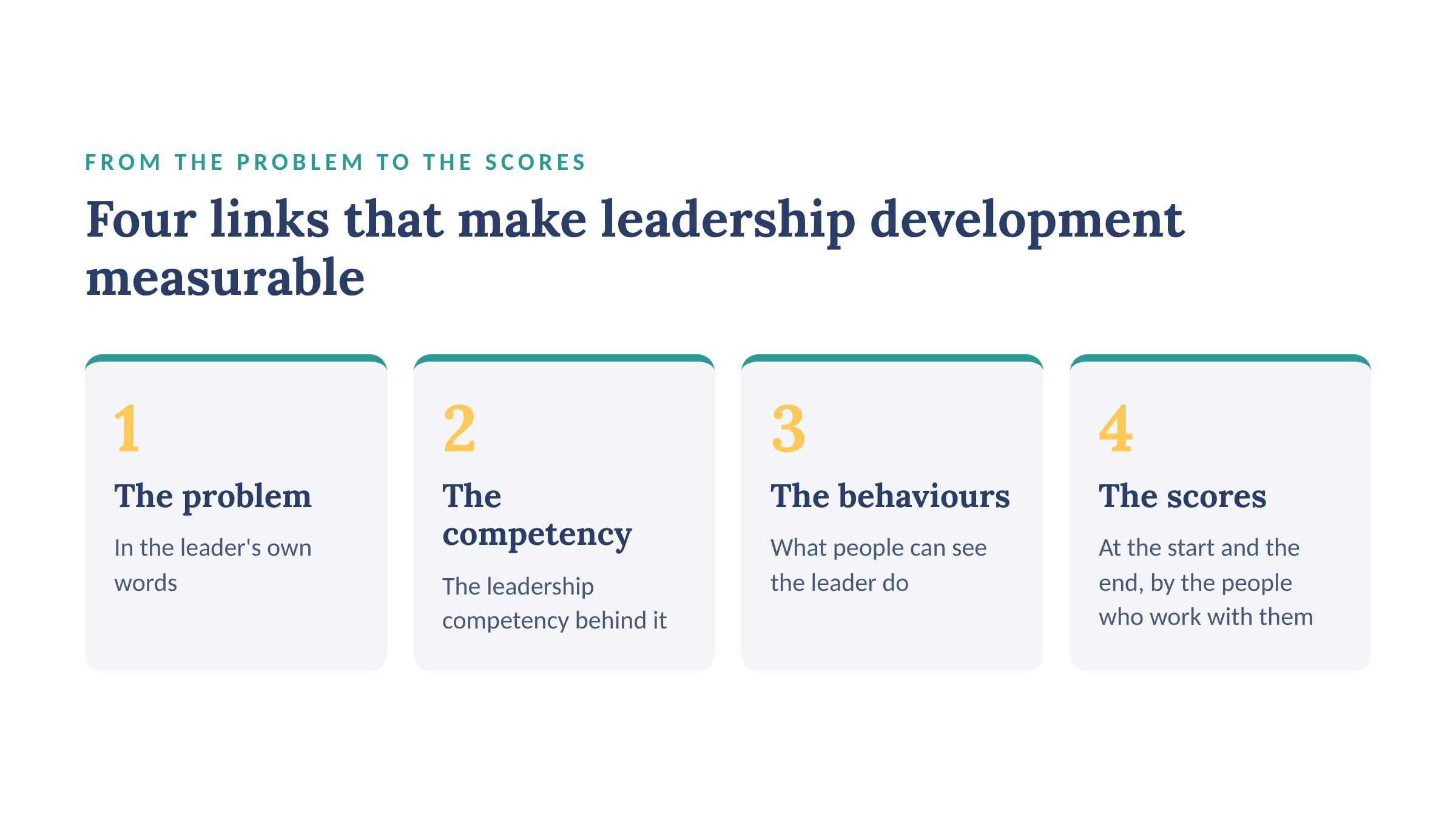
Four links: the problem a leader names, the competency behind it, behaviours people see, and scores at the start and end.
This is how our Leadership Competency Assessment is built. Each leader names where they most want to improve, the report connects it to the competencies behind it, and every competency is made up of behaviours their observers can see. When the leader takes it again, the two sets of scores show what changed, competency by competency. The assessment page shows six common problems traced this way, and a preview of the report.
Who should score a leader’s behaviour?
The people who work with the leader: their direct reports, their peers and their own leader. They see the behaviour every week, and their scores show change more reliably than the leader’s own.
The research is clear on this point. James Smither, Manuel London and Richard Reilly’s 2005 meta-analysis in Personnel Psychology pooled 24 longitudinal studies of assessments completed by the people who work with a leader. Scores from direct reports and supervisors improved a little over time, peers’ improved slightly, and the leaders’ own scores didn’t improve on average. The authors concluded that large, widespread improvement shouldn’t be expected.
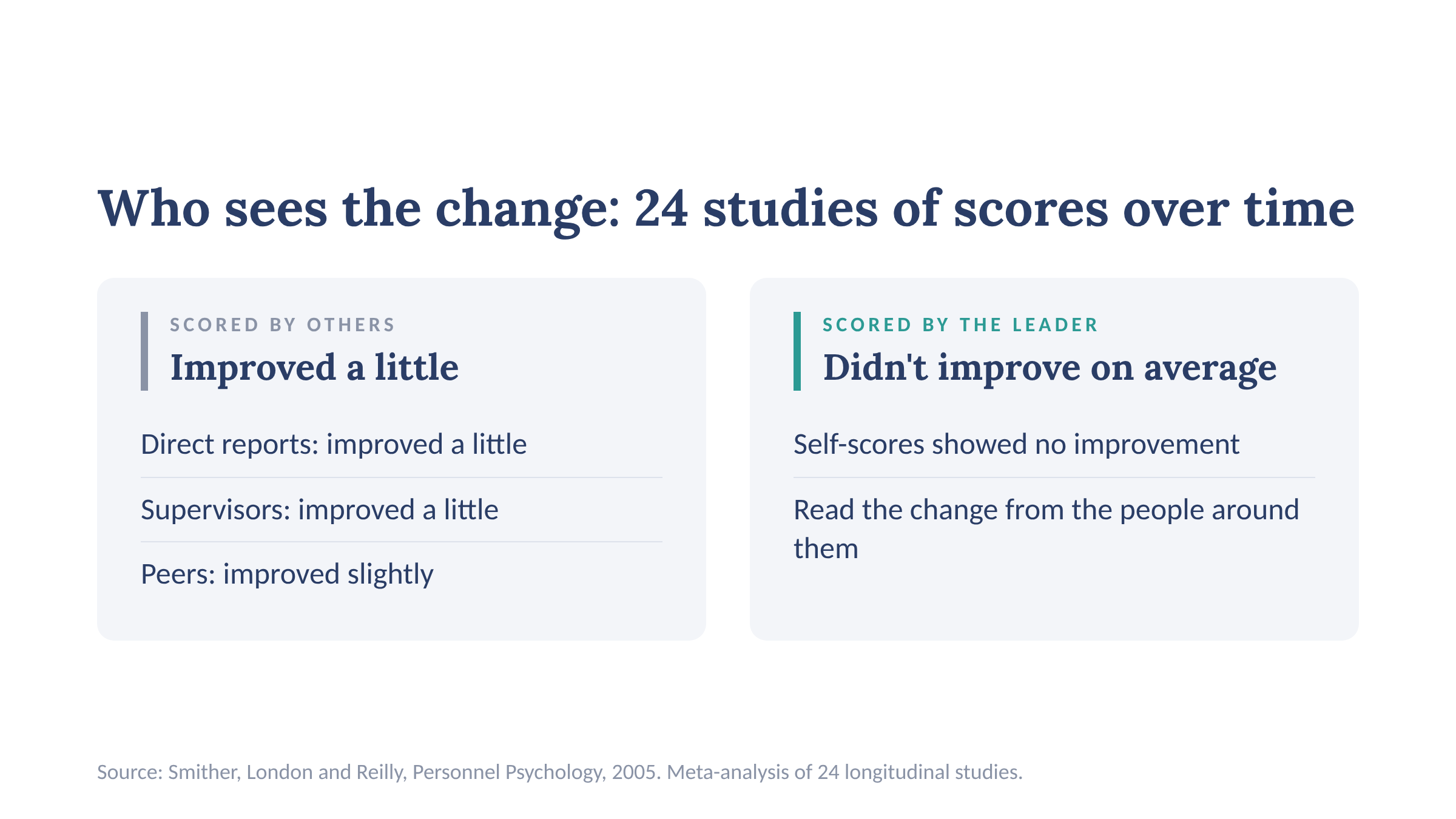
In 24 studies, scores from direct reports, peers and supervisors improved a little over time, and self-scores didn’t.
A likely reason is that leaders judge themselves more strictly once they understand what good leadership looks like, so their own score can stay flat while the people around them see a change. Keep the leader’s self-score, because the gap between it and everyone else’s is useful in a debrief, and read the change from the people who work with them.
How many people score matters too. With only two or three observers, one person’s view can move the average enough to look like a change. Aim for at least five observers on each competency, and ask the same people both times where you can.
What counts as a real change in leadership scores?
A change of about half a point on a five-point scale, on a whole competency, scored by the people who work with the leader, is worth paying attention to. Smaller movements are often chance, especially on a single behaviour.
Three rules keep the reading honest:
Read competencies, not single behaviours. One behaviour is one question averaged over a few people, so it can move half a point by chance. A competency combines several behaviours and moves much less on its own.
Read drops the same way as rises. A lower score can mean people are answering more honestly as trust grows, so look at the context before treating a drop as a leader getting worse.
Use it to read results, and don’t set it as a target. The research above finds that average improvement is small, so some leaders won’t move half a point on every competency, and that’s normal.
The Leadership Competency Assessment page, linked above, explains how we read a change in the results.
Can you measure the ROI of leadership development?
You can measure behaviour change directly, and you can watch your business results in the numbers your company already tracks. Attributing a business result to leadership development alone is hard, because pricing, the market, hiring and many other things move those numbers at the same time.
Heidrick and Struggles make the same point: even companies that try find it hard to define metrics that connect a leadership development journey, which can take months or years, to specific business outcomes. That’s part of why so few organizations measure the return at all.
The honest approach is to keep the two apart. Measure the leadership behaviours at the start and the end, and keep tracking your business results in your own numbers. If the behaviours that matter to your problem improved, you’ll have evidence that the development did what it was for, and you can look at your results alongside it.
How do you start measuring leadership development?
Start before the development does, because you can’t measure a change without a starting point. These steps work for one leader or a whole leadership team.
Name the problem. Ask each leader what they most want to improve, in their own words.
Agree what good looks like. Define the leadership competencies behind those problems, so every leader is measured against the same ones.
Pick the behaviours. For each competency, name three or four behaviours someone could see happen in a normal week.
Score the start. Ask at least five people who work with each leader to score those behaviours, alongside the leader’s own score.
Practice on real work. Each leader picks one or two behaviours to practice in their own meetings and decisions, and checks in on them every quarter.
Score the end. Use the same behaviours, and the same observers where you can, six to twelve months later.
Read the change by competency. Look for changes of about half a point from the people who work with the leader, and talk through the drops as well as the rises.
Our 1:1 Leadership Development and Leadership Team Development both follow these steps. Every leader takes the Leadership Competency Assessment before the first session and again before the final review, and your business results stay in the numbers your company already tracks.
Frequently asked questions
How do you measure leadership development?
Measure whether leaders behave differently, as the people who work with them see it. Trace each leader’s problem to the competencies and behaviours behind it, ask the leader and at least five people who work with them to score those behaviours at the start, score them again six to twelve months later, and compare the two by competency.
What are good leadership development metrics?
Good metrics measure behaviour: how often the people who work with a leader see specific leadership behaviours, scored at the start and the end. Satisfaction scores, attendance and how many people finished the program show whether people took part. Business results matter too, and they’re best tracked in the numbers your company already uses, alongside the behaviour scores.
Can you measure the ROI of leadership development?
You can measure behaviour change directly, and you can track business results in your own numbers. Proving that a business result came from leadership development alone is hard, because many other things move those numbers. Only 16% of organizations measured the return on their learning and development in 2026, according to SHRM.
What counts as a meaningful change in leadership scores?
A change of about half a point on a five-point scale, on a whole competency, scored by the people who work with the leader, is worth paying attention to. Single behaviours move more by chance. It’s a way to read the results, and research finds average improvement is small, so not every competency will move that much.
Why don’t self-assessments show change?
In a meta-analysis of 24 studies, leaders’ own scores didn’t improve on average over time, while scores from the people who worked with them improved a little. A likely reason is that leaders judge themselves more strictly once they understand what good leadership looks like. The people who work with a leader see change more reliably.
See which leadership behaviours changed
If you’ve invested in leadership development and can’t say what changed, a conversation with us can help you set a starting point you can measure against. LoyaltyOps is a leadership development firm that develops individual leaders and leadership teams against clear leadership competencies, so performance improves across your organization.
Sources
Chasse, R., and Krupp, S. “Leadership assurance: A fresh look at measuring the impact of leadership development.” Heidrick and Struggles. No publication date shown. https://www.heidrick.com/en/insights/leadership-development/a-fresh-look-at-measuring-the-impact-of-leadership-development
Abilitie. “Leadership Development Trends L&D Leaders Can’t Ignore in 2026.” From its 2026 Leadership Development Effectiveness Survey. https://abilitie.com/blog/leadership-development-trends-l-d-leaders-can-t-ignore-in-2026
SHRM. “2026 Learning and Development Executives Benchmarking: Developing Critical Talent.” 2026, data from more than 4,600 organizations. https://www.shrm.org/mena/topics-tools/research/2026-ld-executives-benchmarking–developing-critical-talent/full-report
Aharonoff, L. “How to Measure Results of Leadership Development.” DDI, August 24, 2026, citing DDI’s Global Leadership Forecast 2025. https://www.ddi.com/blog/measure-results
Gartner. “Measure the Business Impact of Leadership Development.” October 21, 2026. Public summary. https://www.gartner.com/en/documents/8531209
Betterworks. “2026 Manager Effectiveness Survey.” 2026, a self-reported survey of US and UK leaders. https://www.betterworks.com/magazine/2026-manager-effectiveness-survey
Smither, J. W., London, M., and Reilly, R. R. (2005). “Does Performance Improve Following Multisource Feedback? A Theoretical Model, Meta-Analysis, and Review of Empirical Findings.” Personnel Psychology, 58(1), 33 to 66. Full paper (PDF)
Related episode: UNLEASHED by LoyaltyOps, “How Loblaw Defined Good Leadership for 220,000 People,” October 22, 2026. https://youtu.be/1Im8_mlpIec