
Irreplaceable at Work: Five Strengths That Turn Into a Leadership Trap
Irreplaceable at Work: Five Strengths That Turn Into a Leadership Trap
Being irreplaceable at work becomes a trap when work slows or stops without you and nobody is ready to take on your role. In DDI’s 2025 research, only 20 percent of HR leaders say they have leaders ready to fill many or almost all of their critical business leadership roles. Build each strength in your people.
Key takeaways
If you’re the person everyone relies on, the work slows down or stops when you’re away, and nobody is ready to take on your role.
In DDI’s 2025 research, 75 percent of organizations now prioritize internal promotion for leadership roles.
In the same research, only 20 percent of HR leaders say they have leaders ready to fill many or almost all of their critical business leadership roles.
Gallup estimates that managers account for at least 70 percent of the variance in employee engagement scores across business units.
Five traits make you irreplaceable: having the answers, stepping in to fix it, always being the one who delivers, knowing everything that’s going on, and holding the quality bar yourself.
This week, pick the trait people rely on you for most, and make it safe for one person to practice that work.
Why is being irreplaceable at work a trap for you as a leader?
Being irreplaceable at work becomes a trap when the work slows down or stops without you, and nobody is ready to take on your role. You work harder than anyone, answer every question and do the hardest work yourself, and the next role, or even a week away, gets harder to take.
It probably didn’t happen by accident. You solved problems faster than anyone, knew more and delivered when it counted, and that’s how you were promoted, built the company or became the person people ask for by name. When your team or your company was smaller, that was the job. As it grew, the role kept asking more of you, and nobody showed you how to lead at that level, so the same strengths started to mean the work waits for you.
The research shows why this matters for your next role. DDI’s HR Insights Report 2025, part of its Global Leadership Forecast, analyzed responses from 2,185 HR professionals, including 212 CHROs, and 10,796 leaders in 2,014 organizations in more than 50 countries. It found that “75 percent of organizations now prioritize internal promotion for leadership roles.” In the same research, “only 20 percent of HR leaders say they have leaders ready to fill many or almost all of their critical business leadership roles.” Both findings reflect what HR leaders reported about their own organizations, and together they suggest that the leader with someone ready to take on their role is the one who’s easier to promote.
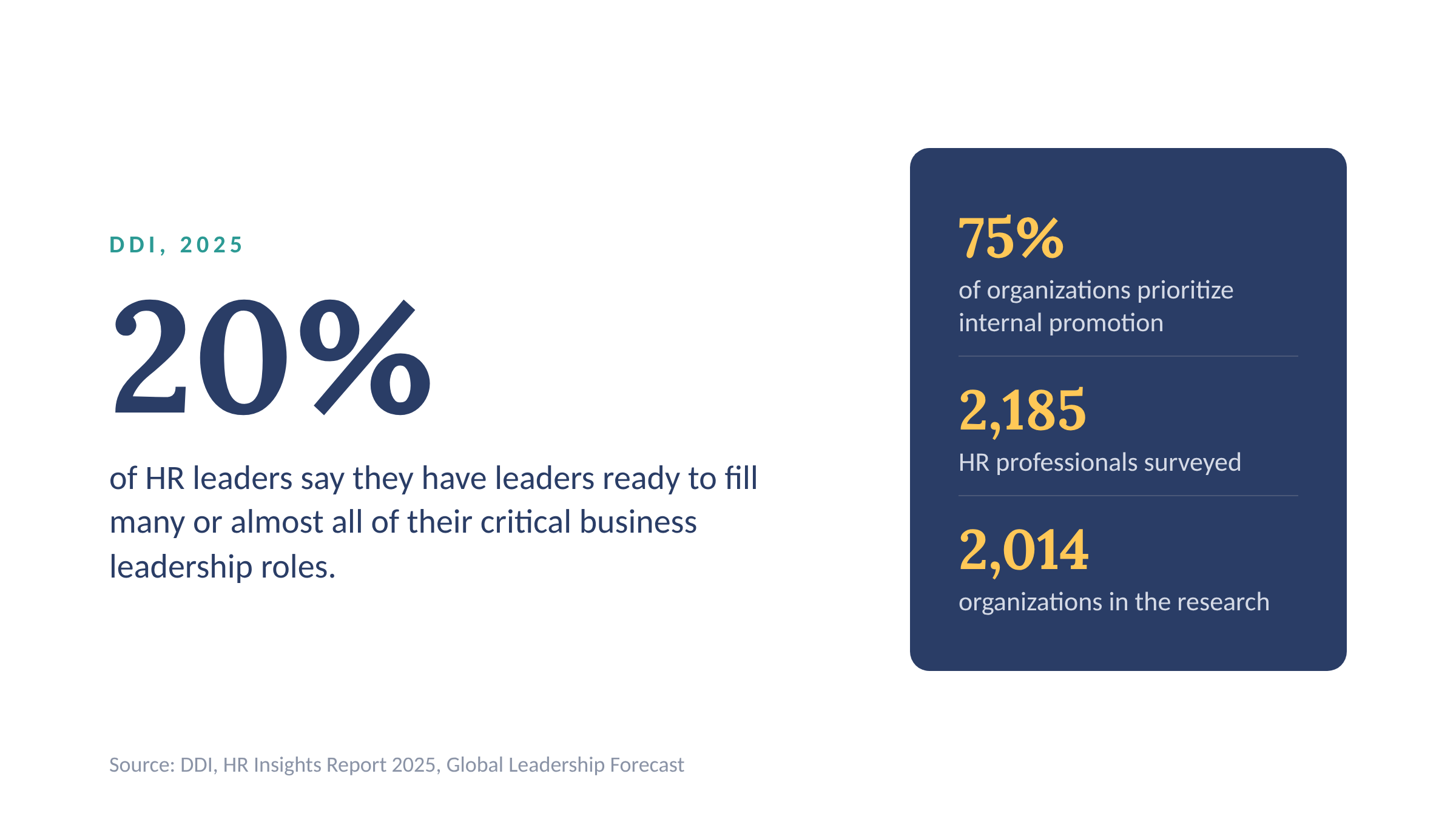
DDI, 2025: only 20% of HR leaders say they have leaders ready to fill many or almost all critical leadership roles.
Gallup estimates that “managers account for at least 70 percent of the variance in employee engagement scores across business units.” The finding comes from Gallup’s State of the American Manager research, reported by Randall Beck and Jim Harter in April 2015, so it’s a decade old. It means the way you lead shapes how engaged your people are.
A single point of failure is anything the work can’t continue without, and in a lot of growing organizations, it’s a leader’s strength. Mickey Anderson, Co-Founder of LoyaltyOps, asks in the video:
“If you were to step away for two weeks starting tomorrow, what would slow down or stop?”
The first answer that comes to mind usually points to one of the five traits in this post.
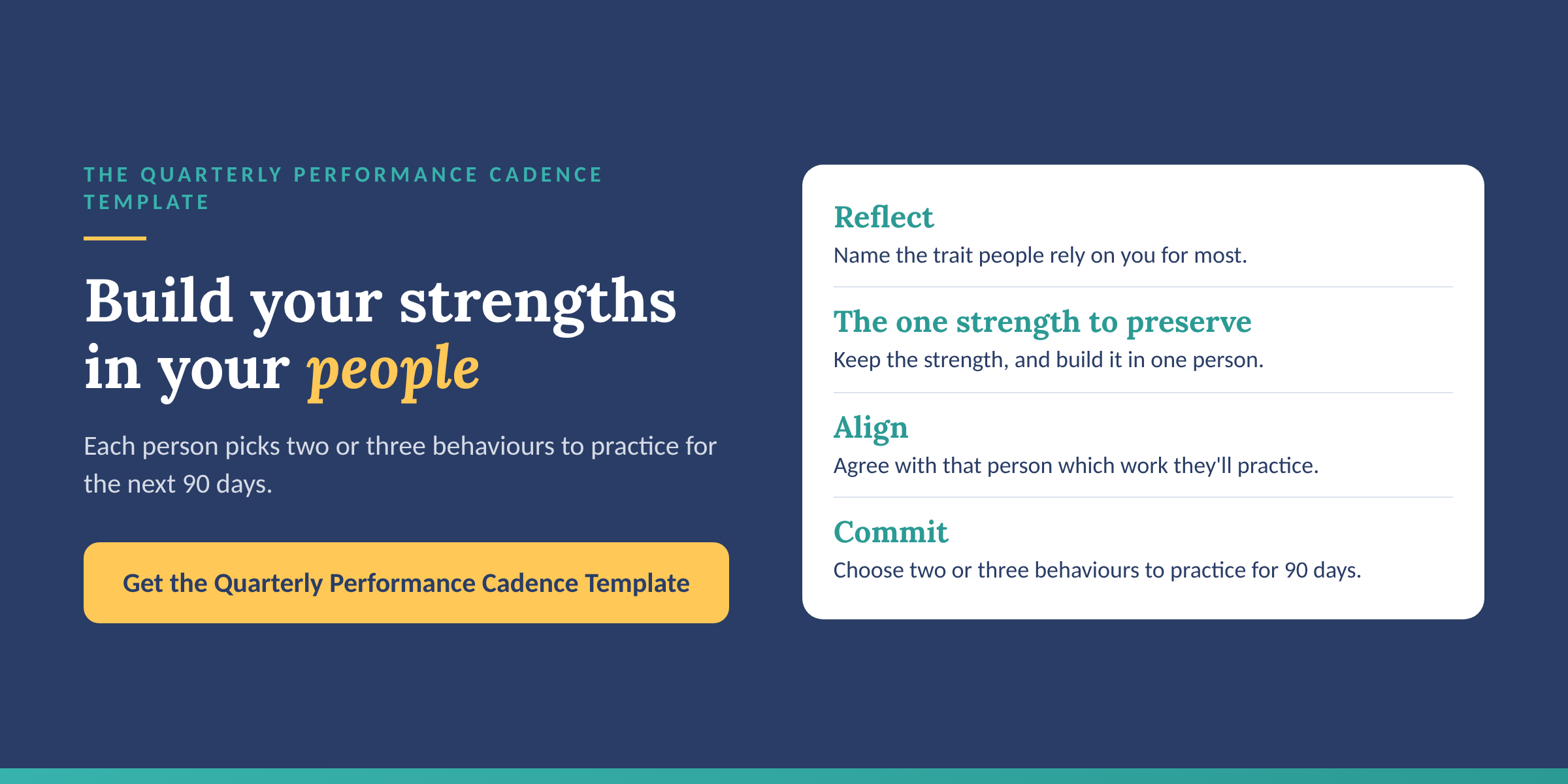
Get the free Quarterly Performance Cadence Template
What’s the difference between a trait, a behaviour and a leadership competency?
A trait is a word people use to describe you, a behaviour is what people see you do, and a leadership competency is a group of behaviours that together make up one leadership skill you can build. You can change a behaviour on purpose, which is why the fix for each trait in this post is a behaviour.
What people see day to day is what you do, such as whether you answer the question or ask your team what they think, and whether you take the file home or coach the person who owns it.
A leadership competency describes one part of good leadership as behaviours other people can see. In the LoyaltyOps Leadership Competency Model, we group those behaviours into competencies, which are leadership skills you can build, and the Leadership Competency Assessment scores you on them from your own view and from observers who work with you. Naming the competency turns “I’m the only one who can do this” into something you can practice and score again in six months.
For each trait, the video gives the behaviour that keeps the strength and builds it in your people at the same time.
LoyaltyOps educational video: Mickey Anderson, Co-Founder of LoyaltyOps, on the five traits that make a leader irreplaceable, and the behaviour to practice for each one.
What are the five traits that make you irreplaceable, and what should you do about each one?
The five traits are having the answers, stepping in to fix it, always being the one who delivers, knowing everything that’s going on, and holding the quality bar yourself. Each one got you where you are, each one costs you something as your role grows, and each one has a competency and a behaviour to practice in its place.
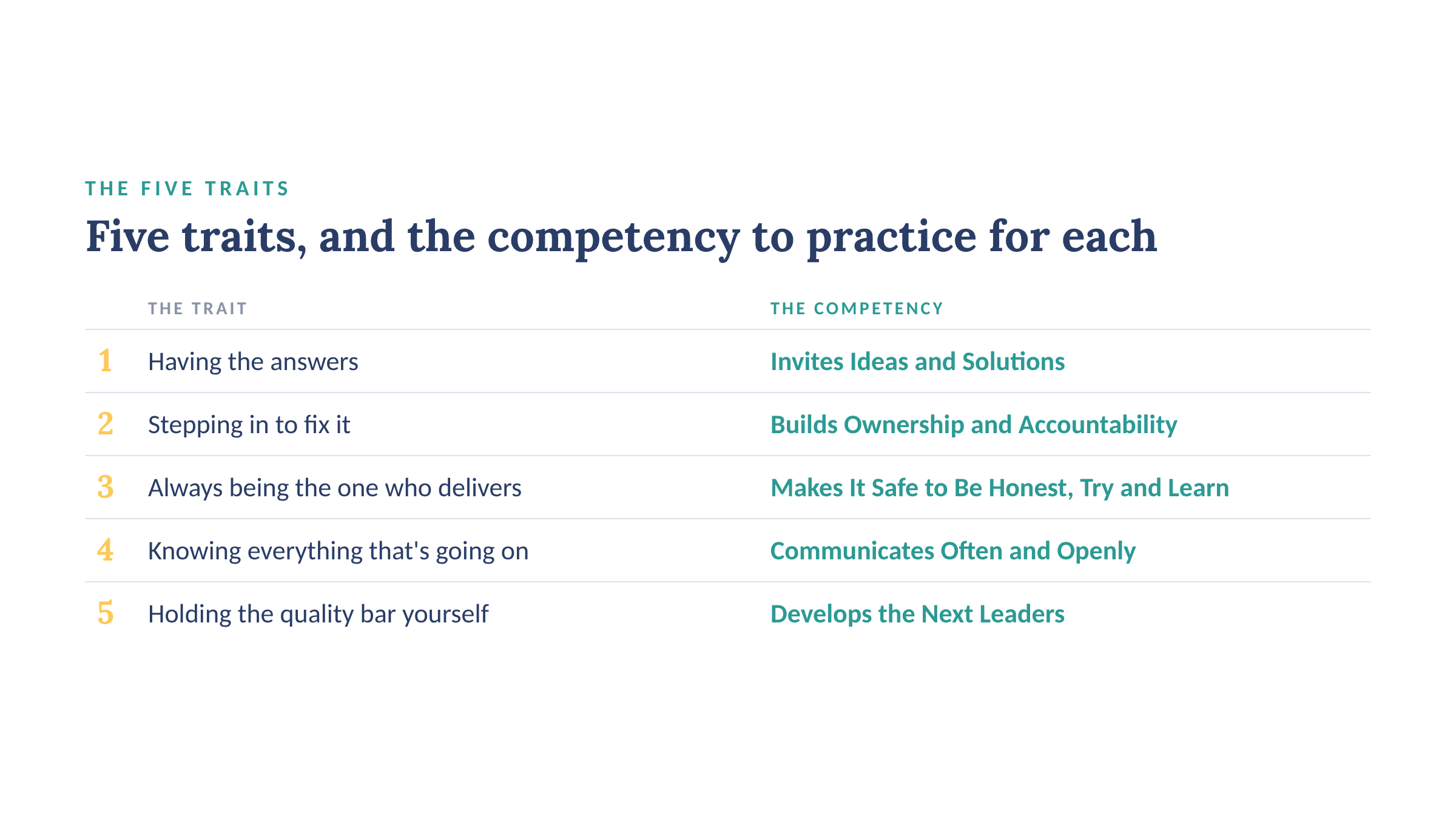
Five traits that make a leader irreplaceable, each paired with the leadership competency to practice in its place.
Trait 1: Having the answers
You’ve seen most problems before, so you can solve them fast, and for a long time that made you the most valuable person on the team. If you’re a CEO, your leadership team brings you every problem, and you end up making decisions your leaders should be making. If you’re new to leading, your people come to you every time they get stuck, and you do your own work at night. If you want the next role, nobody on your team has learned to solve the problems you solve, so nobody is ready to take on your role.
The competency is Invites Ideas and Solutions, and the behaviour is making regular time for the team to generate ideas and solve problems together. In practice, that can be one hour a month where your team picks a recurring problem and works through it together, while you ask questions and keep your own answer to yourself until everyone has had a turn. Our post on giving every decision one owner covers how to agree on which decisions your leaders make.
Trait 2: Stepping in to fix it
You care about the result; you won’t let something fail, and people trust you because of it. When someone tells you a piece of work is hard, you take it and finish it that night, and it feels like support. The next time, they send you the hard part right away because they’ve learned that’s how it works, and once a whole team learns it, you’re doing everyone’s hardest work.
The competency is Builds Ownership and Accountability, and the behaviour is coaching and supporting the person who owns the work when it gets hard, without doing the work for them. The next time someone brings you something hard, ask questions that help them work it out, and let them finish it and send it.
Trait 3: Always being the one who delivers
When the big client meeting, the board presentation or the launch comes up, it goes to you, because you’re the person everyone trusts most. If the important moments always go to you, nobody else has led one, so when you’re away or promoted, nobody is ready. If you’re a CEO, your company’s biggest relationships depend on you. If you’re a senior leader, it can be the reason you haven’t been promoted, because moving you would leave work nobody else is ready to do.
The competency is Makes It Safe to Be Honest, Try and Learn, and the behaviour is making it safe for people to practice work that’s slightly harder than what they can do today, so they get better at it. Pick someone who hasn’t led one of those moments yet and let them lead the next one. Prepare together beforehand, and talk afterward about what went well and what to try next time. If you’re working toward your next role, our post on promotion readiness covers the evidence promotion panels look for.
Trait 4: Knowing everything that’s going on
You know the history, the context and where everything stands, so people come to you to find out. When you’re the one with the context, people can’t make a good decision without checking with you first, and they hear about changes from each other before they hear them from you. If you’re new to leading, your day fills with questions only you can answer. If you’re a CEO, your leadership team waits for your read before it moves.
The competency is Communicates Often and Openly, and the behaviour is sharing where things stand on a regular schedule people can count on. That can be as simple as a short update every Monday morning on what changed last week, so people know when to expect it and can plan their week with it.
Trait 5: Holding the quality bar yourself
You know what good looks like, and you catch what everyone else misses. If the standard is only in your judgment, every piece of work needs your review before it’s done. When your feedback waits for the year-end review, people don’t learn what you’re seeing, so you’re still the only one who knows the standard.
The competency is Develops the Next Leaders, and the behaviour is coaching people in the moment, with specific and honest feedback as things happen. Right after a meeting or a draft, tell the person exactly what you saw, and ask how they want to handle it next time, so they learn the standard from you.
What’s the difference between a strength you have and a strength your organization has?
Each of the five traits is a real strength, and the trap starts when you’re the only one who has it. The leader an organization can least afford to lose is the one whose strengths live in their people.
Mickey Anderson, Co-Founder of LoyaltyOps, said in the video:
“There’s a difference between a strength you have and a strength your organization has. A strength you have goes wherever you go, and a strength your organization has keeps working while you’re away.”
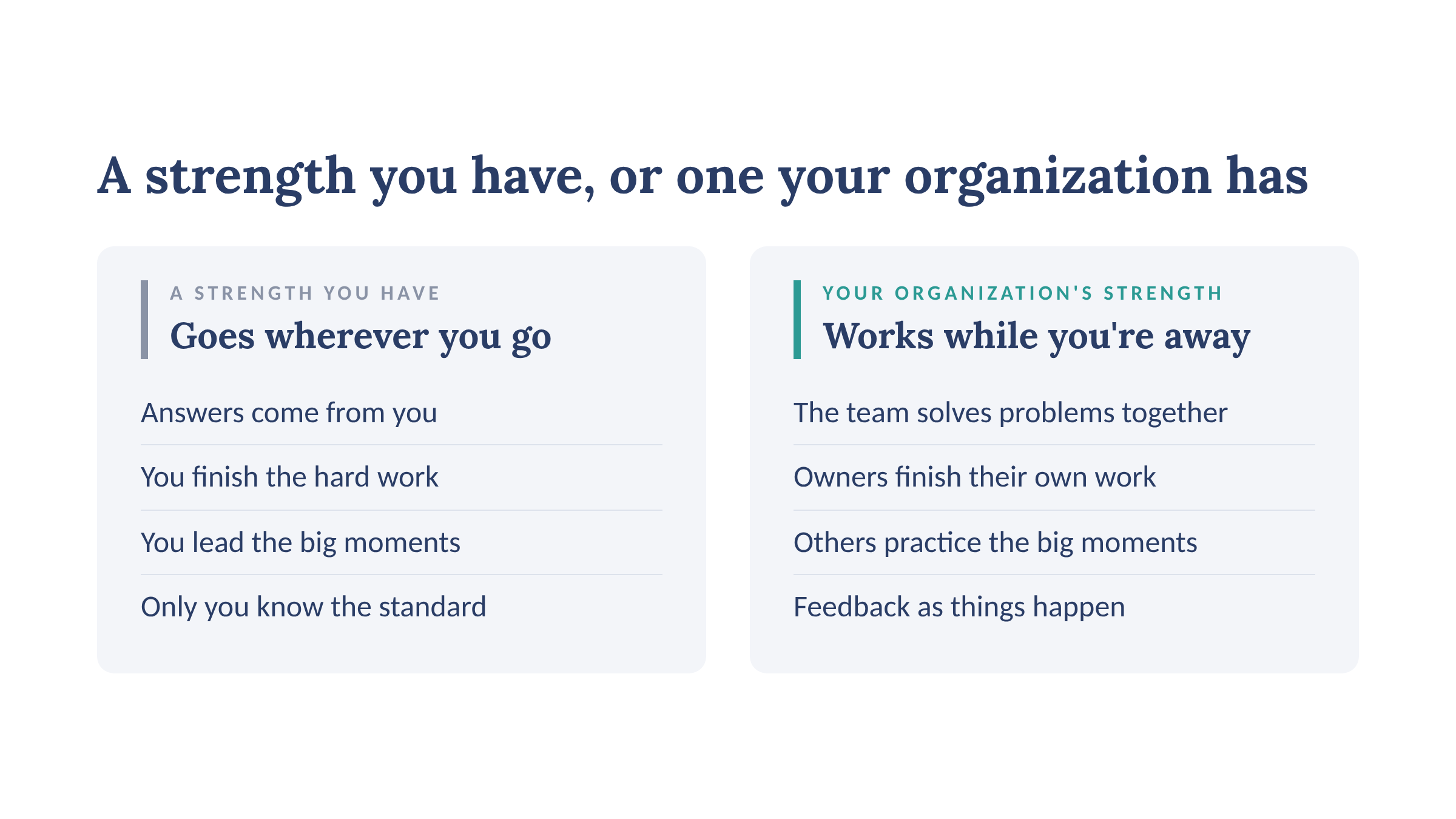
A strength you have goes wherever you go, and a strength your organization has keeps working while you’re away.
When your strengths are in your people, you’re the CEO whose company keeps growing without every decision waiting for you, the new leader whose team gets stronger every month, or the senior leader who gets promoted because someone is ready to take on your role.
What does building your strengths in your people look like in your role?
It depends on the role you’re in now and the one you want next. Your own succession planning starts with building your strengths in one or two people, well before you need anyone to take on your role.
If you’re the CEO and the company still waits for you on most decisions, leadership development for CEOs and owners shows you how to develop a leadership team that decides the way you would.
If you’re a senior leader waiting on a promotion, leadership development for senior leaders shows you which behaviours your executives need to see before they give you a bigger role.
If you’re new to leading and still doing half your team’s work, leadership development for managers and new leaders shows you how to lead so your team makes more of its own decisions.
If you lead a leadership team and several of your leaders are the people everyone relies on, Leadership Team Development develops them with you against clear leadership competencies.
What should you do this week?
Pick the trait from this video that people rely on you for most. Then choose one person, and make it safe for them to practice that work, even though it’s slightly harder than what they can do today.
Prepare together beforehand, and talk afterward about what went well and what to try next time. To keep it going after this week, the Quarterly Performance Cadence Template helps each person choose two or three behaviours to practice for the next 90 days, in four parts:
Reflect. Name the trait people rely on you for most.
The one strength to preserve. Keep the strength, and build it in one person.
Align. Agree with that person which work they’ll practice.
Commit. Choose two or three behaviours to practice for 90 days.
If you want to know how the people around you see your leadership, and where to improve first, take the Leadership Competency Assessment. You’ll see your own view beside what the people who work with you see, behaviour by behaviour.
Frequently asked questions
What does it mean to be irreplaceable at work?
Being irreplaceable at work, as a leader, means the work slows down or stops when you’re not there because the answers, decisions, context, or standard depend on you. It usually comes from real strengths, such as solving problems fast or delivering when it counts. The way out is to keep the strength and build it in the people you lead.
What is a single point of failure in leadership?
A single point of failure is anything the work can’t continue without. In a lot of growing organizations, it’s a leader’s strength, such as having the answers or holding the quality bar. To find yours, ask what would slow down or stop if you were away for two weeks starting tomorrow, then build that strength in one or two people.
How do you make yourself less irreplaceable as a leader?
Pick the strength people rely on you for most, and practice the behaviour that builds it in your people. Make regular time for the team to solve problems together, coach the person who owns hard work without doing it for them, share where things stand on a regular schedule, and give specific and honest feedback as things happen.
Be the leader people trust with more
If you’re working harder than anyone and the work still waits for you, a 30-minute discovery call helps you see what’s really causing it, what it’s costing you, and which strength to build in your people first, so you get your time back, and you’re ready for the role you want next.
Sources
DDI. “HR Insights Report 2025.” Global Leadership Forecast. Development Dimensions International, 2025. Responses from 2,185 HR professionals, including 212 CHROs, and 10,796 leaders in 2,014 organizations. https://media.ddiworld.com/research/ddi-hr-insights-report-2025.pdf
Beck, R., and Harter, J. “Managers Account for 70% of Variance in Employee Engagement.” Gallup Business Journal, April 21, 2015. From Gallup’s State of the American Manager research. https://news.gallup.com/businessjournal/182792/managers-account-variance-employee-engagement.aspx
Video: LoyaltyOps, “Why Being Irreplaceable Is a Leadership Trap,” November 24, 2026. https://www.youtube.com/watch?v=u5CkoMSFZVc