
Is Your Leadership Team a Dysfunctional Team? Seven Signs and What Each One Costs
Is Your Leadership Team a Dysfunctional Team? Seven Signs and What Each One Costs
A leadership team becomes a dysfunctional team when its leaders work for their own functions first and for the organization second. Seven signs show it, from status-report meetings to reopened decisions, and each points to a leadership competency the team hasn’t developed together. Behnam Tabrizi reported in Harvard Business Review that 75% of cross-functional teams are dysfunctional.
Key takeaways
Behnam Tabrizi reported in Harvard Business Review in 2015 that 75% of cross-functional teams are dysfunctional, and a leadership team is the most cross-functional team in your organization.
The signs usually come from leaders who were promoted for leading a function well and haven’t been developed as a team.
A leadership competency describes one part of good leadership as behaviours other people can see, so it tells a team what to develop.
Each sign points to a leadership competency, such as building a team that succeeds and fails together, and has one first move you can make this month.
Scoring every leader against the same competencies, from their own view and from observers, shows the team’s shared strengths and gaps, and where to start.
Related UNLEASHED episode: Mickey Anderson on why every leader on a leadership team belongs to two teams, and why the one they put first decides how the team works.
Agree what a commitment means on your leadership team
Reopened decisions and disagreement after the meeting usually share one cause, which is that the team hasn’t agreed what a commitment means. The free Accountability Standards Builder helps your leadership team agree what each member commits to, who owns each commitment and what happens when one slips, so a decision made on Tuesday is still the decision on Friday.
Get the Accountability Standards Builder
What do leadership competencies have to do with a dysfunctional team?
A leadership competency describes one part of good leadership as behaviours other people can see, such as making expectations clear or building ownership. Each sign of a dysfunctional team is a behaviour too, so each one points to a competency the leaders haven’t yet practiced together, and that tells the team what to develop as well as what to stop.
Our Leadership Competency Model describes ten of these competencies, and the Leadership Competency Assessment scores each leader on them, from the leader’s own view and from observers who work with them. Most leaders developed their competencies leading their own function’s people. On a leadership team, the same competency has to work with peers, and a leader can make expectations clear to their own team every week while leaving their peers guessing what they’ll deliver.
Naming the competency behind a sign also changes the conversation. “Our meetings are a waste of time” is a complaint nobody owns, while “we don’t solve problems together” is a competency the whole team can agree to practice and score again in six months.
How can you tell your leadership team has become a dysfunctional team?
You can tell by what happens between meetings as much as in them. Each of the seven signs below comes with what it costs, the competency behind it and one first move.
1. Meetings are status reports
Each leader reports on their function while the others wait for their turn, and decisions that need two or three functions get moved to next week or sent to the CEO.
What it costs: The team’s time goes to information that could be read in a written update, and the decisions only this team can make keep waiting.
Competency behind it: Invites Ideas and Solutions. On a leadership team, each leader brings problems to their peers, asks for their ideas and solves cross-functional problems with them.
First move: Ask for updates in writing before the meeting, and open the agenda with the two or three decisions that need more than one function.
2. Decisions get reopened
A decision made on Tuesday comes back on Thursday because a leader who said nothing in the meeting has found a reason it won’t work for their function.
What it costs: The teams that report to each leader wait to act, or act and then redo the work.
Competency behind it: Builds a Team That Succeeds and Fails Together. Leaders commit to a decision as a team once it’s made, including one they argued against, and share the result.
First move: Before a decision closes, ask each leader to say whether they’ll commit to it, then record the decision, its owner and the date the team will review it.
3. Leaders defend their function first
Leaders argue for their own budget, headcount and targets, and every trade-off between functions turns into a negotiation.
What it costs: Money and people follow whoever argues hardest, and the organization’s biggest objectives lose to each function’s own goals.
Competency behind it: Sets Clear Direction. Every leader can say what matters most for the whole organization right now and why, so each trade-off has an agreed test.
First move: Agree the organization’s two or three biggest objectives before anyone presents a functional plan, and judge every trade-off against them. Our post on the two teams every leader belongs to covers how to make the leadership team each leader’s first team.
4. Issues go to the CEO instead of each other
When two leaders disagree, each takes the issue to the CEO separately, and the CEO becomes the only place where cross-functional problems get settled.
What it costs: The CEO’s week fills with problems two peers could solve, and decisions move at the speed of one person’s calendar.
Competency behind it: Builds Ownership and Accountability. The CEO leaves each issue with the leaders who own it, and those leaders resolve it with each other before asking for help.
First move: When a leader brings you a cross-functional issue, ask whether they’ve raised it with the other leader yet, and if not, ask them to start there.
5. People hear about decisions at different times
One function hears about a decision the same afternoon, and another hears two weeks later, sometimes from a client.
What it costs: Teams act on different information, and the decision gets questioned again.
Competency behind it: Communicates Often and Openly. Each leader shares the team’s decisions with their people consistently and promptly, so everyone knows where things stand.
First move: End every leadership team meeting by agreeing what each leader will tell their team, in the same words and by the same date.
6. Disagreement happens after the meeting
The meeting ends in apparent agreement, and the real conversation starts afterward in hallways and private messages.
What it costs: Decisions look settled when they aren’t, and the leaders who disagreed quietly don’t commit to them.
Competency behind it: Makes It Safe to Be Honest, Try and Learn. Leaders feel safe to raise a concern in the meeting, while it can still change the decision.
First move: Before a decision closes, ask the leader who has said the least for their biggest concern, and thank the first person who disagrees openly.
7. No one can say what good leadership looks like on this team
Ask each leader what’s expected of them as a member of the leadership team, separate from their function, and you get different answers or none.
What it costs: Leaders can’t hold each other to a standard nobody wrote down, so feedback between peers is rare.
Competency behind it: Lives the Standards First, with Makes Expectations Clear. The team agrees what’s expected of each member, and every leader follows that standard before asking anyone else to.
First move: Agree three to five behaviours the team expects of every member, such as raising disagreement in the meeting, and review them as a team once a quarter.
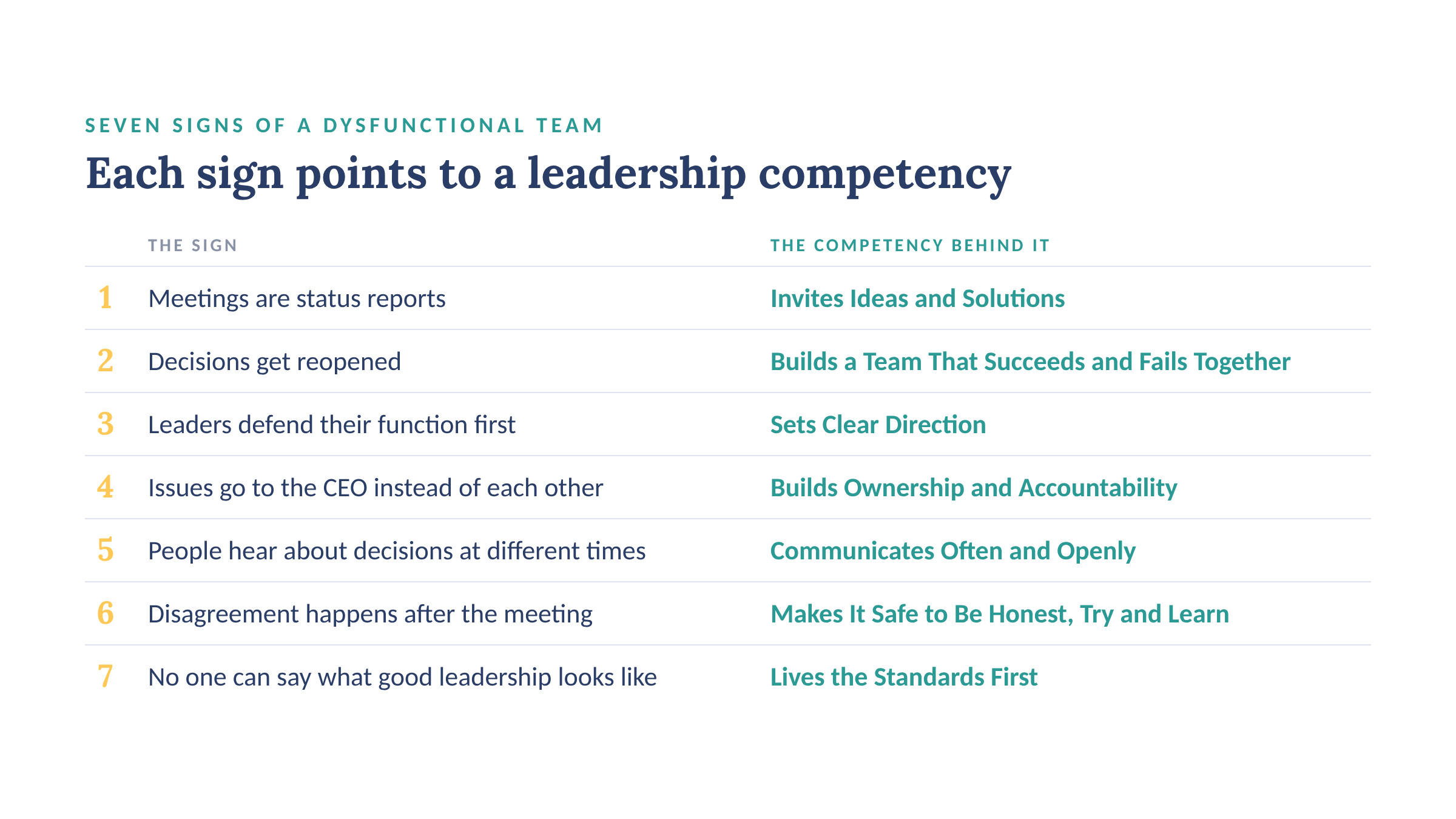
Seven signs of a dysfunctional team and the leadership competency behind each, from status reports to unclear standards.
Why do strong leaders make a dysfunctional team?
Strong leaders often make a weak leadership team because they were promoted for leading a function well, and nobody developed them to lead the organization together. The habits that built each function, such as protecting its people and delivering its numbers, are the same habits that cause the seven signs when those leaders meet as a team.
Patrick Lencioni names building a cohesive leadership team as the first of four disciplines of a healthy organization in his book The Advantage (Jossey-Bass, 2012). He also describes the first team idea: each leader’s first team is the leadership team of their peers, and the function they lead is their second team.
Gallup’s September 2026 article “How to Improve Leadership Alignment” lists six common sources of misalignment on a leadership team: unclear behavioural expectations, a lack of communication in leadership (no effective forum to raise and resolve disagreements), inconsistent accountability, ethical dilemmas, leadership changes and misunderstandings about how leaders work.
Cross-functional work shows the same strain. Behnam Tabrizi, writing in Harvard Business Review in June 2015 about his research into what makes cross-functional teams succeed, reported that 75% of cross-functional teams are dysfunctional. Your leadership team is the most cross-functional team you have.
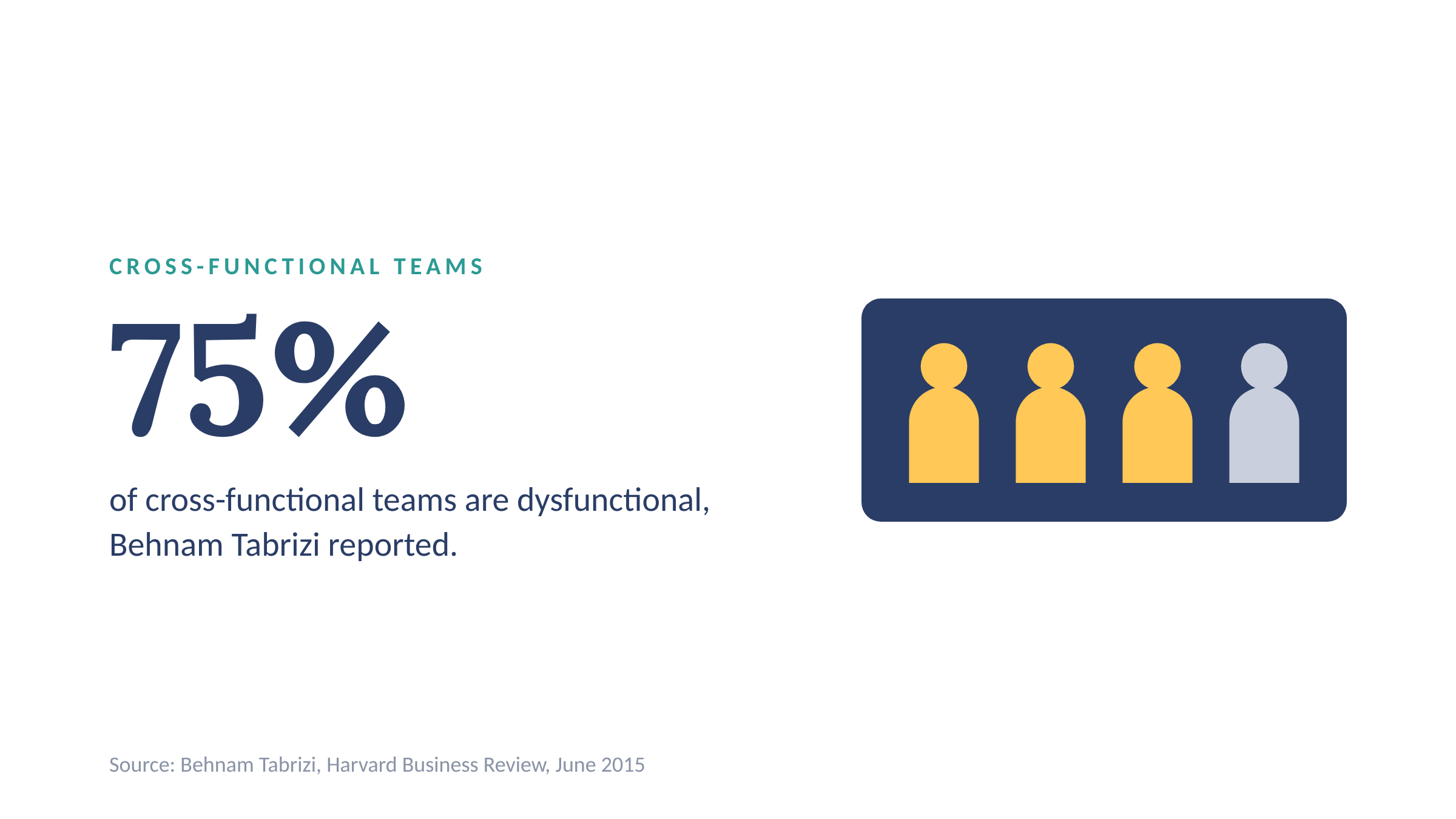
Behnam Tabrizi reported in Harvard Business Review in 2015 that 75% of cross-functional teams are dysfunctional.
What does a dysfunctional team look like in an organization of 30 to 300 people?
In an organization of 30 to 300 people, the signs usually appear as decisions waiting for the CEO. At this size one person can still settle most cross-functional issues, and the leaders often get along well, so the team’s habits can go unnoticed until the organization grows past what one person can decide. Our post on the difference between a good team and a team that executes covers why a team people like working on can still struggle to deliver.
How do you fix a leadership team that doesn’t work together?
Start by scoring the team against the leadership competencies behind the signs, choose the one or two gaps that cost the most, and agree a standard for each as a whole team. Then develop the leaders as a team over months, because the habits behind the signs took years to form.
1. Score the team against the competencies
Scoring every leader against the same competencies shows the team’s shared strengths and where the gaps are. Our Team Assessment, part of the Leadership Competency Assessment, does this for every member of the leadership team, and the results show which signs have a competency gap behind them. For a quick start, ask each leader to mark privately which of the seven signs they see, then compare answers.
2. Pick one or two gaps to work on first
Choose the gaps whose signs cost the most time or rework, often Builds a Team That Succeeds and Fails Together, behind reopened decisions, or Builds Ownership and Accountability, behind issues going to the CEO.
3. Agree the standard together
Write down what the team will do differently, drawn from the competency you chose and in behaviours anyone could see, such as each leader saying whether they commit before a decision closes. Every leader agrees to it, including the CEO, and the team reviews it at the end of each meeting for the first month and then once a quarter.
4. Develop the leaders as a team
A standard changes the meeting, and the leaders’ habits change through practice between meetings with someone who notices and gives feedback. Our Leadership Team Development works with the whole leadership team on the competencies where its scores show gaps, with the Team Assessment at the start and the end so the team can see what changed.
Frequently asked questions
What are the signs of a dysfunctional leadership team?
Seven signs are common: meetings are status reports, decisions get reopened, leaders defend their function first, issues go to the CEO instead of each other, people hear about decisions at different times, disagreement happens after the meeting, and no one can say what good leadership looks like on the team. Each one points to a leadership competency the team hasn’t yet developed together.
Why do strong leaders make a weak leadership team?
Strong leaders are usually promoted for leading a function well, and few are developed to lead the organization together with their peers. The habits that built their function, such as protecting its people and its numbers, cause reopened decisions and function-first arguments when they meet as a team. Patrick Lencioni’s book The Advantage calls building a cohesive leadership team the first discipline.
What leadership competencies does a leadership team need?
A leadership team needs every member to practice the same leadership competencies with their peers that they practice with their own people. The ones most often behind a dysfunctional team are setting clear direction, communicating often and openly, making it safe to be honest, building ownership and accountability, and building a team that succeeds and fails together.
How do you fix a leadership team that doesn’t work together?
Score each leader against the same leadership competencies, from their own view and from observers who work with them, to see the team’s shared strengths and gaps. Pick the one or two gaps that cost the most, agree a standard for each in behaviours anyone could see, and develop the leaders as a team over months, with a second assessment at the end.
Should the CEO be on the leadership team?
In most organizations, the CEO leads the leadership team and is a full member of it. The team tends to work best when the CEO joins cross-functional decisions as one voice among peers and settles only the decisions the team can’t reach, so leaders bring issues to each other first and to the CEO when they can’t agree.
Find out which signs your leadership team shows
If decisions keep coming back to you, or getting reopened after everyone agreed, a conversation with us can help you see which of the seven signs apply to your leadership team and where to start. LoyaltyOps is a leadership development firm that develops individual leaders and leadership teams against clear leadership competencies, so performance improves across your organization.
Sources
Gallup. “How to Improve Leadership Alignment.” September 24, 2026. The page shows no author. https://www.gallup.com/workplace/715013/leadership-alignment-at-work.aspx
Tabrizi, B. “75% of Cross-Functional Teams Are Dysfunctional.” Harvard Business Review, June 23, 2015. https://hbr.org/2015/06/75-of-cross-functional-teams-are-dysfunctional
Lencioni, P. The Advantage: Why Organizational Health Trumps Everything Else in Business. Jossey-Bass, March 20, 2012. Publisher’s page: https://newsroom.wiley.com/press-releases/press-release-details/2012/The-Advantage-Why-Organizational-Health-Trumps-Everything-Else-In-Business/default.aspx
•Related episode: UNLEASHED by LoyaltyOps, “Every Executive Has Two Teams,” September 10, 2026. https://youtu.be/TTXxza6jtHI