
The 90-Day Operations Plan: 3 Foundations First
The 90-Day Operations Plan: The Three Foundations to Build First
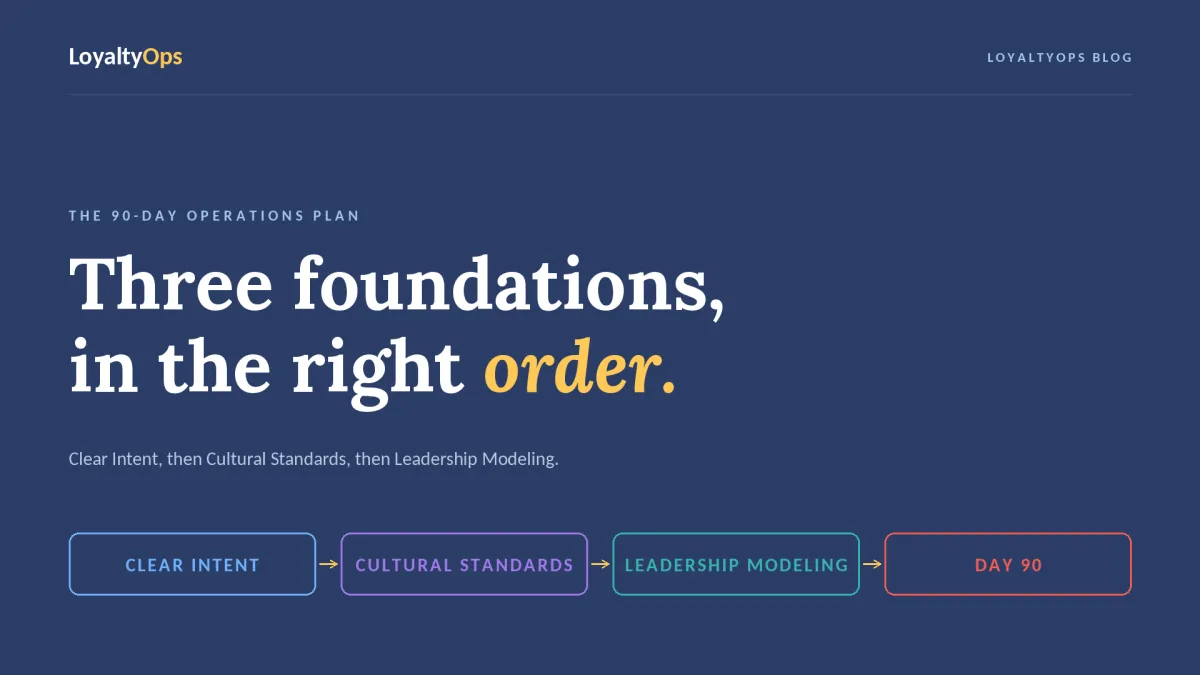
When the way your team works falls behind the business, everything looks like it needs fixing at once, and most leaders either freeze or start with whatever feels most urgent. There's an order that works better. The 90-day operations plan builds three foundations, thirty days each, in the order that makes each one work: Clear Intent, then Cultural Standards, then Leadership Modeling. This is the method we start with at LoyaltyOps, and here's the full plan.
What is the 90-day operations plan?
It's a simple sequence for building the operations your team runs on, over your first ninety days. Operations are the clear standards for how your team actually works day to day: how a decision gets made, how a problem gets raised, how work moves from one person to the next. When those standards live only in your head, the work keeps coming back to you. The 90-day plan builds the first three of them into something the team can use without you.
You spend thirty days on each foundation. At the end of ninety days, you have the base everything else is built on: a team with clear direction, standards it can act on, and a leader who lives those standards in the open.
Why not fix everything at once?
When there's a lot to build, splitting your attention across all of it means nothing gets built well enough to last. And starting with the most urgent gap, meetings one week, accountability the next, works for a little while and then goes back to how it was, because the foundation it needed was never built.
The plan avoids both by building in an order where each foundation gives the next one something to build on. That order is the whole point, so it's worth walking through each foundation and why it comes when it does.
The three foundations, in order
Days 1 to 30: Clear Intent
Clear Intent is four short statements, in plain words, that name your direction: who we are, what we do, why we do it, and where we're going. The military calls the idea Mission Command: give people enough clarity of purpose that they can make the right decision in the moment without waiting for orders.
The test is the One Breath Rule: each statement fits in a single breath, with no buzzwords. What you do this month: each leader drafts the four statements alone, then you compare where the language differs and refine until it's memorable. Test it by asking employees to repeat it the next day, then put it into onboarding and meetings so it stays in use.
Days 31 to 60: Cultural Standards
Most teams have values on a wall that no one can act on. Cultural Standards takes three to five of the values you already use and runs each one through the same chain: the value (the word your team already uses, like accountability or craft), a plain definition that starts with "At our company, this means," a heuristic (a short, sayable phrase of three to eight words people actually quote, like "Own the outcome"), and the behaviors (one to three that match the standard and one to three that break it). If a camera could record it, you've written it well.
What you do this month: pick three to five values, have each leader write a one-sentence definition alone, then compare. If the definitions differ, the value needs work. Build the heuristic and the behaviors for each, and cap the list at five. A few standards the team actually uses are worth more than a long list no one does.
Days 61 to 90: Leadership Modeling
Your team copies what you do, and your consistency is what tells them a standard is real. Leadership Modeling is two or three observable behaviors you live in your own decisions for thirty days before you ask the team to pick them up. Four practices make it work: use the standard without exception in your own meetings and decisions, say it out loud in at least one interaction a day so the language spreads, meet the same expectation you're asking of others, and keep the standard when the week gets tight, because the team watches what happens then.
What you do this month: name two or three behaviors that pass three checks, a camera could record it, you can keep it even in your hardest week, and it fits your Clear Intent and Cultural Standards. Run the daily check for thirty days, then extend the behaviors to the team.
Why does this order matter?
Direction comes first, because a standard with no direction to serve is just a rule, and a behavior you model with no direction behind it doesn't tell the team where it's headed. Once the direction is named, your standards have something to make concrete. Once the standards exist, your own behavior has something specific to model. Build them out of order, and the later pieces have nothing to connect to. That's why so many improvement efforts stop working: they start with a later piece, a behavior or a rule that had no foundation built for it yet.
How do you start in one hour this week?
You don't need the whole ninety days planned to begin. Block one hour this week and draft your Clear Intent: answer who we are, what we do, why we do it, and where we're going, in plain words, each short enough to say in a single breath. Then ask three people on your team to read it and say it back the next day. If they can't repeat it, simplify until they can. That's day one of ninety.
What comes after day 90?
With Clear Intent, Cultural Standards, and Leadership Modeling in place, your team has direction, standards it can act on, and a leader who lives them. That's the foundation. What comes next is the Leadership Operating Flywheel: how the team communicates, brings problems forward, makes decisions, and improves, built one stage at a time. The three foundations are what make the Flywheel stick, which is why they come first.
Download the free 90-Day Operations Starter
We put the full plan into a short guide, the 90-Day Operations Starter. It walks through all three foundations, what to build in each thirty-day block, and the exact first step to take this week. It gives you the order, so you know where to begin and why each piece comes when it does.
→ Download the free guide: loyaltyops.com/operations-starter-page
If you want to build these foundations with a room of leaders working through the same first ninety days, that's the work inside the Leaders Mastermind (loyaltyops.com/leaders).
FAQ
What is a 90-day operations plan?
It's a sequence for building the operations your team runs on over ninety days, thirty days per foundation. The LoyaltyOps version builds three foundations in order: Clear Intent (your direction), Cultural Standards (your values turned into behaviors), and Leadership Modeling (you living those standards before the team is asked to).
Why these three foundations, and why this order?
Direction has to come before standards, and standards before modeling, because each one gives the next something to build on. A standard with no direction behind it is just a rule, and a behavior you model with no standard behind it has nothing specific to it. The order is what makes each piece last.
How is this different from a new-manager 30-60-90 day plan?
A new-manager plan is about learning a role you just joined. This plan is about building the operations of a team you already lead, so the work stops coming back to you. It builds specific foundations rather than mapping a personal onboarding.
Can I start before I've planned all ninety days?
Yes. You start with one hour this week, drafting your four Clear Intent statements and testing whether three people can repeat them the next day. You build the rest thirty days at a time.
What happens after the first ninety days?
You build the Leadership Operating Flywheel, the four-stage system your team runs on day to day. The three foundations from your first ninety days are what make the Flywheel last, so they come first.