
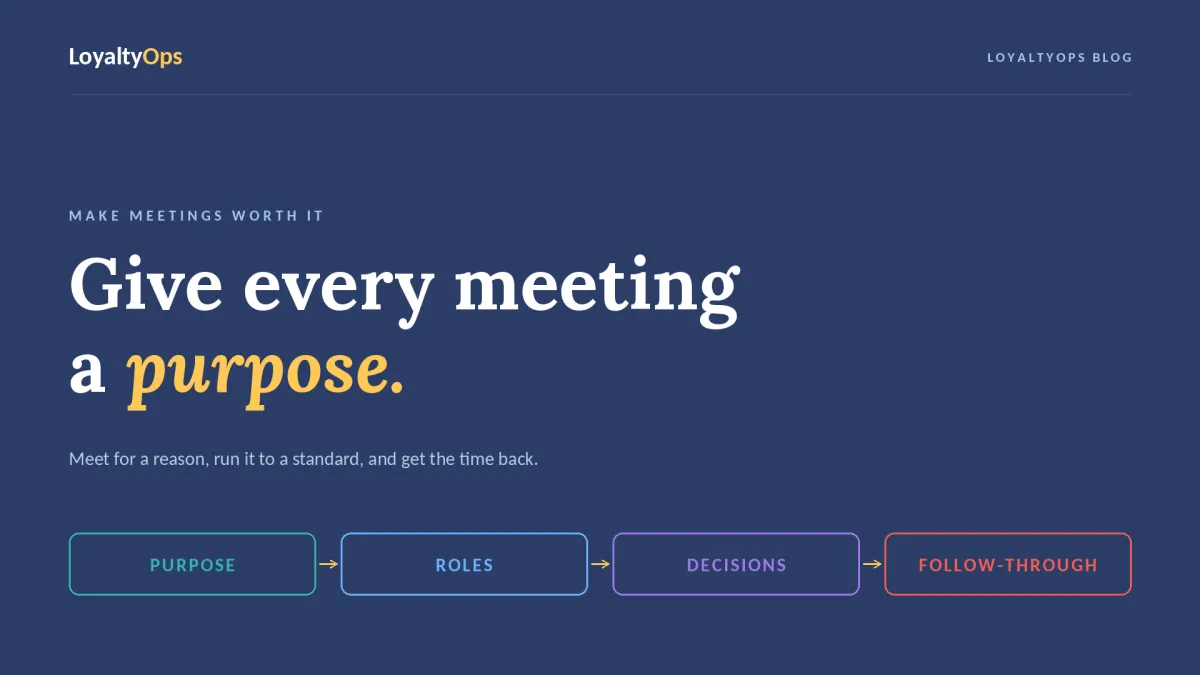
How to Run Effective Meetings (Most Shouldn't Exist)
Most of Your Meetings Shouldn't Exist
Most advice on how to run effective meetings starts with the agenda. Useful, but it skips the more important question, which is whether the meeting should happen at all. On most teams, the real problem isn't that meetings are badly run; it's that far too many of them exist in the first place, and they fill the week until there's little time left to do the work those meetings are about. Run meetings well, and you get better meetings. Ask which ones deserve to exist, and you get your time back. Here's how to do both.
Being busy in meetings isn't the same as doing the work
On most teams, meetings multiply on their own. A recurring sync gets added, a new project starts another standing call, and within a few months everyone's calendar is full of meetings and short on time to do the work. It's easy to mistake a full calendar for a productive one, but a week packed with meetings can go by without the business actually advancing, because being busy in meetings isn't the same as doing the work.
The cause is simple: meetings are easy to add and awkward to cancel, and the team rarely stops to ask whether a given meeting still needs to happen. So they accumulate, and the hours for real work quietly shrink.
The test most meetings fail
The fix starts with one question, asked before the invite goes out: why do these people need to be together? A meeting passes only when there's a real reason for it, usually an opportunity the team wants to move on or a problem or risk it needs to handle, and when the work genuinely calls for people to align, coordinate, or decide together in a way they couldn't apart.
Most standing meetings don't pass, because they were scheduled once and never questioned since. So name the purpose before you schedule a meeting, invite only the people it needs, and if you can't name a purpose, cancel the meeting or replace it with a written update, because a message does the same job without taking an hour from everyone.
Meet for a reason, then protect the reason
Meetings are for the work a group has to do together: building a shared understanding, coordinating across people, solving a problem in real time, or making a decision that genuinely needs the group. Anything that doesn't need that shared time is better handled another way.
Once a meeting has earned its place, structure is what keeps it worth the hour. The rest of this method is that structure: two roles, a named decision type for each decision, and a clean close. None of it is heavy, and all of it protects the purpose you set.
Two roles keep a meeting on purpose
You assign two roles before the meeting starts, and you keep them with different people.
The facilitator runs the agenda and keeps the conversation focused, on time, and on the purpose you set. This isn't automatically the most senior person; running a meeting well is its own skill, and the role can rotate.
The scribe owns the notes. They pull the agenda and briefing together beforehand and send them out at least a day ahead, then capture decisions and action items during the meeting, usually straight into your project tools. An AI notetaker can assist, but it doesn't do this job for you.
Keep the two roles with different people. Running the conversation and writing it down at the same time is too much for one person, and when you ask someone to do both, one of them slips.
Name how each decision gets made
Decisions are where meetings often stall, because people argue the decision without agreeing on how it will even be made. The fix is to name the decision type out loud before you decide. There are four:
Collective. Everyone gets a vote.
Informed. One person decides, with input from others.
Independent. One person decides.
Escalated. The decision is passed to a specific person to make, usually someone more senior.
Naming the type takes seconds and clears up most of the confusion about who is actually deciding, so the meeting keeps moving instead of stalling on the same point. It also prevents the quiet problem where everyone thinks they had a vote and only one person did, or the reverse.
Close it out, and give the time back
A meeting is worth the time only if what happened in it turns into action afterward, so close every one the same way. Confirm the decisions, give every commitment a named owner and a due date, and agree on any check-ins where someone will brief the work back so questions and wrong assumptions come up early. End on time. Afterward, the scribe finalizes the notes and sends them to everyone within a day, with decisions and tasks added to your project tracker so they're visible and owned.
Run meetings like this and two things change at once. Each meeting gets shorter and sharper, because it has a purpose and a structure. And the total number of meetings drops, because the many that never needed to exist stop getting scheduled. That's how you get time back for the work, and how meetings start moving the business forward instead of filling the week.
Where meeting standards fit
Good meetings aren't a standalone trick; they're where two parts of how your team operates show up in the same room. A well-run meeting is how the team communicates and how it commits: people leave with a shared understanding and with decisions that have clear owners. That's why meeting standards are one of the operational tools of the Leadership Operating Flywheel, the four-stage system your team runs on. Strong meetings make the Communicate and Commit stages real, week after week.
Download the free Meeting Standards Checklist
We put all of this into the Meeting Standards Checklist, a one-page list you run a meeting against from before it starts to after it ends. It covers the purpose and attendees, the two roles, the four decision types, and the close-out that turns the meeting into action.
→ Download the free checklist: loyaltyops.com/meeting-standards
If you want to build meeting standards alongside a room of other leaders raising the bar on how their teams run, that's part of the work inside the Leaders Mastermind.
FAQ
How do I run effective meetings?
Start by asking whether the meeting should exist at all: can the group name a real reason to be together? For the meetings that pass, give each a clear purpose, assign a facilitator and a scribe, name the decision type for each decision, and close with every commitment owned and dated. Fewer, sharper meetings beat more, longer ones.
Why do we have so many meetings?
Because meetings are easy to add and awkward to cancel. Recurring invites run by default, and teams rarely question whether a meeting still needs to happen, so they pile up until there's little time for the work. Putting each recurring meeting to a purpose test is how you thin them out.
What are the four decision types in a meeting?
Collective (everyone gets a vote), Informed (one person decides with input from others), Independent (one person decides), and Escalated (the decision is passed to a specific person, usually more senior). Naming the type before you decide keeps the meeting from stalling on who actually decides.
Why should a meeting have a facilitator and a separate scribe?
Because running the conversation and writing it down are each a full job, and doing both at once means one slips. The facilitator keeps the discussion focused and on time; the scribe captures decisions and action items. Keeping them separate, and rotating both, builds the skills across the team.
What is the LoyaltyOps Meeting Standards approach?
It's a purpose-first way to run meetings: meet only when there's a real reason, run the ones that earn their place with clear roles and named decision types, and close each one into action. The result is fewer, shorter meetings and hours back for the work.