
Why Work Comes Back to You: Free Field Guide
The "Why Work Comes Back to You" Field Guide: Find Your Gap in One Week
If the work you hand off keeps coming back to you, there's usually a specific reason, and you can find yours in one week of watching for it. The free field guide Why the Work Keeps Coming Back to You is the tool that helps you do it. Here's exactly what's inside and what you'll be able to do after you read it.
What is the guide?
It's a short LoyaltyOps field guide, eight pages, that explains why work returns to you and helps you find the one gap costing you the most time right now. It's built for the leader of a growing team who hired people so the work would stop running through them, and who's still the one catching what falls.
You can read it in one sitting and start using it the same week. There's no course to work through and no sign-up marathon, just the four gaps and a simple way to find yours.
What's inside the guide?
The guide walks through six short sections:
The problem you keep living — the handful of ways reverse delegation shows up in your week.
Why hiring, meetings, and tools haven't fixed it — why the three usual responses leave the cause in place.
The real reason the work comes back — how the standards for your team ended up living in your head.
The one-week comeback log — the tracker you use to find your own pattern.
What changes when it stops — the week you get back when the standards are built.
Where this fits, and what comes next — how you build the operations, one standard at a time.
The tool at the center: the one-week comeback log
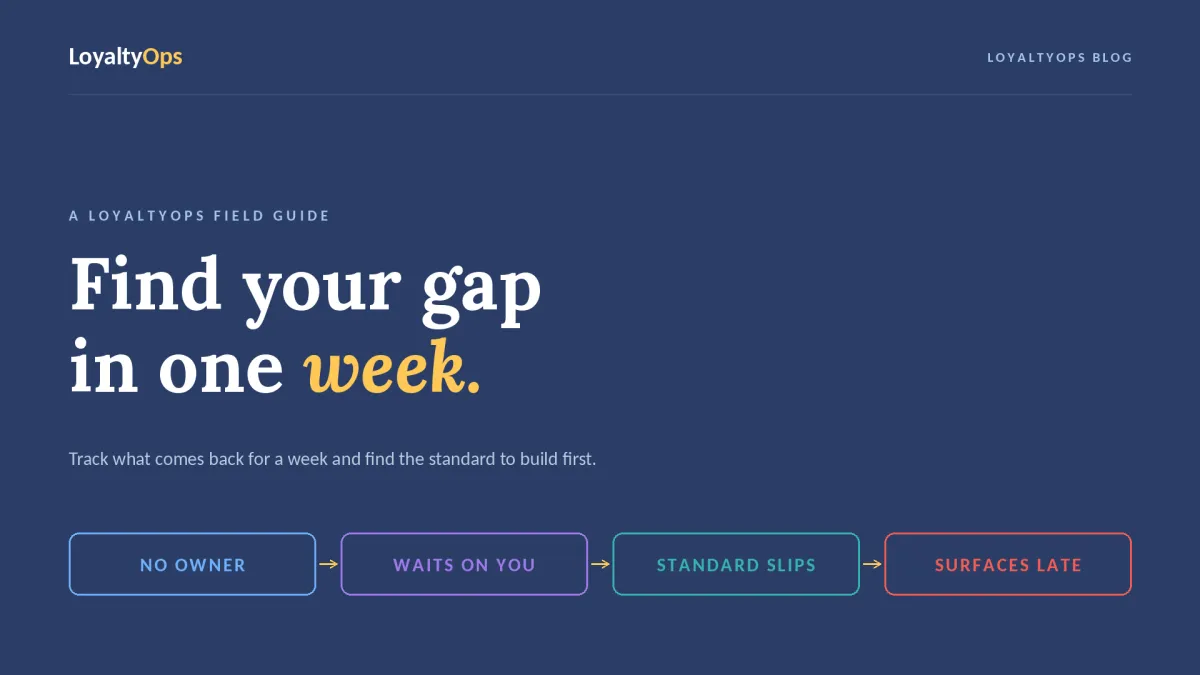
The heart of the guide is a simple tracking table you use for one week. Every time something you thought was handled comes back to you, you write down what it was and mark which of four gaps it came through:
No owner — no single person owned it across team lines.
Waited on me — the decision came up to you instead of being made closer to the work.
Standard slipped — what you set didn't survive the week.
Surfaced late — the problem reached you after it had already grown.
At the end of the week, the column with the most marks is the gap costing you the most time. That's where building one standard gives you back the most hours, and the guide points you to exactly that.
A quick example
Say you track your week and, by Friday, four of your seven marks are in the "Waited on me" column. Decisions your team is capable of making kept coming up to you: which vendor to use, how to handle a client request, whether to greenlight a small spend. The pattern is clear. Your biggest gap is decisions waiting for you.
Your first step comes straight from the guide: name the one decision standard the team is missing, decide who owns those decisions and what they need to decide, and put the right people in the room to set it. One standard, one gap, and the decisions that used to come up to you stay with the team that's closest to the work.
What does building one standard look like?
The guide points you to a gap, and the fix is always one concrete standard the team can see and use. A few examples of what that looks like in practice:
For "no owner across team lines," the standard names one person accountable for the whole path of a cross-team project, start to finish, so it has an owner even where two teams meet.
For "decisions wait for you," the standard writes down which decisions the team owns and what they need in hand to make them, so those decisions get made close to the work.
For "standards slipped," the standard turns a spoken expectation into a short written one the team can point to, so it shows up the same way when you aren't in the room.
Each one is small, specific, and something the team can start using the same week. You're not rebuilding how the team works. You're building the single standard behind the gap that costs you the most, and the guide shows you which one that is.
How do you use the guide with your team?
Two ways, and both take under an hour. On your own, read it, run the one-week log, and build the standard behind your most common gap. That's the fastest way to start.
With your team, share the four gaps and ask each person where they see the work coming back. Your team usually feels the same gap you do, and naming it together makes the standard easier to build, because everyone already agrees on where to start.
What will you be able to do after reading it?
By the end of the week, you'll be able to name which of the four gaps sends the most work back to you, point to the exact standard your team is missing, and decide who needs to be in the room to build it. That's a concrete first operation, not another framework to file away. And because you'll have watched your own week rather than guessed, you'll be able to explain to your team exactly why that standard matters, using real examples from the days you just tracked.
Who is the guide for?
It's for the capable leader of a growing team, roughly under thirty people, who hired good people and is still the one keeping the work on track. If you're busy all day and the work you handed off keeps returning, the guide is built for your situation. It doesn't blame the team, because the team was never the cause; it helps you build the standards the team has grown past.
Get the guide and find your gap this week
Find the gap that sends the most work back to you. → Download the free field guide
Track what comes back for one week, name the standard your team is missing, and build it first. That's where you get the most of your week back.
→ Get the guide: loyaltyops.com/work-comes-back
FAQ
Is the Why the Work Keeps Coming Back to You guide really free?
Yes. It's a free download at loyaltyops.com/work-comes-back, with no course to buy. Read it once and you can start the one-week log the same day.
How long does it take to use?
A few minutes to read, then one week of quick notes using the comeback log. You'll have your answer by the end of that week.
What is the one-week comeback log?
It's a simple tracking table. For one week, every time work comes back to you, you note it and mark which of the four gaps it came through. The gap with the most marks is the one to fix first.
What do I do after I find my gap?
Name the single standard your team is missing behind that gap, decide who owns it, and put the right people in the room to set it. The guide walks you through that first step.
How is this different from a generic delegation guide?
A generic guide tells you to delegate better. This one shows you the four specific gaps that send delegated work back and gives you a one-week way to find which one is costing you the most, so you fix the cause instead of trying harder.