
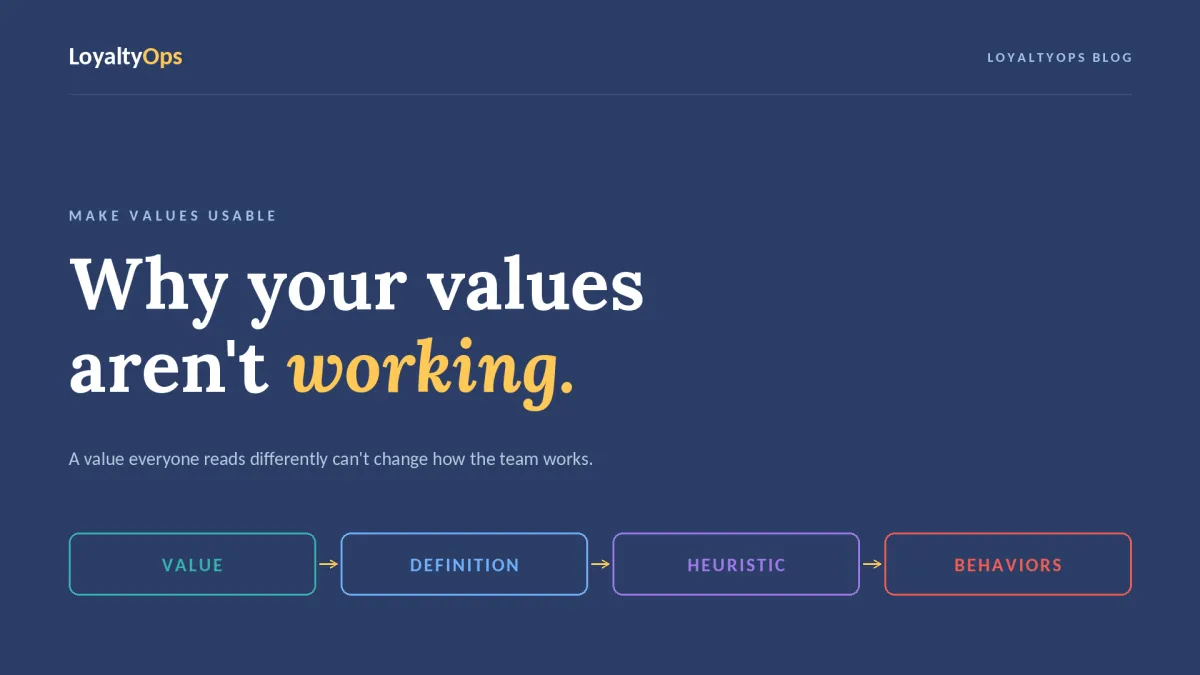
Why Company Values Don't Work (and How to Fix It)
Why Your Company Values Don't Change How Anyone Works
Most teams have a set of values. They're on a wall, in the handbook, maybe on the careers page. And for most teams, they change how people actually work almost not at all. If that's true for you, it isn't a sign that you picked the wrong values or that your team doesn't care. It's a sign of something more specific, and it's fixable.
Here's why company values so often do nothing, and what to do instead.
Why don't our company values work?
Try this. Ask five people on your team what one of your values means in practice, separately. If you get five different answers, you've found the problem. A word like accountability or teamwork means something different to everyone who reads it, so each person acts on their own version of it, certain they're living the value.
That's how culture quietly breaks down. Two people both believe they're being accountable, and they do two different things, because the word pointed them in two directions. The value didn't align them, because a word on its own can't. It only sounds like it should.
The real problem: one word, many meanings
A value written as a single word is an invitation to interpret. "We value ownership" feels clear when you write it, because you know exactly what you mean. But the person reading it fills in their own meaning, and so does the next person, and the gaps between those meanings grow as the team grows.
A clear standard works like a filter for decisions: people can tell what it rules in and what it rules out. A vague value does the opposite, because everyone reads into it whatever they already wanted to do. The value ends up agreeing with everyone, which is another way of saying it guides no one.
Isn't the fix to define our values better?
Partly, but not the way most teams try. The usual move is to add a sentence or two of description, and that helps a little, but it still leaves the value as an idea rather than an action. People nod at the idea and then go do what they were going to do anyway.
The real fix is to take the value all the way to behavior, the specific thing a person does that you could actually watch. A value only becomes useful when it stops being a word and becomes something anyone on the team can see. That's the difference between a value people admire and one they use.
The fix: turn a value into a behavior anyone can see
You can turn any value into something usable by taking it through four short steps:
The value — the word your team already uses, like accountability or teamwork.
A plain definition — one sentence, starting with "At our company, this means," that says what the value looks like in action here.
A short phrase — three to eight words people can quote without thinking, like "Own the outcome," so the value shows up in everyday language.
The behaviors — one to three actions that match the value and one to three that break it, written so plainly that a camera could record them.
By the end, "teamwork" isn't a word anymore. It's "share what you're working on early so others can act on it," and "don't hold information back until it's convenient." Those are things a person can see, copy, and be recognized for, which is what a value was supposed to do all along.
What a value looks like before and after
It helps to see the change on a single value. Take accountability, which almost every company lists. As a word, it means whatever the reader brings to it: to one person it's owning up to mistakes, to another it's hitting deadlines, to a third it's not needing to be chased. Three people, three behaviors, all under the same word, and none of them wrong.
Now take it through the four steps. The definition becomes "At our company, this means you own the outcome you signed up for, including the parts you didn't personally cause." The phrase becomes "Own the outcome." The matching behavior is "you flag a risk the day you see it, not the week it becomes a problem," and the breaking behavior is "you wait to be asked before you raise something you already knew." Now accountability isn't a word people interpret. It's a behavior they can see in each other, and that's the version that actually changes how the team works.
What changes when a value becomes a behavior
Once a value is a behavior, a few things shift at once. People can act on it without asking you what you meant, because the standard already says what good looks like. They can recognize it in each other, so the value spreads through example rather than reminders. And they can give feedback on it without it feeling personal, because they're pointing to a named behavior, not a judgment of someone's character. A value on a wall can do none of those things. A behavior anyone can see does all three.
How do you start this week?
You don't need to fix all your values at once, and you shouldn't try. Pick the one value that would matter most if the whole team actually lived it, and take just that one through the four steps. Write the definition, distill the phrase, name the behaviors on both sides.
Building one this way gives you the pattern for the rest, and it changes something real within a week, because for the first time the team can see exactly what that value looks like in the work.
Make one of your values real this week
If your values sound good but haven't changed how the team works, the fix is to turn one into a behavior anyone can see. Our free Cultural Standards Builder walks you through the four steps and has you build your first standard from start to finish this week.
→ Download the free Cultural Standards Builder: loyaltyops.com/cultural-standards-builder
FAQ
Why don't company values work?
Because a value written as a single word means something different to everyone who reads it. People act on their own version, so the value never aligns anyone. It starts to work only when you turn it into a specific behavior the whole team can see.
Are company values pointless?
No. The values usually aren't the problem; the form is. A value left as a word on a wall changes little, but the same value turned into a defined behavior with a memorable phrase and clear examples can shape how the team works every day.
How do I make our values actually mean something?
Take one value through four steps: define what it means here in a plain sentence, distill it into a short phrase people will quote, and name the specific behaviors that match it and break it. Write the behaviors so plainly that a camera could record them.
What's the difference between a value and a behavior?
A value is a word, like accountability. A behavior is the specific action that shows it, like "you flag a risk the day you see it, not the week it becomes a problem." People can't see a value directly, but they can see a behavior, copy it, and be recognized for it.
How many values should we turn into standards?
Cap it at three to five. A few standards the team actually uses are worth far more than a long list no one remembers. Build one well first, then use it as the pattern for the others.