
How to Get Your Team to Make Decisions Without You
Why Your Team Brings Every Decision to You (and How to Fix It)
Look back at the decisions that came to you this week, and be honest about how many your team could have made. The discount someone wanted to approve. The small hire. The vendor choice. The priority call between two projects. For most leaders, it's a long list, and every item on it is a call that waited for you before the work could keep going.
It's easy to read that as a sign your team won't step up. Usually it's the opposite. Here's why capable people keep bringing you decisions they could make, and how to change it.
Why does my team bring every decision to me?
Because, by default, the decision is yours. When no one has ever said out loud who owns a particular decision, it belongs to the most senior person in reach, which is you. Your team isn't avoiding the call; they genuinely don't know it's theirs to make, so the safe move is to ask.
And asking is rational. If someone makes a decision that turned out to be yours, they've overstepped. If they wait and check with you, they're being careful. When ownership is unclear, checking is always the lower-risk choice, so that's what capable people do, over and over, until your calendar is full of decisions and the work waits on you.
It isn't a people problem
You hired good people and told them to take ownership, and you meant it. But telling someone to "own more" doesn't tell them which decisions are actually theirs. Ownership in the abstract can't be acted on. Ownership of a specific decision can.
So the pile of decisions on your desk isn't evidence that your team lacks initiative. It's evidence that the decisions were never assigned. That's a good thing, because an unassigned decision is a much easier problem to fix than an unmotivated team.
Why "you can decide this" isn't enough on its own
Here's the part most leaders miss. You can tell someone a decision is theirs, and it still comes back to you, because a single sentence of permission doesn't give them what they need to make the call with confidence.
To actually own a decision, a person needs four things: to know the call is genuinely theirs, to know how to make it well, to know what a good outcome looks like, and to know when to bring it back to you. Give someone only the first, and the moment they're unsure, they'll do the sensible thing and check with you, which puts the decision right back where it started. The fix isn't more encouragement. It's a cleaner hand-off.
The fix: give every decision one owner
The change that makes decisions stick with your team is simple to state: every decision gets exactly one owner. A decision a group owns is a decision no one owns, so you name a single person for each one.
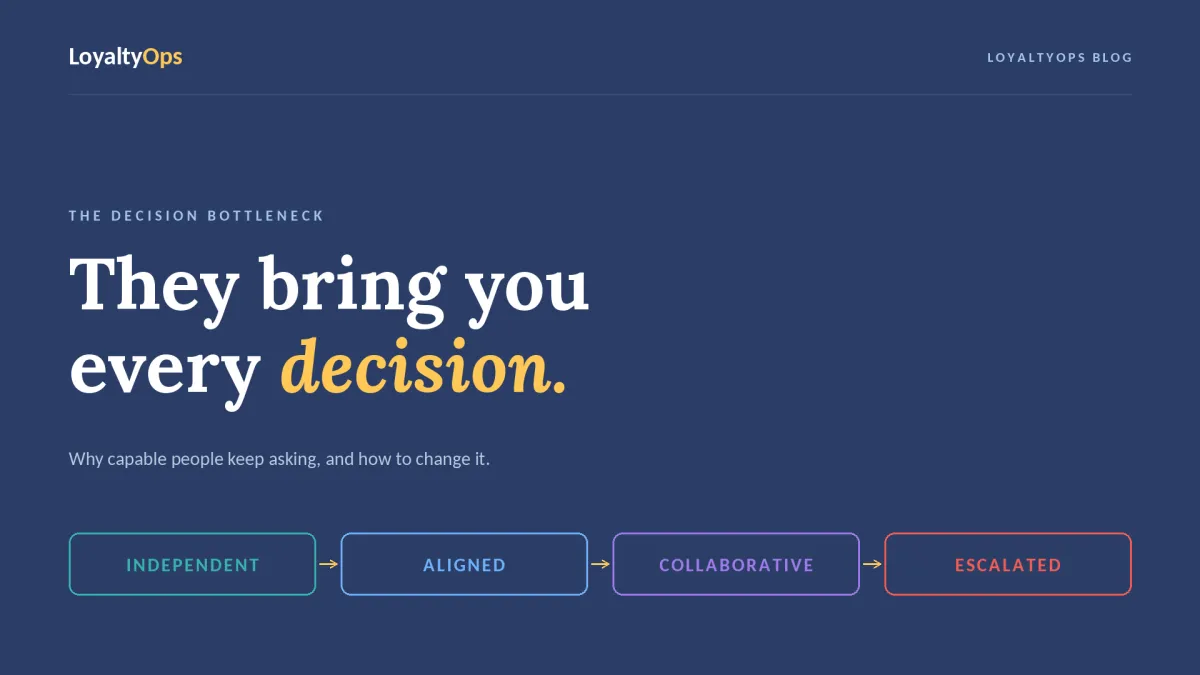
From there, it helps to name how that owner makes the call, and there are four common ways:
Independent — the owner decides and acts alone, no input or sign-off needed.
Aligned — the owner gathers input or gives a heads-up first, then decides.
Collaborative — the group works it out together, and one person still owns the call and the follow-through.
Escalated — the owner takes it to someone more senior for the decision or sign-off.
Naming the type sets a clear expectation, so people know when to just decide and when to check first. It's the difference between "use your judgment" and a decision someone can actually take on.
Which decisions are actually yours to make?
Handing decisions off doesn't mean handing off all of them. Some calls genuinely belong to you, and the goal is to keep those and pass on the rest, so you can tell the difference on purpose instead of by default.
A decision is more likely to be yours when it commits a lot of money, changes the direction of the business, sets a precedent others will follow, or would be expensive to undo. Those deserve your attention. A decision is a good candidate to hand off when it comes up often, sits inside clear limits, and a wrong call is recoverable. Most of what reaches you in a given week is the second kind, not the first.
The trouble is that when nothing is named, both kinds come to you the same way. Sorting your recent decisions into "genuinely mine" and "someone on my team could own this" is usually the moment it becomes obvious how many belong to other people.
How do you start this week?
Don't try to reassign everything at once. List the decisions you keep making that someone on your team is ready to own, and pick one. Then hand it off properly: tell the person it's theirs, which type it is, how to make it well, what a good and bad outcome look like, and the line where it should come back to you.
One decision handed off in full does more for you than ten you vaguely delegated, because the owner actually has what they need to make the call without you. Do that once, and you've started making only the decisions that genuinely need you.
Give the first decision to its owner this week
If decisions keep piling up on you, the fix is to give each one a clear owner and a clean hand-off. Our free Decision Rights Map gives you the four decision types, a simple way to decide who should own a call, and a hand-off card to give one over cleanly this week.
→ Download the free Decision Rights Map: loyaltyops.com/decision-rights
FAQ
Why can't my team make decisions without me?
Usually because no one ever named who owns each decision, so by default it belongs to you. Capable people check with you not because they lack initiative, but because when ownership is unclear, asking is the lower-risk choice. Naming a single owner for each decision is what changes that.
How do I get my team to make decisions without me?
Give each decision one clear owner, and hand it off in full: name that it's theirs, how to make it well, what a good outcome looks like, and when to bring it back to you. A single clean hand-off works far better than a general instruction to "take more ownership."
Isn't telling someone to own it enough?
No. "Own more" is an abstraction people can't act on. To take on a specific decision with confidence, a person needs to know the call is theirs, how to make it well, what good looks like, and when to escalate. Without those, they'll keep checking with you, which is the sensible thing to do.
Why do I end up the bottleneck for decisions?
Because every unassigned decision defaults to you, and unassigned decisions pile up quietly as the business grows. When each call has a named owner and clear limits, only the ones that genuinely need you come to you, and the rest get made by the people closest to the work.
What kinds of decisions should I hand off first?
Start with the ones you keep making that someone on your team is clearly ready to own, where the downside of a wrong call is manageable. Those give you a fast win and a template for the rest, without betting the business on the first hand-off.