
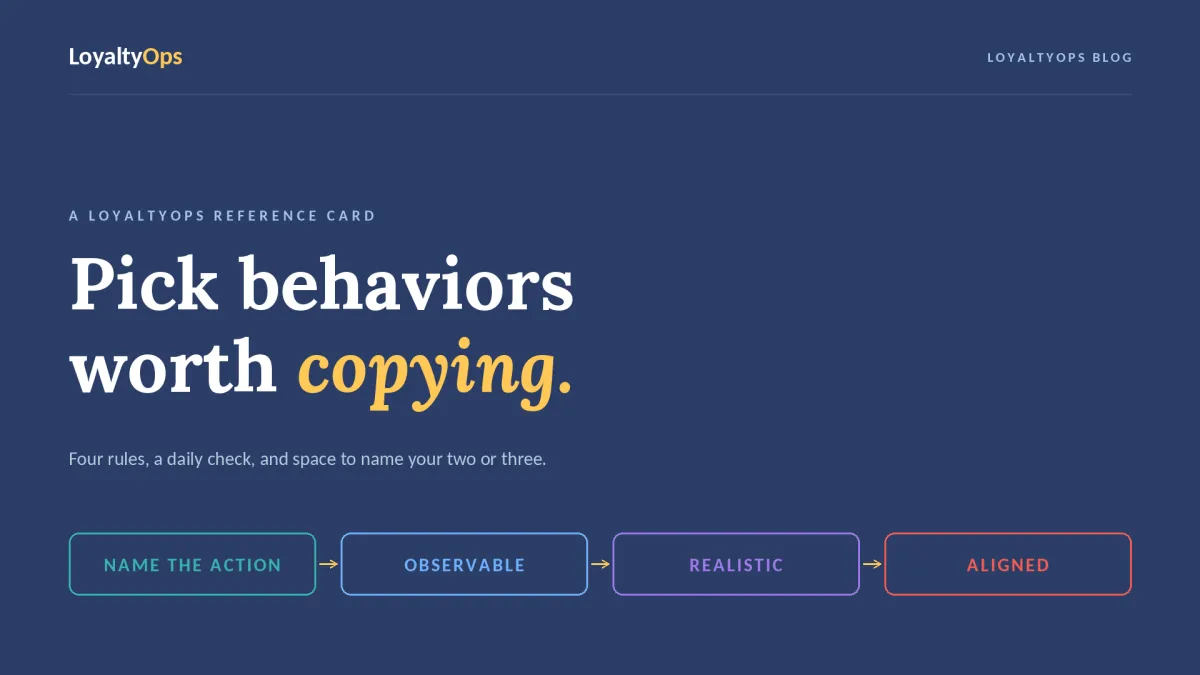
Leadership Modeling Reference Card: Free Download
The Leadership Modeling Reference Card: The Behaviors Worth Copying
Your team copies what you do, so the fastest way to raise the standard is to choose the behaviors worth copying and model them on purpose. The free Leadership Modeling Reference Card gives you a one-page method for doing exactly that. Here's what's on it and how to use it this week.
What is the Leadership Modeling Reference Card?
It's a short LoyaltyOps reference card, four pages, that puts the whole method for leading by example on purpose onto one page you can keep in front of you. It gives you the four rules for choosing a behavior worth modeling, the daily check for your first thirty days, and space to name the two or three behaviors you'll go first on.
It's built for the leader who wants the team to raise its standards and knows the example has to start with them. You can name your behaviors in one sitting and start modeling them the same day.
What's on the card?
The card sets out the method in three parts:
Your team copies what you do — why you're always modeling something, and why choosing it on purpose matters.
The four rules every behavior passes — the checks that keep a behavior something you can actually model.
Go first, then the team picks it up — the thirty-day discipline and the daily check that make a behavior real.
There's space to write your two or three behaviors and check each one against the rules, so the card is a tool you fill in, not just an article you read.
The four rules for choosing a behavior
Before you commit to modeling a behavior, run it through four rules:
Name the action, not the outcome. Describe what you do, like keeping the standup to fifteen minutes, and leave the hoped-for result out. The team can copy an action, not a wish.
Make it observable. A camera could record it. An attitude or intention is too vague to copy.
Keep it realistic under pressure. You can do it in your hardest week. If it stops happening when the calendar gets tight, pick something smaller you can keep to.
Keep it aligned. It fits your Clear Intent and your Cultural Standards. If a behavior contradicts them, change one so they agree before you model it.
The daily check for your first thirty days
You model each behavior in your own work for about thirty days before asking the team to pick it up. The card gives you a short daily check to stay consistent through that window:
Use it without exception — apply the standard in your own meetings and decisions every day.
Say it out loud — name the standard in at least one conversation a day, so the language spreads.
Meet your own standard — apply the same expectation to yourself that you ask of others.
Keep it under pressure — protect the standard when the week gets tight, because that's when the team watches most closely.
Treat friction as progress — early slowdowns and clarifying questions mean the standard is taking hold.
A worked example
Say you want your team to make more decisions without you. "Be more decisive" is an outcome, not a behavior, so it fails the first rule. Run it through the four rules instead, and you get something you can model:
The behavior: "When a decision comes to me that the team could make, I hand it back with what they need to decide, instead of deciding it myself."
Observable? Yes, a camera could record the moment you hand it back.
Realistic under pressure? Yes, even in a tight week, though it's tempting to just decide.
Aligned? Yes, it fits a direction where the team acts closer to the work.
Model that for thirty days, name it out loud when you do it, and keep doing it in the weeks when it would be faster to just make the decision. By day thirty, the team brings you fewer decisions that were theirs to make, because they've watched you consistently hand them back.
How to use the card
Name your two or three behaviors this week. Write each one so a camera could record it, and check it against the four rules before you commit. Then start going first: model them in your own work every day for about thirty days, keeping them especially when the week gets tight.
Pick behaviors that matter most for how you want the team to work, and keep the list to two or three, because a short list you model consistently teaches more than a long one you can't keep up.
Why two or three, and not ten
The card is deliberate about the number, and it's worth understanding why. A behavior only teaches when you do it consistently, and consistency across ten behaviors in your hardest week is more than any leader can manage. Two or three you actually keep to will change how the team works; ten you manage only on calm weeks will teach the team that standards are for calm weeks. Start with the two or three that matter most, get them to the point where the team uses them without prompting, and only then add the next one. A short list modeled well is the whole method.
Who is the card for?
It's for the leader who wants the team to work to a higher standard and understands that the example has to start with them. If you've set standards that faded, the card gives you a structured way to choose a few behaviors worth copying and model them until they're the norm. It doesn't ask you to change your personality; it asks you to choose a few actions and go first on them.
It pairs naturally with the other two foundations. If you've already written your Clear Intent and your Cultural Standards, the behaviors you model here are the ones that bring those to life, which is why the "aligned" rule checks each behavior against both before you commit to it.
Get the Leadership Modeling Reference Card
Choose the behaviors worth copying, and go first this week. → Download the free Leadership Modeling Reference Card: loyaltyops.com/leadership-modeling
Name your two or three behaviors, check each against the four rules, and model them in your own work for thirty days. That's how the standard becomes the norm.
→ Get the card: loyaltyops.com/leadership-modeling
FAQ
Is the Leadership Modeling Reference Card really free?
Yes. It's a free download at loyaltyops.com/leadership-modeling, with no course to buy. You can name your two or three behaviors in one sitting and start modeling them the same day.
What's on the card?
The four rules for choosing a behavior worth modeling, a daily check for your first thirty days of going first, and space to write the two or three behaviors you'll model, each checked against the rules.
How many behaviors should I choose?
Two or three. A short list you model consistently teaches far more than a long list you can't keep up. Once those are the norm, you can add more.
How do I know if a behavior is worth modeling?
Run it through the four rules: it names an action rather than an outcome, a camera could record it, you can do it in your hardest week, and it fits your direction and standards. If it passes all four, it's worth going first on.
What happens after thirty days?
The team tends to use the behavior without being prompted, even under pressure, because they've watched you model it consistently for a month. From there, you can choose the next behavior and repeat the same thirty-day discipline.