
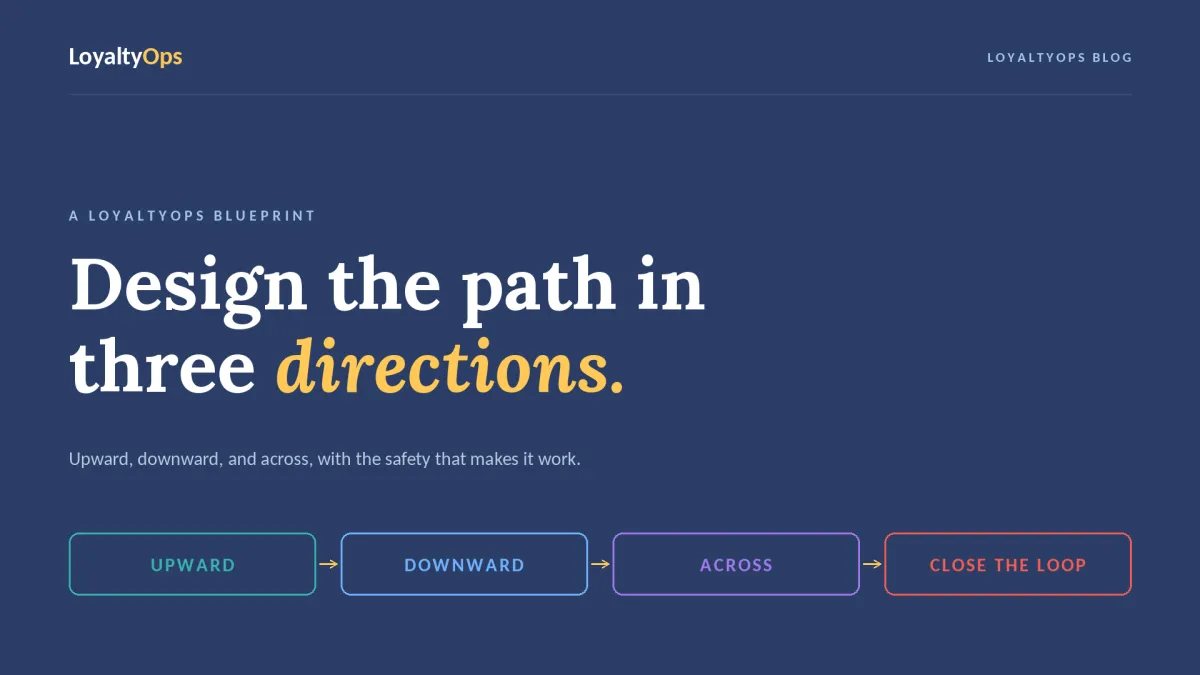
Feedback Loops Blueprint: Free Feedback Framework
The Feedback Loops Blueprint: Build Feedback in Three Directions
If problems keep reaching you too late, the fix is to build the paths that get them to you early. The free Feedback Loops Blueprint gives you a step-by-step way to do it. Here's what's inside and how to use it this week.
What is the Feedback Loops Blueprint?
It's a short LoyaltyOps blueprint, ten pages, that helps you design the paths feedback travels in your business, so problems and ideas reach the people who can act on them early. It covers the three directions feedback needs to run, a menu of structures to choose from, the safety agreement that makes people willing to speak, the format that makes an issue easy to act on, and the four ways to close a loop.
It's built for the leader who keeps finding out about problems too late. You can design your first structures in one sitting and start using them the same week.
What's inside the blueprint?
The blueprint walks through the whole system:
Why problems reach you late — the missing path, and why more communication hasn't fixed it.
The three directions — upward, downward, and across, with the five components you design from.
Make it safe first — the safety agreement to set with the team before you start.
A menu of structures — common upward, downward, and across structures to choose from.
The one-per-direction worksheet — design one structure in each direction, with format, frequency, owner, and next date.
Give every issue the same shape — the problem/impact/recommendation format, with a worked example.
Close the loop — the four ways to close a loop, and the test for whether it's closed.
The three directions, and a menu to pick from
Feedback runs three ways, and the blueprint gives you a menu for each so you can pick the few that fit how you work. Most teams do well with two or three upward, two or three downward, and one or two across.
Upward, the team to you: an open feedback forum where the team brings problems with recommendations, a short anonymous pulse survey, or a skip-level session.
Downward, you to the team: a what-we-heard update, a town hall, or a closing-the-loop message.
Across, team to team: a cross-functional review, a project retrospective, or a handoff review.
Make it safe first
Before you run any structure, the blueprint has you set a safety agreement with the team, because people bring hard information only when it's safe to. You agree, in your team's own words, to focus on the problem and its impact rather than the person who raised it, to protect what's shared, to treat raising a risk early as doing the job well so it's never held against anyone, and to make sure whatever gets raised gets a response. Everyone agrees to it together, so the safety is shared and people can count on it.
Give every issue the same shape
Structures decide where feedback goes; the format decides whether it's usable. The blueprint has the team bring every issue in the same three parts, so each one arrives ready to act on:
Problem: Onboarding emails go out two days after a client signs.
Impact: New clients hit their first task with no guidance, and week-one support tickets are up.
Recommendation: Trigger the emails off the signed contract. I can have it tested by Friday.
The same issue framed as "onboarding is a mess" gives you nothing to act on. Framed in three parts, it's ready to move on.
Close the loop
Getting the information is half the work; closing the loop is the half most businesses skip. The blueprint gives you four ways to close one: follow up with the person and name what you're doing and by when, write up what changed and send it to everyone it affects, name the themes at a town hall, or point to the thing that's different now because someone raised it. And it gives you one test: can people name something that changed because they spoke up? If they can't, the loop is still open.
Why all three directions matter
It's tempting to build only the upward direction, since that's the one that gets information to you. But upward on its own tends to go quiet. People raise things, nothing visibly comes back, and they read the silence as "not worth it." The downward direction is what keeps the upward one alive, because it shows people their feedback was heard and used. And the across direction handles the large category of problems that live between two teams, which otherwise route up to you and get patched instead of fixed where they happen. The blueprint has you build one structure in each direction for exactly this reason: the three work together, and any one of them alone tends to fade.
How to use the blueprint
Use the worksheet to design one structure in each direction: name the structure, its format, how often it runs, who's in it, who owns it, and the date of the next one. Then, this week, close one loop: pick something your team raised in the last month that they never heard back on, and tell them what you heard and what you've decided to do about it.
That one closed loop is what tells the team it's worth bringing you the next one, and it's the fastest way to feel the system start working.
Who is the blueprint for?
It's for the leader who keeps getting surprised by problems the team saw coming. If the truth reaches you late and the same issues keep repeating, the blueprint gives you a structured way to build the paths that carry information early, with the safety and follow-through that make people actually use them. It doesn't require new software; it's a design you build into how the team already works.
Get the Feedback Loops Blueprint
Build the paths that get problems to you early. → Download the free Feedback Loops Blueprint: loyaltyops.com/feedback-loops
Design one structure in each direction, set the safety agreement with your team, and close one open loop this week. That's how the truth starts reaching you in time to use it.
→ Get the blueprint: loyaltyops.com/feedback-loops
FAQ
Is the Feedback Loops Blueprint really free?
Yes. It's a free download at loyaltyops.com/feedback-loops, with no course to buy. You can design your first structures in one sitting and start the same week.
What will I build with it?
One feedback structure in each of the three directions (upward, downward, and across), a safety agreement set with your team, a shared format for raising issues, and a habit of closing the loop so people keep speaking up.
What are the three directions of feedback?
Upward (the team raises risks and ideas to you), downward (you name what you heard and what you're doing), and across (teams resolve issues between them). Most businesses build only upward, which is why feedback often goes quiet.
How do I close a feedback loop?
Show the person that what they raised was heard and acted on: follow up with next steps, write up what changed, name it at a town hall, or point to the specific thing that's different now. The test is whether people can name something that changed because they spoke up.
Do I need special tools to use the blueprint?
No. The structures can run in person, over video, or in writing, using whatever your team already has. The blueprint is a design and a set of habits, not a piece of software.