
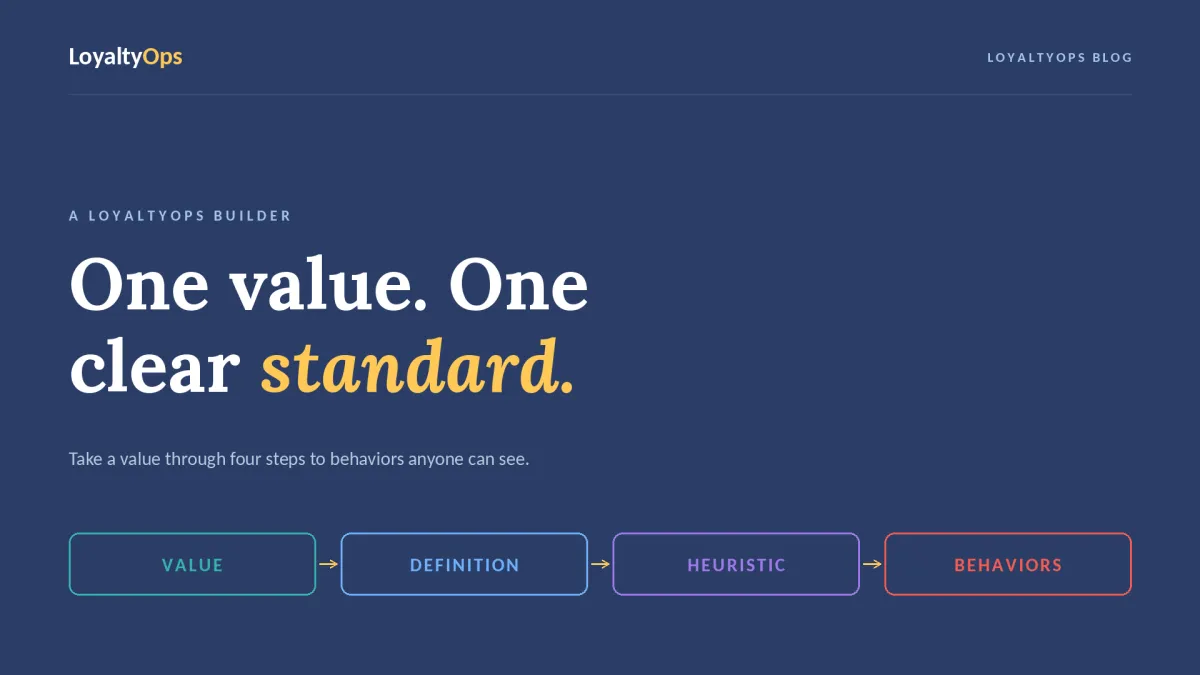
Cultural Standards Builder: Free Values-to-Behavior Template
The Cultural Standards Builder: Turn One Value Into a Behavior This Week
If your company values sound good but haven't changed how the team works, the fix is to turn one of them into a behavior anyone can see. The free Cultural Standards Builder walks you through it, one value at a time. Here's what's inside and what you'll have built by the end.
What is the Cultural Standards Builder?
It's a short LoyaltyOps builder, nine pages, that turns a value you already have into a standard the team can use. It takes each value through four steps, from the word to a plain definition to a memorable phrase to the specific behaviors that match it and break it, with a test for each step.
It's built for the leader of a growing team whose values live on a wall and haven't changed the daily work. You can build your first standard in one focused sitting and start using it the same week.
What's inside the builder?
The builder walks through seven short sections:
Why values stop working — why a value left as a word changes little.
The four-link chain — the four steps every standard runs through.
Step 1: Define what each value means — the "At our company, this means" definition, with an alignment check.
Step 2: Distill it into a phrase — the three-to-eight-word heuristic, with examples and tests.
Step 3: Name the behaviors — the matching and breaking behaviors, with the Camera Test.
Build your first standard — one value taken all the way through, start to finish.
Keep it alive — how to make the standard real by living it.
The four links you'll fill in
Each step has a prompt and a test, so you're never staring at a blank page:
Value — the word your team already uses, like accountability or teamwork.
Definition — one sentence starting with "At our company, this means," describing what it looks like in action here.
Heuristic — a short phrase of three to eight words people will quote, like "Own the outcome."
Behaviors — one to three that match the standard and one to three that break it, each specific enough to pass the Camera Test.
A full worked example
Here's what one standard looks like, filled in all the way through:
Value: Teamwork
Definition: At our company, this means we share what we know early, so others can do their best work.
Heuristic: Team over ego.
Matching behaviors: Share context before you're asked, so others can act on it. Coordinate a decision with the teams it affects before you make it.
Breaking behaviors: Hold information back until it's convenient for you. Blame another team for a problem that was shared.
Read those behaviors and notice how little room they leave to interpret. Nobody has to guess what "teamwork" means here, because the standard shows them exactly what it looks like and exactly what crosses it. That's a value the team can see, copy, and keep each other to.
Why the breaking behaviors matter as much as the matching ones
Most teams that try this only write the good half: what the value looks like when someone lives it. The builder has you write the breaking behaviors too, and they do just as much work. A standard that only says what good looks like still leaves room to interpret the edges, and people will interpret them generously toward whatever they already do. Naming one or two behaviors that break the standard draws a clear boundary, so "teamwork" rules out holding information back just as clearly as it rules in sharing it early. That's what lets people give each other feedback without it turning into an argument about intentions.
The Camera Test keeps it honest
The behaviors are where most standards go soft, so the builder gives you one check to keep them sharp: the Camera Test. If a camera couldn't record it, it isn't specific enough yet. "Be respectful" fails the test, because you can't film it. "Let people finish before you respond" passes, because you can. Running each behavior through the Camera Test is what turns a nice-sounding standard into one people can actually follow.
How to use the builder
Pick one value this week, the one that would matter most if the whole team lived it, and take it all the way through the four steps. That's the fastest way to start, and it gives you the pattern for the rest.
If you want the standard to be shared rather than yours alone, use the alignment check: have a few people write a one-sentence definition of the value on their own, then compare. Where the definitions differ a lot, you've found a value that needs work before it becomes a standard. And cap your full set at three to five, because a short set the team remembers beats a long one it ignores.
What to do after you build your first standard
Building the standard is the start; using it is what makes it real. Put the phrase into your meetings, feedback, and onboarding, so the language shows up where the work happens. Recognize the matching behavior out loud when you see it, and redirect the breaking kind early, while it's still small. Most of all, live it yourself, because people copy what you do more than what you say, and a standard the leader visibly follows is one the team takes seriously. Once the first one is running, repeat the four steps for two to four more values, and stop at five.
Who is the builder for?
It's for the capable leader of a growing team whose values sound good but haven't changed how the team works. If people nod at your values and then act on their own version of them, the builder gives you a fast, structured way to turn one into a behavior everyone can see. It doesn't ask you to invent new values; it makes the ones you have usable.
Get the Cultural Standards Builder
Turn one value into a behavior your team can see this week. → Download the free Cultural Standards Builder
Pick your most important value, take it through the four steps, and run each behavior through the Camera Test. That's your first standard the team can use.
→ Get the builder: loyaltyops.com/cultural-standards-builder
FAQ
Is the Cultural Standards Builder really free?
Yes. It's a free download at loyaltyops.com/cultural-standards-builder, with no course to buy. You can build your first standard in one sitting and start using it the same week.
What will I have when I'm done?
One complete Cultural Standard: a value, a plain definition, a memorable phrase, and the specific behaviors that match it and break it, ready to put into your meetings, feedback, and onboarding.
Do I need to have company values already?
Yes. The builder turns values you already have into behaviors, so you'll want your values list first. If your team has never named its values, do that first, then use the builder to make them usable.
How long does it take to build one standard?
One focused sitting for the first standard, once you've picked the value. The four steps are quick with the prompts, and the Camera Test tells you when each behavior is specific enough.
What do I do after I build one?
Live it, and build a few more. Model the behavior yourself, put the phrase into meetings and onboarding, and recognize the matching behavior when you see it. Then repeat the four steps for two to four more values, capping your set at five.