
How to Turn Company Values Into Behaviors: Cultural Standards
How to Turn Company Values Into Behaviors With Cultural Standards
Every leader has been told that culture matters, and most have a set of values to prove they take it seriously. Far fewer have values that change what the team does on a Tuesday. The gap between the two isn't about caring more or writing better slogans. It's about turning each value from a word into a behavior anyone can see. That's what Cultural Standards does, and here's the full method.
Why values stop working
Most teams have values on a wall or in a handbook, and they rarely change how anyone works. The reason is simple: a word like accountability or teamwork means something different to everyone who reads it, so if you ask ten people what one of them means in practice, you get ten answers.
Culture starts to break down when good people make different assumptions about the same value, each of them certain they're living it. A value only becomes useful when it stops being a word and becomes a behavior anyone can see and recognize.
What are Cultural Standards?
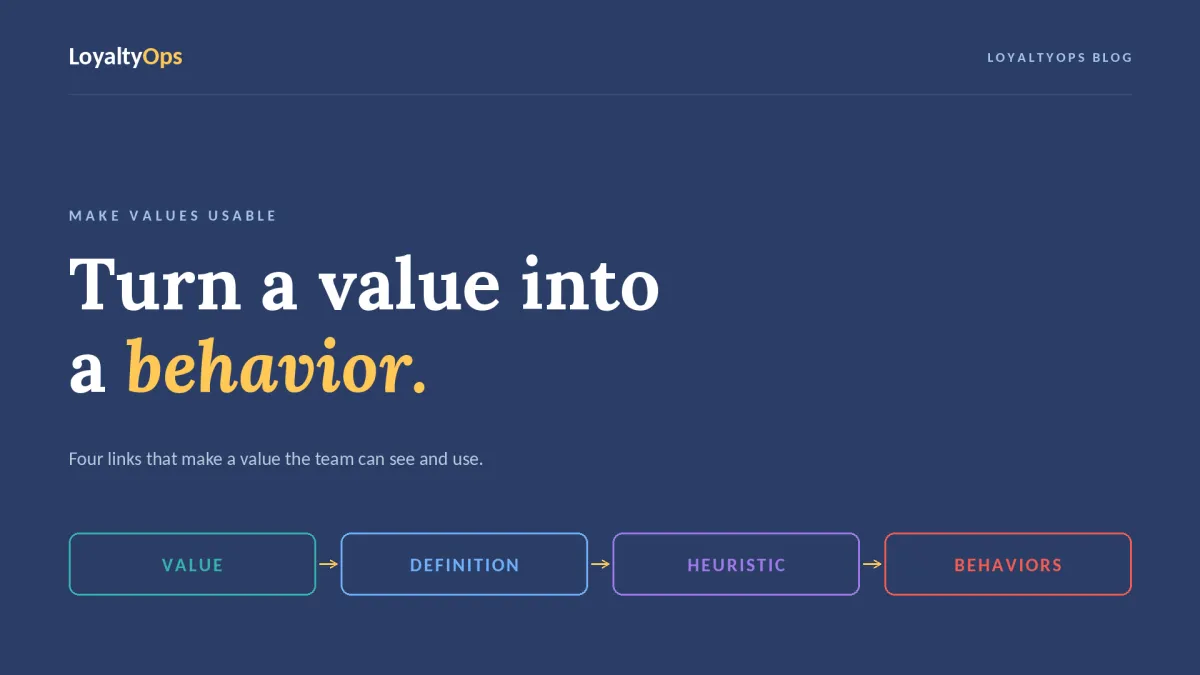
A Cultural Standard is one value turned into a behavior the whole team can recognize. You take a value you already have and run it through four steps, each one making the value more concrete than the last, until you end with specific actions people can see, copy, and keep each other to.
The point isn't to add more values. It's to make the ones you have usable, so "accountability" stops being a word people interpret and becomes a behavior people can point to.
The four links every standard runs through
Each standard moves through the same four steps.
Value
This is the word your team already uses, like accountability or teamwork. You're not inventing new values here; you're making the existing ones real.
Definition
This is one plain sentence, starting with "At our company, this means," that says what the value looks like in action here. Skip generic lines like "integrity matters." A clear definition helps people decide, because they can tell what it rules in and what it rules out. A vague one lets everyone read into it whatever they already wanted to do.
Heuristic
This is a short, sayable phrase of three to eight words that people quote without thinking, like "Own the outcome" or "Team over ego." People remember phrases, not paragraphs, so this is what carries the standard into everyday language. A good phrase would be quoted unprompted, understood by a new hire at once, and clear enough that you can name what would break it.
Behaviors
These are one to three behaviors that match the standard and one to three that break it, written so plainly that a camera could record them. The behaviors that break it matter as much as the ones that match it, because a standard that only says what good looks like, without saying what crosses it, still leaves room to interpret.
Building a standard, link by link
You already have the value, so the work is the other three steps.
Start with the definition. Write one sentence beginning with "At our company, this means," and describe what the value looks like in practice. A quick way to catch a vague value: ask a few people what it means in practice, and if their answers differ a lot, the value needs work before it can become a standard.
Then distill it into a heuristic. Make it easy to quote, like "Own the outcome" or "Team over ego." If it sounds like a polished tagline, it's too vague to guide anyone; if it takes a paragraph to explain, it's too long to remember.
Finally, name the behaviors. Write one to three that match the standard and one to three that break it, and keep them factual and observable. Use the Camera Test: if a camera couldn't capture it, it isn't specific enough yet. For teamwork with the phrase "Team over ego," a matching behavior is sharing context early so others can act on it, and a breaking one is holding information back until it's convenient for you.
Do one this week, and cap the set at three to five
You don't need every standard at once. Pick one value this week and take it all the way through the four steps, from the word to the definition to the phrase to the behaviors. Building one well gives you the pattern for the rest.
Cap your full set at three to five. A few standards the team actually uses are worth more than a long list no one remembers, and a short set is easier to keep in front of people week after week.
Keep it alive by living it
A written standard changes nothing until leaders live it, because people copy what you do more than what you announce. Model the behavior yourself every day, so that admitting your own mistake first is what proves "own the outcome" is real. Put the phrases into your meetings, feedback, and onboarding so the language spreads, and reinforce each standard by recognizing the matching behavior out loud and redirecting the breaking kind early, while it's still small.
That last part, living the standard yourself before the team is asked to, is its own foundation. We call it Leadership Modeling, and it's the piece that makes Cultural Standards stick.
Where Cultural Standards fits
Cultural Standards is the second of three foundations we help leaders build. Clear Intent comes first and names your direction. Cultural Standards comes second and turns your values into behaviors that serve that direction. Leadership Modeling comes third, where you live those behaviors yourself before the team is asked to. Together, those three are the foundation the Leadership Operating Flywheel is built on.
Download the free Cultural Standards Builder
We put the whole method into the Cultural Standards Builder, which walks you through the four steps, gives you the tests for each one, including the Camera Test, and has you build your first standard from start to finish this week.
→ Download the free builder: loyaltyops.com/cultural-standards-builder
If you want to build your standards with a room of leaders agreeing on the exact behaviors together, that's part of the work inside the Leaders Mastermind.
FAQ
How do you turn company values into behaviors?
Take one value through four steps: define what it means here in a plain sentence starting with "At our company, this means," distill it into a three-to-eight-word phrase people will quote, and name the specific behaviors that match it and break it. Write the behaviors so plainly that a camera could record them.
What are Cultural Standards?
Cultural Standards are your values turned into behaviors the whole team can see. Each one runs through four steps, from the value to a definition to a memorable phrase to specific behaviors, so a word like accountability becomes an action people can recognize and repeat.
What is the Camera Test?
It's a check for the behaviors in a standard: if a camera couldn't record it, it isn't specific enough yet. It keeps behaviors factual and observable, so "communicate well" becomes something concrete like "share context before you're asked, not after."
How many Cultural Standards should we have?
Three to five. A few standards the team actually uses beat a long list no one remembers. Build one well first, then use it as the pattern for the rest.
How is this different from writing better core values?
Better wording still leaves a value as an idea people interpret. Cultural Standards takes the value all the way to behavior, which is the part that actually changes how the team works. You keep your values; you make them usable.