
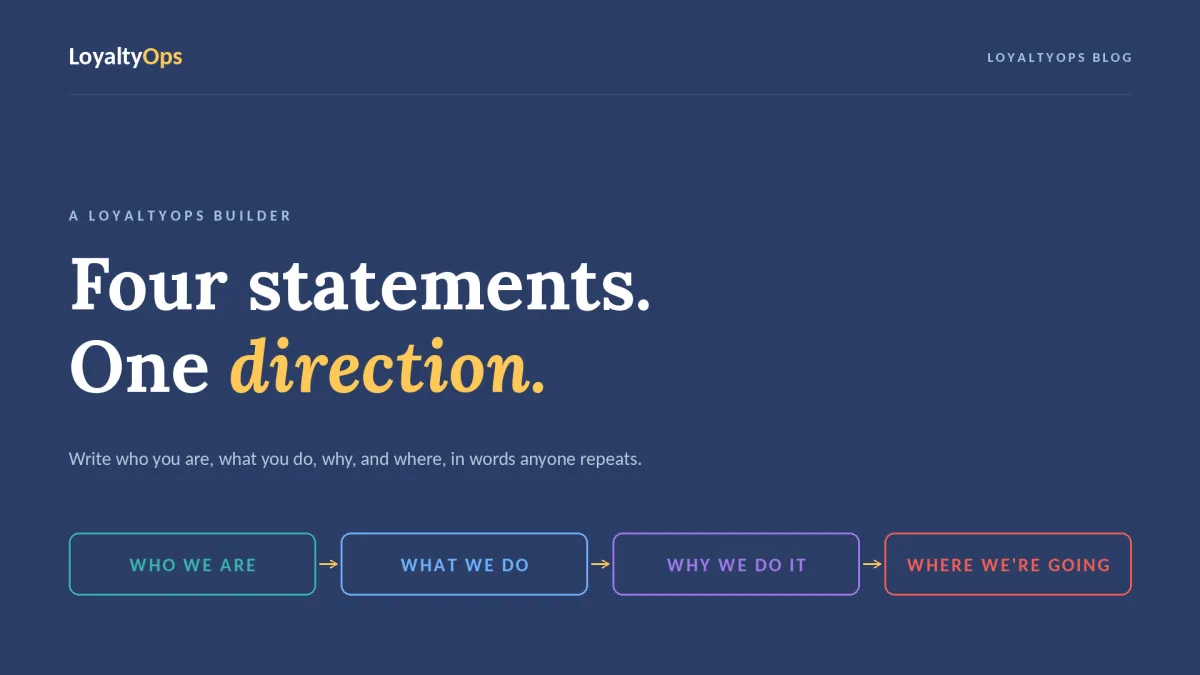
Clear Intent Builder: Free Team Direction Template
The Clear Intent Builder: Write Your Team's Direction in 4 Statements
If your team keeps working from different versions of the goal, the fix is to write your direction down in words anyone can repeat. The free Clear Intent Builder walks you through it, one statement at a time. Here's what's inside and what you'll have written by the end.
What is the Clear Intent Builder?
It's a short LoyaltyOps builder, ten pages, that helps you write the four statements that name your team's direction: who we are, what we do, why we do it, and where we're going. Each statement gets its own page with a prompt, an example, and a word limit, plus the four checks to measure each one against and the test to run this week.
It's built for the leader of a growing team whose direction still lives in their head. You can fill it in during one focused hour and start using the statements the same week.
What's inside the builder?
The builder walks through eight short sections:
What Clear Intent is, and the four rules — the method, and the checks every statement passes.
How to build your four statements — the draft-alone-then-align steps.
Who we are — your identity, with a prompt, example, and word limit.
What we do — your promise, in one line a stranger would understand.
Why we do it — the belief that gives the work meaning, starting with "Because."
Where we're going — the specific future goal that sets your priorities.
Bring it together and test it — write the final four and run the say-it-back test.
Keep it alive — how to use the statements every week so they stay in use.
The four statements you'll write
Each page gives you a rule, an example, and a word limit, so you're never staring at a blank box:
Who we are (25 words or fewer) — declarative, human, true even on your worst day. Example: "We are a financial planning firm that puts client trust ahead of sales pressure."
What we do (15 words or fewer) — start with a verb, name what changes. Example: "We help multi-location operators run smoother service by turning bookings, tables, and demand into clear workflows."
Why we do it (15 words or fewer, starting with "Because") — the belief behind the work. Example: "Because financial clarity reduces fear and helps families make better long-term choices."
Where we're going (future tense, specific) — the goal you can measure. Example: "By 2035 we will be the operating standard for reservation and guest flow in our category."
The four checks that keep each one usable
Before a statement is done, it passes four checks: it fits in one breath, a new hire can repeat it after hearing it once, it carries no buzzwords you'd have to explain, and it sounds the same whoever says it. These checks are what keep your statements from ending up as words on a wall that no one can act on.
The test that tells you it worked
The builder ends with one real test. You write your final four statements, then ask three people on your team to read them and say them back the next day. If they can repeat them without checking, your direction is clear and the team can use it. If they say them three different ways, you simplify until they can't get it wrong. That test is the difference between a direction people admire and one they actually use.
A quick example of a full set
Here's what the four statements look like together for one company, a small hospitality software firm:
Who we are: We are a hospitality software company that treats our customers' service reputation as our own.
What we do: We help multi-location restaurants turn bookings and demand into clear, calm service.
Why we do it: Because good service is hard, and the right tools let good people give it consistently.
Where we're going: By 2030 we will be the booking standard for growing restaurant groups.
Four lines, each short enough to say in a breath, and a new hire could repeat them the next day. That's a direction a team can act on without checking with the founder first.
How do you use the builder with your team?
You can fill the builder in two ways. On your own, draft the four statements, run them through the four checks, and test them with three people this week. That's the fastest way to start.
With your leadership team, the builder is built for shared work. Each leader drafts their own version of the four statements without seeing the others, then you compare them side by side. Where the wording differs, you've found a place your leaders quietly picture the direction differently, and agreeing on the exact words is how you close that gap. A direction the whole leadership team shares is far stronger than one written by a single person, because everyone who has to use it helped set it.
Who is the builder for?
It's for the capable leader of a growing team whose direction lives in their head and needs to be written where the team can use it. If your people are strong but keep working from different versions of the goal, the builder gives you a fast, structured way to name the direction and make it shared. It doesn't ask you to invent a new strategy; it helps you put the one you already have into words the team can repeat.
It's also a strong fit for a leadership team that senses it isn't fully aligned but can't point to where. Drafting the four statements separately and comparing them tends to reveal the disagreement in an afternoon, in the specific words where two leaders describe the same direction differently. Once those words are agreed, the whole team has one version to work from instead of several.
Get the Clear Intent Builder
Write your team's direction in four statements this week. → Download the free Clear Intent Builder
Draft your four statements, test whether three people can repeat them the next day, and put them into your meetings and onboarding. That's a direction your team can use without you.
→ Get the builder: loyaltyops.com/clear-intent-builder
FAQ
Is the Clear Intent Builder really free?
Yes. It's a free download at loyaltyops.com/clear-intent-builder, with no course to buy. You can fill it in during one focused hour and start using your statements the same week.
How long does it take to complete?
About an hour to draft your four statements on your own, or a session with your leadership team if you want the wording agreed together. The say-it-back test then runs over the following day.
What will I have when I'm done?
Four short statements that name your direction, each one tested against the four checks, ready to put into your meetings, onboarding, and reviews so the team works from the same direction.
Do I need a mission and vision statement first?
No. The Clear Intent Builder covers the same ground more usefully. The four statements name who you are, what you do, why you do it, and where you're going, in words your team can actually repeat and act on.
What do I do with the statements after I write them?
Use them. Open meetings with them and check your decisions against them, teach them on a new hire's first day, and re-test them before big planning sessions. Repetition is what turns four statements into how the team works.