
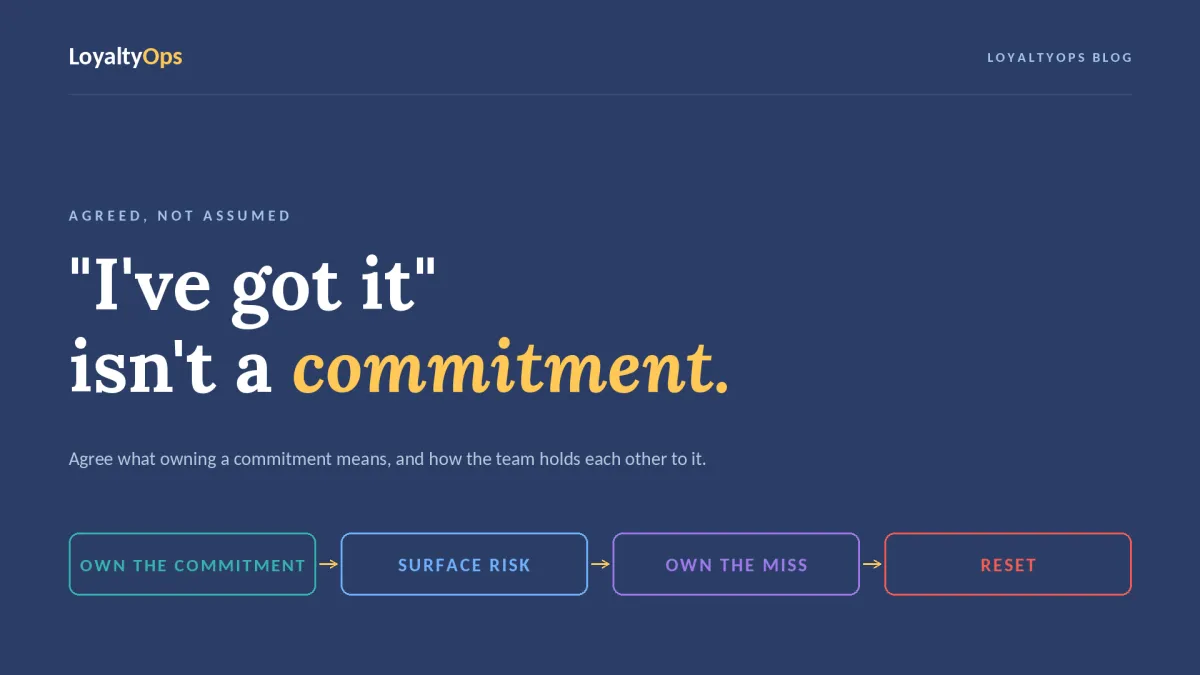
Accountability Standards: Agreed, Not Assumed
"I've Got It" Isn't a Commitment
Most leaders spend a real share of the week chasing commitments that were never actually commitments. Someone said "I've got it," everyone moved on, and days later it turns out "got it" meant something different to them than it did to you. The work slips, you find out late, and slowly every unfinished thing comes back to you to chase. The cause usually isn't that people stopped caring. It's that owning a commitment was never defined. Accountability standards are how you fix that, and here's the whole method, made simple enough to run on a small team.
You're chasing commitments that were never defined
The trouble starts with a phrase that sounds like a promise. "I've got it" feels like a commitment, so everyone moves on, and then a risk that was clear days ago never reaches you, and a miss gets explained when what you needed was a new plan. You end up with surprises where you wanted predictability, and silence where you wanted an early warning.
You've already told the team to take ownership, and tried to hold people to it without being heavy-handed, and the commitments still slip. The reason is that "own it" was never defined as anything a person can actually do. When the standard for "I've got this" lives only in people's heads, each person carries a different version, so what one person thinks they promised isn't what you think you heard.
Accountability works when it's agreed, not assumed
A standard isn't a value, and it isn't a poster. It's observable behavior and the exact words people use. Accountability fails when the expectations are assumed, because each person fills in their own version. It works when the expectations are agreed out loud, because then there's one shared version everyone signed up for.
That's the whole shift. You stop enforcing accountability after a miss and start making ownership explicit before anything goes wrong. Accountability standards make ownership clear up front, so it's a thing the team agreed to rather than a thing you police.
It runs on two layers
Accountability standards run on two layers, and the order matters.
The first layer is self-accountability: how each person owns their own commitments before anyone else has to get involved.
The second is mutual accountability: how peers reinforce the standard with each other, calmly and without politics, so not everything comes back to you. Self-accountability comes first, because peers can only hold each other to a standard once each person already owns their own.
Layer one: what owning a commitment means
For self-accountability, four behaviors do most of the work. Each one is a standard the team writes in its own words and agrees to together.
Own the commitment. A commitment is real only when the outcome, the owner, and the date are all clear. "I'll try," "I'll get to it," and "soon" aren't commitments, because none of them names those three things.
Surface risk early. Raise a risk when your confidence drops, well before a miss is certain. An early warning is doing the job well, and the team treats it that way rather than as a failure.
Own the miss. Misses happen, and hiding them is what breaks trust. Keep it short, factual, and focused on what's next: "I missed this, here's the impact, here's what's next."
Reset the plan. A miss leaves a gap, and the gap has to close. An apology isn't a plan, so the reset proposes a new date, a new owner, or the support you need.
Agree those four and "I've got it" stops being a hopeful phrase. It becomes a specific promise everyone reads the same way.
Layer two: how the team holds each other to it
Once people own their own commitments, the team can reinforce the standard with each other, so accountability runs between peers and not only through you. This layer is also behavior and words, and it comes down to five agreements:
What you hold each other to. Name the standards in scope, and keep personality and intent out of it.
When you speak up. Agree what gets handled peer to peer and what gets escalated.
How you do it. Talk about the impact and the work, keep it off the person, and keep it brief.
Safe language. Agree on a few shared phrases, like "can we realign on what we agreed," that make it easier to raise something without it turning tense.
What you rule out. Name the behaviors that erode trust — gossip, going around someone, saving issues to raise later in a review — and agree they're out of bounds.
Safe language is the piece most teams skip, and it's the one that makes the rest usable. A shared phrase gives a colleague a calm, expected way to raise the standard, so speaking up stops feeling like starting a fight.
It only works if it's safe
Every one of these standards asks for something exposing: name a risk before you have the fix, own a miss out loud, challenge a peer. People do that only when it's safe. The moment raising a problem gets met with blame, people stop raising problems, and you're back to finding out too late.
You make it safe in four ways. Separate the miss from the person, and treat an owned miss as professionalism you never use against someone later. Reward the early warning out loud, so flagging a risk is clearly doing the job well. Normalize the miss, so a clean, fast reset is the expected response rather than a drama. And make challenge welcome, so a peer raising the standard is received as help, not as overstepping. This is a culture of accountability without blame, and it's what lets people tell the truth early.
Start this week, and go first
A written standard becomes real only when the team watches you live it. Use the same language you ask everyone else to use. Own your own misses in front of the team, plainly, and reset fast. Raise your own risks early, which gives everyone permission to do the same. And invite the team to hold you to the standard too.
Start small: name one commitment this week as an owner, an outcome, and a date, and the next time you miss one, own it in front of the team. One leader modeling the standard does more than a page of rules, because it shows the standard is real.
Where Accountability Standards fit
Accountability Standards are one of the standards inside the Leadership Operating Flywheel, the way the whole business aligns, grows capacity, and turns effort into growth. Clear decisions tell the team who owns what, and accountability standards make the commitment that follows actually stick. The standard works best alongside the others: a team that shares one direction, raises problems early, and makes good decisions with clear rights. Each standard strengthens the others, and together they're what lets the team run without you in every decision.
Download the free Accountability Standards Builder
We put both layers into the Accountability Standards Builder. It walks you through the four self-accountability standards, the five mutual-accountability standards including the safe phrases to speak up, the four ways to make it safe to tell the truth, and a worked example, so your team can agree to the standard and sign it together.
→ Download the free Builder: loyaltyops.com/accountability-standards-builder
If you want to set the standard alongside a room of other leaders working through the same thing, that's part of the work inside the Leaders Mastermind.
FAQ
What are accountability standards?
Accountability standards are an agreed, written definition of what owning a commitment means and how peers hold each other to it. Instead of assuming everyone means the same thing by "I've got it," the team agrees the specific behavior and words — a real commitment, raising risk early, owning a miss, and resetting — and signs up to them together.
What are the two layers of accountability?
Self-accountability is how each person owns their own commitments: name the outcome, owner, and date, raise risk early, own the miss, and reset. Mutual accountability is how peers reinforce that standard with each other, calmly and with agreed safe language, so accountability runs across the team instead of only through the leader.
How do you build a culture of accountability without blame?
Make it safe to tell the truth early. Treat an owned miss as professionalism rather than something used against someone later, reward early warnings out loud, normalize misses with a fast reset, and receive a peer's challenge as help. When honesty is safe, people raise problems early, which is what prevents most misses.
What makes a commitment real?
A commitment is real only when the outcome, the owner, and the date are all clear. "I'll try," "I'll get to it," and "soon" aren't commitments, because none of them names those three things. Naming all three is what lets everyone read the same promise.
How is this different from just setting goals or KPIs?
Goals say what you want to achieve; accountability standards define how the team commits, warns, and recovers along the way. You can have clear goals and still miss them quietly if "I've got it" was never defined. The standard is what makes the day-to-day commitments behind the goals reliable.