
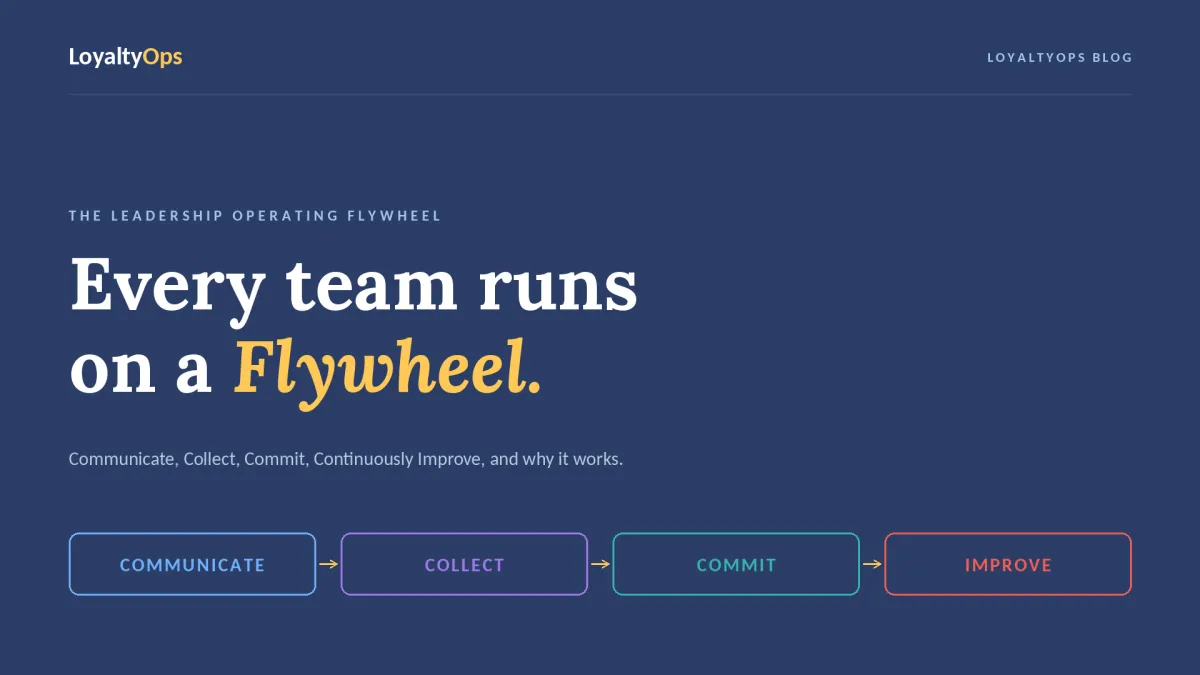
The Leadership Operating Flywheel: 4 Stages
TL;DR
Every team runs on the same four stages, whether anyone named them or not.
The team communicates, it collects what is really happening, it commits to decisions, and it improves on the work.
Then it runs again.
You are already running all four.
The only question is how well each one is built; for most leaders, three run fine and one is weak. That one stage is where most of the week goes.
What is the Leadership Operating Flywheel?
The Leadership Operating Flywheel is a four-stage model of how a team operates day to day. The stages are Communicate, Collect, Commit and Continuously Improve, and they turn in that order every time.
You start with Communicate. You do not skip a stage, and you do not jump ahead without coming back through Communicate first.
The order matters because each stage sets up the one after it. Clear communication makes honest collection possible. Honest collection makes good decisions possible. Good decisions give you something real to improve on. Improvement feeds back into clearer communication the next time round.
You are already running all four
You can usually tell when a team is running well before any number confirms it. The work moves, decisions get made close to the work, and the same problems stop coming back every few weeks.
You can tell when it is struggling too. The team is busy and good at the job, and the week still takes more of your time than it should. You are in every decision, work you thought was clear comes back needing another pass, and you cannot always say why.
The four stages are always present. If nobody built them on purpose, they still exist, just left to chance, and the stage that got the least attention is usually the one costing you the most.
Communicate: speak it, show it, live it
Communicate carries objectives, expectations, decisions and standards into the team, through behaviour as much as through words.
Working: people can name what the team is doing and how. Your behaviour matches what you have said. Standards hold in the small moments.
Breaking: different people read the same standard in different ways. The standard you set bends under pressure. Decisions get reopened in side conversations.
Collect: listen, observe, learn
Collect brings reality back to you and to the team. It verifies what was understood and surfaces what is actually happening, so drift gets caught while it is still small.
Working: the team plays back what they heard before they act. People bring real information forward. Drift gets caught early.
Breaking: you hear what the team thinks you want to hear. Hard information arrives late. The updates feel more polished than the reality underneath them.
Commit: own it, honour it
Commit turns alignment into action. Every decision has one owner, accountability stays calm, and priorities hold across the time they were set for.
Working: owners are clear. Accountability holds when the work is hard. The priority list does not shift every week.
Breaking: decisions get made and nobody owns the next step. Priorities shift weekly. The same decision gets made two or three times.
Continuously Improve: reflect, refine, repeat
Continuously Improve closes out the work that just happened and starts the next round. Reflection turns into a change the team carries forward.
Working: reflection becomes a change in how the team works. Standards tighten. The team gets sharper over time.
Breaking: the team talks about what could be better and nothing changes. The same issues return in a different form.
The pattern worth noticing
A breaking stage shows up as the same problem, again and again, in a slightly different shape.
If you can name a problem your team has solved more than once this year, the stage it keeps coming back through is the one to build first.
Why the Flywheel works
The Flywheel is not a productivity trend, and it is not something we invented. Four reasons sit underneath it, each one well understood and each one holding up in a real room.
Social modeling.
People copy what their leaders consistently do. Behaviour carries a standard further than words, which is why Communicate is about what you live rather than only what you say.
Psychological safety.
Teams that can raise hard information without fear catch problems early. That is the engine behind a strong Collect stage.
Commitment and consistency.
Public commitments made against an agreed standard are far more likely to be kept, which is what makes Commit hold when the work gets hard.
Deliberate practice.
Small, visible improvements accumulate into performance that lasts, which is Continuously Improve doing its job.
The Flywheel puts those four in the order a team actually runs them.
Why the usual fixes do not move it
More meetings spend time managing the gap without changing the structure underneath it.
Better people join the same setup and, within a quarter, work the way everyone else does.
New tools used by two teams that operate differently still produce two different ways of working.
The issue was never effort or talent. It is the system the work runs through, and that is something you build rather than something you buy.
The one weak stage
For most leaders, three of the four stages run fine, and one is weak. That single gap is where most of the week goes.
A leader with a weak Collect stage spends the week reacting to problems that surfaced too late. A leader with a weak Commit stage spends it being the person every decision comes back to. The team feels disorganized from the inside, and the cause is one stage that was never built to hold on its own.
So the move that helps most is narrow. Find the one stage costing you the most right now, and build that one. Trying to fix all four at once usually stalls the whole effort.
Find yours, and run one move this week
Score each stage honestly against the working-and-breaking descriptions above: running clean, some strain, or breaking. It takes about ten minutes, and the stage you felt most as you read is almost always the one.
Then run a single move for it this week.
Communicate. Name one thing your team reads from your behaviour that you did not mean to send, and decide what you will do differently.
Collect. Recall the last time someone brought you hard news early, and how you responded. Then make it easier to do again.
Commit. Pick one decision your team made this month and name its single owner out loud, so it is clear to everyone.
Continuously Improve. Name one mistake your team has made twice this year, and the one rhythm or checklist that would carry the lesson forward.
One honest score and one small visible change is how this starts.
How each stage gets built
Each stage is built with two specific methods, in the order that makes each piece hold.
Communicate is built with Clear Intent, which names the direction, and cultural standards, which turn your values into behaviours people can see. Meeting standards do a lot of the day-to-day work here too.
Collect is built with feedback loops, which are the paths information travels, and back briefing, which confirms that what you said is what landed.
Commit is built with decision rights, which give every call one owner, and accountability standards, which define what owning a commitment means.
Continuously Improve is built with after action reviews, which turn finished work into a change, and a quarterly performance cadence, which does the same for people.
Underneath all four sits leadership modeling, because a stage you build and then do not live yourself will not hold.
Common questions
What is the Leadership Operating Flywheel?
A four-stage model of how a team operates every day: Communicate, Collect, Commit and Continuously Improve, run in that order. Every team already runs all four. The Flywheel makes them visible so you can see which one is weak.
What are the four stages?
Communicate carries direction and standards into the team. Collect brings reality back and catches drift early. Commit turns alignment into decisions with one clear owner each. Continuously Improve turns reflection into a change the team keeps.
Which stage should I build first?
The one costing you the most right now. Read the working-and-breaking descriptions for each and notice which one matches your last month.
How do I know a stage is breaking?
The same problem keeps returning in a slightly different shape. That repetition is the signal, and the stage it travels through is the one to build.
Why doesn't hiring better people fix it?
Because people join the system that already exists. Strong individuals inside a weak stage produce the same results as everyone else within a quarter, which is a structural outcome rather than a talent one.
Does it work for a small team?
Yes. The four stages are the same at any size. A smaller team just feels a weak stage sooner, because there is less slack to absorb it.
Where does this leave the tools I already use?
Planning systems, dashboards and project tools sit on top of these four stages rather than replacing them. They amplify whatever is underneath, which is why a good tool applied to a weak stage tends to make the inconsistency more visible without closing it. There is more on that in why execution breaks down as organizations grow.
Get the guide
We have put the whole Flywheel on paper in a free guide: all four stages, the working and breaking version of each, a ten-minute self-score for your own team, and one move to run for whichever stage comes out weakest.