
What to Build First When Operations Need Fixing
Everything Needs Fixing? Here's What to Build First
When the way your team works hasn't kept up with how much the business has grown, there's a lot to build. You can see it in the decisions that come back to you, the handoffs that stall, the standards you set that slip by the end of the week. Everything looks like it needs fixing, and it's hard to know where to begin.
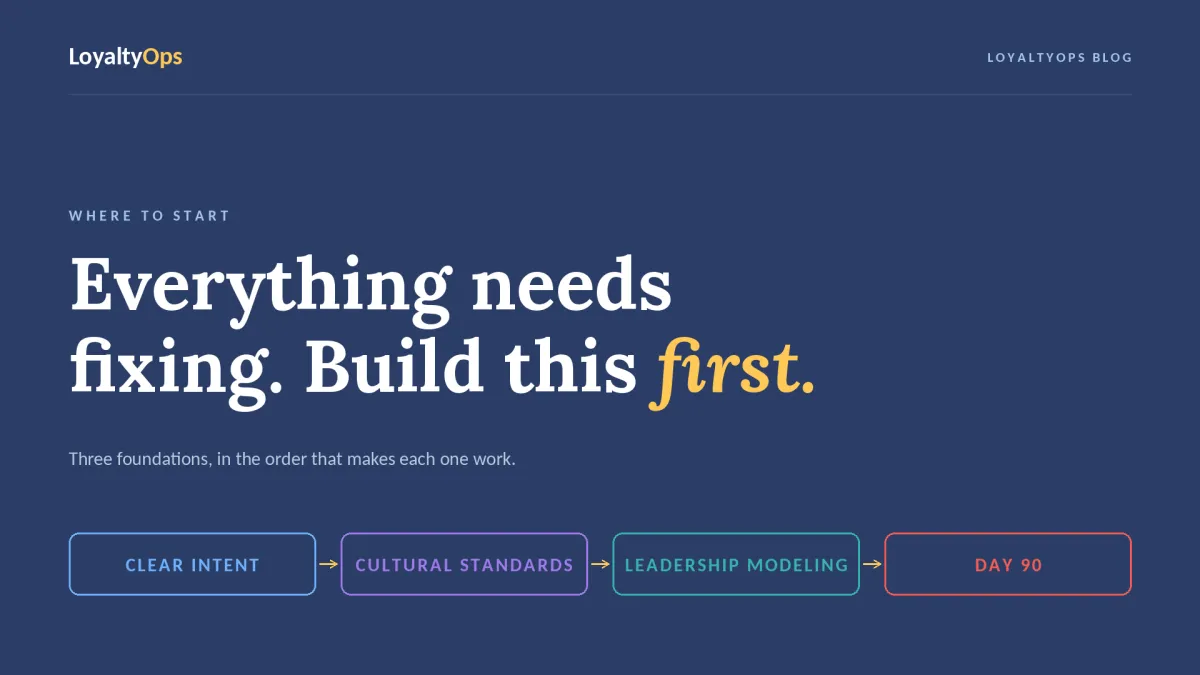
That feeling is normal, and it has a way out. You don't fix all of it at once. You build three foundations, in a specific order, thirty days each, and at the end of ninety days you have the base everything else is built on. Here's what to build first and why the order matters.
Why does it feel like everything needs fixing at once?
Your business grew, the team grew, and the way the team works together didn't grow with them. When you're small, you keep the standards for how work gets done in your own head, and the team picks them up because they're near you while you set them. As the team gets bigger, those standards stay where they are, and more and more of the work needs you in the room to keep it on track.
So the gaps show up everywhere at the same time: decisions, handoffs, quality, communication. It isn't that your team is failing. It's that the operations, the clear standards for how your team works day to day, haven't caught up to the size of the business. That's a build problem, and build problems get solved in an order.
The two ways leaders get stuck
When everything needs work, most leaders get stuck in one of two ways.
The first is trying to fix all of it at once.
You look at the full list of gaps and start on every one, and because your attention is split across all of them, nothing gets built well enough to last. Three months later the list looks the same.
The second is starting with whatever feels most urgent this week.
You fix meetings, or you fix accountability, and it works for a little while, then it goes back to how it was, because the foundation it needed was never built. A standard with no direction behind it is just a rule people forget.
There's an order that avoids both, and it starts with three foundations.
What to build first: three foundations, in order
Spend thirty days on each. The order is the point, because each foundation gives the next one something to build on.
Days 1 to 30: Clear Intent
Clear Intent is four short statements, in plain words, that name your direction: who you are, what you do, why you do it, and where you're going. The military calls the idea Mission Command: give people enough clarity of purpose that they can make the right decision in the moment without waiting for orders. Written well, anyone on your team can repeat the four statements the next day and act on them without coming to you first.
Direction comes first because a standard with no direction to serve is just a rule, and a behavior you model with no direction behind it doesn't tell the team where it's headed.
Days 31 to 60: Cultural Standards
Most teams have values on a wall that no one can act on. Ask ten people what one of them means, and you get ten answers. Cultural Standards takes three to five of the values you already use and turns each one into behavior anyone can see: a plain definition that starts with "At our company, this means," a short phrase people actually quote, and a few behaviors that match the standard and a few that break it. If a camera could record it, you've written it well.
Standards come second because now they have a direction to make concrete. Clear Intent said where you're going; Cultural Standards says how the team acts to get there.
Days 61 to 90: Leadership Modeling
Your team copies what you do, and your consistency is what tells them a standard is real. Leadership Modeling is two or three observable behaviors you live in your own decisions for thirty days before you ask the team to pick them up. You use the standard in your own meetings every day, you name it out loud so the language spreads, you meet the same expectation you're asking of others, and you keep it when the week gets tight.
Modeling comes last because now you have something specific to model. You're not performing a vague idea of good leadership. You're living the exact standards you just built.
Why does the order matter this much?
Because each foundation gives the next one something to build on. Direction first, so your standards have a purpose to make concrete. Standards next, so your own behavior has something specific to model. Modeling last, so the team sees the standards lived before they're asked to live them. Build these out of order, and the later pieces have nothing to connect to, which is exactly why the "fix the most urgent thing" approach goes back to how it was.
How do you start this week?
You don't need the whole ninety days planned to begin. You need one hour this week. Block it, and draft your four Clear Intent statements: who we are, what we do, why we do it, and where we're going. Keep each one short enough to say in a single breath, with no buzzwords.
Then test it. Ask three people on your team to read your draft and say it back the next day. If they can't repeat it, simplify until they can. That's day one of ninety.
Start your first 90 days this week
You don't have to fix everything at once. You build three foundations in order, and you can take the first step today. Our free 90-Day Operations Starter walks through all three, what to do in each thirty-day block, and the exact one-hour first step.
→ Download the free 90-Day Operations Starter: loyaltyops.com/operations-starter-page
FAQ
What should I build first when everything about my team needs fixing?
Start with Clear Intent: four short statements that name your direction. Direction comes before standards and behavior because a standard with no direction behind it is just a rule people forget. Build Clear Intent in your first thirty days, then Cultural Standards, then Leadership Modeling.
Why not just fix the most urgent problem first?
Because the most urgent gap is usually a symptom of a missing foundation. You can fix meetings or accountability for a few weeks, but without clear direction and standards in place, it goes back to how it was. Building in order fixes the cause, not the symptom.
How long does it take to build a foundation for how my team works?
About ninety days for the three foundations, thirty days each. You can start in a single hour this week by drafting your Clear Intent, and you'll have the full base in place in a quarter.
What are the three foundations?
Clear Intent (your direction, in four plain statements), Cultural Standards (three to five values turned into behaviors anyone can see), and Leadership Modeling (two or three behaviors you live yourself before asking the team to). Each is built in a thirty-day block, in that order.
Is this the same as a business plan or a strategy?
No. A strategy names what the business will pursue. These foundations name how your team works day to day so the strategy can actually happen without you in every decision. They're the operations that make the plan possible.