
The Decision Rights Map: Free Delegation Template
The Decision Rights Map: Give Every Decision One Owner
If you're the approval step on too many decisions, the fix is to give each one a clear owner and hand it over cleanly. The free Decision Rights Map gives you a simple, repeatable way to do it. Here's what's inside and how to use it this week.
What is the Decision Rights Map?
It's a short LoyaltyOps map and template that helps you move the decisions you keep making onto the right owners, with the limits they need to make each call well. It gives you the four decision types, a simple way to decide who should own any call, a hand-off card for giving one over in full, and two short standards for how decisions get escalated and recorded.
It's built for the leader who's become the required sign-off on more decisions than they should be. You can hand off your first decision with it this week.
What's inside the map?
The map walks through the whole method:
The one-owner rule — why every decision needs exactly one owner.
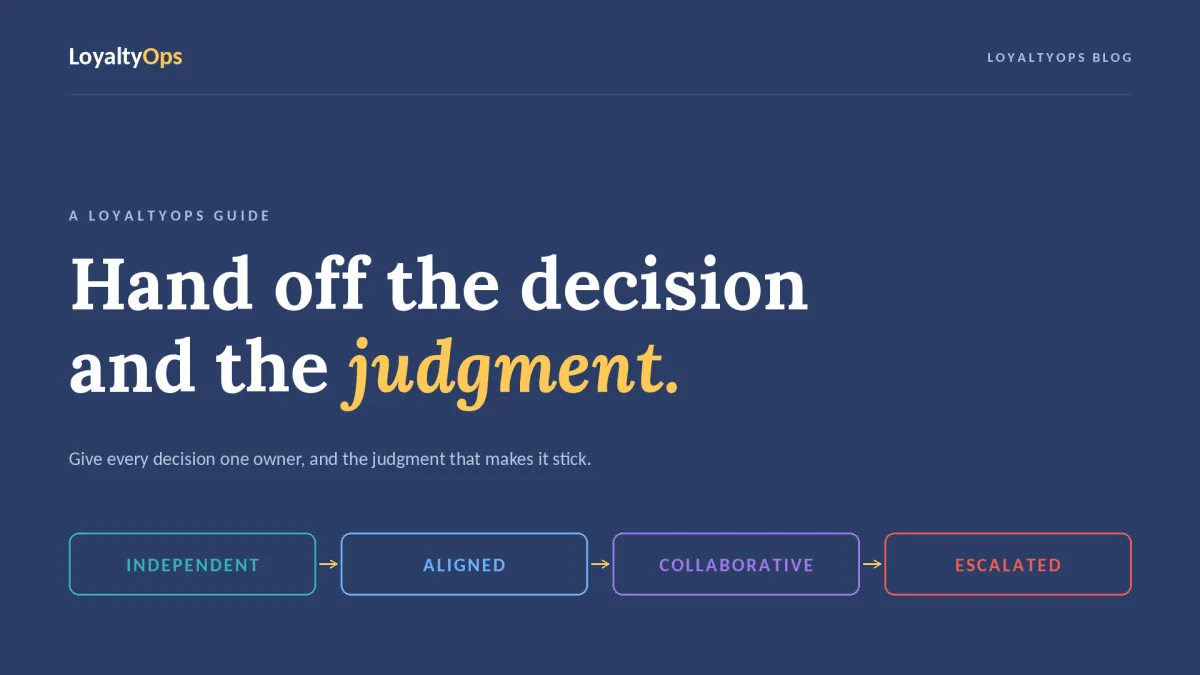
The four decision types — Independent, Aligned, Collaborative, and Escalated.
What makes a decision big — the factors that tell you who should own a call.
The clean hand-off — the six things to give a new owner.
The hand-off card — a fill-in template with a worked example.
Two standards — how decisions get escalated and how they get recorded.
The four decision types
Every decision has one owner and one of four types, named by how that owner makes the call:
Independent — decides and acts alone, no input or sign-off needed.
Aligned — gathers input or gives a heads-up first, then decides.
Collaborative — the group works it out, and one person still owns the call and the follow-through.
Escalated — takes it to someone more senior for the decision or sign-off.
What makes a decision big
You decide who owns a call by what it touches, not by who's most senior. The map gives you seven factors: budget impact, timeline impact, resource impact, client or brand impact, cross-team impact, risk and exposure, and reversibility. The higher a decision scores on these, the more input or sign-off it needs, moving it from an independent call toward aligned, collaborative, or escalated.
The hand-off card, with a worked example
The heart of the map is the hand-off card, which you fill in for one decision to give it over in full. It names the decision, its type, how to make it well, what good and bad look like, when to escalate, the new owner, and where it's documented. Here's the worked example from the map:
The decision: Approving client discounts up to fifteen percent.
Type: Independent.
How to make it well: Stay inside the margin floor and the discount grid.
What good looks like: Keeps the client while protecting margin.
What bad looks like: Sets a precedent that erodes pricing.
Escalate when: The ask goes above fifteen percent or changes a contract term.
New owner: The account lead.
Documented in: The deal notes, visible to the team.
Filled in like that, the account lead can approve discounts all day without checking with you, and both of you know exactly where the line is.
Two standards that keep it clean
The map also gives you two short standards. The first is how a decision gets escalated when it needs to: name the decision or issue, why it matters now, what's at risk, what's been tried, and what's needed next. The second is how a decision gets recorded once it's made, so the team acts on the same version: the Why (the context), the What (the decision and any information people need), the How (what changes as a result), and the Now (what happens next, and who owns it). A decision that never reaches the people it affects gets made again by accident, which these two standards prevent.
How to use the map
Pick one decision you keep making that someone on your team is ready to own, and take it through the hand-off card. Name its type, the limits, what good and bad look like, when to escalate, and where it's recorded, then sit down with the new owner and walk them through it. Start with a decision where a wrong call is recoverable, so the first hand-off is a safe win. One decision handed off in full is worth more than ten you vaguely delegated.
Who is the map for?
It's for the leader who's the approval step on too many decisions, and who wants their people to make more of the calls they're ready for. If decisions pile up on you and the work waits while they do, the map gives you a structured, low-effort way to hand the right ones off with the judgment that makes them stick. It isn't a governance system to install; it's a card and a habit.
What changes once you use it
The first thing you'll notice is a shorter list of decisions waiting on you. The calls you handed off get made without you, usually faster, because the person making them is closer to the work and no longer waiting for a reply. You stay involved only where the hand-off card says to, which is the decisions that genuinely need you.
The second thing is that the decisions get made more consistently. Because the owner has the limits and knows what a good and bad outcome looks like, they make the call the way you would, and the next person who owns a similar decision has the same guide to follow. Over time, that's a team that makes good calls without you in the room, which is the point.
Get the Decision Rights Map
Hand off the right decisions, with the judgment that makes them stick. → Download the free Decision Rights Map
Pick one decision you keep making, take it through the hand-off card, and give it to the person ready to own it. That one clean hand-off is how you start making only the decisions that genuinely need you.
→ Get the map: loyaltyops.com/decision-rights
FAQ
Is the Decision Rights Map really free?
Yes. It's a free download at loyaltyops.com/decision-rights, with no course to buy. You can hand off your first decision with it this week.
What will I get?
The four decision types, the seven factors for deciding who should own a call, a hand-off card to give one decision over in full with a worked example, and two short standards for escalating and recording decisions.
What are the four decision types?
Independent (decide alone), Aligned (gather input, then decide), Collaborative (work it out as a group, one owner), and Escalated (take it to someone more senior). Every decision has one owner and one of these four types.
How is this different from RACI or RAPID?
It's a lighter version built for a growing team. RACI and RAPID assign multiple roles per decision; the Decision Rights Map keeps the core rule of one owner per decision and adds just enough to hand a decision over cleanly, without a matrix to maintain.
How do I keep decisions from coming back to me?
Hand over the judgment, not just the permission. Give the new owner the six things on the hand-off card, especially the limits and the line for when to bring it back. When people have those, they make the call with confidence instead of checking with you.