
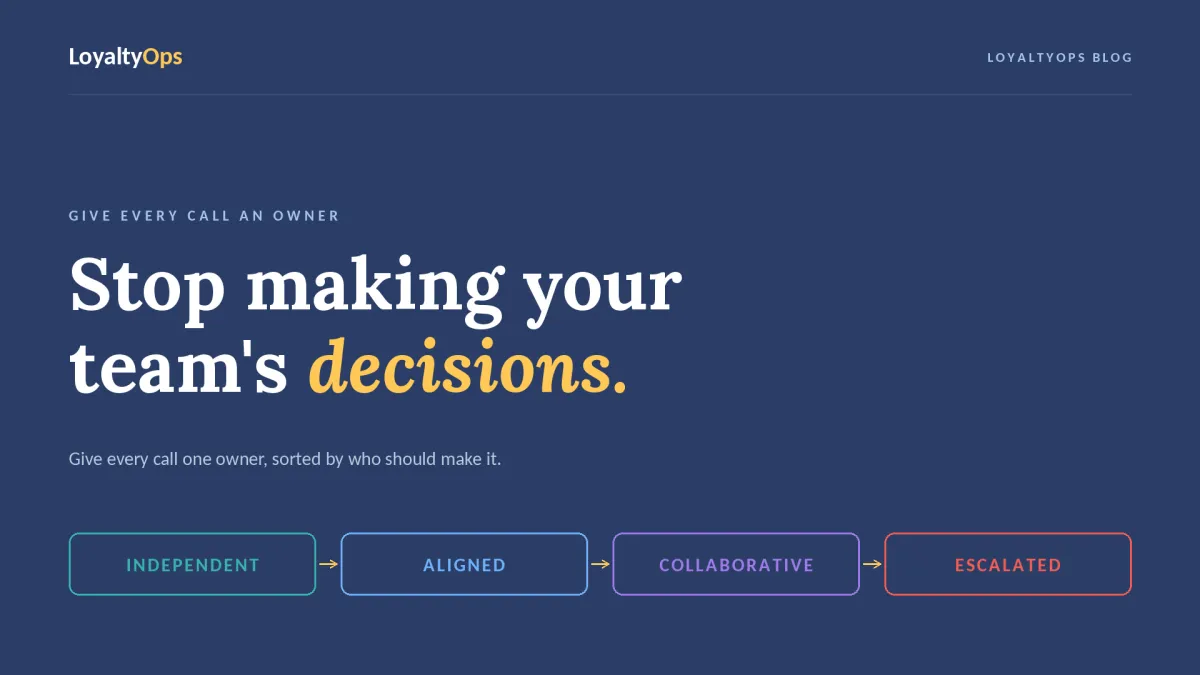
Decision Rights: Give Every Call One Owner
Stop Making Your Team's Decisions
Most leaders spend a surprising share of the week making decisions that belong to their team. It slows the work down, keeps your calendar full, and quietly caps how big the business can get, because everything depends on one person. The cause usually isn't that people won't step up. It's that no one ever named who owns each decision. Decision rights is how you fix that, and here's the whole method, made simple enough to use on a small team.
You're making decisions that belong to your team
Look at the decisions you made this week, and you'll probably find a stack your team could have made. You approved things your people could approve, weighed in on calls they could own, and stayed the required sign-off on work that no longer needs you. Every one of those is a decision your team is ready to make, and while it waits for you, the work waits too.
Your people are capable. The real question is ownership, because no one ever named which decisions belong to whom, so by default every unnamed decision belongs to you. And even when you tell someone a call is theirs, that alone rarely sticks, because to own a decision a person needs to know it's theirs, how to make it well, what a good outcome looks like, and when to bring it back to you.
Every decision has one owner, and one of four types
The Decision Rights Map sorts the decisions in your business by who owns them and how each call gets made. The first rule is that every decision has exactly one owner, because a decision a group owns is a decision no one owns. From there, every decision is one of four types, based on how that single owner makes the call.
Independent. One person decides and acts alone, with no input or sign-off needed.
Aligned. One person owns the call, and they gather input or give a heads-up first, then decide.
Collaborative. The group works the call out together, and one person still owns it and the follow-through.
Escalated. The owner takes it to someone more senior for the decision or sign-off.
These four work at every level, from the calls you make yourself to the calls a single role makes. Naming the type sets a clear expectation for how each decision gets made, so people know when to just decide and when to check first.
Decide who owns a call by what it touches
You don't judge a decision by who's most senior; you judge it by what it actually involves. A handful of factors tell you how big a decision is: how much money it commits, whether it changes a deadline others depend on, whether it takes people away from other work, whether it touches a client or the brand, whether it affects another team, the downside if it goes wrong, and how hard it is to undo.
The bigger a decision is on those factors, the more people it should involve before the call, which is the difference between an independent call and an aligned, collaborative, or escalated one. Keep the rule tight, because if everything needs your sign-off, you're the bottleneck again, just with a framework around it.
To hand a decision over, hand over your judgment
Telling someone a decision is theirs is the easy part, and it's rarely enough on its own. To take it on with confidence, the new owner needs the judgment you've been using without thinking about it. A clean hand-off gives them six things:
The type it is (independent, aligned, collaborative, or escalated).
How to make it well — the limits to stay inside, and what to weigh.
What a good outcome looks like.
What a bad one looks like, so they catch it early.
When to bring it back to you — the line where it stops being theirs.
Where it's recorded, so the team can see it.
Given all six, the person can make the call the way you would, and it doesn't come straight back to you the first time they're unsure.
How this compares to RACI and RAPID
If you've looked at decision-making frameworks before, you've probably met RACI or RAPID. They're useful in large organizations, and they're often too heavy for a growing team, with roles to assign for every decision and a matrix to maintain.
The Decision Rights Map keeps the one idea that matters most, a single clear owner for every decision, and adds just enough structure to hand a decision over well: the four types, the factors that size a decision, and the six-part hand-off. It's less a governance system to install and more a habit you can start this week with one decision.
Give one decision to its owner this week
You don't reassign every decision at once. List the decisions you keep making that someone on your team is ready to own, then take the first one through a full hand-off: name its type, the limits, what good and bad look like, when to bring it back, who the owner is, and where it's recorded. Sit down with that person and walk them through it. One decision given over properly does more for you than ten you vaguely delegated, because the owner actually has what they need to make the call without you.
Where Decision Rights fit
The Decision Rights Map is one of the operational tools of the Leadership Operating Flywheel, the four-stage system your team runs on. It's how the Commit stage works in practice, the point where decisions get made and owned instead of waiting on you. It works best alongside the others: a team that shares one direction, brings problems forward early, and keeps each other accountable for following through. Each of those tools strengthens the rest, and together they're what lets the team run without you in every decision.
Download the free Decision Rights Map
We put the whole method into the Decision Rights Map. It has the four decision types, the factors for deciding who should own any call, a hand-off card to give one over cleanly with a worked example, and two short standards for how decisions get escalated and recorded.
→ Download the free map: loyaltyops.com/decision-rights
If you want to map your decisions alongside a room of other leaders working through the same thing, that's part of the work inside the Leaders Mastermind.
FAQ
What are decision rights?
Decision rights are a clear statement of who owns each decision and how they make it. Giving each decision a single owner, and naming how that owner decides, keeps decisions from defaulting to the most senior person and lets the people closest to the work make the calls they're ready for.
What are the four types of decisions?
Independent (one person decides alone), Aligned (one person decides after gathering input or giving a heads-up), Collaborative (the group works it out, one person still owns it), and Escalated (the owner takes it to someone more senior). Every decision has one owner and one of these four types.
How do I decide who should own a decision?
Judge it by what it touches, not by seniority: how much money it commits, whether it moves a shared deadline, whether it pulls people off other work, whether it affects a client or another team, the downside if it goes wrong, and how hard it is to undo. The bigger it is on those, the more input or sign-off it needs.
Is this the same as RACI or RAPID?
It's a lighter version of the same idea. RACI and RAPID assign several roles per decision and suit large organizations; the Decision Rights Map keeps the core rule, one owner per decision, and adds just enough to hand a decision over cleanly, which fits a growing team better.
How do I actually hand off a decision so it sticks?
Give the new owner six things: the type, how to make it well, what good and bad outcomes look like, when to bring it back, and where it's recorded. Handing over the judgment, not just the permission, is what keeps the decision from coming straight back to you.